Roadsters (video game)
Topic: Software
 From HandWiki - Reading time: 16 min
| Roadsters | |
|---|---|
 European Nintendo 64 cover art | |
| Developer(s) | Titus Interactive (Nintendo 64) Genetic Fantasia (Game Boy Color) Smart Dog (PlayStation) Player 1 (Dreamcast) |
| Publisher(s) | Titus Interactive |
| Platform(s) | Nintendo 64, PlayStation, Dreamcast, Game Boy Color |
| Release | Nintendo 64 Game Boy Color Dreamcast, PlayStation |
| Genre(s) | Racing |
| Mode(s) | Single player, multiplayer |
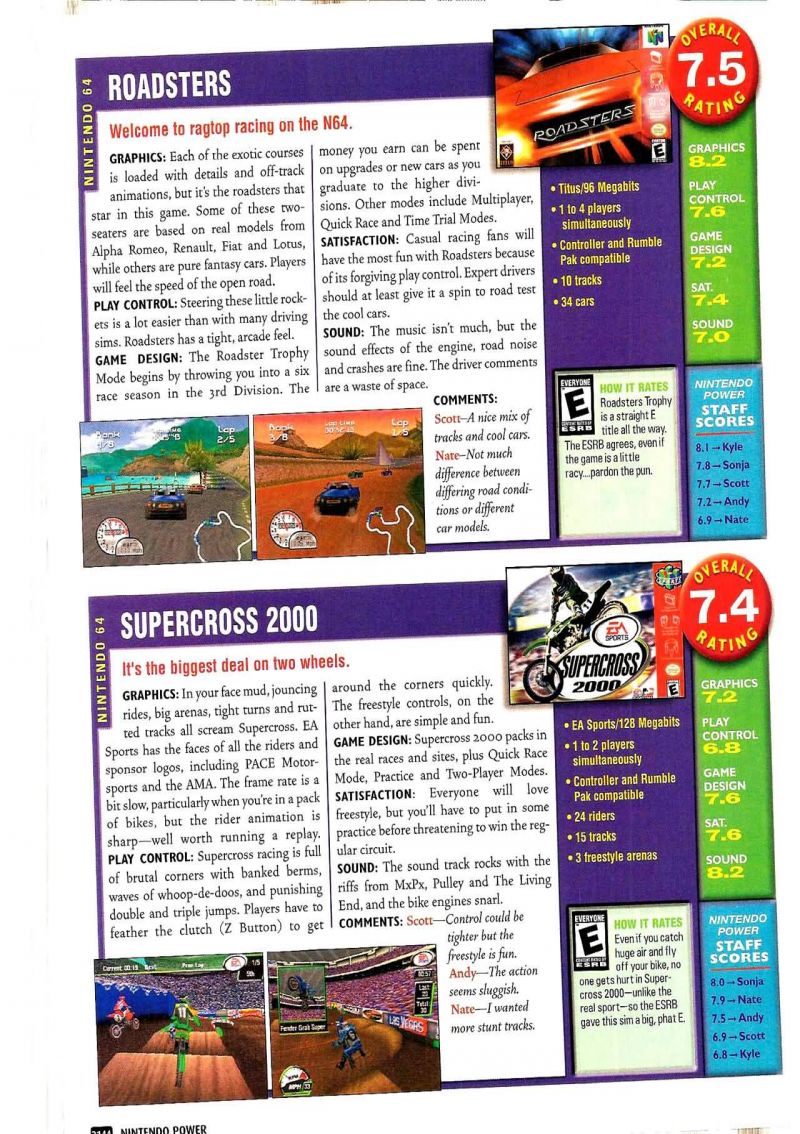
Roadsters (working title: Roadsters Trophy) is a racing game released by Titus Software for Nintendo 64 in 1999, and for PlayStation, Dreamcast and Game Boy Color in 2000. It is a car racing game that features both licensed cars from manufacturers (e.g. Mitsubishi, Alfa Romeo, Lotus) and unlicensed cars from imaginary manufacturers that are based on and bear great resemblance to their equivalent, real car models. The game also includes a multi-player mode supports up to 2 human players that can compete in any of the available circuits with 4 more CPU controlled racers.[3] A PlayStation 2 version was originally planned to release on April 11, 2001.[4]
Gameplay
Roadsters is a car racing game that features both licensed cars from manufacturers (e.g. Mitsubishi, Alfa Romeo, Lotus) and unlicensed cars from imaginary manufacturers that are based on and bear great resemblance to their equivalent, real car models. The game has 8 racers and 34 cars from which players can choose from and 4 modes in total.
In the Roadster Trophy, the player starts by selecting one of the available racers and is given a sum of money that must be used to acquire a car. There are 3 divisions in which the player can compete on with the 3rd being of the easiest difficulty and requiring less money to participate; the 1st being the most difficult one and needing a higher amount of money in order to participate. More money can be earned by winning the races and that in turn allows to buy new cars or upgrade the ones that are already in possession. In Quick Race the player can select the racer, car, circuit and weather conditions, and race against 7 more CPU controlled players.
The game also includes a Multi-Player mode which supports up to 2 human players that can compete in any of the available circuits with 4 more CPU controlled racers. The mode allows for either vertical or horizontal split screen. Like Quick Race mode, the player can also select here the racer, car, circuit and weather conditions but without the competition of the other modes, the player races against time for as many laps as the player wants.[3]
Reception
| Reception | |||||||||||||||||||||||||||||||||||||||||||||||||||||||||||||||||||||||||||||||
|---|---|---|---|---|---|---|---|---|---|---|---|---|---|---|---|---|---|---|---|---|---|---|---|---|---|---|---|---|---|---|---|---|---|---|---|---|---|---|---|---|---|---|---|---|---|---|---|---|---|---|---|---|---|---|---|---|---|---|---|---|---|---|---|---|---|---|---|---|---|---|---|---|---|---|---|---|---|---|---|
| |||||||||||||||||||||||||||||||||||||||||||||||||||||||||||||||||||||||||||||||


The Nintendo 64 and PlayStation versions received mixed reviews, while the Dreamcast and Game Boy Color versions received unfavorable reviews, according to the review aggregation website GameRankings.[5][6][7][8] Michael Wolf of NextGen said of the N64 version in its April 2000 issue, "While not as adrenaline-pumping as San Francisco Rush, it's a solid game with a decent engine that will certainly tide racing fans over until Nintendo releases Ridge Racer 64."[31] Three issues later, however, Greg Orlando said that the Dreamcast version "provides a rather straight and uninterrupted ride to ennui."[30]
Four-Eyed Dragon of GamePro said of the Nintendo 64 version in one review, "While it doesn't grab victory honors in the racing genre, Roadsters still crosses the finish line with a flourish. Both casual drivers and hardcore racers will enjoy taking a ride with this impressive game."[33][lower-alpha 3] In another GamePro review, however, The Freshman said that the same N64 version "isn't bad, it's just average, which is a good thing for Titus (infamous for Superman for the N64). If you really need another racer for the N64, get this one. If not, wait for Ridge Racer 64, or just go play Beetle Adventure Racing again. Your N64'll thank you."[34][lower-alpha 4] Later, The D-Pad Destroyer said that the Dreamcast version "could have been a lot better, but it just doesn't seem like the developers put enough care into it. With so many problems, especially in its control, Roadsters is about as fun as the flu during Spring Break."[35][lower-alpha 5] The Freshman said that the PlayStation version "isn't the worst PSX racer out there, but it's far from the best. You're better off with a Need for Speed or a Ridge Racer if you want arcade racing on the PSX."[36][lower-alpha 6]
Notes
- ↑ In Electronic Gaming Monthly's review of the Nintendo 64 version, two critics gave it each a score of 4.5/10, while one gave it 3.5/10, and the other 3/10.
- ↑ In GameFan's viewpoint of the Dreamcast version, one critic gave it 51, another gave it 53, and a third gave it 60.
- ↑ In one review, GamePro gave the Nintendo 64 version two 4/5 scores for graphics and fun factor, 2/5 for sound, and 4.5/5 for control.
- ↑ In another review, GamePro gave the Nintendo 64 version two 4/5 scores for graphics and control, and two 3.5/5 scores for sound and fun factor.
- ↑ GamePro gave the Dreamcast version 4/5 for graphics, 3.5/5 for sound, 2.5/5 for control, and 3/5 for fun factor.
- ↑ GamePro gave the PlayStation version three 3/5 scores for graphics, sound, and fun factor, and 3.5/5 for control.
References
- ↑ IGN staff (December 14, 1999). "Roadsters Goes Dirt Cheap". Ziff Davis. Archived from the original on November 18, 2023. https://web.archive.org/web/20231118165511/https://www.ign.com/articles/1999/12/15/roadsters-goes-dirt-cheap. Retrieved November 18, 2023.
- ↑ "ROADSTERS SET TO ZOOM INTO STORES (Mustang Give Away Excites Consumers, Retailers)". March 20, 2000. Archived from the original on February 11, 2001. https://web.archive.org/web/20010211023126/http://www.titusgames.com/company/press/pr_000320.php. Retrieved March 4, 2021.
- ↑ 3.0 3.1 Titus Software (1999) Roadsters Manual
- ↑ "Video Game release dates". The Pantagraph (Lee Enterprises): p. 65. March 29, 2001. https://www.newspapers.com/article/the-pantagraph/85788795/. Retrieved November 18, 2023.
- ↑ 5.0 5.1 "Roadsters for Dreamcast". CBS Interactive. Archived from the original on May 5, 2019. https://web.archive.org/web/20190505070144/https://www.gamerankings.com/dreamcast/250619-roadsters/index.html. Retrieved March 4, 2021.
- ↑ 6.0 6.1 "Roadsters for Game Boy Color". CBS Interactive. Archived from the original on May 22, 2019. https://web.archive.org/web/20190522230257/https://www.gamerankings.com/gbc/576283-roadsters/index.html. Retrieved March 4, 2021.
- ↑ 7.0 7.1 "Roadsters for Nintendo 64". CBS Interactive. Archived from the original on May 12, 2019. https://web.archive.org/web/20190512174920/https://www.gamerankings.com/n64/198496-roadsters/index.html. Retrieved March 4, 2021.
- ↑ 8.0 8.1 "Roadsters for PlayStation". CBS Interactive. Archived from the original on May 27, 2019. https://web.archive.org/web/20190527055405/https://www.gamerankings.com/ps/576335-roadsters/index.html. Retrieved March 4, 2021.
- ↑ Scoleri III, Joseph. "Roadsters (N64) - Review". All Media Network. Archived from the original on November 16, 2014. https://web.archive.org/web/20141116003610/http://www.allgame.com/game.php?id=19250&tab=review. Retrieved March 4, 2021.
- ↑ Kanarick, Mark. "Roadsters (PS) - Review". All Media Network. Archived from the original on November 16, 2014. https://web.archive.org/web/20141116030532/http://www.allgame.com/game.php?id=20685&tab=review. Retrieved March 4, 2021.
- ↑ Mahood, Andy (April 21, 2000). "Roadsters (DC) [Incomplete"]. CNET. Archived from the original on August 18, 2000. https://web.archive.org/web/20000818201518/http://www.gamecenter.com/Consoles/Dreamcast/Roadsters/. Retrieved March 5, 2021.
- ↑ Mahood, Andy (February 4, 2000). "Roadsters (N64)". CNET. Archived from the original on August 23, 2000. https://web.archive.org/web/20000823205658/http://gamecenter.com/Consoles/Nintendo/Roadsters/. Retrieved March 5, 2021.
- ↑ Chou, Che; Johnston, Chris; Hager, Dean; Davison, John (February 2000). "Roadsters (N64)". Electronic Gaming Monthly (Ziff Davis) (127): 180. Archived from the original on October 29, 2021. https://web.archive.org/web/20211029172640/https://www.nintendo64ever.com/scans/mags/Scan-Magazine-1736-180.jpg. Retrieved November 18, 2023.
- ↑ Nash, Jeff (May 28, 2000). "Roadsters (DC)". Greedy Productions Ltd.. Archived from the original on September 10, 2002. https://web.archive.org/web/20020910005223/http://www.elecplay.com/review.html?article=2549&full=1#mr_toppy. Retrieved November 18, 2023.
- ↑ Conlin, Shaun (February 16, 2000). "Roadsters (N64)". Greedy Productions Ltd.. Archived from the original on February 23, 2002. https://web.archive.org/web/20020223133626/http://www.elecplay.com/review.html?article=2044&full=1#mr_toppy. Retrieved November 18, 2023.
- ↑ "Roadsters (DC)". Game Informer (FuncoLand) (86). June 2000.
- ↑ "Roadsters Trophy [sic] (N64)". Game Informer (FuncoLand) (81). January 2000.
- ↑ Weitzner, Jason "Fury" (May 2000). "Roadsters (DC)". GameFan (Shinno Media) 8 (5): 56–57. https://archive.org/details/Gamefan_Vol_8_Issue_05/page/n57/mode/2up. Retrieved March 5, 2021.
- ↑ Mylonas, Eric "ECM"; Ngo, George "Eggo"; Rodriguez, Tyrone "Cerberus" (May 2000). "Roadsters (DC)". GameFan (Shinno Media) 8 (5): 14. https://archive.org/details/Gamefan_Vol_8_Issue_05/page/n15/mode/2up. Retrieved March 5, 2021.
- ↑ "REVIEW for Roadsters (N64)". GameFan (Shinno Media). December 17, 1999.
- ↑ Amsbury, Robert (April 2000). "Roadsters Review (N64)". CraveOnline. Archived from the original on October 9, 2015. https://web.archive.org/web/20151009200125/http://www.gamerevolution.com/review/roadsters. Retrieved March 4, 2021.
- ↑ Stahl, Ben (April 11, 2000). "Roadsters Review (DC) [date mislabeled as "March 4, 2004""]. Fandom. Archived from the original on November 7, 2004. https://web.archive.org/web/20041107064721/http://www.gamespot.com/dreamcast/driving/roadsters/review.html. Retrieved November 18, 2023.
- ↑ Stahl, Ben (December 22, 1999). "Roadsters Trophy [sic Review (N64) [date mislabeled as "April 28, 2000"]"]. Fandom. Archived from the original on December 20, 2004. https://web.archive.org/web/20041220043011/http://www.gamespot.com/n64/driving/roadsterstrophy/review.html. Retrieved November 18, 2023.
- ↑ Jetzep (March 24, 2000). "Roadsters". IGN Entertainment. Archived from the original on January 23, 2009. https://web.archive.org/web/20090123161444/http://www.planetdreamcast.com/games/reviews/roadsters/. Retrieved March 4, 2021.
- ↑ Dunham, Jeremy (March 27, 2000). "Roadsters Review (DC)". Ziff Davis. Archived from the original on April 17, 2021. https://web.archive.org/web/20210417172755/https://www.ign.com/articles/2000/03/28/roadsters-review. Retrieved November 18, 2023.
- ↑ Harris, Craig (February 23, 2000). "Roadsters (GBC)". Ziff Davis. Archived from the original on April 17, 2021. https://web.archive.org/web/20210417130554/https://www.ign.com/articles/2000/02/24/roadsters-2. Retrieved November 18, 2023.
- ↑ Boulding, Aaron (January 6, 2000). "Roadsters (N64)". Ziff Davis. Archived from the original on March 3, 2021. https://web.archive.org/web/20210303095025/https://www.ign.com/articles/2000/01/07/roadsters-6. Retrieved November 18, 2023.
- ↑ Bishop, Samuel (May 1, 2000). "Roadsters (PS)". Ziff Davis. Archived from the original on November 18, 2023. https://web.archive.org/web/20231118170833/https://www.ign.com/articles/2000/05/02/roadsters. Retrieved November 18, 2023.
- ↑ Weaver, Tim (Christmas 1999). "Roadsters". N64 Magazine (Future Publishing) (36): 58–59.
- ↑ 30.0 30.1 Orlando, Greg (July 2000). "Roadsters (DC)". NextGen (Imagine Media) (67): 91. https://archive.org/details/NextGen67Jul2000/page/n91/mode/2up. Retrieved March 4, 2021.
- ↑ 31.0 31.1 Wolf, Michael (April 2000). "Roadsters (N64)". NextGen (Imagine Media) (64): 85. https://archive.org/details/NextGen64Apr2000/page/n85/mode/2up. Retrieved March 4, 2021.
- ↑ "Roadsters". Nintendo Power (Nintendo of America) 128: 144. January 2000. Archived from the original on October 29, 2021. https://web.archive.org/web/20211029172640/https://www.nintendo64ever.com/scans/mags/Scan-Magazine-370-144.jpg. Retrieved November 18, 2023.
- ↑ Four-Eyed Dragon (February 2000). "Roadsters (N64)". GamePro (IDG) (137): 102. Archived from the original on October 29, 2021. https://web.archive.org/web/20211029172638/https://www.nintendo64ever.com/scans/mags/Scan-Magazine-1670-102.jpg. Retrieved November 18, 2023.
- ↑ The Freshman (December 30, 1999). "Roadsters (N64)". GamePro (IDG Entertainment). Archived from the original on March 19, 2005. https://web.archive.org/web/20050319100254/http://www.gamepro.com/nintendo/n64/games/reviews/3961.shtml. Retrieved March 4, 2021.
- ↑ The D-Pad Destroyer (April 24, 2000). "Roadsters Review for Dreamcast on GamePro.com". GamePro (IDG). Archived from the original on March 15, 2004. https://web.archive.org/web/20040315091624/http://www.gamepro.com/sega/dreamcast/games/reviews/5309.shtml. Retrieved March 4, 2021.
- ↑ The Freshman (April 21, 2000). "Roadsters Review for PlayStation on GamePro.com". GamePro (IDG Entertainment). Archived from the original on March 15, 2004. https://web.archive.org/web/20040315114525/http://www.gamepro.com/sony/psx/games/reviews/5302.shtml. Retrieved March 4, 2021.
External links
- MobyGames is a commercial database website that catalogs information on video games and the people and companies behind them via crowdsourcing. This includes over 300,000 games for hundreds of platforms.[1] Founded in 1999, ownership of the site has changed hands several times. It has been owned by Atari SA since 2022.
Features
Edits and submissions to the site (including screenshots, box art, developer information, game summaries, and more) go through a verification process of fact-checking by volunteer "approvers".[2] This approval process after submission can range from minutes to days or months.[3] The most commonly used sources are the video game's website, packaging, and credit screens. There is a published standard for game information and copy-editing.[4] A ranking system allows users to earn points for contributing accurate information.[5]
Registered users can rate and review games. Users can create private or public "have" and "want" lists, which can generate a list of games available for trade with other registered users. The site contains an integrated forum. Each listed game can have its own sub-forum.
History

MobyGames was founded on March 1, 1999, by Jim Leonard and Brian Hirt, and joined by David Berk 18 months later, the three of which had been friends since high school.[6][7] Leonard had the idea of sharing information about computer games with a larger audience. The database began with information about games for IBM PC compatibles, relying on the founders' personal collections. Eventually, the site was opened up to allow general users to contribute information.[5] In a 2003 interview, Berk emphasized MobyGames' dedication to taking video games more seriously than broader society and to preserving games for their important cultural influence.[5]
In mid-2010, MobyGames was purchased by GameFly for an undisclosed amount.[8] This was announced to the community post factum , and the site's interface was given an unpopular redesign.[7] A few major contributors left, refusing to do volunteer work for a commercial website.{{Citation needed|date=June 2025} On December 18, 2013, MobyGames was acquired by Jeremiah Freyholtz, owner of Blue Flame Labs (a San Francisco-based game and web development company) and VGBoxArt (a site for fan-made video game box art).[9] Blue Flame Labs reverted MobyGames' interface to its pre-overhaul look and feel,[10] and for the next eight years, the site was run by Freyholtz and Independent Games Festival organizer Simon Carless.[7]
On November 24, 2021, Atari SA announced a potential deal with Blue Flame Labs to purchase MobyGames for $1.5 million.[11] The purchase was completed on 8 March 2022, with Freyholtz remaining as general manager.[12][13][14] Over the next year, the financial boost given by Atari led to a rework of the site being built from scratch with a new backend codebase, as well as updates improving the mobile and desktop user interface.[1] This was accomplished by investing in full-time development of the site instead of its previously part-time development.[15]
In 2024, MobyGames began offering a paid "Pro" membership option for the site to generate additional revenue.[16] Previously, the site had generated income exclusively through banner ads and (from March 2014 onward) a small number of patrons via the Patreon website.[17]
On February 13, 2025, Freyholtz stepped down as the site lead to move onto new projects, leaving operations to Tracy Poff, a veteran coder on the site, and Atari staff.[18]
See also
- IGDB – game database used by Twitch for its search and discovery functions
References
- ↑ 1.0 1.1 Sheehan, Gavin (2023-02-22). "Atari Relaunches The Fully Rebuilt & Optimized MobyGames Website". https://bleedingcool.com/games/atari-relaunches-the-fully-rebuilt-optimized-mobygames-website/.
- ↑ Litchfield, Ted (2021-11-26). "Zombie company Atari to devour MobyGames". https://www.pcgamer.com/zombie-company-atari-to-devour-mobygames/.
- ↑ "MobyGames FAQ: Emails Answered § When will my submission be approved?". Blue Flame Labs. 30 March 2014. http://www.mobygames.com/info/faq7#g1.
- ↑ "The MobyGames Standards and Practices". Blue Flame Labs. 6 January 2016. http://www.mobygames.com/info/standards.
- ↑ 5.0 5.1 5.2 Miller, Stanley A. (2003-04-22). "People's choice awards honor favorite Web sites". Milwaukee Journal Sentinel.
- ↑ "20 Years of MobyGames" (in en). 2019-02-28. https://trixter.oldskool.org/2019/02/28/20-years-of-mobygames/.
- ↑ 7.0 7.1 7.2 Plunkett, Luke (2022-03-10). "Atari Buys MobyGames For $1.5 Million". https://kotaku.com/mobygames-retro-credits-database-imdb-atari-freyholtz-b-1848638521.
- ↑ "Report: MobyGames Acquired By GameFly Media". Gamasutra. 2011-02-07. https://www.gamedeveloper.com/game-platforms/report-mobygames-acquired-by-gamefly-media.
- ↑ Corriea, Alexa Ray (December 31, 2013). "MobyGames purchased from GameFly, improvements planned". http://www.polygon.com/2013/12/31/5261414/mobygames-purchased-from-gamefly-improvements-planned.
- ↑ Wawro, Alex (31 December 2013). "Game dev database MobyGames getting some TLC under new owner". Gamasutra. https://www.gamedeveloper.com/business/game-dev-database-mobygames-getting-some-tlc-under-new-owner.
- ↑ "Atari invests in Anstream, may buy MobyGames". November 24, 2021. https://www.gamesindustry.biz/articles/2021-11-24-atari-invests-in-anstream-may-buy-mobygames.
- ↑ Rousseau, Jeffrey (2022-03-09). "Atari purchases Moby Games". https://www.gamesindustry.biz/atari-purchases-moby-games.
- ↑ "Atari Completes MobyGames Acquisition, Details Plans for the Site's Continued Support". March 8, 2022. https://www.atari.com/atari-completes-mobygames-acquisition-details-plans-for-the-sites-continued-support/.
- ↑ "Atari has acquired game database MobyGames for $1.5 million" (in en-GB). 2022-03-09. https://www.videogameschronicle.com/news/atari-has-acquired-game-database-mobygames-for-1-5-million/.
- ↑ Stanton, Rich (2022-03-10). "Atari buys videogame database MobyGames for $1.5 million". https://www.pcgamer.com/atari-buys-videogame-database-mobygames-for-dollar15-million/.
- ↑ Harris, John (2024-03-09). "MobyGames Offering “Pro” Membership". https://setsideb.com/mobygames-offering-pro-membership/.
- ↑ "MobyGames on Patreon". http://www.patreon.com/mobygames.
- ↑ "An update on MobyGames leadership". 2025-02-13. https://www.mobygames.com/forum/3/thread/269628/an-update-on-mobygames-leadership/#post-269628.
 |
Wikidata has the property:
|




External links
- No URL found. Please specify a URL here or add one to Wikidata.

 |  |
- MobyGames is a commercial database website that catalogs information on video games and the people and companies behind them via crowdsourcing. This includes over 300,000 games for hundreds of platforms.[1] Founded in 1999, ownership of the site has changed hands several times. It has been owned by Atari SA since 2022.
Features
Edits and submissions to the site (including screenshots, box art, developer information, game summaries, and more) go through a verification process of fact-checking by volunteer "approvers".[2] This approval process after submission can range from minutes to days or months.[3] The most commonly used sources are the video game's website, packaging, and credit screens. There is a published standard for game information and copy-editing.[4] A ranking system allows users to earn points for contributing accurate information.[5]
Registered users can rate and review games. Users can create private or public "have" and "want" lists, which can generate a list of games available for trade with other registered users. The site contains an integrated forum. Each listed game can have its own sub-forum.
History
MobyGames was founded on March 1, 1999, by Jim Leonard and Brian Hirt, and joined by David Berk 18 months later, the three of which had been friends since high school.[6][7] Leonard had the idea of sharing information about computer games with a larger audience. The database began with information about games for IBM PC compatibles, relying on the founders' personal collections. Eventually, the site was opened up to allow general users to contribute information.[5] In a 2003 interview, Berk emphasized MobyGames' dedication to taking video games more seriously than broader society and to preserving games for their important cultural influence.[5]
In mid-2010, MobyGames was purchased by GameFly for an undisclosed amount.[8] This was announced to the community post factum , and the site's interface was given an unpopular redesign.[7] A few major contributors left, refusing to do volunteer work for a commercial website.{{Citation needed|date=June 2025} On December 18, 2013, MobyGames was acquired by Jeremiah Freyholtz, owner of Blue Flame Labs (a San Francisco-based game and web development company) and VGBoxArt (a site for fan-made video game box art).[9] Blue Flame Labs reverted MobyGames' interface to its pre-overhaul look and feel,[10] and for the next eight years, the site was run by Freyholtz and Independent Games Festival organizer Simon Carless.[7]
On November 24, 2021, Atari SA announced a potential deal with Blue Flame Labs to purchase MobyGames for $1.5 million.[11] The purchase was completed on 8 March 2022, with Freyholtz remaining as general manager.[12][13][14] Over the next year, the financial boost given by Atari led to a rework of the site being built from scratch with a new backend codebase, as well as updates improving the mobile and desktop user interface.[1] This was accomplished by investing in full-time development of the site instead of its previously part-time development.[15]
In 2024, MobyGames began offering a paid "Pro" membership option for the site to generate additional revenue.[16] Previously, the site had generated income exclusively through banner ads and (from March 2014 onward) a small number of patrons via the Patreon website.[17]
On February 13, 2025, Freyholtz stepped down as the site lead to move onto new projects, leaving operations to Tracy Poff, a veteran coder on the site, and Atari staff.[18]
See also
- IGDB – game database used by Twitch for its search and discovery functions
References
- ↑ 1.0 1.1 Sheehan, Gavin (2023-02-22). "Atari Relaunches The Fully Rebuilt & Optimized MobyGames Website". https://bleedingcool.com/games/atari-relaunches-the-fully-rebuilt-optimized-mobygames-website/.
- ↑ Litchfield, Ted (2021-11-26). "Zombie company Atari to devour MobyGames". https://www.pcgamer.com/zombie-company-atari-to-devour-mobygames/.
- ↑ "MobyGames FAQ: Emails Answered § When will my submission be approved?". Blue Flame Labs. 30 March 2014. http://www.mobygames.com/info/faq7#g1.
- ↑ "The MobyGames Standards and Practices". Blue Flame Labs. 6 January 2016. http://www.mobygames.com/info/standards.
- ↑ 5.0 5.1 5.2 Miller, Stanley A. (2003-04-22). "People's choice awards honor favorite Web sites". Milwaukee Journal Sentinel.
- ↑ "20 Years of MobyGames" (in en). 2019-02-28. https://trixter.oldskool.org/2019/02/28/20-years-of-mobygames/.
- ↑ 7.0 7.1 7.2 Plunkett, Luke (2022-03-10). "Atari Buys MobyGames For $1.5 Million". https://kotaku.com/mobygames-retro-credits-database-imdb-atari-freyholtz-b-1848638521.
- ↑ "Report: MobyGames Acquired By GameFly Media". Gamasutra. 2011-02-07. https://www.gamedeveloper.com/game-platforms/report-mobygames-acquired-by-gamefly-media.
- ↑ Corriea, Alexa Ray (December 31, 2013). "MobyGames purchased from GameFly, improvements planned". http://www.polygon.com/2013/12/31/5261414/mobygames-purchased-from-gamefly-improvements-planned.
- ↑ Wawro, Alex (31 December 2013). "Game dev database MobyGames getting some TLC under new owner". Gamasutra. https://www.gamedeveloper.com/business/game-dev-database-mobygames-getting-some-tlc-under-new-owner.
- ↑ "Atari invests in Anstream, may buy MobyGames". November 24, 2021. https://www.gamesindustry.biz/articles/2021-11-24-atari-invests-in-anstream-may-buy-mobygames.
- ↑ Rousseau, Jeffrey (2022-03-09). "Atari purchases Moby Games". https://www.gamesindustry.biz/atari-purchases-moby-games.
- ↑ "Atari Completes MobyGames Acquisition, Details Plans for the Site's Continued Support". March 8, 2022. https://www.atari.com/atari-completes-mobygames-acquisition-details-plans-for-the-sites-continued-support/.
- ↑ "Atari has acquired game database MobyGames for $1.5 million" (in en-GB). 2022-03-09. https://www.videogameschronicle.com/news/atari-has-acquired-game-database-mobygames-for-1-5-million/.
- ↑ Stanton, Rich (2022-03-10). "Atari buys videogame database MobyGames for $1.5 million". https://www.pcgamer.com/atari-buys-videogame-database-mobygames-for-dollar15-million/.
- ↑ Harris, John (2024-03-09). "MobyGames Offering “Pro” Membership". https://setsideb.com/mobygames-offering-pro-membership/.
- ↑ "MobyGames on Patreon". http://www.patreon.com/mobygames.
- ↑ "An update on MobyGames leadership". 2025-02-13. https://www.mobygames.com/forum/3/thread/269628/an-update-on-mobygames-leadership/#post-269628.
|
Wikidata has the property:
|
External links
- No URL found. Please specify a URL here or add one to Wikidata.
| |
Warning: Default sort key "Roadsters (Video Game)" overrides earlier default sort key "Mobygames".
| |
 EncycloReader
is supported by the
EncycloReader
is supported by the  KSF
KSF