Table of Contents Categories
Sapiens (video game)
Topic: Software
 From HandWiki - Reading time: 9 min
| Sapiens | |
|---|---|
 | |
| Developer(s) | Didier Guillion, Olivier Guillion |
| Publisher(s) | Loriciel, Myriad Online |
| Composer(s) | Gilles Soulet |
| Platform(s) | Amstrad CPC, Atari ST, DOS, Thomson, Classic Mac OS, Windows, macOS |
| Release | 1986 |
| Genre(s) | Adventure, survival, RPG, fighting |
| Mode(s) | Single-player |
Sapiens is an action-adventure and text-based game set in an open world environment and played alternatively in flip-screen and first-person perspective. One of the earliest representatives of the survival game genre, it is set in a fictionalisation of Prehistory. Developed by Didier Guillion and Olivier Guillion, it was published by Loriciel in 1986 on Thomson MO5, ported to Amstrad CPC (1986), Atari ST (1987), and DOS (1987). Myriad Online, the company created by the Guillion brothers, published a Mac OS and Microsoft Windows port in 1996, recompiled in 2017.
Synopsis
The game is set in 100,000 BC during the end of the Paleolithic period in Europe. It takes place in a procedurally generated open world filled with different types of flora and fauna such as savannas and tundras. Players customize a Neanderthal avatar by naming it, assigning it a gender, choosing its hairstyle and dresscode. The RPG aspect also entails customizing five parameters at game start (agility, strength, charisma, vitality, resistance), while gender defines different aptitudes. By default, the player incarnates Torgan, a hunter-gatherer warrior from the tribe of the Light-Footed. The game plot, influenced by J.-H. Rosny aîné's writings as well as The Quest for Fire, features several missions and reaches a climax when the player takes the lead of its tribe. The player hunts in unknown territories and faces neighbouring hostile tribes, hunts down cave bears and wolves, collects water from streams and healing plants.
Gameplay
As the game starts, Hognor, the tribe leader orders the player to gather food to feed the tribe. If they fail displaying due respect and accepting the task, the player will undergo a bastinado. Once set on their quest, the player alternates between the side-view to explore, forage, hunt and meet other characters, and the landscape view, first-person perspective, progressing through a wide scenery in order to reach the different goals set by the tribe leader. The player can take Non-player characters allies on his quest, as well as tame wild animals which serve as companions for the player and can assist them in combating enemies. Non-player characters will also task the player to rescue tribe-mates and perform other tasks which improve the village, as well as provide free crafting materials. The game also features a dynamic weather system and day-night cycle. When flint is present in the inventory, the player is also given the opportunity to craft flint tools through a dedicated submenu. Since the task is made hard by design, it is also possible to skip it altogether and retrieve handaxes or spears from fallen opponents. After fighting, the player must use natural remedies, ointments and plants to heal. When hungry, they must eat proteinic food in order to avoid starvation ; when tired, they must sleep, and when they wake up, they will be thirsty, and hence must reach a water stream to quench their thrist and they can fill their wineskins if available in their inventory.
Reception
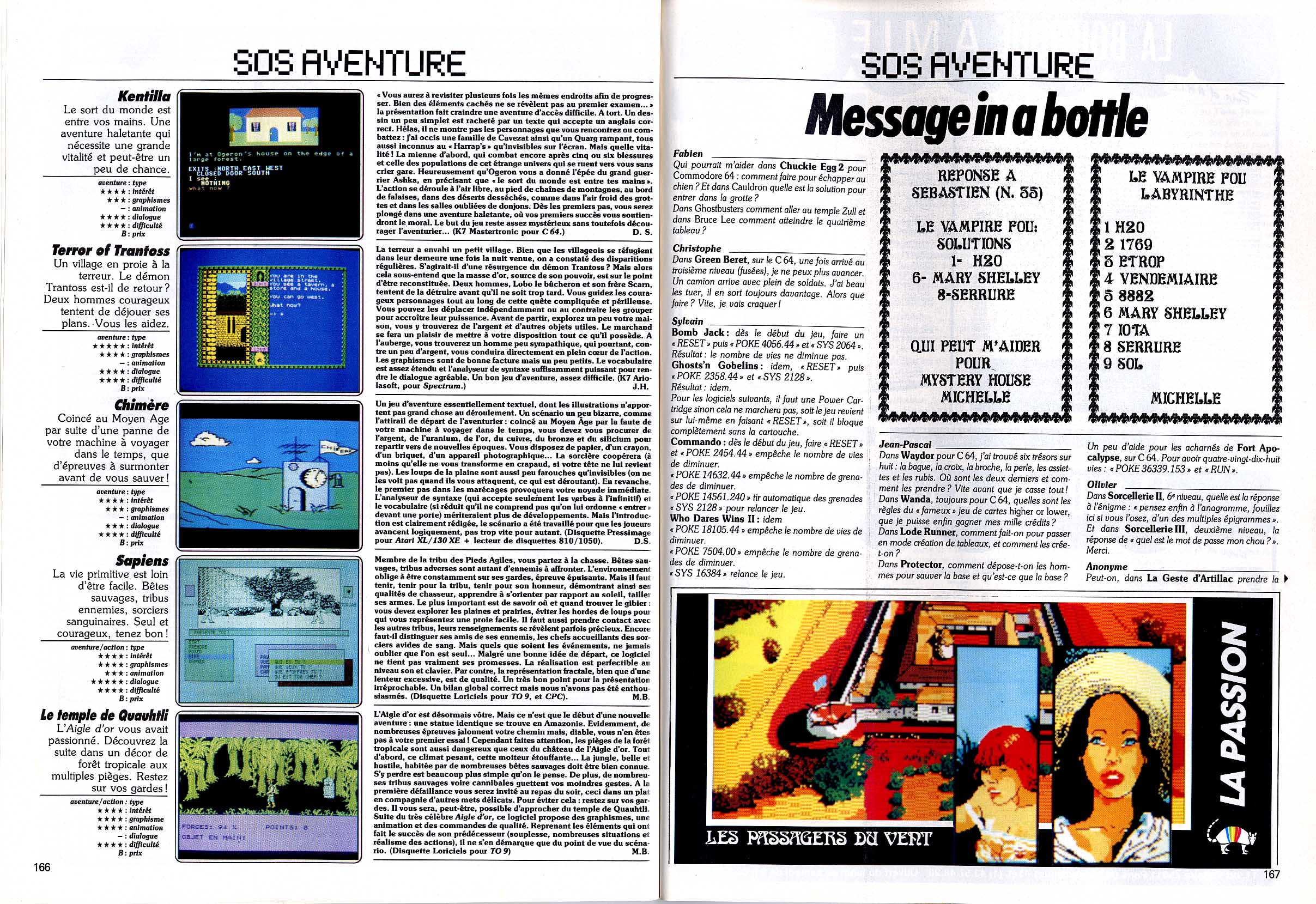
Sapiens received immediate critical and popular success. Although information about the foreign sales is scarce, after being translated in English, the game was exported to the USA. The Atari ST version of Sapiens receives the Tilt d'or / « Most original software » award from Canal+ in 1987.[1] <references responsive="1" group="">
The Games Machine felt that the plot and implementation were "quite original" and that the graphics were "very effective and polished" and that the game was "quite easy to get into".[2]
Computer and Video Games could not tell how to solve problems or find a winning strategy, and that the game play "did not make itself apparent", and found that actions taken by the player have "no immediately effect on progress".[3]
Reviews
References
- ↑ Eric Cubizolle (15 September 2011). "Sapiens". Pix'n Love (17): 60-71.
- ↑ "The Games Machine Magazine Issue 02". https://archive.org/details/thegamesmachine-magazine-02/page/n73/mode/2up.
- ↑ "CVG Magazine Issue 079". May 1988. https://archive.org/details/cvg-magazine-079/page/n77/mode/2up.
- ↑ "Jeux & stratégie 42". December 1986. https://archive.org/details/jeux-et-strategie-42/page/n63/mode/2up.
- ↑ "Aktueller Software Markt (ASM) Magazine (January 1988)". January 1988. https://archive.org/details/asm_magazine-1988-01/page/n89/mode/2up.
- ↑ http://download.abandonware.org/magazines/Tilt/tilt_numero037/tilt%20N%C2%B0037%20-%20decembre%201986%20-%20page166%20et%20167.jpg
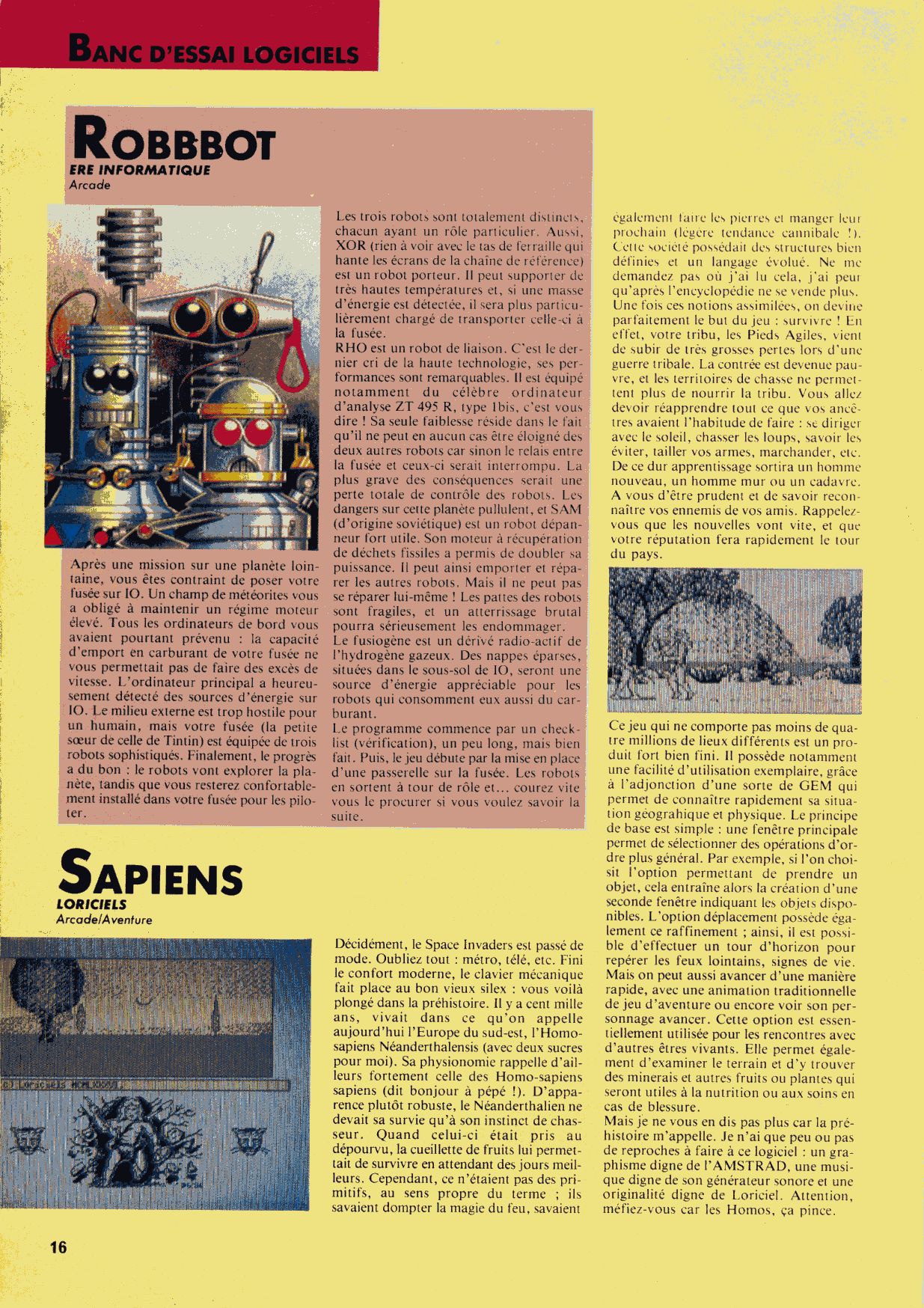
- ↑ http://download.abandonware.org/magazines/Amstar/amstar_numero01/ams01_016.JPG
- ↑ "Jeux & stratégie HS 3". 1986. https://archive.org/details/jeux-et-strategie-hs-3/page/72/mode/2up.
External links
- Interview de Didier et Olivier Guillion sur Ex0097, Novembre 2018
- Interview de Didier et Olivier Guillion sur Logiciels Thomson, Juin 2005
- Interview de Didier et Olivier Guillion sur Amstrad.eu, Septembre 2003
- Interview de Didier et Olivier Guillion sur Thomsonistes, Octobre 1998
- Interview de Didier et Olivier Guillion sur le magazine Amstard n°2, Octobre 1986
- Sapiens sur Emu Nova
- MobyGames is a commercial database website that catalogs information on video games and the people and companies behind them via crowdsourcing. This includes over 300,000 games for hundreds of platforms.[1] Founded in 1999, ownership of the site has changed hands several times. It has been owned by Atari SA since 2022.
Features
Edits and submissions to the site (including screenshots, box art, developer information, game summaries, and more) go through a verification process of fact-checking by volunteer "approvers".[2] This approval process after submission can range from minutes to days or months.[3] The most commonly used sources are the video game's website, packaging, and credit screens. There is a published standard for game information and copy-editing.[4] A ranking system allows users to earn points for contributing accurate information.[5]
Registered users can rate and review games. Users can create private or public "have" and "want" lists, which can generate a list of games available for trade with other registered users. The site contains an integrated forum. Each listed game can have its own sub-forum.
History

MobyGames was founded on March 1, 1999, by Jim Leonard and Brian Hirt, and joined by David Berk 18 months later, the three of which had been friends since high school.[6][7] Leonard had the idea of sharing information about computer games with a larger audience. The database began with information about games for IBM PC compatibles, relying on the founders' personal collections. Eventually, the site was opened up to allow general users to contribute information.[5] In a 2003 interview, Berk emphasized MobyGames' dedication to taking video games more seriously than broader society and to preserving games for their important cultural influence.[5]
In mid-2010, MobyGames was purchased by GameFly for an undisclosed amount.[8] This was announced to the community post factum , and the site's interface was given an unpopular redesign.[7] A few major contributors left, refusing to do volunteer work for a commercial website.{{Citation needed|date=June 2025} On December 18, 2013, MobyGames was acquired by Jeremiah Freyholtz, owner of Blue Flame Labs (a San Francisco-based game and web development company) and VGBoxArt (a site for fan-made video game box art).[9] Blue Flame Labs reverted MobyGames' interface to its pre-overhaul look and feel,[10] and for the next eight years, the site was run by Freyholtz and Independent Games Festival organizer Simon Carless.[7]
On November 24, 2021, Atari SA announced a potential deal with Blue Flame Labs to purchase MobyGames for $1.5 million.[11] The purchase was completed on 8 March 2022, with Freyholtz remaining as general manager.[12][13][14] Over the next year, the financial boost given by Atari led to a rework of the site being built from scratch with a new backend codebase, as well as updates improving the mobile and desktop user interface.[1] This was accomplished by investing in full-time development of the site instead of its previously part-time development.[15]
In 2024, MobyGames began offering a paid "Pro" membership option for the site to generate additional revenue.[16] Previously, the site had generated income exclusively through banner ads and (from March 2014 onward) a small number of patrons via the Patreon website.[17]
On February 13, 2025, Freyholtz stepped down as the site lead to move onto new projects, leaving operations to Tracy Poff, a veteran coder on the site, and Atari staff.[18]
See also
- IGDB – game database used by Twitch for its search and discovery functions
References
- ↑ 1.0 1.1 Sheehan, Gavin (2023-02-22). "Atari Relaunches The Fully Rebuilt & Optimized MobyGames Website". https://bleedingcool.com/games/atari-relaunches-the-fully-rebuilt-optimized-mobygames-website/.
- ↑ Litchfield, Ted (2021-11-26). "Zombie company Atari to devour MobyGames". https://www.pcgamer.com/zombie-company-atari-to-devour-mobygames/.
- ↑ "MobyGames FAQ: Emails Answered § When will my submission be approved?". Blue Flame Labs. 30 March 2014. http://www.mobygames.com/info/faq7#g1.
- ↑ "The MobyGames Standards and Practices". Blue Flame Labs. 6 January 2016. http://www.mobygames.com/info/standards.
- ↑ 5.0 5.1 5.2 Miller, Stanley A. (2003-04-22). "People's choice awards honor favorite Web sites". Milwaukee Journal Sentinel.
- ↑ "20 Years of MobyGames" (in en). 2019-02-28. https://trixter.oldskool.org/2019/02/28/20-years-of-mobygames/.
- ↑ 7.0 7.1 7.2 Plunkett, Luke (2022-03-10). "Atari Buys MobyGames For $1.5 Million". https://kotaku.com/mobygames-retro-credits-database-imdb-atari-freyholtz-b-1848638521.
- ↑ "Report: MobyGames Acquired By GameFly Media". Gamasutra. 2011-02-07. https://www.gamedeveloper.com/game-platforms/report-mobygames-acquired-by-gamefly-media.
- ↑ Corriea, Alexa Ray (December 31, 2013). "MobyGames purchased from GameFly, improvements planned". http://www.polygon.com/2013/12/31/5261414/mobygames-purchased-from-gamefly-improvements-planned.
- ↑ Wawro, Alex (31 December 2013). "Game dev database MobyGames getting some TLC under new owner". Gamasutra. https://www.gamedeveloper.com/business/game-dev-database-mobygames-getting-some-tlc-under-new-owner.
- ↑ "Atari invests in Anstream, may buy MobyGames". November 24, 2021. https://www.gamesindustry.biz/articles/2021-11-24-atari-invests-in-anstream-may-buy-mobygames.
- ↑ Rousseau, Jeffrey (2022-03-09). "Atari purchases Moby Games". https://www.gamesindustry.biz/atari-purchases-moby-games.
- ↑ "Atari Completes MobyGames Acquisition, Details Plans for the Site's Continued Support". March 8, 2022. https://www.atari.com/atari-completes-mobygames-acquisition-details-plans-for-the-sites-continued-support/.
- ↑ "Atari has acquired game database MobyGames for $1.5 million" (in en-GB). 2022-03-09. https://www.videogameschronicle.com/news/atari-has-acquired-game-database-mobygames-for-1-5-million/.
- ↑ Stanton, Rich (2022-03-10). "Atari buys videogame database MobyGames for $1.5 million". https://www.pcgamer.com/atari-buys-videogame-database-mobygames-for-dollar15-million/.
- ↑ Harris, John (2024-03-09). "MobyGames Offering “Pro” Membership". https://setsideb.com/mobygames-offering-pro-membership/.
- ↑ "MobyGames on Patreon". http://www.patreon.com/mobygames.
- ↑ "An update on MobyGames leadership". 2025-02-13. https://www.mobygames.com/forum/3/thread/269628/an-update-on-mobygames-leadership/#post-269628.
 |
Wikidata has the property:
|

External links
- No URL found. Please specify a URL here or add one to Wikidata.

 |  |
- Sapiens (1/3), Sapiens (2/3), Sapiens (3/3), articles de Didier Guillion sur le blog de Myriad-online
| |
 EncycloReader
is supported by the
EncycloReader
is supported by the  KSF
KSF