Table of Contents Categories
The Simpsons Skateboarding
Topic: Software
 From HandWiki - Reading time: 12 min
| The Simpsons Skateboarding | |
|---|---|
 North American box art | |
| Developer(s) | Mass Media The Code Monkeys |
| Publisher(s) | Electronic Arts Fox Interactive |
| Artist(s) | William Brand Daniel Hughes Paul Hunter |
| Writer(s) | Tim Long Matt Selman |
| Composer(s) | Christopher Tyng |
| Series | The Simpsons |
| Engine | RenderWare |
| Platform(s) | PlayStation 2 |
| Release | |
| Genre(s) | Sports |
| Mode(s) | Single-player, multiplayer |
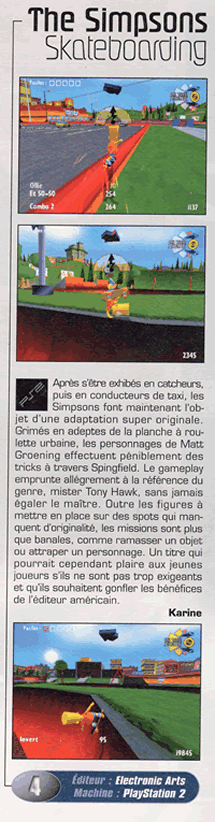
The Simpsons Skateboarding is a sports video game based on the animated sitcom The Simpsons. It was released for the PlayStation 2 in North America on 12 November 2002 and Europe on 6 December 2002. The game was developed by Mass Media and The Code Monkeys and published by Electronic Arts and Fox Interactive. The story and dialogue were written by writers from The Simpsons, with all character voices supplied by the cast. The game received generally negative reviews from critics.
Gameplay
Springfield has been converted into a skate park for the Annual Skate Tour, full of skate-able objects and landmarks from the television series. Players are able to choose one of the nine characters available and complete for the grand prize. All of the characters' voices were recorded by the actual voice actors from The Simpsons. Each character has over forty unique moves. Players can test their skills in either a two-player head-to-head skate off, or in one of the fast and furious modes: Freeskate, Skate Fest, Trick Contest, and a game of skateboard H-O-R-S-E, unlocking additional characters, locations, and skateboards. Players can also choose to learn all the skateboard moves and tricks before they begin the actual game in the Skillz School mode.[1]
Development
The Simpsons Skateboarding was developed by Mass Media and The Code Monkeys, and published by Electronic Arts (EA Games) under license from Fox Interactive. Before EA made an official announcement about The Simpsons Skateboarding, an advertisement for the game was featured on the back page of the instruction manual for Software:The Simpsons: Road Rage, and on in-game billboards, which was released in 2001. There were no mention of a console in the advertisement and no gameplay details were revealed. In November 2001, EA representatives said they were not ready to comment on the product.[2] On 16 May 2002, a few days before the E3 Media and Business Summit, they released their first piece of information about the game.[3] All of the characters' voices were recorded by the actual voice actors from The Simpsons.[1][4]
Reception
| Reception | ||||||||||||||||||||||||||||||||||||||||||||||||
|---|---|---|---|---|---|---|---|---|---|---|---|---|---|---|---|---|---|---|---|---|---|---|---|---|---|---|---|---|---|---|---|---|---|---|---|---|---|---|---|---|---|---|---|---|---|---|---|---|
| ||||||||||||||||||||||||||||||||||||||||||||||||
The Simpsons Skateboarding garnered abysmal reviews from professional critics, who generally already disliked most of the prior track record with Simpsons video games.[6][11][23][5] Some reviews labeled it one of the worst games of 2002, one of the worst PlayStation 2 games, and the worst all-time Simpsons video game.[21][10][12] The general consensus was that it was devoid of redeeming qualities and shocking in its amount of failed aspects,[9][10][12][14] feeling like a product conceived by marketing executives.[15][9][14] Most reviewers recommended The Simpsons fans and skateboarding enthusiasts to avoid the game, only a couple suggesting it would appeal to hardcore fans of the show.[lower-alpha 1] The minority of positive publications included Play who called it the best Simpsons video game, and X-Play who concluded it was better than most video game adaptations of media properties.[22][24][20] In 2015, HobbyConsolas ranked The Simpsons Skateboarding number 12 in a worst-to-best ranking of video games based on The Simpsons.[25]
The controls were widely condemned as unresponsive and complicated with poor handling,[lower-alpha 2] and inconsistencies were noted in the physics, especially when it came to the flips and ollies.[12][8][15] X-Play and 4Players noted unruliness in collision detection, such as successfully landing on the ground after randomly pushing buttons or grinding when clearly not near the surface to.[6][20] The camera was also panned for causing quick zoom-ins and perspective changes during air tricks, which made spotting and collecting objects harder.[7][12][17]
The level themes were praised for reflecting the show and sometimes being obscure references that would appeal to Simpsons fans.[7][8][19][20] However, their design was criticized for being too simple.[11][17][18] A common point was the low number of opportunities to pull off combos, which was attributed to the skateboarding lines, particularly their rudimentary design and low quantity.[8][9][12][15] The challenges, especially those that require spelling words, were also dismissed for being mundane and ludicrous, not helped by the inclusion of a time limit.[8][9][19][16]
The visuals were poorly-received. The environments garnered negative comments for their perceived plain textures, angular modeling, and low amount of polygons.[lower-alpha 3] While some acknowledged the faithfulness to the TV series, even they still criticized it.[7][15] The most well-received aspect of the graphics were the character models, which were generally described as decent and reflective of the original characters.[6][13][15][17] However, even they received some scrutiny.[19][11] The animations were also poorly-received by 4Players, GameSpy and X-Play.[6][12][20] Some reviewers were also dismayed with the absence of cel shading.[21][12][19]
The voice clips were noted for their incorporation of the original voice actors, but the repetitive usage of them was widely condemned.[lower-alpha 4] The phrases, such as "my butt hurts", were criticized by some reviewers as unfunny, annoying, and by GameZone as "often strange".[lower-alpha 5] Reviewers were particularly annoyed by Kent Brockman's announcement of every trick the players pull off.[lower-alpha 6] The dependence on voice clips was also cited as an example of the game's lack of humor and poor incorporation of the license.[lower-alpha 7] The soundtrack was dismissed as "lousy," "uninspiring," "generic," irritating, and "a whimsical non-event of a soundtrack," its incorporation of Danny Elfman's theme particularly deried as "blasé" and "mutated."[lower-alpha 8] Mostly categorized as Ska, the music was generally considered unsuitable for a Simpsons property.[9][12][15][19]
Some journalists reported bugs and glitches, such as pop-up, lock-ups during gameplay, and going through and getting stuck in collision.[7][10][17] Load times were described as excessive, long, and inexcusable given the little detail in the models and textures.[6][7][12][15] Reviews had conflicting coverage on the framerate; GameZone and Play claimed it was smooth and "dips just a smidgeon now and then," while others called it inconsistent, "vicious and sporadic," and having "occasional slowdown."[13][24][11][20]
Notes
References
- ↑ 1.0 1.1 1.2 "Shred and Grind Springfield in the Simpsons Skateboarding for the PlayStation 2 From EA and Fox Interactive". Business Wire. 14 November 2002. http://www.wilsongame.com/shred-and-grind-springfield-in-the-simpsons-skateboarding-for-the-playstation-2-from-ea-and-fox-interactive/. Retrieved 20 August 2016.
- ↑ IGN staff (27 November 2001). "The Simpsons Go Skateboarding". http://www.ign.com/articles/2001/11/27/the-simpsons-go-skateboarding. Retrieved 20 August 2016.
- ↑ Smith, David (17 May 2002). "[The Simpsons Skateboarding (Preview)"]. http://www.ign.com/articles/2002/05/17/simpsons-skateboarding-2. Retrieved 20 August 2016.
- ↑ "Here's a nostalgia inducing list of skateboard games". Magneto. 8 November 2015. https://magnetoelectricskateboard.com/blogs/news/63995589-a-history-of-skateboard-games. Retrieved 8 November 2015.
- ↑ 5.0 5.1 "The Simpsons Skateboarding for PlayStation 2 Reviews". https://www.metacritic.com/game/playstation-2/the-simpsons-skateboarding.
- ↑ 6.00 6.01 6.02 6.03 6.04 6.05 6.06 6.07 6.08 6.09 Kautz, Paul (26 January 2003). "Test: The Simpsons: Skateboarding (Sport)" (in de). 4Players. https://www.4players.de/4players.php/dispbericht/Allgemein/Test/2632/1702/0/The_Simpsons_Skateboarding.html.
- ↑ 7.00 7.01 7.02 7.03 7.04 7.05 7.06 7.07 7.08 7.09 7.10 Marriott, Scott Alan. "The Simpsons Skateboarding - Review". AllGame. Archived from the original on 14 November 2014. https://web.archive.org/web/20141114233530/http://www.allgame.com/game.php?id=37753&tab=review. Retrieved 26 January 2023.
- ↑ 8.0 8.1 8.2 8.3 8.4 8.5 EGM staff (January 2003). "The Simpsons Skateboarding". Electronic Gaming Monthly (162): 176. Archived from the original on 14 May 2004. https://web.archive.org/web/20040514052402/http://www.egmmag.com/article2/0,2053,1489635,00.asp. Retrieved 26 January 2023.
- ↑ 9.0 9.1 9.2 9.3 9.4 9.5 9.6 9.7 9.8 Taylor, Martin (1 January 2003). "[The Simpsons Skateboarding"]. http://www.eurogamer.net/articles/r_simpsonsskate_ps2. Retrieved 26 January 2023.
- ↑ 10.0 10.1 10.2 10.3 10.4 10.5 Reiner, Andrew (December 2002). "Simpsons' [sic Skateboarding"]. Game Informer (116): 123. Archived from the original on 12 January 2008. https://web.archive.org/web/20080112223749/http://gameinformer.com/Games/Review/200212/R03.0731.1138.03070.htm. Retrieved 26 January 2023.
- ↑ 11.0 11.1 11.2 11.3 11.4 11.5 11.6 11.7 11.8 Davis, Ryan (26 November 2002). "The Simpsons Skateboarding Review". http://www.gamespot.com/reviews/the-simpsons-skateboarding/1900-2898697/. Retrieved 26 January 2023.
- ↑ 12.00 12.01 12.02 12.03 12.04 12.05 12.06 12.07 12.08 12.09 12.10 12.11 Murphy, Kevin (2 December 2002). "GameSpy: The Simpsons Skateboarding". GameSpy. http://ps2.gamespy.com/playstation-2/the-simpsons-skateboarding/565598p1.html. Retrieved 26 January 2023.
- ↑ 13.00 13.01 13.02 13.03 13.04 13.05 13.06 13.07 13.08 13.09 Valentino, Nick (24 November 2002). "The Simpsons Skateboarding - PS2 - Review". GameZone. Archived from the original on 8 December 2008. https://web.archive.org/web/20081208180609/http://ps2.gamezone.com/gzreviews/r19636.htm. Retrieved 26 January 2023.
- ↑ 14.0 14.1 14.2 14.3 14.4 14.5 Shea, Cam (February 2003). "The Simpsons Skateboarding". Hyper (112). https://archive.org/details/hyper-112/page/80/mode/2up?q=%22the+simpsons+skateboarding%22. Retrieved 26 January 2023.
- ↑ 15.00 15.01 15.02 15.03 15.04 15.05 15.06 15.07 15.08 15.09 15.10 15.11 15.12 15.13 Smith, David (19 November 2002). "[The Simpsons Skateboarding"]. http://www.ign.com/articles/2002/11/19/simpsons-skateboarding. Retrieved 26 January 2023.
- ↑ 16.0 16.1 Kerine (2003). "The Simpsons Skateboarding" (in fr). Joypad (127). http://cabanedebart.free.fr/images/joypad127.gif. Retrieved 26 January 2023.
- ↑ 17.0 17.1 17.2 17.3 17.4 17.5 17.6 17.7 17.8 Pilou (13 January 2003). "The Simpsons Skateboarding" (in fr). https://www.jeuxvideo.com/articles/0000/00002800_test.htm.
- ↑ 18.0 18.1 18.2 Evans, Dean (April 2003). "The Simpsons Skateboarding". PlayStation 2 Official Magazine – Australia (13). https://archive.org/details/Official_AUS_Playstation_2_Magazine_Issue_013_2003_04_Derwent_Howard_Publishing_AU/page/50/mode/2up?q=%22the+simpsons+skateboarding%22. Retrieved 28 January 2023.
- ↑ 19.0 19.1 19.2 19.3 19.4 19.5 19.6 19.7 19.8 Rybicki, Joe (January 2003). "The Simpsons Skateboarding". Official U.S. PlayStation Magazine: 132. Archived from the original on 29 March 2004. https://web.archive.org/web/20040329071417/http://www.playstationmagazine.com/article2/0,2053,1495335,00.asp. Retrieved 26 January 2023.
- ↑ 20.0 20.1 20.2 20.3 20.4 20.5 20.6 Rubenstein, Glenn (25 November 2002). "'[The Simpsons Skateboarding' (PS2) Review"]. X-Play. Archived from the original on 25 November 2002. https://web.archive.org/web/20021125022257/http://www.techtv.com/extendedplay/reviews/story/0,24330,3408509,00.html. Retrieved 26 January 2023.
- ↑ 21.0 21.1 21.2 21.3 21.4 Stevenson, James (9 December 2002). "Game Review: The Simpsons Skateboarding". Cinescape. http://www.cinescape.com/0/editorial.asp?aff_id=0&this_cat=Games&action=page&type_id=&cat_id=&obj_id=37179.
- ↑ 22.0 22.1 Theobald, Phil (January 2003). "The Simpsons Skateboarding". GameNOW (15). https://archive.org/details/game-now-january-2003/page/n51/mode/2up?q=%22the+simpsons+skateboarding%22. Retrieved 28 January 2023.
- ↑ 23.0 23.1 Boyce, Ryan (25 October 2002). "[The Simpsons Skateboarding"]. Maxim. Archived from the original on 24 November 2002. https://web.archive.org/web/20021124225752/http://www.maximonline.com/entertainment/reviews/review_games_4221.html. Retrieved 26 January 2023.
- ↑ 24.0 24.1 24.2 Halverson, Dave (December 2002). "The Simpsons Skateboarding". Play (12). https://archive.org/details/PLAY12Dec2002/page/n85/mode/2up. Retrieved 26 January 2023.
- ↑ Alonso, Álvaro (25 February 2015). "Los mejores juegos de Los Simpson para PC y todas las consolas" (in es). HobbyConsolas. https://www.hobbyconsolas.com/reportajes/mejores-juegos-simpson-111054.
External links
- The Simpsons Skateboarding on IMDb
- MobyGames is a commercial database website that catalogs information on video games and the people and companies behind them via crowdsourcing. This includes over 300,000 games for hundreds of platforms.[1] Founded in 1999, ownership of the site has changed hands several times. It has been owned by Atari SA since 2022.
Features
Edits and submissions to the site (including screenshots, box art, developer information, game summaries, and more) go through a verification process of fact-checking by volunteer "approvers".[2] This approval process after submission can range from minutes to days or months.[3] The most commonly used sources are the video game's website, packaging, and credit screens. There is a published standard for game information and copy-editing.[4] A ranking system allows users to earn points for contributing accurate information.[5]
Registered users can rate and review games. Users can create private or public "have" and "want" lists, which can generate a list of games available for trade with other registered users. The site contains an integrated forum. Each listed game can have its own sub-forum.
History

MobyGames was founded on March 1, 1999, by Jim Leonard and Brian Hirt, and joined by David Berk 18 months later, the three of which had been friends since high school.[6][7] Leonard had the idea of sharing information about computer games with a larger audience. The database began with information about games for IBM PC compatibles, relying on the founders' personal collections. Eventually, the site was opened up to allow general users to contribute information.[5] In a 2003 interview, Berk emphasized MobyGames' dedication to taking video games more seriously than broader society and to preserving games for their important cultural influence.[5]
In mid-2010, MobyGames was purchased by GameFly for an undisclosed amount.[8] This was announced to the community post factum , and the site's interface was given an unpopular redesign.[7] A few major contributors left, refusing to do volunteer work for a commercial website.{{Citation needed|date=June 2025} On December 18, 2013, MobyGames was acquired by Jeremiah Freyholtz, owner of Blue Flame Labs (a San Francisco-based game and web development company) and VGBoxArt (a site for fan-made video game box art).[9] Blue Flame Labs reverted MobyGames' interface to its pre-overhaul look and feel,[10] and for the next eight years, the site was run by Freyholtz and Independent Games Festival organizer Simon Carless.[7]
On November 24, 2021, Atari SA announced a potential deal with Blue Flame Labs to purchase MobyGames for $1.5 million.[11] The purchase was completed on 8 March 2022, with Freyholtz remaining as general manager.[12][13][14] Over the next year, the financial boost given by Atari led to a rework of the site being built from scratch with a new backend codebase, as well as updates improving the mobile and desktop user interface.[1] This was accomplished by investing in full-time development of the site instead of its previously part-time development.[15]
In 2024, MobyGames began offering a paid "Pro" membership option for the site to generate additional revenue.[16] Previously, the site had generated income exclusively through banner ads and (from March 2014 onward) a small number of patrons via the Patreon website.[17]
On February 13, 2025, Freyholtz stepped down as the site lead to move onto new projects, leaving operations to Tracy Poff, a veteran coder on the site, and Atari staff.[18]
See also
- IGDB – game database used by Twitch for its search and discovery functions
References
- ↑ 1.0 1.1 Sheehan, Gavin (2023-02-22). "Atari Relaunches The Fully Rebuilt & Optimized MobyGames Website". https://bleedingcool.com/games/atari-relaunches-the-fully-rebuilt-optimized-mobygames-website/.
- ↑ Litchfield, Ted (2021-11-26). "Zombie company Atari to devour MobyGames". https://www.pcgamer.com/zombie-company-atari-to-devour-mobygames/.
- ↑ "MobyGames FAQ: Emails Answered § When will my submission be approved?". Blue Flame Labs. 30 March 2014. http://www.mobygames.com/info/faq7#g1.
- ↑ "The MobyGames Standards and Practices". Blue Flame Labs. 6 January 2016. http://www.mobygames.com/info/standards.
- ↑ 5.0 5.1 5.2 Miller, Stanley A. (2003-04-22). "People's choice awards honor favorite Web sites". Milwaukee Journal Sentinel.
- ↑ "20 Years of MobyGames" (in en). 2019-02-28. https://trixter.oldskool.org/2019/02/28/20-years-of-mobygames/.
- ↑ 7.0 7.1 7.2 Plunkett, Luke (2022-03-10). "Atari Buys MobyGames For $1.5 Million". https://kotaku.com/mobygames-retro-credits-database-imdb-atari-freyholtz-b-1848638521.
- ↑ "Report: MobyGames Acquired By GameFly Media". Gamasutra. 2011-02-07. https://www.gamedeveloper.com/game-platforms/report-mobygames-acquired-by-gamefly-media.
- ↑ Corriea, Alexa Ray (December 31, 2013). "MobyGames purchased from GameFly, improvements planned". http://www.polygon.com/2013/12/31/5261414/mobygames-purchased-from-gamefly-improvements-planned.
- ↑ Wawro, Alex (31 December 2013). "Game dev database MobyGames getting some TLC under new owner". Gamasutra. https://www.gamedeveloper.com/business/game-dev-database-mobygames-getting-some-tlc-under-new-owner.
- ↑ "Atari invests in Anstream, may buy MobyGames". November 24, 2021. https://www.gamesindustry.biz/articles/2021-11-24-atari-invests-in-anstream-may-buy-mobygames.
- ↑ Rousseau, Jeffrey (2022-03-09). "Atari purchases Moby Games". https://www.gamesindustry.biz/atari-purchases-moby-games.
- ↑ "Atari Completes MobyGames Acquisition, Details Plans for the Site's Continued Support". March 8, 2022. https://www.atari.com/atari-completes-mobygames-acquisition-details-plans-for-the-sites-continued-support/.
- ↑ "Atari has acquired game database MobyGames for $1.5 million" (in en-GB). 2022-03-09. https://www.videogameschronicle.com/news/atari-has-acquired-game-database-mobygames-for-1-5-million/.
- ↑ Stanton, Rich (2022-03-10). "Atari buys videogame database MobyGames for $1.5 million". https://www.pcgamer.com/atari-buys-videogame-database-mobygames-for-dollar15-million/.
- ↑ Harris, John (2024-03-09). "MobyGames Offering “Pro” Membership". https://setsideb.com/mobygames-offering-pro-membership/.
- ↑ "MobyGames on Patreon". http://www.patreon.com/mobygames.
- ↑ "An update on MobyGames leadership". 2025-02-13. https://www.mobygames.com/forum/3/thread/269628/an-update-on-mobygames-leadership/#post-269628.
 |
Wikidata has the property:
|

External links
- No URL found. Please specify a URL here or add one to Wikidata.
 |  |
The Simpsons video games and pinball machines | |
|---|---|
| Console | |
| Handheld | |
| Pinball | |


Warning: Default sort key "Simpsons Skateboarding, The" overrides earlier default sort key "Mobygames".
| |
Cite error: <ref> tags exist for a group named "lower-alpha", but no corresponding <references group="lower-alpha"/> tag was found
 EncycloReader
is supported by the
EncycloReader
is supported by the  KSF
KSF