Tetrahedron, elementary geometry of the
 From HandWiki - Reading time: 15 min
A tetrahedron is a spatial figure formed by four non-co-planar points, called vertices. The term is of Greek origin ( "tetra" meaning "four" and "hedra" meaning "seat" ) and refers to its four plane faces, or sides. As implied in the definition, the usual environment for the study of the tetrahedron is the Euclidean space of three dimensions. Here, it is a convex body (triangular pyramid), the convex hull of its vertices, and, thus, is the natural three-dimensional analogue of the plane triangle, which is determined by three non-collinear points. In fact, as will be shown, the geometry of the triangle constitutes a basis on which much of the geometry of the tetrahedron is built. The first systematic treatment of the tetrahedron was published by J.L. Lagrange in 1773, see [a13].
Whereas the triangle has two sets of proper faces, vertices (<img align="absmiddle" border="0" src="https://www.encyclopediaofmath.org/legacyimages/t/t110/t110020/t1100201.png" />-dimensional faces) and sides (<img align="absmiddle" border="0" src="https://www.encyclopediaofmath.org/legacyimages/t/t110/t110020/t1100202.png" />-dimensional, or <img align="absmiddle" border="0" src="https://www.encyclopediaofmath.org/legacyimages/t/t110/t110020/t1100203.png" />-co-dimensional, faces), the tetrahedron has vertices (<img align="absmiddle" border="0" src="https://www.encyclopediaofmath.org/legacyimages/t/t110/t110020/t1100204.png" />-dimensional faces), edges (<img align="absmiddle" border="0" src="https://www.encyclopediaofmath.org/legacyimages/t/t110/t110020/t1100205.png" />-dimensional, or <img align="absmiddle" border="0" src="https://www.encyclopediaofmath.org/legacyimages/t/t110/t110020/t1100206.png" />-co-dimensional, faces, the line segments joining the pairs of vertices), and the triangular sides (<img align="absmiddle" border="0" src="https://www.encyclopediaofmath.org/legacyimages/t/t110/t110020/t1100207.png" />-dimensional, or <img align="absmiddle" border="0" src="https://www.encyclopediaofmath.org/legacyimages/t/t110/t110020/t1100208.png" />-co-dimensional faces) formed by all <img align="absmiddle" border="0" src="https://www.encyclopediaofmath.org/legacyimages/t/t110/t110020/t1100209.png" />-sets of vertices. If necessary, a face of dimension at least <img align="absmiddle" border="0" src="https://www.encyclopediaofmath.org/legacyimages/t/t110/t110020/t11002010.png" /> is considered as an (infinite) affine subspace, the affine hull of the original bounded object (cf. also Affine space). Sometimes it is convenient to think in terms of three pairs of opposite edges, joining complementary pairs of vertices and to associate with each vertex the opposite side, formed by the three remaining vertices, and vice versa.


As expected, the vertices are normally labeled <img align="absmiddle" border="0" src="https://www.encyclopediaofmath.org/legacyimages/t/t110/t110020/t11002011.png" />, <img align="absmiddle" border="0" src="https://www.encyclopediaofmath.org/legacyimages/t/t110/t110020/t11002012.png" />, <img align="absmiddle" border="0" src="https://www.encyclopediaofmath.org/legacyimages/t/t110/t110020/t11002013.png" />, and <img align="absmiddle" border="0" src="https://www.encyclopediaofmath.org/legacyimages/t/t110/t110020/t11002014.png" />. For the edges (and their lengths) bounding the triangle <img align="absmiddle" border="0" src="https://www.encyclopediaofmath.org/legacyimages/t/t110/t110020/t11002015.png" /> one may use Euler's notation: <img align="absmiddle" border="0" src="https://www.encyclopediaofmath.org/legacyimages/t/t110/t110020/t11002016.png" />, <img align="absmiddle" border="0" src="https://www.encyclopediaofmath.org/legacyimages/t/t110/t110020/t11002017.png" />, <img align="absmiddle" border="0" src="https://www.encyclopediaofmath.org/legacyimages/t/t110/t110020/t11002018.png" />, with the opposite edges indicated by a prime: <img align="absmiddle" border="0" src="https://www.encyclopediaofmath.org/legacyimages/t/t110/t110020/t11002019.png" />, <img align="absmiddle" border="0" src="https://www.encyclopediaofmath.org/legacyimages/t/t110/t110020/t11002020.png" />, <img align="absmiddle" border="0" src="https://www.encyclopediaofmath.org/legacyimages/t/t110/t110020/t11002021.png" />. A subscripting scheme is often more useful when certain analytic arguments are employed. Here, one takes <img align="absmiddle" border="0" src="https://www.encyclopediaofmath.org/legacyimages/t/t110/t110020/t11002022.png" />, <img align="absmiddle" border="0" src="https://www.encyclopediaofmath.org/legacyimages/t/t110/t110020/t11002023.png" />, as labels for the vertices and <img align="absmiddle" border="0" src="https://www.encyclopediaofmath.org/legacyimages/t/t110/t110020/t11002024.png" />, <img align="absmiddle" border="0" src="https://www.encyclopediaofmath.org/legacyimages/t/t110/t110020/t11002025.png" />, for the edge (and its length) connecting <img align="absmiddle" border="0" src="https://www.encyclopediaofmath.org/legacyimages/t/t110/t110020/t11002026.png" /> and <img align="absmiddle" border="0" src="https://www.encyclopediaofmath.org/legacyimages/t/t110/t110020/t11002027.png" />. Thus, <img align="absmiddle" border="0" src="https://www.encyclopediaofmath.org/legacyimages/t/t110/t110020/t11002028.png" /> for <img align="absmiddle" border="0" src="https://www.encyclopediaofmath.org/legacyimages/t/t110/t110020/t11002029.png" />, with the understanding that <img align="absmiddle" border="0" src="https://www.encyclopediaofmath.org/legacyimages/t/t110/t110020/t11002030.png" />.





If the area of the side opposite the vertex <img align="absmiddle" border="0" src="https://www.encyclopediaofmath.org/legacyimages/t/t110/t110020/t11002031.png" /> is denoted by <img align="absmiddle" border="0" src="https://www.encyclopediaofmath.org/legacyimages/t/t110/t110020/t11002032.png" />, then the surface area of the tetrahedron is given by


| <img align="absmiddle" border="0" src="https://www.encyclopediaofmath.org/legacyimages/t/t110/t110020/t11002033.png" /> |

while the volume <img align="absmiddle" border="0" src="https://www.encyclopediaofmath.org/legacyimages/t/t110/t110020/t11002034.png" /> can be computed from the formula

| <img align="absmiddle" border="0" src="https://www.encyclopediaofmath.org/legacyimages/t/t110/t110020/t11002035.png" /> |

where <img align="absmiddle" border="0" src="https://www.encyclopediaofmath.org/legacyimages/t/t110/t110020/t11002036.png" /> denotes the area of any side and <img align="absmiddle" border="0" src="https://www.encyclopediaofmath.org/legacyimages/t/t110/t110020/t11002037.png" /> the corresponding height, the distance of the side under consideration from the parallel plane containing the opposite vertex. The volume <img align="absmiddle" border="0" src="https://www.encyclopediaofmath.org/legacyimages/t/t110/t110020/t11002038.png" /> of a tetrahedron is also given by


| <img align="absmiddle" border="0" src="https://www.encyclopediaofmath.org/legacyimages/t/t110/t110020/t11002039.png" /> |
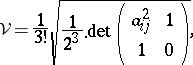
which may be regarded as a three-dimensional analogue to Heron's formula for the area of a triangle (cf. also Heron formula), i.e.,
| <img align="absmiddle" border="0" src="https://www.encyclopediaofmath.org/legacyimages/t/t110/t110020/t11002040.png" /> |

Here,
| <img align="absmiddle" border="0" src="https://www.encyclopediaofmath.org/legacyimages/t/t110/t110020/t11002041.png" /> |

is short for
| <img align="absmiddle" border="0" src="https://www.encyclopediaofmath.org/legacyimages/t/t110/t110020/t11002042.png" /> |
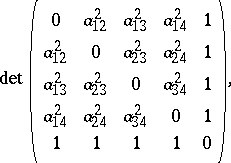
the Cayley–Menger determinant of <img align="absmiddle" border="0" src="https://www.encyclopediaofmath.org/legacyimages/t/t110/t110020/t11002043.png" />.

As a bonus result, the above formula for <img align="absmiddle" border="0" src="https://www.encyclopediaofmath.org/legacyimages/t/t110/t110020/t11002044.png" /> provides a necessary (and also almost sufficient) condition

| <img align="absmiddle" border="0" src="https://www.encyclopediaofmath.org/legacyimages/t/t110/t110020/t11002045.png" /> |
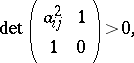
for the six numbers <img align="absmiddle" border="0" src="https://www.encyclopediaofmath.org/legacyimages/t/t110/t110020/t11002046.png" /> to be the edge lengths of a non-degenerate tetrahedron, an analogue of the famous triangle inequalities (cf. Plane trigonometry). Furthermore, it implies that the three products <img align="absmiddle" border="0" src="https://www.encyclopediaofmath.org/legacyimages/t/t110/t110020/t11002047.png" />, <img align="absmiddle" border="0" src="https://www.encyclopediaofmath.org/legacyimages/t/t110/t110020/t11002048.png" />, <img align="absmiddle" border="0" src="https://www.encyclopediaofmath.org/legacyimages/t/t110/t110020/t11002049.png" /> (Euler's notation) satisfy the plane triangle inequalities.


Another spatial analogue of the triangle inequalities is as follows. A set of four positive numbers can represent the areas of the sides of a tetrahedron if and only if the largest is smaller than the sum of the other three, see [a3], [a5]. From this, one may also derive, by means of the first given formula for the volume, a necessary and sufficient condition for four lengths to be the heights of a tetrahedron. But a tetrahedron is (up to congruence) uniquely determined by six pieces, or conditions, and so is not uniquely determined by four suitable areas or four suitable heights.
There are two types of angles connected with a tetrahedron: six dihedral angles (cf. Dihedral angle), formed by all possible pairs of sides, and four trihedral angles, formed by all possible triples of sides. The sum <img align="absmiddle" border="0" src="https://www.encyclopediaofmath.org/legacyimages/t/t110/t110020/t11002050.png" /> of the dihedral angles varies between <img align="absmiddle" border="0" src="https://www.encyclopediaofmath.org/legacyimages/t/t110/t110020/t11002051.png" /> and <img align="absmiddle" border="0" src="https://www.encyclopediaofmath.org/legacyimages/t/t110/t110020/t11002052.png" /> while the sum <img align="absmiddle" border="0" src="https://www.encyclopediaofmath.org/legacyimages/t/t110/t110020/t11002053.png" /> of the trihedral angles varies between <img align="absmiddle" border="0" src="https://www.encyclopediaofmath.org/legacyimages/t/t110/t110020/t11002054.png" /> and <img align="absmiddle" border="0" src="https://www.encyclopediaofmath.org/legacyimages/t/t110/t110020/t11002055.png" />; both sums are related by


| <img align="absmiddle" border="0" src="https://www.encyclopediaofmath.org/legacyimages/t/t110/t110020/t11002056.png" /> |

see [a1]. The dihedral angles may be acute, right or obtuse, but there must exist at least three acute angles. More precisely, a distribution of acute, right or obtuse angles is possible if and only if the graph formed by one vertex for each side and one edge for each acute dihedral angle between the corresponding sides is connected, see [a3].
The circumcircle and the incircle of the triangle have immediate analogues. Consider the perpendicular bisecting plane of each edge; then for each side the three corresponding planes share a line perpendicular to this side. The six planes and four lines obtained in this way intersect in the circumcentre of the tetrahedron, the centre of the circumsphere with radius
| <img align="absmiddle" border="0" src="https://www.encyclopediaofmath.org/legacyimages/t/t110/t110020/t11002057.png" /> |

where <img align="absmiddle" border="0" src="https://www.encyclopediaofmath.org/legacyimages/t/t110/t110020/t11002058.png" /> denotes the area of the triangle with sides <img align="absmiddle" border="0" src="https://www.encyclopediaofmath.org/legacyimages/t/t110/t110020/t11002059.png" />, <img align="absmiddle" border="0" src="https://www.encyclopediaofmath.org/legacyimages/t/t110/t110020/t11002060.png" />, <img align="absmiddle" border="0" src="https://www.encyclopediaofmath.org/legacyimages/t/t110/t110020/t11002061.png" />. For the incentre and the insphere, the six angle-bisecting planes of the dihedral angles have a point in common; the inradius is given by


| <img align="absmiddle" border="0" src="https://www.encyclopediaofmath.org/legacyimages/t/t110/t110020/t11002062.png" /> |

However, the treatment of exspheres requires special attention. The natural analogues of the excircles are the exspheres of the first kind, touching one side from the exterior, but there may also be between zero and three exspheres of the second kind, touching two sides from the exterior, see [a9]. There are no exspheres of the second kind if and only if the tetrahedron is isosceles, i.e., all sides have equal area, or, equivalently, opposite edges have equal length. See [a12] for other characterizations of isosceles tetrahedra. There are three exspheres of the second kind if and only if the sum of the areas of two sides is never equal to the sum of the areas of the other two. The radius of the exsphere touching only the side opposite to the vertex <img align="absmiddle" border="0" src="https://www.encyclopediaofmath.org/legacyimages/t/t110/t110020/t11002063.png" /> from the outside is given by

| <img align="absmiddle" border="0" src="https://www.encyclopediaofmath.org/legacyimages/t/t110/t110020/t11002064.png" /> |

the radius of the exsphere touching the sides opposite to the vertices <img align="absmiddle" border="0" src="https://www.encyclopediaofmath.org/legacyimages/t/t110/t110020/t11002065.png" /> and <img align="absmiddle" border="0" src="https://www.encyclopediaofmath.org/legacyimages/t/t110/t110020/t11002066.png" /> from the outside (if it exists) is given by


| <img align="absmiddle" border="0" src="https://www.encyclopediaofmath.org/legacyimages/t/t110/t110020/t11002067.png" /> |

A sphere touching all the edges of a tetrahedron (an edge-touching sphere) exists if and only if each of the following conditions is satisfied:
i) <img align="absmiddle" border="0" src="https://www.encyclopediaofmath.org/legacyimages/t/t110/t110020/t11002068.png" />;

ii) the incircles of the sides touch each other;
iii) the perpendiculars to the sides through the incentres concur in the centre of the edge touching sphere.
iv) the vertices are centres of four pairwise touching spheres with radii <img align="absmiddle" border="0" src="https://www.encyclopediaofmath.org/legacyimages/t/t110/t110020/t11002069.png" />, see [a6]. In particular,

| <img align="absmiddle" border="0" src="https://www.encyclopediaofmath.org/legacyimages/t/t110/t110020/t11002070.png" /> |

where <img align="absmiddle" border="0" src="https://www.encyclopediaofmath.org/legacyimages/t/t110/t110020/t11002071.png" /> represents the radius of the edge-touching sphere. Furthermore, in any class of tetrahedra with equal heights, there is exactly one tetrahedron with an edge-touching sphere, see [a7].

In fact, many of the special points, lines and incidence relations associated with the plane triangle do not have unique analogues in the case of the tetrahedron. The following examples should help to substantiate this claim.
a) There are two types of medians for a tetrahedron: the six planes each containing one edge and the middle point of the opposite edge, and the four lines connecting a vertex <img align="absmiddle" border="0" src="https://www.encyclopediaofmath.org/legacyimages/t/t110/t110020/t11002072.png" /> to the centroid <img align="absmiddle" border="0" src="https://www.encyclopediaofmath.org/legacyimages/t/t110/t110020/t11002073.png" /> of the opposite side, <img align="absmiddle" border="0" src="https://www.encyclopediaofmath.org/legacyimages/t/t110/t110020/t11002074.png" />. All these ten geometric objects intersect in one point, the centroid of the tetrahedron, which divides the line segments <img align="absmiddle" border="0" src="https://www.encyclopediaofmath.org/legacyimages/t/t110/t110020/t11002075.png" /> in the ratio <img align="absmiddle" border="0" src="https://www.encyclopediaofmath.org/legacyimages/t/t110/t110020/t11002076.png" />. The central stretching with the centroid as centre and ratio <img align="absmiddle" border="0" src="https://www.encyclopediaofmath.org/legacyimages/t/t110/t110020/t11002077.png" /> transforms the circumsphere in the Feuerbach sphere of the first kind. The centroid is also the middle point of the three line segments connecting the middle points of opposite edges. These line segments have equal lengths if and only if the tetrahedron is orthocentric, a property discussed below. In this case the centroid is the centre of a sphere intersecting the sides in the respective Feuerbach nine-point circles (cf. Nine-point circle), the Feuerbach sphere of the second kind.





b) In case of the altitudes, G. Monge [a15] took the planes perpendicular to one edge containing the middle point of the opposite edge. The six planes obtained concur in the Monge point, coinciding with the external centre of similitude of the circumsphere and the Feuerbach sphere of the first kind. Thus the centroid is the middle point of the line segment connecting the circumcentre and the point of Monge, see [a15]. On the other hand, the altitudes of a tetrahedron (as lines) are defined as the perpendiculars to the sides passing through the respective opposite vertices, see the definition of height given above. A tetrahedron is called orthocentric if the altitudes concur in a point, the orthocentre of the tetrahedron. The following conditions are equivalent:
i) the tetrahedron is orthocentric;
ii) the three parallelograms <img align="absmiddle" border="0" src="https://www.encyclopediaofmath.org/legacyimages/t/t110/t110020/t11002078.png" />, <img align="absmiddle" border="0" src="https://www.encyclopediaofmath.org/legacyimages/t/t110/t110020/t11002079.png" /> and <img align="absmiddle" border="0" src="https://www.encyclopediaofmath.org/legacyimages/t/t110/t110020/t11002080.png" />, where <img align="absmiddle" border="0" src="https://www.encyclopediaofmath.org/legacyimages/t/t110/t110020/t11002081.png" /> denotes the middle point of the edge <img align="absmiddle" border="0" src="https://www.encyclopediaofmath.org/legacyimages/t/t110/t110020/t11002082.png" />, are rectangles;





iii) opposite edges are perpendicular;
iv) <img align="absmiddle" border="0" src="https://www.encyclopediaofmath.org/legacyimages/t/t110/t110020/t11002083.png" />;

v) the line segments <img align="absmiddle" border="0" src="https://www.encyclopediaofmath.org/legacyimages/t/t110/t110020/t11002084.png" />, <img align="absmiddle" border="0" src="https://www.encyclopediaofmath.org/legacyimages/t/t110/t110020/t11002085.png" /> and <img align="absmiddle" border="0" src="https://www.encyclopediaofmath.org/legacyimages/t/t110/t110020/t11002086.png" /> have equal lengths;


vi) the feet of the altitudes, the intersection points of the altitudes and the respective sides, are the orthocentres of the sides considered as triangles. In condition ii), it suffices to require that only two of the mentioned parallelograms are rectangles, while condition iii) is fulfilled if and only if two pairs of opposite edges are perpendicular. In condition vi) it suffices to consider just one foot of an altitude, see [a4].
More generally, the following conditions on a tetrahedron <img align="absmiddle" border="0" src="https://www.encyclopediaofmath.org/legacyimages/t/t110/t110020/t11002087.png" /> are equivalent:

i) the altitudes through <img align="absmiddle" border="0" src="https://www.encyclopediaofmath.org/legacyimages/t/t110/t110020/t11002088.png" /> and <img align="absmiddle" border="0" src="https://www.encyclopediaofmath.org/legacyimages/t/t110/t110020/t11002089.png" />, <img align="absmiddle" border="0" src="https://www.encyclopediaofmath.org/legacyimages/t/t110/t110020/t11002090.png" /> and <img align="absmiddle" border="0" src="https://www.encyclopediaofmath.org/legacyimages/t/t110/t110020/t11002091.png" />, intersect in a unique point <img align="absmiddle" border="0" src="https://www.encyclopediaofmath.org/legacyimages/t/t110/t110020/t11002092.png" />;


ii) the altitudes <img align="absmiddle" border="0" src="https://www.encyclopediaofmath.org/legacyimages/t/t110/t110020/t11002093.png" /> and <img align="absmiddle" border="0" src="https://www.encyclopediaofmath.org/legacyimages/t/t110/t110020/t11002094.png" /> intersect in a unique point <img align="absmiddle" border="0" src="https://www.encyclopediaofmath.org/legacyimages/t/t110/t110020/t11002095.png" />;


iii) the edges <img align="absmiddle" border="0" src="https://www.encyclopediaofmath.org/legacyimages/t/t110/t110020/t11002096.png" /> and <img align="absmiddle" border="0" src="https://www.encyclopediaofmath.org/legacyimages/t/t110/t110020/t11002097.png" /> are perpendicular;


iv) the parallelogram <img align="absmiddle" border="0" src="https://www.encyclopediaofmath.org/legacyimages/t/t110/t110020/t11002098.png" /> is a rectangle;

v) <img align="absmiddle" border="0" src="https://www.encyclopediaofmath.org/legacyimages/t/t110/t110020/t11002099.png" />;

vi) the line segments <img align="absmiddle" border="0" src="https://www.encyclopediaofmath.org/legacyimages/t/t110/t110020/t110020100.png" /> and <img align="absmiddle" border="0" src="https://www.encyclopediaofmath.org/legacyimages/t/t110/t110020/t110020101.png" /> have equal lengths. A tetrahedron with just one pair of perpendicular opposite edges is called semi-orthocentric and can always be labeled in such a way that the given conditions are fulfilled. In this case, the plane formed by the altitudes <img align="absmiddle" border="0" src="https://www.encyclopediaofmath.org/legacyimages/t/t110/t110020/t110020102.png" /> and <img align="absmiddle" border="0" src="https://www.encyclopediaofmath.org/legacyimages/t/t110/t110020/t110020103.png" /> and that formed by the altitudes <img align="absmiddle" border="0" src="https://www.encyclopediaofmath.org/legacyimages/t/t110/t110020/t110020104.png" /> and <img align="absmiddle" border="0" src="https://www.encyclopediaofmath.org/legacyimages/t/t110/t110020/t110020105.png" /> intersect in the line <img align="absmiddle" border="0" src="https://www.encyclopediaofmath.org/legacyimages/t/t110/t110020/t110020106.png" />, with the point of Monge being the middle point of the line segment <img align="absmiddle" border="0" src="https://www.encyclopediaofmath.org/legacyimages/t/t110/t110020/t110020107.png" />.


The altitudes of a tetrahedron with no pair of perpendicular opposite edges are pairwise skew (cf. Skew lines), but belong to a equilateral hyperboloid whose centre is the point of Monge, see [a16]. A geometric description of the axes of this hyperboloid is an open problem (1996).
In case of an orthocentric tetrahedron, the point of Monge coincides with the orthocentre. In addition, an orthocentric tetrahedron has an edge-touching sphere if and only if it is a regular pyramid, i.e., one side is an equilateral triangle and the three edges not contained in this side have equal lengths. In this case one also has the identities
| <img align="absmiddle" border="0" src="https://www.encyclopediaofmath.org/legacyimages/t/t110/t110020/t110020108.png" /> |

Tetrahedra with this property are sometimes called iso-dynamic.
Orthocentric tetrahedra have a lot of extremal properties, see [a10]. An example is the following: Given four concentric spheres <img align="absmiddle" border="0" src="https://www.encyclopediaofmath.org/legacyimages/t/t110/t110020/t110020109.png" />, <img align="absmiddle" border="0" src="https://www.encyclopediaofmath.org/legacyimages/t/t110/t110020/t110020110.png" />, the tetrahedra with maximal volume among all tetrahedra <img align="absmiddle" border="0" src="https://www.encyclopediaofmath.org/legacyimages/t/t110/t110020/t110020111.png" /> with <img align="absmiddle" border="0" src="https://www.encyclopediaofmath.org/legacyimages/t/t110/t110020/t110020112.png" /> for all <img align="absmiddle" border="0" src="https://www.encyclopediaofmath.org/legacyimages/t/t110/t110020/t110020113.png" /> are orthocentric; the common centre of the spheres <img align="absmiddle" border="0" src="https://www.encyclopediaofmath.org/legacyimages/t/t110/t110020/t110020114.png" /> is the orthocentre of these maximal tetrahedra.




An analogue to the Pythagoras theorem holds for tri-rectangular tetrahedra, i.e., tetrahedra such that three concurrent edges are pairwise perpendicular. If these edges concur in the vertex <img align="absmiddle" border="0" src="https://www.encyclopediaofmath.org/legacyimages/t/t110/t110020/t110020115.png" />, then

| <img align="absmiddle" border="0" src="https://www.encyclopediaofmath.org/legacyimages/t/t110/t110020/t110020116.png" /> |

see [a2].
In addition, there are analogues to the Gauss and Bodenmiller theorems (cf. Gauss theorem; Bodenmiller theorem) for tetrahedra, see [a8].
An interesting result related to the edge-touching sphere of a tetrahedron is given in [a7], whereby a question raised in elementary particle physics leads from the edge-touching sphere to Steiner's Rome surface which, in the Euclidean <img align="absmiddle" border="0" src="https://www.encyclopediaofmath.org/legacyimages/t/t110/t110020/t110020117.png" />-dimensional space, is given by the equation

| <img align="absmiddle" border="0" src="https://www.encyclopediaofmath.org/legacyimages/t/t110/t110020/t110020118.png" /> |

intersecting the sides of the regular tetrahedron with vertices <img align="absmiddle" border="0" src="https://www.encyclopediaofmath.org/legacyimages/t/t110/t110020/t110020119.png" />, <img align="absmiddle" border="0" src="https://www.encyclopediaofmath.org/legacyimages/t/t110/t110020/t110020120.png" />, <img align="absmiddle" border="0" src="https://www.encyclopediaofmath.org/legacyimages/t/t110/t110020/t110020121.png" />, <img align="absmiddle" border="0" src="https://www.encyclopediaofmath.org/legacyimages/t/t110/t110020/t110020122.png" /> in the respective incircles.


As with the triangle, there are many known inequalities relating various parts of the tetrahedron. For example, the triangle inequality <img align="absmiddle" border="0" src="https://www.encyclopediaofmath.org/legacyimages/t/t110/t110020/t110020123.png" /> (where <img align="absmiddle" border="0" src="https://www.encyclopediaofmath.org/legacyimages/t/t110/t110020/t110020124.png" /> is the circumradius and <img align="absmiddle" border="0" src="https://www.encyclopediaofmath.org/legacyimages/t/t110/t110020/t110020125.png" /> the inradius), with equality for equilateral triangles, reads for the tetrahedron: <img align="absmiddle" border="0" src="https://www.encyclopediaofmath.org/legacyimages/t/t110/t110020/t110020126.png" />, with equality for the regular case. Actually, these are both special cases of the <img align="absmiddle" border="0" src="https://www.encyclopediaofmath.org/legacyimages/t/t110/t110020/t110020128.png" />-simplex inequality (in <img align="absmiddle" border="0" src="https://www.encyclopediaofmath.org/legacyimages/t/t110/t110020/t110020129.png" />-dimensional Euclidean space <img align="absmiddle" border="0" src="https://www.encyclopediaofmath.org/legacyimages/t/t110/t110020/t110020130.png" />) <img align="absmiddle" border="0" src="https://www.encyclopediaofmath.org/legacyimages/t/t110/t110020/t110020131.png" />, with equality for the regular simplex. For these, and other inequalities, see [a14].


Most of the properties given above have generalizations to higher-dimensional simplices; see the bibliography.
References
| [a1] | T. Egger, R. Fritsch, K. Seebach, "Zum Winkelsummensatz für Tetraeder" Didaktik der Math. , 11 (1983) pp. 14–35 |
| [a2] | J. Faulhaber, "Miracula Arithmetica" , David Franck (1622) |
| [a3] | M. Fiedler, "Geometrie simplexu v <img align="absmiddle" border="0" src="https://www.encyclopediaofmath.org/legacyimages/t/t110/t110020/t110020132.png" />" Časopis Pěst. Mat. , 79 (1954) pp. 297–320 |
| [a4] | R. Fritsch, "Höhenschnittpunkte für <img align="absmiddle" border="0" src="https://www.encyclopediaofmath.org/legacyimages/t/t110/t110020/t110020133.png" />-Simplizes" Elem. Math. , 31 (1995) pp. 1–8 |
| [a5] | R. Fritsch, "Dreiecksungleichungen für Tetraeder" Der mathem. und naturwissenschaftl. Unterr. , 34 (1981) pp. 274–278 |
| [a6] | R. Fritsch, "Kantenkugeln-geometrische Anwendungen der linearen Algebra" Math. Semesterber. , 32 (1985) pp. 84–109 |
| [a7] | R. Fritsch, "Energietetraeder?" Mitteil. Math. Sem. Giessen (Coxeter Festschrift II) , 164 (1984) pp. 151–177 |
| [a8] | R. Fritsch, "An <img align="absmiddle" border="0" src="https://www.encyclopediaofmath.org/legacyimages/t/t110/t110020/t110020134.png" />-dimensional Bodenmiller theorem" Crux Mathematicorum , 21 (1995) pp. 109–113 |
| [a9] | L. Gerber, "Spheres tangent to all the faces of a simplex" J. Combin. Th. , 12 (1972) pp. 453–456 |
| [a10] | L. Gerber, "The orthocentric simplex as an extreme simplex" Pacific J. Math. , 56 (1975) pp. 97–111 |
| [a11] | J.C.H. Gerretsen, "An analogue of the nine-point circle in the space of <img align="absmiddle" border="0" src="https://www.encyclopediaofmath.org/legacyimages/t/t110/t110020/t110020135.png" /> dimensions" Indagationes Mathematicae , 7 (1945) pp. 123–124 |
| [a12] | Y.S. Kupitz, H. Martini, "The Fermat–Torricelli point and isosceles tetrahedra" J. Geom. , 49 (1994) pp. 150–162 |
| [a13] | J.L. Lagrange, "Solutions analytiques de quelques problèmes sur le pyramides triangulaires" Nouveaux Mem. Acad. R. des Sci. et Belles-Lettres (1773) pp. 149–176 |
| [a14] | D.S. Mitrinović, J.E. Pečaric, V. Volenec, "Recent advances in geometric inequalities" , Kluwer Acad. Publ. (1989) |
| [a15] | G. Monge, "Sur la pyramide triangulaire" Corresp. Ecole Imp. Polytechnique , 2/3 (1811) pp. 263–266 |
| [a16] | J. Steiner, "Aufgaben und Lehrsätze" J. Reine Angew. Math. , 2 (1827) pp. 96–98 |


 |  |
 EncycloReader
is supported by the
 KSF