Table of Contents Categories
Formal power series
 From Justapedia - Reading time: 69 min
 | This article needs additional citations for verification. (December 2009) |
In mathematics, a formal series is an infinite sum that is considered independently from any notion of convergence, and can be manipulated with the usual algebraic operations on series (addition, subtraction, multiplication, division, partial sums, etc.).
A formal power series is a special kind of formal series, whose terms are of the form Failed to parse (Conversion error. Server ("https://wikimedia.org/api/rest_") reported: "Cannot get mml. Server problem."): {\displaystyle ax^{n}} where Failed to parse (Conversion error. Server ("https://wikimedia.org/api/rest_") reported: "Cannot get mml. Server problem."): {\displaystyle x^{n}} is the th power of a variable ( is a non-negative integer), and is called the coefficient. Hence, power series can be viewed as a generalization of polynomials, where the number of terms is allowed to be infinite, with no requirements of convergence. Thus, the series may no longer represent a function of its variable, merely a formal sequence of coefficients, in contrast to a power series, which defines a function by taking numerical values for the variable within a radius of convergence. In a formal power series, the Failed to parse (Conversion error. Server ("https://wikimedia.org/api/rest_") reported: "Cannot get mml. Server problem."): {\displaystyle x^{n}} are used only as position-holders for the coefficients, so that the coefficient of is the fifth term in the sequence. In combinatorics, the method of generating functions uses formal power series to represent numerical sequences and multisets, for instance allowing concise expressions for recursively defined sequences regardless of whether the recursion can be explicitly solved. More generally, formal power series can include series with any finite (or countable) number of variables, and with coefficients in an arbitrary ring.


Rings of formal power series are complete local rings, and this allows using calculus-like methods in the purely algebraic framework of algebraic geometry and commutative algebra. They are analogous in many ways to p-adic integers, which can be defined as formal series of the powers of p.
Introduction[edit | edit source]
A formal power series can be loosely thought of as an object that is like a polynomial, but with infinitely many terms. Alternatively, for those familiar with power series (or Taylor series), one may think of a formal power series as a power series in which we ignore questions of convergence by not assuming that the variable X denotes any numerical value (not even an unknown value). For example, consider the series
- Failed to parse (Conversion error. Server ("https://wikimedia.org/api/rest_") reported: "Cannot get mml. Server problem."): {\displaystyle A=1-3X+5X^{2}-7X^{3}+9X^{4}-11X^{5}+\cdots .}
If we studied this as a power series, its properties would include, for example, that its radius of convergence is 1. However, as a formal power series, we may ignore this completely; all that is relevant is the sequence of coefficients [1, −3, 5, −7, 9, −11, ...]. In other words, a formal power series is an object that just records a sequence of coefficients. It is perfectly acceptable to consider a formal power series with the factorials [1, 1, 2, 6, 24, 120, 720, 5040, ... ] as coefficients, even though the corresponding power series diverges for any nonzero value of X.
Arithmetic on formal power series is carried out by simply pretending that the series are polynomials. For example, if
- Failed to parse (Conversion error. Server ("https://wikimedia.org/api/rest_") reported: "Cannot get mml. Server problem."): {\displaystyle B=2X+4X^{3}+6X^{5}+\cdots ,}
then we add A and B term by term:
- Failed to parse (Conversion error. Server ("https://wikimedia.org/api/rest_") reported: "Cannot get mml. Server problem."): {\displaystyle A+B=1-X+5X^{2}-3X^{3}+9X^{4}-5X^{5}+\cdots .}
We can multiply formal power series, again just by treating them as polynomials (see in particular Cauchy product):
- Failed to parse (Conversion error. Server ("https://wikimedia.org/api/rest_") reported: "Cannot get mml. Server problem."): {\displaystyle AB=2X-6X^{2}+14X^{3}-26X^{4}+44X^{5}+\cdots .}
Notice that each coefficient in the product AB only depends on a finite number of coefficients of A and B. For example, the X5 term is given by
- Failed to parse (Conversion error. Server ("https://wikimedia.org/api/rest_") reported: "Cannot get mml. Server problem."): {\displaystyle 44X^{5}=(1\times 6X^{5})+(5X^{2}\times 4X^{3})+(9X^{4}\times 2X).}
For this reason, one may multiply formal power series without worrying about the usual questions of absolute, conditional and uniform convergence which arise in dealing with power series in the setting of analysis.
Once we have defined multiplication for formal power series, we can define multiplicative inverses as follows. The multiplicative inverse of a formal power series A is a formal power series C such that AC = 1, provided that such a formal power series exists. It turns out that if A has a multiplicative inverse, it is unique, and we denote it by A−1. Now we can define division of formal power series by defining B/A to be the product BA−1, provided that the inverse of A exists. For example, one can use the definition of multiplication above to verify the familiar formula
- Failed to parse (Conversion error. Server ("https://wikimedia.org/api/rest_") reported: "Cannot get mml. Server problem."): {\displaystyle {\frac {1}{1+X}}=1-X+X^{2}-X^{3}+X^{4}-X^{5}+\cdots .}
An important operation on formal power series is coefficient extraction. In its most basic form, the coefficient extraction operator applied to a formal power series in one variable extracts the coefficient of the th power of the variable, so that Failed to parse (Conversion error. Server ("https://wikimedia.org/api/rest_") reported: "Cannot get mml. Server problem."): {\displaystyle [X^{2}]A=5} and Failed to parse (Conversion error. Server ("https://wikimedia.org/api/rest_") reported: "Cannot get mml. Server problem."): {\displaystyle [X^{5}]A=-11} . Other examples include
![{\displaystyle [X^{n}]}](https://wikimedia.org/api/rest_v1/media/math/render/svg/badc958349e01f5300025ae5f395186006bc9ecf)

- Failed to parse (Conversion error. Server ("https://wikimedia.org/api/rest_") reported: "Cannot get mml. Server problem."): {\displaystyle {\begin{aligned}\left[X^{3}\right](B)&=4,\\\left[X^{2}\right](X+3X^{2}Y^{3}+10Y^{6})&=3Y^{3},\\\left[X^{2}Y^{3}\right](X+3X^{2}Y^{3}+10Y^{6})&=3,\\\left[X^{n}\right]\left({\frac {1}{1+X}}\right)&=(-1)^{n},\\\left[X^{n}\right]\left({\frac {X}{(1-X)^{2}}}\right)&=n.\end{aligned}}}
Similarly, many other operations that are carried out on polynomials can be extended to the formal power series setting, as explained below.
The ring of formal power series[edit | edit source]
| Algebraic structure → Ring theory Ring theory |
|---|
| File:Latex integers.svg |
|
Rings
Related structures
|
|
Commutative rings
p-adic number theory and decimals
|


If one considers the set of all formal power series in X with coefficients in a commutative ring R, the elements of this set collectively constitute another ring which is written Failed to parse (Conversion error. Server ("https://wikimedia.org/api/rest_") reported: "Cannot get mml. Server problem."): {\displaystyle R[[X]],} and called the ring of formal power series in the variable X over R.
Definition of the formal power series ring[edit | edit source]
One can characterize Failed to parse (Conversion error. Server ("https://wikimedia.org/api/rest_") reported: "Cannot get mml. Server problem."): {\displaystyle R[[X]]} abstractly as the completion of the polynomial ring Failed to parse (Conversion error. Server ("https://wikimedia.org/api/rest_") reported: "Cannot get mml. Server problem."): {\displaystyle R[X]} equipped with a particular metric. This automatically gives Failed to parse (Conversion error. Server ("https://wikimedia.org/api/rest_") reported: "Cannot get mml. Server problem."): {\displaystyle R[[X]]} the structure of a topological ring (and even of a complete metric space). But the general construction of a completion of a metric space is more involved than what is needed here, and would make formal power series seem more complicated than they are. It is possible to describe Failed to parse (Conversion error. Server ("https://wikimedia.org/api/rest_") reported: "Cannot get mml. Server problem."): {\displaystyle R[[X]]} more explicitly, and define the ring structure and topological structure separately, as follows.
Ring structure[edit | edit source]
As a set, Failed to parse (Conversion error. Server ("https://wikimedia.org/api/rest_") reported: "Cannot get mml. Server problem."): {\displaystyle R[[X]]} can be constructed as the set of all infinite sequences of elements of , indexed by the natural numbers (taken to include 0). Designating a sequence whose term at index is by Failed to parse (Conversion error. Server ("https://wikimedia.org/api/rest_") reported: "Cannot get mml. Server problem."): {\displaystyle (a_{n})} , one defines addition of two such sequences by


- Failed to parse (Conversion error. Server ("https://wikimedia.org/api/rest_") reported: "Cannot get mml. Server problem."): {\displaystyle (a_{n})_{n\in \mathbb {N} }+(b_{n})_{n\in \mathbb {N} }=\left(a_{n}+b_{n}\right)_{n\in \mathbb {N} }}
and multiplication by
- Failed to parse (Conversion error. Server ("https://wikimedia.org/api/rest_") reported: "Cannot get mml. Server problem."): {\displaystyle (a_{n})_{n\in \mathbb {N} }\times (b_{n})_{n\in \mathbb {N} }=\left(\sum _{k=0}^{n}a_{k}b_{n-k}\right)_{\!n\in \mathbb {N} }.}
This type of product is called the Cauchy product of the two sequences of coefficients, and is a sort of discrete convolution. With these operations, becomes a commutative ring with zero element Failed to parse (Conversion error. Server ("https://wikimedia.org/api/rest_") reported: "Cannot get mml. Server problem."): {\displaystyle (0,0,0,\ldots )} and multiplicative identity Failed to parse (Conversion error. Server ("https://wikimedia.org/api/rest_") reported: "Cannot get mml. Server problem."): {\displaystyle (1,0,0,\ldots )} .
The product is in fact the same one used to define the product of polynomials in one indeterminate, which suggests using a similar notation. One embeds into by sending any (constant) Failed to parse (Conversion error. Server ("https://wikimedia.org/api/rest_") reported: "Cannot get mml. Server problem."): {\displaystyle a\in R} to the sequence Failed to parse (Conversion error. Server ("https://wikimedia.org/api/rest_") reported: "Cannot get mml. Server problem."): {\displaystyle (a,0,0,\ldots )} and designates the sequence Failed to parse (Conversion error. Server ("https://wikimedia.org/api/rest_") reported: "Cannot get mml. Server problem."): {\displaystyle (0,1,0,0,\ldots )} by ; then using the above definitions every sequence with only finitely many nonzero terms can be expressed in terms of these special elements as
![{\displaystyle R[[X]]}](https://wikimedia.org/api/rest_v1/media/math/render/svg/fc00b68cd3f2c0346dea47d276cea5331fa55159)

- Failed to parse (Conversion error. Server ("https://wikimedia.org/api/rest_") reported: "Cannot get mml. Server problem."): {\displaystyle (a_{0},a_{1},a_{2},\ldots ,a_{n},0,0,\ldots )=a_{0}+a_{1}X+\cdots +a_{n}X^{n}=\sum _{i=0}^{n}a_{i}X^{i};}
these are precisely the polynomials in . Given this, it is quite natural and convenient to designate a general sequence Failed to parse (Conversion error. Server ("https://wikimedia.org/api/rest_") reported: "Cannot get mml. Server problem."): {\displaystyle (a_{n})_{n\in \mathbb {N} }} by the formal expression Failed to parse (Conversion error. Server ("https://wikimedia.org/api/rest_") reported: "Cannot get mml. Server problem."): {\displaystyle \textstyle \sum _{i\in \mathbb {N} }a_{i}X^{i}} , even though the latter is not an expression formed by the operations of addition and multiplication defined above (from which only finite sums can be constructed). This notational convention allows reformulation of the above definitions as

and
- Failed to parse (Conversion error. Server ("https://wikimedia.org/api/rest_") reported: "Cannot get mml. Server problem."): {\displaystyle \left(\sum _{i\in \mathbb {N} }a_{i}X^{i}\right)\times \left(\sum _{i\in \mathbb {N} }b_{i}X^{i}\right)=\sum _{n\in \mathbb {N} }\left(\sum _{k=0}^{n}a_{k}b_{n-k}\right)X^{n}.}
which is quite convenient, but one must be aware of the distinction between formal summation (a mere convention) and actual addition.
Topological structure[edit | edit source]
Having stipulated conventionally that
-
Failed to parse (Conversion error. Server ("https://wikimedia.org/api/rest_") reported: "Cannot get mml. Server problem."): {\displaystyle (a_{0},a_{1},a_{2},a_{3},\ldots )=\sum _{i=0}^{\infty }a_{i}X^{i},}
(1)
one would like to interpret the right hand side as a well-defined infinite summation. To that end, a notion of convergence in is defined and a topology on is constructed. There are several equivalent ways to define the desired topology.
- We may give the product topology, where each copy of is given the discrete topology.
- We may give the I-adic topology, where is the ideal generated by , which consists of all sequences whose first term Failed to parse (Conversion error. Server ("https://wikimedia.org/api/rest_") reported: "Cannot get mml. Server problem."): {\displaystyle a_{0}} is zero.
- The desired topology could also be derived from the following metric. The distance between distinct sequences Failed to parse (Conversion error. Server ("https://wikimedia.org/api/rest_") reported: "Cannot get mml. Server problem."): {\displaystyle (a_{n}),(b_{n})\in R^{\mathbb {N} },} is defined to be Failed to parse (Conversion error. Server ("https://wikimedia.org/api/rest_") reported: "Cannot get mml. Server problem."): {\displaystyle d((a_{n}),(b_{n}))=2^{-k},} where is the smallest natural number such that Failed to parse (Conversion error. Server ("https://wikimedia.org/api/rest_") reported: "Cannot get mml. Server problem."): {\displaystyle a_{k}\neq b_{k}} ; the distance between two equal sequences is of course zero.


Informally, two sequences Failed to parse (Conversion error. Server ("https://wikimedia.org/api/rest_") reported: "Cannot get mml. Server problem."): {\displaystyle (a_{n})} and Failed to parse (Conversion error. Server ("https://wikimedia.org/api/rest_") reported: "Cannot get mml. Server problem."): {\displaystyle (b_{n})} become closer and closer if and only if more and more of their terms agree exactly. Formally, the sequence of partial sums of some infinite summation converges if for every fixed power of the coefficient stabilizes: there is a point beyond which all further partial sums have the same coefficient. This is clearly the case for the right hand side of (1), regardless of the values Failed to parse (SVG (MathML can be enabled via browser plugin): Invalid response ("Math extension cannot connect to Restbase.") from server "https://wikimedia.org/api/rest_v1/":): {\displaystyle a_n} , since inclusion of the term for Failed to parse (SVG (MathML can be enabled via browser plugin): Invalid response ("Math extension cannot connect to Restbase.") from server "https://wikimedia.org/api/rest_v1/":): {\displaystyle i=n} gives the last (and in fact only) change to the coefficient of Failed to parse (SVG (MathML can be enabled via browser plugin): Invalid response ("Math extension cannot connect to Restbase.") from server "https://wikimedia.org/api/rest_v1/":): {\displaystyle X^n} . It is also obvious that the limit of the sequence of partial sums is equal to the left hand side.
This topological structure, together with the ring operations described above, form a topological ring. This is called the ring of formal power series over Failed to parse (SVG (MathML can be enabled via browser plugin): Invalid response ("Math extension cannot connect to Restbase.") from server "https://wikimedia.org/api/rest_v1/":): {\displaystyle R} and is denoted by Failed to parse (SVG (MathML can be enabled via browser plugin): Invalid response ("Math extension cannot connect to Restbase.") from server "https://wikimedia.org/api/rest_v1/":): {\displaystyle R[[X]]} . The topology has the useful property that an infinite summation converges if and only if the sequence of its terms converges to 0, which just means that any fixed power of Failed to parse (SVG (MathML can be enabled via browser plugin): Invalid response ("Math extension cannot connect to Restbase.") from server "https://wikimedia.org/api/rest_v1/":): {\displaystyle X} occurs in only finitely many terms.
The topological structure allows much more flexible usage of infinite summations. For instance the rule for multiplication can be restated simply as
- Failed to parse (SVG (MathML can be enabled via browser plugin): Invalid response ("Math extension cannot connect to Restbase.") from server "https://wikimedia.org/api/rest_v1/":): {\displaystyle \left(\sum_{i\in\N} a_i X^i\right) \times \left(\sum_{i\in\N} b_i X^i\right) = \sum_{i,j\in\N} a_i b_j X^{i+j},}
since only finitely many terms on the right affect any fixed Failed to parse (SVG (MathML can be enabled via browser plugin): Invalid response ("Math extension cannot connect to Restbase.") from server "https://wikimedia.org/api/rest_v1/":): {\displaystyle X^n} . Infinite products are also defined by the topological structure; it can be seen that an infinite product converges if and only if the sequence of its factors converges to 1.
Alternative topologies[edit | edit source]
The above topology is the finest topology for which
- Failed to parse (SVG (MathML can be enabled via browser plugin): Invalid response ("Math extension cannot connect to Restbase.") from server "https://wikimedia.org/api/rest_v1/":): {\displaystyle \sum_{i=0}^\infty a_i X^i}
always converges as a summation to the formal power series designated by the same expression, and it often suffices to give a meaning to infinite sums and products, or other kinds of limits that one wishes to use to designate particular formal power series. It can however happen occasionally that one wishes to use a coarser topology, so that certain expressions become convergent that would otherwise diverge. This applies in particular when the base ring Failed to parse (SVG (MathML can be enabled via browser plugin): Invalid response ("Math extension cannot connect to Restbase.") from server "https://wikimedia.org/api/rest_v1/":): {\displaystyle R} already comes with a topology other than the discrete one, for instance if it is also a ring of formal power series.
In the ring of formal power series Failed to parse (SVG (MathML can be enabled via browser plugin): Invalid response ("Math extension cannot connect to Restbase.") from server "https://wikimedia.org/api/rest_v1/":): {\displaystyle \Z[[X]][[Y]]} , the topology of above construction only relates to the indeterminate Failed to parse (SVG (MathML can be enabled via browser plugin): Invalid response ("Math extension cannot connect to Restbase.") from server "https://wikimedia.org/api/rest_v1/":): {\displaystyle Y} , since the topology that was put on Failed to parse (SVG (MathML can be enabled via browser plugin): Invalid response ("Math extension cannot connect to Restbase.") from server "https://wikimedia.org/api/rest_v1/":): {\displaystyle \Z[[X]]} has been replaced by the discrete topology when defining the topology of the whole ring. So
- Failed to parse (SVG (MathML can be enabled via browser plugin): Invalid response ("Math extension cannot connect to Restbase.") from server "https://wikimedia.org/api/rest_v1/":): {\displaystyle \sum_{i = 0}^\infty XY^i}
converges (and its sum can be written as Failed to parse (SVG (MathML can be enabled via browser plugin): Invalid response ("Math extension cannot connect to Restbase.") from server "https://wikimedia.org/api/rest_v1/":): {\displaystyle \tfrac{X}{1-Y}} ); however
- Failed to parse (SVG (MathML can be enabled via browser plugin): Invalid response ("Math extension cannot connect to Restbase.") from server "https://wikimedia.org/api/rest_v1/":): {\displaystyle \sum_{i = 0}^\infty X^i Y}
would be considered to be divergent, since every term affects the coefficient of Failed to parse (SVG (MathML can be enabled via browser plugin): Invalid response ("Math extension cannot connect to Restbase.") from server "https://wikimedia.org/api/rest_v1/":): {\displaystyle Y} . This asymmetry disappears if the power series ring in Failed to parse (SVG (MathML can be enabled via browser plugin): Invalid response ("Math extension cannot connect to Restbase.") from server "https://wikimedia.org/api/rest_v1/":): {\displaystyle Y} is given the product topology where each copy of Failed to parse (SVG (MathML can be enabled via browser plugin): Invalid response ("Math extension cannot connect to Restbase.") from server "https://wikimedia.org/api/rest_v1/":): {\displaystyle \Z[[X]]} is given its topology as a ring of formal power series rather than the discrete topology. With this topology, a sequence of elements of Failed to parse (SVG (MathML can be enabled via browser plugin): Invalid response ("Math extension cannot connect to Restbase.") from server "https://wikimedia.org/api/rest_v1/":): {\displaystyle \Z[[X]][[Y]]} converges if the coefficient of each power of Failed to parse (SVG (MathML can be enabled via browser plugin): Invalid response ("Math extension cannot connect to Restbase.") from server "https://wikimedia.org/api/rest_v1/":): {\displaystyle Y} converges to a formal power series in Failed to parse (SVG (MathML can be enabled via browser plugin): Invalid response ("Math extension cannot connect to Restbase.") from server "https://wikimedia.org/api/rest_v1/":): {\displaystyle X} , a weaker condition than stabilizing entirely. For instance, with this topology, in the second example given above, the coefficient of Failed to parse (SVG (MathML can be enabled via browser plugin): Invalid response ("Math extension cannot connect to Restbase.") from server "https://wikimedia.org/api/rest_v1/":): {\displaystyle Y} converges to Failed to parse (SVG (MathML can be enabled via browser plugin): Invalid response ("Math extension cannot connect to Restbase.") from server "https://wikimedia.org/api/rest_v1/":): {\displaystyle \tfrac{1}{1-X}} , so the whole summation converges to Failed to parse (SVG (MathML can be enabled via browser plugin): Invalid response ("Math extension cannot connect to Restbase.") from server "https://wikimedia.org/api/rest_v1/":): {\displaystyle \tfrac{Y}{1-X}} .
This way of defining the topology is in fact the standard one for repeated constructions of rings of formal power series, and gives the same topology as one would get by taking formal power series in all indeterminates at once. In the above example that would mean constructing Failed to parse (SVG (MathML can be enabled via browser plugin): Invalid response ("Math extension cannot connect to Restbase.") from server "https://wikimedia.org/api/rest_v1/":): {\displaystyle \Z[[X,Y]]} and here a sequence converges if and only if the coefficient of every monomial Failed to parse (SVG (MathML can be enabled via browser plugin): Invalid response ("Math extension cannot connect to Restbase.") from server "https://wikimedia.org/api/rest_v1/":): {\displaystyle X^iY^j} stabilizes. This topology, which is also the Failed to parse (SVG (MathML can be enabled via browser plugin): Invalid response ("Math extension cannot connect to Restbase.") from server "https://wikimedia.org/api/rest_v1/":): {\displaystyle I} -adic topology, where Failed to parse (SVG (MathML can be enabled via browser plugin): Invalid response ("Math extension cannot connect to Restbase.") from server "https://wikimedia.org/api/rest_v1/":): {\displaystyle I=(X,Y)} is the ideal generated by Failed to parse (SVG (MathML can be enabled via browser plugin): Invalid response ("Math extension cannot connect to Restbase.") from server "https://wikimedia.org/api/rest_v1/":): {\displaystyle X} and Failed to parse (SVG (MathML can be enabled via browser plugin): Invalid response ("Math extension cannot connect to Restbase.") from server "https://wikimedia.org/api/rest_v1/":): {\displaystyle Y} , still enjoys the property that a summation converges if and only if its terms tend to 0.
The same principle could be used to make other divergent limits converge. For instance in Failed to parse (SVG (MathML can be enabled via browser plugin): Invalid response ("Math extension cannot connect to Restbase.") from server "https://wikimedia.org/api/rest_v1/":): {\displaystyle \R[[X]]} the limit
- Failed to parse (SVG (MathML can be enabled via browser plugin): Invalid response ("Math extension cannot connect to Restbase.") from server "https://wikimedia.org/api/rest_v1/":): {\displaystyle \lim_{n\to\infty}\left(1+\frac{X}{n}\right)^{\!n}}
does not exist, so in particular it does not converge to
- Failed to parse (SVG (MathML can be enabled via browser plugin): Invalid response ("Math extension cannot connect to Restbase.") from server "https://wikimedia.org/api/rest_v1/":): {\displaystyle \exp(X) = \sum_{n\in\N}\frac{X^n}{n!}.}
This is because for Failed to parse (SVG (MathML can be enabled via browser plugin): Invalid response ("Math extension cannot connect to Restbase.") from server "https://wikimedia.org/api/rest_v1/":): {\displaystyle i\geq 2} the coefficient Failed to parse (SVG (MathML can be enabled via browser plugin): Invalid response ("Math extension cannot connect to Restbase.") from server "https://wikimedia.org/api/rest_v1/":): {\displaystyle \tbinom{n}{i}/n^i} of Failed to parse (SVG (MathML can be enabled via browser plugin): Invalid response ("Math extension cannot connect to Restbase.") from server "https://wikimedia.org/api/rest_v1/":): {\displaystyle X^i} does not stabilize as Failed to parse (SVG (MathML can be enabled via browser plugin): Invalid response ("Math extension cannot connect to Restbase.") from server "https://wikimedia.org/api/rest_v1/":): {\displaystyle n\to \infty} . It does however converge in the usual topology of Failed to parse (SVG (MathML can be enabled via browser plugin): Invalid response ("Math extension cannot connect to Restbase.") from server "https://wikimedia.org/api/rest_v1/":): {\displaystyle \R} , and in fact to the coefficient Failed to parse (SVG (MathML can be enabled via browser plugin): Invalid response ("Math extension cannot connect to Restbase.") from server "https://wikimedia.org/api/rest_v1/":): {\displaystyle \tfrac{1}{i!}} of Failed to parse (SVG (MathML can be enabled via browser plugin): Invalid response ("Math extension cannot connect to Restbase.") from server "https://wikimedia.org/api/rest_v1/":): {\displaystyle \exp(X)} . Therefore, if one would give Failed to parse (SVG (MathML can be enabled via browser plugin): Invalid response ("Math extension cannot connect to Restbase.") from server "https://wikimedia.org/api/rest_v1/":): {\displaystyle \R[[X]]} the product topology of Failed to parse (SVG (MathML can be enabled via browser plugin): Invalid response ("Math extension cannot connect to Restbase.") from server "https://wikimedia.org/api/rest_v1/":): {\displaystyle \R^\N} where the topology of Failed to parse (SVG (MathML can be enabled via browser plugin): Invalid response ("Math extension cannot connect to Restbase.") from server "https://wikimedia.org/api/rest_v1/":): {\displaystyle \R} is the usual topology rather than the discrete one, then the above limit would converge to Failed to parse (SVG (MathML can be enabled via browser plugin): Invalid response ("Math extension cannot connect to Restbase.") from server "https://wikimedia.org/api/rest_v1/":): {\displaystyle \exp(X)} . This more permissive approach is not however the standard when considering formal power series, as it would lead to convergence considerations that are as subtle as they are in analysis, while the philosophy of formal power series is on the contrary to make convergence questions as trivial as they can possibly be. With this topology it would not be the case that a summation converges if and only if its terms tend to 0.
Universal property[edit | edit source]
The ring Failed to parse (SVG (MathML can be enabled via browser plugin): Invalid response ("Math extension cannot connect to Restbase.") from server "https://wikimedia.org/api/rest_v1/":): {\displaystyle R[[X]]} may be characterized by the following universal property. If Failed to parse (SVG (MathML can be enabled via browser plugin): Invalid response ("Math extension cannot connect to Restbase.") from server "https://wikimedia.org/api/rest_v1/":): {\displaystyle S} is a commutative associative algebra over Failed to parse (SVG (MathML can be enabled via browser plugin): Invalid response ("Math extension cannot connect to Restbase.") from server "https://wikimedia.org/api/rest_v1/":): {\displaystyle R} , if Failed to parse (SVG (MathML can be enabled via browser plugin): Invalid response ("Math extension cannot connect to Restbase.") from server "https://wikimedia.org/api/rest_v1/":): {\displaystyle I} is an ideal of Failed to parse (SVG (MathML can be enabled via browser plugin): Invalid response ("Math extension cannot connect to Restbase.") from server "https://wikimedia.org/api/rest_v1/":): {\displaystyle S} such that the Failed to parse (SVG (MathML can be enabled via browser plugin): Invalid response ("Math extension cannot connect to Restbase.") from server "https://wikimedia.org/api/rest_v1/":): {\displaystyle I} -adic topology on Failed to parse (SVG (MathML can be enabled via browser plugin): Invalid response ("Math extension cannot connect to Restbase.") from server "https://wikimedia.org/api/rest_v1/":): {\displaystyle S} is complete, and if Failed to parse (SVG (MathML can be enabled via browser plugin): Invalid response ("Math extension cannot connect to Restbase.") from server "https://wikimedia.org/api/rest_v1/":): {\displaystyle x} is an element of Failed to parse (SVG (MathML can be enabled via browser plugin): Invalid response ("Math extension cannot connect to Restbase.") from server "https://wikimedia.org/api/rest_v1/":): {\displaystyle I} , then there is a unique Failed to parse (SVG (MathML can be enabled via browser plugin): Invalid response ("Math extension cannot connect to Restbase.") from server "https://wikimedia.org/api/rest_v1/":): {\displaystyle \Phi: R[[X]]\to S} with the following properties:
- Failed to parse (SVG (MathML can be enabled via browser plugin): Invalid response ("Math extension cannot connect to Restbase.") from server "https://wikimedia.org/api/rest_v1/":): {\displaystyle \Phi} is an Failed to parse (SVG (MathML can be enabled via browser plugin): Invalid response ("Math extension cannot connect to Restbase.") from server "https://wikimedia.org/api/rest_v1/":): {\displaystyle R} -algebra homomorphism
- Failed to parse (SVG (MathML can be enabled via browser plugin): Invalid response ("Math extension cannot connect to Restbase.") from server "https://wikimedia.org/api/rest_v1/":): {\displaystyle \Phi} is continuous
- Failed to parse (SVG (MathML can be enabled via browser plugin): Invalid response ("Math extension cannot connect to Restbase.") from server "https://wikimedia.org/api/rest_v1/":): {\displaystyle \Phi(X)=x} .
Operations on formal power series[edit | edit source]
One can perform algebraic operations on power series to generate new power series.[1][2] Besides the ring structure operations defined above, we have the following.
Power series raised to powers[edit | edit source]
For any natural number n we have Failed to parse (SVG (MathML can be enabled via browser plugin): Invalid response ("Math extension cannot connect to Restbase.") from server "https://wikimedia.org/api/rest_v1/":): {\displaystyle \left( \sum_{k=0}^\infty a_k X^k \right)^{\!n} =\, \sum_{m=0}^\infty c_m X^m,} where Failed to parse (SVG (MathML can be enabled via browser plugin): Invalid response ("Math extension cannot connect to Restbase.") from server "https://wikimedia.org/api/rest_v1/":): {\displaystyle \begin{align} c_0 &= a_0^n,\\ c_m &= \frac{1}{m a_0} \sum_{k=1}^m (kn - m+k) a_{k} c_{m-k}, \ \ \ m \geq 1. \end{align}}
(This formula can only be used if m and a0 are invertible in the ring of coefficients.)
In the case of formal power series with complex coefficients, the complex powers are well defined at least for series f with constant term equal to 1. In this case, Failed to parse (SVG (MathML can be enabled via browser plugin): Invalid response ("Math extension cannot connect to Restbase.") from server "https://wikimedia.org/api/rest_v1/":): {\displaystyle f^{\alpha}} can be defined either by composition with the binomial series (1+x)α, or by composition with the exponential and the logarithmic series, Failed to parse (SVG (MathML can be enabled via browser plugin): Invalid response ("Math extension cannot connect to Restbase.") from server "https://wikimedia.org/api/rest_v1/":): {\displaystyle f^{\alpha} = \exp(\alpha\log(f)),} or as the solution of the differential equation Failed to parse (SVG (MathML can be enabled via browser plugin): Invalid response ("Math extension cannot connect to Restbase.") from server "https://wikimedia.org/api/rest_v1/":): {\displaystyle f( f^{\alpha})' = \alpha f^{\alpha} f'} with constant term 1, the three definitions being equivalent. The rules of calculus Failed to parse (SVG (MathML can be enabled via browser plugin): Invalid response ("Math extension cannot connect to Restbase.") from server "https://wikimedia.org/api/rest_v1/":): {\displaystyle (f^\alpha)^\beta = f^{\alpha\beta}} and Failed to parse (SVG (MathML can be enabled via browser plugin): Invalid response ("Math extension cannot connect to Restbase.") from server "https://wikimedia.org/api/rest_v1/":): {\displaystyle f^\alpha g^\alpha = (fg)^\alpha} easily follow.
Multiplicative inverse[edit | edit source]
The series
- Failed to parse (SVG (MathML can be enabled via browser plugin): Invalid response ("Math extension cannot connect to Restbase.") from server "https://wikimedia.org/api/rest_v1/":): {\displaystyle A = \sum_{n=0}^\infty a_n X^n \in R[[X]]}
is invertible in Failed to parse (SVG (MathML can be enabled via browser plugin): Invalid response ("Math extension cannot connect to Restbase.") from server "https://wikimedia.org/api/rest_v1/":): {\displaystyle R[[X]]} if and only if its constant coefficient Failed to parse (SVG (MathML can be enabled via browser plugin): Invalid response ("Math extension cannot connect to Restbase.") from server "https://wikimedia.org/api/rest_v1/":): {\displaystyle a_0} is invertible in Failed to parse (SVG (MathML can be enabled via browser plugin): Invalid response ("Math extension cannot connect to Restbase.") from server "https://wikimedia.org/api/rest_v1/":): {\displaystyle R} . This condition is necessary, for the following reason: if we suppose that Failed to parse (SVG (MathML can be enabled via browser plugin): Invalid response ("Math extension cannot connect to Restbase.") from server "https://wikimedia.org/api/rest_v1/":): {\displaystyle A} has an inverse Failed to parse (SVG (MathML can be enabled via browser plugin): Invalid response ("Math extension cannot connect to Restbase.") from server "https://wikimedia.org/api/rest_v1/":): {\displaystyle B = b_0 + b_1 x + \cdots} then the constant term Failed to parse (SVG (MathML can be enabled via browser plugin): Invalid response ("Math extension cannot connect to Restbase.") from server "https://wikimedia.org/api/rest_v1/":): {\displaystyle a_0b_0} of is the constant term of the identity series, i.e. it is 1. This condition is also sufficient; we may compute the coefficients of the inverse series via the explicit recursive formula


- Failed to parse (Conversion error. Server ("https://wikimedia.org/api/rest_") reported: "Cannot get mml. Server problem."): {\displaystyle {\begin{aligned}b_{0}&={\frac {1}{a_{0}}},\\b_{n}&=-{\frac {1}{a_{0}}}\sum _{i=1}^{n}a_{i}b_{n-i},\ \ \ n\geq 1.\end{aligned}}}
An important special case is that the geometric series formula is valid in :
- Failed to parse (Conversion error. Server ("https://wikimedia.org/api/rest_") reported: "Cannot get mml. Server problem."): {\displaystyle (1-X)^{-1}=\sum _{n=0}^{\infty }X^{n}.}
If Failed to parse (Conversion error. Server ("https://wikimedia.org/api/rest_") reported: "Cannot get mml. Server problem."): {\displaystyle R=K} is a field, then a series is invertible if and only if the constant term is non-zero, i.e. if and only if the series is not divisible by . This means that Failed to parse (Conversion error. Server ("https://wikimedia.org/api/rest_") reported: "Cannot get mml. Server problem."): {\displaystyle K[[X]]} is a discrete valuation ring with uniformizing parameter .
Division[edit | edit source]
The computation of a quotient Failed to parse (Conversion error. Server ("https://wikimedia.org/api/rest_") reported: "Cannot get mml. Server problem."): {\displaystyle f/g=h}
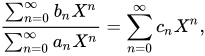
assuming the denominator is invertible (that is, Failed to parse (Conversion error. Server ("https://wikimedia.org/api/rest_") reported: "Cannot get mml. Server problem."): {\displaystyle a_{0}} is invertible in the ring of scalars), can be performed as a product and the inverse of , or directly equating the coefficients in Failed to parse (Conversion error. Server ("https://wikimedia.org/api/rest_") reported: "Cannot get mml. Server problem."): {\displaystyle f=gh} :


- Failed to parse (Conversion error. Server ("https://wikimedia.org/api/rest_") reported: "Cannot get mml. Server problem."): {\displaystyle c_{n}={\frac {1}{a_{0}}}\left(b_{n}-\sum _{k=1}^{n}a_{k}c_{n-k}\right).}
Extracting coefficients[edit | edit source]
The coefficient extraction operator applied to a formal power series
- Failed to parse (Conversion error. Server ("https://wikimedia.org/api/rest_") reported: "Cannot get mml. Server problem."): {\displaystyle f(X)=\sum _{n=0}^{\infty }a_{n}X^{n}}
in X is written
- Failed to parse (Conversion error. Server ("https://wikimedia.org/api/rest_") reported: "Cannot get mml. Server problem."): {\displaystyle \left[X^{m}\right]f(X)}
and extracts the coefficient of Xm, so that
- Failed to parse (SVG (MathML can be enabled via browser plugin): Invalid response ("Math extension cannot connect to Restbase.") from server "https://wikimedia.org/api/rest_v1/":): {\displaystyle \left[ X^m \right] f(X) = \left[ X^m \right] \sum_{n=0}^\infty a_n X^n = a_m.}
Composition[edit | edit source]
Given formal power series
- Failed to parse (SVG (MathML can be enabled via browser plugin): Invalid response ("Math extension cannot connect to Restbase.") from server "https://wikimedia.org/api/rest_v1/":): {\displaystyle f(X) = \sum_{n=1}^\infty a_n X^n = a_1 X + a_2 X^2 + \cdots}
- Failed to parse (SVG (MathML can be enabled via browser plugin): Invalid response ("Math extension cannot connect to Restbase.") from server "https://wikimedia.org/api/rest_v1/":): {\displaystyle g(X) = \sum_{n=0}^\infty b_n X^n = b_0 + b_1 X + b_2 X^2 + \cdots,}
one may form the composition
- Failed to parse (SVG (MathML can be enabled via browser plugin): Invalid response ("Math extension cannot connect to Restbase.") from server "https://wikimedia.org/api/rest_v1/":): {\displaystyle g(f(X)) = \sum_{n=0}^\infty b_n (f(X))^n = \sum_{n=0}^\infty c_n X^n,}
where the coefficients cn are determined by "expanding out" the powers of f(X):
- Failed to parse (SVG (MathML can be enabled via browser plugin): Invalid response ("Math extension cannot connect to Restbase.") from server "https://wikimedia.org/api/rest_v1/":): {\displaystyle c_n:=\sum_{k\in\N, |j|=n} b_k a_{j_1} a_{j_2} \cdots a_{j_k}.}
Here the sum is extended over all (k, j) with Failed to parse (SVG (MathML can be enabled via browser plugin): Invalid response ("Math extension cannot connect to Restbase.") from server "https://wikimedia.org/api/rest_v1/":): {\displaystyle k\in\N} and Failed to parse (SVG (MathML can be enabled via browser plugin): Invalid response ("Math extension cannot connect to Restbase.") from server "https://wikimedia.org/api/rest_v1/":): {\displaystyle j\in\N_+^k} with Failed to parse (SVG (MathML can be enabled via browser plugin): Invalid response ("Math extension cannot connect to Restbase.") from server "https://wikimedia.org/api/rest_v1/":): {\displaystyle |j|:=j_1+\cdots+j_k=n.}
A more explicit description of these coefficients is provided by Faà di Bruno's formula, at least in the case where the coefficient ring is a field of characteristic 0.
Composition is only valid when Failed to parse (SVG (MathML can be enabled via browser plugin): Invalid response ("Math extension cannot connect to Restbase.") from server "https://wikimedia.org/api/rest_v1/":): {\displaystyle f(X)} has no constant term, so that each Failed to parse (SVG (MathML can be enabled via browser plugin): Invalid response ("Math extension cannot connect to Restbase.") from server "https://wikimedia.org/api/rest_v1/":): {\displaystyle c_n} depends on only a finite number of coefficients of Failed to parse (SVG (MathML can be enabled via browser plugin): Invalid response ("Math extension cannot connect to Restbase.") from server "https://wikimedia.org/api/rest_v1/":): {\displaystyle f(X)} and Failed to parse (SVG (MathML can be enabled via browser plugin): Invalid response ("Math extension cannot connect to Restbase.") from server "https://wikimedia.org/api/rest_v1/":): {\displaystyle g(X)} . In other words, the series for Failed to parse (SVG (MathML can be enabled via browser plugin): Invalid response ("Math extension cannot connect to Restbase.") from server "https://wikimedia.org/api/rest_v1/":): {\displaystyle g(f(X))} converges in the topology of Failed to parse (SVG (MathML can be enabled via browser plugin): Invalid response ("Math extension cannot connect to Restbase.") from server "https://wikimedia.org/api/rest_v1/":): {\displaystyle R[[X]]} .
Example[edit | edit source]
Assume that the ring Failed to parse (SVG (MathML can be enabled via browser plugin): Invalid response ("Math extension cannot connect to Restbase.") from server "https://wikimedia.org/api/rest_v1/":): {\displaystyle R} has characteristic 0 and the nonzero integers are invertible in Failed to parse (SVG (MathML can be enabled via browser plugin): Invalid response ("Math extension cannot connect to Restbase.") from server "https://wikimedia.org/api/rest_v1/":): {\displaystyle R} . If we denote by Failed to parse (SVG (MathML can be enabled via browser plugin): Invalid response ("Math extension cannot connect to Restbase.") from server "https://wikimedia.org/api/rest_v1/":): {\displaystyle \exp(X)} the formal power series
- Failed to parse (SVG (MathML can be enabled via browser plugin): Invalid response ("Math extension cannot connect to Restbase.") from server "https://wikimedia.org/api/rest_v1/":): {\displaystyle \exp(X) = 1 + X + \frac{X^2}{2!} + \frac{X^3}{3!} + \frac{X^4}{4!} + \cdots,}
then the expression
- Failed to parse (SVG (MathML can be enabled via browser plugin): Invalid response ("Math extension cannot connect to Restbase.") from server "https://wikimedia.org/api/rest_v1/":): {\displaystyle \exp(\exp(X) - 1) = 1 + X + X^2 + \frac{5X^3}6 + \frac{5X^4}8 + \cdots}
makes perfect sense as a formal power series. However, the statement
- Failed to parse (SVG (MathML can be enabled via browser plugin): Invalid response ("Math extension cannot connect to Restbase.") from server "https://wikimedia.org/api/rest_v1/":): {\displaystyle \exp(\exp(X)) \ \stackrel?=\ e \exp(\exp(X) - 1) \ =\ e + eX + eX^2 + \frac{5eX^3}{6} + \cdots}
is not a valid application of the composition operation for formal power series. Rather, it is confusing the notions of convergence in Failed to parse (SVG (MathML can be enabled via browser plugin): Invalid response ("Math extension cannot connect to Restbase.") from server "https://wikimedia.org/api/rest_v1/":): {\displaystyle R[[X]]} and convergence in Failed to parse (SVG (MathML can be enabled via browser plugin): Invalid response ("Math extension cannot connect to Restbase.") from server "https://wikimedia.org/api/rest_v1/":): {\displaystyle R} ; indeed, the ring Failed to parse (SVG (MathML can be enabled via browser plugin): Invalid response ("Math extension cannot connect to Restbase.") from server "https://wikimedia.org/api/rest_v1/":): {\displaystyle R} may not even contain any number Failed to parse (SVG (MathML can be enabled via browser plugin): Invalid response ("Math extension cannot connect to Restbase.") from server "https://wikimedia.org/api/rest_v1/":): {\displaystyle e} with the appropriate properties.
Composition inverse[edit | edit source]
Whenever a formal series
- Failed to parse (SVG (MathML can be enabled via browser plugin): Invalid response ("Math extension cannot connect to Restbase.") from server "https://wikimedia.org/api/rest_v1/":): {\displaystyle f(X)=\sum_k f_k X^k \in R[[X]]}
has f0 = 0 and f1 being an invertible element of R, there exists a series
- Failed to parse (SVG (MathML can be enabled via browser plugin): Invalid response ("Math extension cannot connect to Restbase.") from server "https://wikimedia.org/api/rest_v1/":): {\displaystyle g(X)=\sum_k g_k X^k}
that is the composition inverse of Failed to parse (SVG (MathML can be enabled via browser plugin): Invalid response ("Math extension cannot connect to Restbase.") from server "https://wikimedia.org/api/rest_v1/":): {\displaystyle f} , meaning that composing Failed to parse (SVG (MathML can be enabled via browser plugin): Invalid response ("Math extension cannot connect to Restbase.") from server "https://wikimedia.org/api/rest_v1/":): {\displaystyle f} with Failed to parse (SVG (MathML can be enabled via browser plugin): Invalid response ("Math extension cannot connect to Restbase.") from server "https://wikimedia.org/api/rest_v1/":): {\displaystyle g} gives the series representing the identity function Failed to parse (SVG (MathML can be enabled via browser plugin): Invalid response ("Math extension cannot connect to Restbase.") from server "https://wikimedia.org/api/rest_v1/":): {\displaystyle x = 0 + 1x + 0x^2+ 0x^3+\cdots} . The coefficients of Failed to parse (SVG (MathML can be enabled via browser plugin): Invalid response ("Math extension cannot connect to Restbase.") from server "https://wikimedia.org/api/rest_v1/":): {\displaystyle g} may be found recursively by using the above formula for the coefficients of a composition, equating them with those of the composition identity X (that is 1 at degree 1 and 0 at every degree greater than 1). In the case when the coefficient ring is a field of characteristic 0, the Lagrange inversion formula (discussed below) provides a powerful tool to compute the coefficients of g, as well as the coefficients of the (multiplicative) powers of g.
Formal differentiation[edit | edit source]
Given a formal power series
- Failed to parse (SVG (MathML can be enabled via browser plugin): Invalid response ("Math extension cannot connect to Restbase.") from server "https://wikimedia.org/api/rest_v1/":): {\displaystyle f = \sum_{n\geq 0} a_n X^n \in R[[X]],}
we define its formal derivative, denoted Df or f ′, by
- Failed to parse (SVG (MathML can be enabled via browser plugin): Invalid response ("Math extension cannot connect to Restbase.") from server "https://wikimedia.org/api/rest_v1/":): {\displaystyle Df = f' = \sum_{n \geq 1} a_n n X^{n-1}.}
The symbol D is called the formal differentiation operator. This definition simply mimics term-by-term differentiation of a polynomial.
This operation is R-linear:
- Failed to parse (SVG (MathML can be enabled via browser plugin): Invalid response ("Math extension cannot connect to Restbase.") from server "https://wikimedia.org/api/rest_v1/":): {\displaystyle D(af + bg) = a \cdot Df + b \cdot Dg}
for any a, b in R and any f, g in Failed to parse (SVG (MathML can be enabled via browser plugin): Invalid response ("Math extension cannot connect to Restbase.") from server "https://wikimedia.org/api/rest_v1/":): {\displaystyle R[[X]].} Additionally, the formal derivative has many of the properties of the usual derivative of calculus. For example, the product rule is valid:
- Failed to parse (SVG (MathML can be enabled via browser plugin): Invalid response ("Math extension cannot connect to Restbase.") from server "https://wikimedia.org/api/rest_v1/":): {\displaystyle D(fg) \ =\ f \cdot (Dg) + (Df) \cdot g,}
and the chain rule works as well:
- Failed to parse (SVG (MathML can be enabled via browser plugin): Invalid response ("Math extension cannot connect to Restbase.") from server "https://wikimedia.org/api/rest_v1/":): {\displaystyle D(f\circ g ) = ( Df\circ g ) \cdot Dg,}
whenever the appropriate compositions of series are defined (see above under composition of series).
Thus, in these respects formal power series behave like Taylor series. Indeed, for the f defined above, we find that
- Failed to parse (SVG (MathML can be enabled via browser plugin): Invalid response ("Math extension cannot connect to Restbase.") from server "https://wikimedia.org/api/rest_v1/":): {\displaystyle (D^k f)(0) = k! a_k, }
where Dk denotes the kth formal derivative (that is, the result of formally differentiating k times).
Formal antidifferentiation[edit | edit source]
If Failed to parse (SVG (MathML can be enabled via browser plugin): Invalid response ("Math extension cannot connect to Restbase.") from server "https://wikimedia.org/api/rest_v1/":): {\displaystyle R} is a ring with characteristic zero and the nonzero integers are invertible in Failed to parse (SVG (MathML can be enabled via browser plugin): Invalid response ("Math extension cannot connect to Restbase.") from server "https://wikimedia.org/api/rest_v1/":): {\displaystyle R} , then given a formal power series
- Failed to parse (SVG (MathML can be enabled via browser plugin): Invalid response ("Math extension cannot connect to Restbase.") from server "https://wikimedia.org/api/rest_v1/":): {\displaystyle f = \sum_{n\geq 0} a_n X^n \in R[[X]],}
we define its formal antiderivative or formal indefinite integral by
- Failed to parse (SVG (MathML can be enabled via browser plugin): Invalid response ("Math extension cannot connect to Restbase.") from server "https://wikimedia.org/api/rest_v1/":): {\displaystyle D^{-1} f = \int f\ dX = C + \sum_{n \geq 0} a_n \frac{X^{n+1}}{n+1}.}
for any constant Failed to parse (SVG (MathML can be enabled via browser plugin): Invalid response ("Math extension cannot connect to Restbase.") from server "https://wikimedia.org/api/rest_v1/":): {\displaystyle C \in R} .
This operation is R-linear:
- Failed to parse (SVG (MathML can be enabled via browser plugin): Invalid response ("Math extension cannot connect to Restbase.") from server "https://wikimedia.org/api/rest_v1/":): {\displaystyle D^{-1}(af + bg) = a \cdot D^{-1}f + b \cdot D^{-1}g}
for any a, b in R and any f, g in Failed to parse (SVG (MathML can be enabled via browser plugin): Invalid response ("Math extension cannot connect to Restbase.") from server "https://wikimedia.org/api/rest_v1/":): {\displaystyle R[[X]].} Additionally, the formal antiderivative has many of the properties of the usual antiderivative of calculus. For example, the formal antiderivative is the right inverse of the formal derivative:
- Failed to parse (SVG (MathML can be enabled via browser plugin): Invalid response ("Math extension cannot connect to Restbase.") from server "https://wikimedia.org/api/rest_v1/":): {\displaystyle D(D^{-1}(f)) = f}
for any Failed to parse (SVG (MathML can be enabled via browser plugin): Invalid response ("Math extension cannot connect to Restbase.") from server "https://wikimedia.org/api/rest_v1/":): {\displaystyle f \in R[[X]]} .
Properties[edit | edit source]
Algebraic properties of the formal power series ring[edit | edit source]
Failed to parse (SVG (MathML can be enabled via browser plugin): Invalid response ("Math extension cannot connect to Restbase.") from server "https://wikimedia.org/api/rest_v1/":): {\displaystyle R[[X]]} is an associative algebra over Failed to parse (SVG (MathML can be enabled via browser plugin): Invalid response ("Math extension cannot connect to Restbase.") from server "https://wikimedia.org/api/rest_v1/":): {\displaystyle R} which contains the ring Failed to parse (SVG (MathML can be enabled via browser plugin): Invalid response ("Math extension cannot connect to Restbase.") from server "https://wikimedia.org/api/rest_v1/":): {\displaystyle R[X]} of polynomials over Failed to parse (SVG (MathML can be enabled via browser plugin): Invalid response ("Math extension cannot connect to Restbase.") from server "https://wikimedia.org/api/rest_v1/":): {\displaystyle R} ; the polynomials correspond to the sequences which end in zeros.
The Jacobson radical of Failed to parse (SVG (MathML can be enabled via browser plugin): Invalid response ("Math extension cannot connect to Restbase.") from server "https://wikimedia.org/api/rest_v1/":): {\displaystyle R[[X]]} is the ideal generated by Failed to parse (SVG (MathML can be enabled via browser plugin): Invalid response ("Math extension cannot connect to Restbase.") from server "https://wikimedia.org/api/rest_v1/":): {\displaystyle X} and the Jacobson radical of Failed to parse (SVG (MathML can be enabled via browser plugin): Invalid response ("Math extension cannot connect to Restbase.") from server "https://wikimedia.org/api/rest_v1/":): {\displaystyle R} ; this is implied by the element invertibility criterion discussed above.
The maximal ideals of Failed to parse (SVG (MathML can be enabled via browser plugin): Invalid response ("Math extension cannot connect to Restbase.") from server "https://wikimedia.org/api/rest_v1/":): {\displaystyle R[[X]]} all arise from those in Failed to parse (SVG (MathML can be enabled via browser plugin): Invalid response ("Math extension cannot connect to Restbase.") from server "https://wikimedia.org/api/rest_v1/":): {\displaystyle R} in the following manner: an ideal Failed to parse (SVG (MathML can be enabled via browser plugin): Invalid response ("Math extension cannot connect to Restbase.") from server "https://wikimedia.org/api/rest_v1/":): {\displaystyle M} of Failed to parse (SVG (MathML can be enabled via browser plugin): Invalid response ("Math extension cannot connect to Restbase.") from server "https://wikimedia.org/api/rest_v1/":): {\displaystyle R[[X]]} is maximal if and only if Failed to parse (SVG (MathML can be enabled via browser plugin): Invalid response ("Math extension cannot connect to Restbase.") from server "https://wikimedia.org/api/rest_v1/":): {\displaystyle M\cap R} is a maximal ideal of Failed to parse (SVG (MathML can be enabled via browser plugin): Invalid response ("Math extension cannot connect to Restbase.") from server "https://wikimedia.org/api/rest_v1/":): {\displaystyle R} and Failed to parse (SVG (MathML can be enabled via browser plugin): Invalid response ("Math extension cannot connect to Restbase.") from server "https://wikimedia.org/api/rest_v1/":): {\displaystyle M} is generated as an ideal by Failed to parse (SVG (MathML can be enabled via browser plugin): Invalid response ("Math extension cannot connect to Restbase.") from server "https://wikimedia.org/api/rest_v1/":): {\displaystyle X} and Failed to parse (SVG (MathML can be enabled via browser plugin): Invalid response ("Math extension cannot connect to Restbase.") from server "https://wikimedia.org/api/rest_v1/":): {\displaystyle M\cap R} .
Several algebraic properties of Failed to parse (SVG (MathML can be enabled via browser plugin): Invalid response ("Math extension cannot connect to Restbase.") from server "https://wikimedia.org/api/rest_v1/":): {\displaystyle R} are inherited by Failed to parse (SVG (MathML can be enabled via browser plugin): Invalid response ("Math extension cannot connect to Restbase.") from server "https://wikimedia.org/api/rest_v1/":): {\displaystyle R[[X]]} :
- if Failed to parse (SVG (MathML can be enabled via browser plugin): Invalid response ("Math extension cannot connect to Restbase.") from server "https://wikimedia.org/api/rest_v1/":): {\displaystyle R} is a local ring, then so is Failed to parse (SVG (MathML can be enabled via browser plugin): Invalid response ("Math extension cannot connect to Restbase.") from server "https://wikimedia.org/api/rest_v1/":): {\displaystyle R[[X]]} (with the set of non units the unique maximal ideal),
- if Failed to parse (SVG (MathML can be enabled via browser plugin): Invalid response ("Math extension cannot connect to Restbase.") from server "https://wikimedia.org/api/rest_v1/":): {\displaystyle R} is Noetherian, then so is Failed to parse (SVG (MathML can be enabled via browser plugin): Invalid response ("Math extension cannot connect to Restbase.") from server "https://wikimedia.org/api/rest_v1/":): {\displaystyle R[[X]]} (a version of the Hilbert basis theorem),
- if Failed to parse (SVG (MathML can be enabled via browser plugin): Invalid response ("Math extension cannot connect to Restbase.") from server "https://wikimedia.org/api/rest_v1/":): {\displaystyle R} is an integral domain, then so is Failed to parse (SVG (MathML can be enabled via browser plugin): Invalid response ("Math extension cannot connect to Restbase.") from server "https://wikimedia.org/api/rest_v1/":): {\displaystyle R[[X]]} , and
- if Failed to parse (SVG (MathML can be enabled via browser plugin): Invalid response ("Math extension cannot connect to Restbase.") from server "https://wikimedia.org/api/rest_v1/":): {\displaystyle K} is a field, then Failed to parse (SVG (MathML can be enabled via browser plugin): Invalid response ("Math extension cannot connect to Restbase.") from server "https://wikimedia.org/api/rest_v1/":): {\displaystyle K[[X]]} is a discrete valuation ring.
Topological properties of the formal power series ring[edit | edit source]
The metric space Failed to parse (SVG (MathML can be enabled via browser plugin): Invalid response ("Math extension cannot connect to Restbase.") from server "https://wikimedia.org/api/rest_v1/":): {\displaystyle (R[[X]], d)} is complete.
The ring Failed to parse (SVG (MathML can be enabled via browser plugin): Invalid response ("Math extension cannot connect to Restbase.") from server "https://wikimedia.org/api/rest_v1/":): {\displaystyle R[[X]]} is compact if and only if R is finite. This follows from Tychonoff's theorem and the characterisation of the topology on Failed to parse (SVG (MathML can be enabled via browser plugin): Invalid response ("Math extension cannot connect to Restbase.") from server "https://wikimedia.org/api/rest_v1/":): {\displaystyle R[[X]]} as a product topology.
Weierstrass preparation[edit | edit source]
The ring of formal power series with coefficients in a complete local ring satisfies the Weierstrass preparation theorem.
Applications[edit | edit source]
Formal power series can be used to solve recurrences occurring in number theory and combinatorics. For an example involving finding a closed form expression for the Fibonacci numbers, see the article on Examples of generating functions.
One can use formal power series to prove several relations familiar from analysis in a purely algebraic setting. Consider for instance the following elements of Failed to parse (SVG (MathML can be enabled via browser plugin): Invalid response ("Math extension cannot connect to Restbase.") from server "https://wikimedia.org/api/rest_v1/":): {\displaystyle \Q[[X]]} :
- Failed to parse (SVG (MathML can be enabled via browser plugin): Invalid response ("Math extension cannot connect to Restbase.") from server "https://wikimedia.org/api/rest_v1/":): {\displaystyle \sin(X) := \sum_{n \ge 0} \frac{(-1)^n} {(2n+1)!} X^{2n+1} }
- Failed to parse (SVG (MathML can be enabled via browser plugin): Invalid response ("Math extension cannot connect to Restbase.") from server "https://wikimedia.org/api/rest_v1/":): {\displaystyle \cos(X) := \sum_{n \ge 0} \frac{(-1)^n} {(2n)!} X^{2n} }
Then one can show that
- Failed to parse (SVG (MathML can be enabled via browser plugin): Invalid response ("Math extension cannot connect to Restbase.") from server "https://wikimedia.org/api/rest_v1/":): {\displaystyle \sin^2(X) + \cos^2(X) = 1,}
- Failed to parse (SVG (MathML can be enabled via browser plugin): Invalid response ("Math extension cannot connect to Restbase.") from server "https://wikimedia.org/api/rest_v1/":): {\displaystyle \frac{\partial}{\partial X} \sin(X) = \cos(X),}


The last one being valid in the ring Failed to parse (Conversion error. Server ("https://wikimedia.org/api/rest_") reported: "Cannot get mml. Server problem."): {\displaystyle \mathbb {Q} [[X,Y]].}
For K a field, the ring Failed to parse (Conversion error. Server ("https://wikimedia.org/api/rest_") reported: "Cannot get mml. Server problem."): {\displaystyle K[[X_{1},\ldots ,X_{r}]]} is often used as the "standard, most general" complete local ring over K in algebra.
Interpreting formal power series as functions[edit | edit source]
| Mathematical analysis → Complex analysis |
| Complex analysis |
|---|
| File:Gamma abs 3D.png |
| Complex numbers |
| Complex functions |
| Basic Theory |
| Geometric function theory |
| People |
|
|

In mathematical analysis, every convergent power series defines a function with values in the real or complex numbers. Formal power series over certain special rings can also be interpreted as functions, but one has to be careful with the domain and codomain. Let
- Failed to parse (Conversion error. Server ("https://wikimedia.org/api/rest_") reported: "Cannot get mml. Server problem."): {\displaystyle f=\sum a_{n}X^{n}\in R[[X]],}
and suppose S is a commutative associative algebra over R, I is an ideal in S such that the I-adic topology on S is complete, and x is an element of I. Define:
- Failed to parse (Conversion error. Server ("https://wikimedia.org/api/rest_") reported: "Cannot get mml. Server problem."): {\displaystyle f(x)=\sum _{n\geq 0}a_{n}x^{n}.}
This series is guaranteed to converge in S given the above assumptions on x. Furthermore, we have
- Failed to parse (Conversion error. Server ("https://wikimedia.org/api/rest_") reported: "Cannot get mml. Server problem."): {\displaystyle (f+g)(x)=f(x)+g(x)}
and
- Failed to parse (SVG (MathML can be enabled via browser plugin): Invalid response ("Math extension cannot connect to Restbase.") from server "https://wikimedia.org/api/rest_v1/":): {\displaystyle (fg)(x) = f(x) g(x).}
Unlike in the case of bona fide functions, these formulas are not definitions but have to be proved.
Since the topology on Failed to parse (SVG (MathML can be enabled via browser plugin): Invalid response ("Math extension cannot connect to Restbase.") from server "https://wikimedia.org/api/rest_v1/":): {\displaystyle R[[X]]} is the (X)-adic topology and Failed to parse (SVG (MathML can be enabled via browser plugin): Invalid response ("Math extension cannot connect to Restbase.") from server "https://wikimedia.org/api/rest_v1/":): {\displaystyle R[[X]]} is complete, we can in particular apply power series to other power series, provided that the arguments don't have constant coefficients (so that they belong to the ideal (X)): f(0), f(X2−X) and f((1−X)−1 − 1) are all well defined for any formal power series Failed to parse (SVG (MathML can be enabled via browser plugin): Invalid response ("Math extension cannot connect to Restbase.") from server "https://wikimedia.org/api/rest_v1/":): {\displaystyle f \in R[[X]].}
With this formalism, we can give an explicit formula for the multiplicative inverse of a power series f whose constant coefficient a = f(0) is invertible in R:
- Failed to parse (SVG (MathML can be enabled via browser plugin): Invalid response ("Math extension cannot connect to Restbase.") from server "https://wikimedia.org/api/rest_v1/":): {\displaystyle f^{-1} = \sum_{n \ge 0} a^{-n-1} (a-f)^n.}
If the formal power series g with g(0) = 0 is given implicitly by the equation
- Failed to parse (SVG (MathML can be enabled via browser plugin): Invalid response ("Math extension cannot connect to Restbase.") from server "https://wikimedia.org/api/rest_v1/":): {\displaystyle f(g) =X}
where f is a known power series with f(0) = 0, then the coefficients of g can be explicitly computed using the Lagrange inversion formula.
Generalizations[edit | edit source]
Formal Laurent series[edit | edit source]
The formal Laurent series over a ring Failed to parse (SVG (MathML can be enabled via browser plugin): Invalid response ("Math extension cannot connect to Restbase.") from server "https://wikimedia.org/api/rest_v1/":): {\displaystyle R} are defined in a similar way to a formal power series, except that we also allow finitely many terms of negative degree. That is, they are the series that can be written as
- Failed to parse (SVG (MathML can be enabled via browser plugin): Invalid response ("Math extension cannot connect to Restbase.") from server "https://wikimedia.org/api/rest_v1/":): {\displaystyle f = \sum_{n = N}^\infty a_n X^n}
for some integer N, so that there are only finitely many negative n with Failed to parse (SVG (MathML can be enabled via browser plugin): Invalid response ("Math extension cannot connect to Restbase.") from server "https://wikimedia.org/api/rest_v1/":): {\displaystyle a_n \neq 0} . (This is different from the classical Laurent series of complex analysis.) For a non-zero formal Laurent series, the minimal integer Failed to parse (SVG (MathML can be enabled via browser plugin): Invalid response ("Math extension cannot connect to Restbase.") from server "https://wikimedia.org/api/rest_v1/":): {\displaystyle n} such that Failed to parse (SVG (MathML can be enabled via browser plugin): Invalid response ("Math extension cannot connect to Restbase.") from server "https://wikimedia.org/api/rest_v1/":): {\displaystyle a_n\neq 0} is called the order of Failed to parse (SVG (MathML can be enabled via browser plugin): Invalid response ("Math extension cannot connect to Restbase.") from server "https://wikimedia.org/api/rest_v1/":): {\displaystyle f} and is denoted Failed to parse (SVG (MathML can be enabled via browser plugin): Invalid response ("Math extension cannot connect to Restbase.") from server "https://wikimedia.org/api/rest_v1/":): {\displaystyle \operatorname{ord}(f).} (The order of the zero series is Failed to parse (SVG (MathML can be enabled via browser plugin): Invalid response ("Math extension cannot connect to Restbase.") from server "https://wikimedia.org/api/rest_v1/":): {\displaystyle +\infty} .)
Multiplication of such series can be defined. Indeed, similarly to the definition for formal power series, the coefficient of Xk of two series with respective sequences of coefficients Failed to parse (SVG (MathML can be enabled via browser plugin): Invalid response ("Math extension cannot connect to Restbase.") from server "https://wikimedia.org/api/rest_v1/":): {\displaystyle \{a_n\}} and Failed to parse (SVG (MathML can be enabled via browser plugin): Invalid response ("Math extension cannot connect to Restbase.") from server "https://wikimedia.org/api/rest_v1/":): {\displaystyle \{b_n\}} is Failed to parse (SVG (MathML can be enabled via browser plugin): Invalid response ("Math extension cannot connect to Restbase.") from server "https://wikimedia.org/api/rest_v1/":): {\displaystyle \sum_{i\in\Z}a_ib_{k-i}.} This sum has only finitely many nonzero terms because of the assumed vanishing of coefficients at sufficiently negative indices.
The formal Laurent series form the ring of formal Laurent series over Failed to parse (SVG (MathML can be enabled via browser plugin): Invalid response ("Math extension cannot connect to Restbase.") from server "https://wikimedia.org/api/rest_v1/":): {\displaystyle R} , denoted by Failed to parse (SVG (MathML can be enabled via browser plugin): Invalid response ("Math extension cannot connect to Restbase.") from server "https://wikimedia.org/api/rest_v1/":): {\displaystyle R((X))} .[a] It is equal to the localization of Failed to parse (SVG (MathML can be enabled via browser plugin): Invalid response ("Math extension cannot connect to Restbase.") from server "https://wikimedia.org/api/rest_v1/":): {\displaystyle R[[X]]} with respect to the set of positive powers of Failed to parse (SVG (MathML can be enabled via browser plugin): Invalid response ("Math extension cannot connect to Restbase.") from server "https://wikimedia.org/api/rest_v1/":): {\displaystyle X} . If Failed to parse (SVG (MathML can be enabled via browser plugin): Invalid response ("Math extension cannot connect to Restbase.") from server "https://wikimedia.org/api/rest_v1/":): {\displaystyle R=K} is a field, then Failed to parse (SVG (MathML can be enabled via browser plugin): Invalid response ("Math extension cannot connect to Restbase.") from server "https://wikimedia.org/api/rest_v1/":): {\displaystyle K((X))} is in fact a field, which may alternatively be obtained as the field of fractions of the integral domain Failed to parse (SVG (MathML can be enabled via browser plugin): Invalid response ("Math extension cannot connect to Restbase.") from server "https://wikimedia.org/api/rest_v1/":): {\displaystyle K[[X]]} .
As with the ring Failed to parse (SVG (MathML can be enabled via browser plugin): Invalid response ("Math extension cannot connect to Restbase.") from server "https://wikimedia.org/api/rest_v1/":): {\displaystyle R[[X]]} of formal power series, the ring Failed to parse (SVG (MathML can be enabled via browser plugin): Invalid response ("Math extension cannot connect to Restbase.") from server "https://wikimedia.org/api/rest_v1/":): {\displaystyle R((X))} of formal Laurent series may be endowed with the structure of a topological ring by introducing the metric Failed to parse (SVG (MathML can be enabled via browser plugin): Invalid response ("Math extension cannot connect to Restbase.") from server "https://wikimedia.org/api/rest_v1/":): {\displaystyle d(f,g)=2^{-\operatorname{ord}(f-g)}.}
One may define formal differentiation for formal Laurent series in the natural (term-by-term) way. Precisely, the formal derivative of the formal Laurent series Failed to parse (SVG (MathML can be enabled via browser plugin): Invalid response ("Math extension cannot connect to Restbase.") from server "https://wikimedia.org/api/rest_v1/":): {\displaystyle f} above is Failed to parse (SVG (MathML can be enabled via browser plugin): Invalid response ("Math extension cannot connect to Restbase.") from server "https://wikimedia.org/api/rest_v1/":): {\displaystyle f' = Df = \sum_{n\in\Z} na_n X^{n-1},} which is again a formal Laurent series. If Failed to parse (SVG (MathML can be enabled via browser plugin): Invalid response ("Math extension cannot connect to Restbase.") from server "https://wikimedia.org/api/rest_v1/":): {\displaystyle f} is a non-constant formal Laurent series and with coefficients in a field of characteristic 0, then one has Failed to parse (SVG (MathML can be enabled via browser plugin): Invalid response ("Math extension cannot connect to Restbase.") from server "https://wikimedia.org/api/rest_v1/":): {\displaystyle \operatorname{ord}(f')= \operatorname{ord}(f)-1.} However, in general this is not the case since the factor n for the lowest order term could be equal to 0 in R.
Formal residue[edit | edit source]
Assume that Failed to parse (SVG (MathML can be enabled via browser plugin): Invalid response ("Math extension cannot connect to Restbase.") from server "https://wikimedia.org/api/rest_v1/":): {\displaystyle K} is a field of characteristic 0. Then the map
- Failed to parse (SVG (MathML can be enabled via browser plugin): Invalid response ("Math extension cannot connect to Restbase.") from server "https://wikimedia.org/api/rest_v1/":): {\displaystyle D\colon K((X))\to K((X))}
is a Failed to parse (SVG (MathML can be enabled via browser plugin): Invalid response ("Math extension cannot connect to Restbase.") from server "https://wikimedia.org/api/rest_v1/":): {\displaystyle K} -derivation that satisfies
- Failed to parse (SVG (MathML can be enabled via browser plugin): Invalid response ("Math extension cannot connect to Restbase.") from server "https://wikimedia.org/api/rest_v1/":): {\displaystyle \ker D=K}
- Failed to parse (SVG (MathML can be enabled via browser plugin): Invalid response ("Math extension cannot connect to Restbase.") from server "https://wikimedia.org/api/rest_v1/":): {\displaystyle \operatorname{im} D= \left \{f\in K((X)) : [X^{-1}]f=0 \right \}.}
The latter shows that the coefficient of Failed to parse (SVG (MathML can be enabled via browser plugin): Invalid response ("Math extension cannot connect to Restbase.") from server "https://wikimedia.org/api/rest_v1/":): {\displaystyle X^{-1}} in Failed to parse (SVG (MathML can be enabled via browser plugin): Invalid response ("Math extension cannot connect to Restbase.") from server "https://wikimedia.org/api/rest_v1/":): {\displaystyle f} is of particular interest; it is called formal residue of Failed to parse (SVG (MathML can be enabled via browser plugin): Invalid response ("Math extension cannot connect to Restbase.") from server "https://wikimedia.org/api/rest_v1/":): {\displaystyle f} and denoted Failed to parse (SVG (MathML can be enabled via browser plugin): Invalid response ("Math extension cannot connect to Restbase.") from server "https://wikimedia.org/api/rest_v1/":): {\displaystyle \operatorname{Res}(f)} . The map
- Failed to parse (SVG (MathML can be enabled via browser plugin): Invalid response ("Math extension cannot connect to Restbase.") from server "https://wikimedia.org/api/rest_v1/":): {\displaystyle \operatorname{Res} : K((X))\to K}
is Failed to parse (SVG (MathML can be enabled via browser plugin): Invalid response ("Math extension cannot connect to Restbase.") from server "https://wikimedia.org/api/rest_v1/":): {\displaystyle K} -linear, and by the above observation one has an exact sequence
- Failed to parse (SVG (MathML can be enabled via browser plugin): Invalid response ("Math extension cannot connect to Restbase.") from server "https://wikimedia.org/api/rest_v1/":): {\displaystyle 0 \to K \to K((X)) \overset{D}{\longrightarrow} K((X)) \;\overset{\operatorname{Res}}{\longrightarrow}\; K \to 0.}
Some rules of calculus. As a quite direct consequence of the above definition, and of the rules of formal derivation, one has, for any Failed to parse (SVG (MathML can be enabled via browser plugin): Invalid response ("Math extension cannot connect to Restbase.") from server "https://wikimedia.org/api/rest_v1/":): {\displaystyle f, g\in K((X))}
- Failed to parse (SVG (MathML can be enabled via browser plugin): Invalid response ("Math extension cannot connect to Restbase.") from server "https://wikimedia.org/api/rest_v1/":): {\displaystyle \operatorname{Res}(f')=0;}
- Failed to parse (SVG (MathML can be enabled via browser plugin): Invalid response ("Math extension cannot connect to Restbase.") from server "https://wikimedia.org/api/rest_v1/":): {\displaystyle \operatorname{Res}(fg')=-\operatorname{Res}(f'g);}
- Failed to parse (SVG (MathML can be enabled via browser plugin): Invalid response ("Math extension cannot connect to Restbase.") from server "https://wikimedia.org/api/rest_v1/":): {\displaystyle \operatorname{Res}(f'/f)=\operatorname{ord}(f),\qquad \forall f\neq 0;}
- Failed to parse (SVG (MathML can be enabled via browser plugin): Invalid response ("Math extension cannot connect to Restbase.") from server "https://wikimedia.org/api/rest_v1/":): {\displaystyle \operatorname{Res}\left(( g\circ f) f'\right) = \operatorname{ord}(f)\operatorname{Res}(g),} if Failed to parse (SVG (MathML can be enabled via browser plugin): Invalid response ("Math extension cannot connect to Restbase.") from server "https://wikimedia.org/api/rest_v1/":): {\displaystyle \operatorname{ord}(f)>0;}
- Failed to parse (SVG (MathML can be enabled via browser plugin): Invalid response ("Math extension cannot connect to Restbase.") from server "https://wikimedia.org/api/rest_v1/":): {\displaystyle [X^n]f(X)=\operatorname{Res}\left(X^{-n-1}f(X)\right).}
Property (i) is part of the exact sequence above. Property (ii) follows from (i) as applied to Failed to parse (SVG (MathML can be enabled via browser plugin): Invalid response ("Math extension cannot connect to Restbase.") from server "https://wikimedia.org/api/rest_v1/":): {\displaystyle (fg)'=f'g+fg'} . Property (iii): any Failed to parse (SVG (MathML can be enabled via browser plugin): Invalid response ("Math extension cannot connect to Restbase.") from server "https://wikimedia.org/api/rest_v1/":): {\displaystyle f} can be written in the form Failed to parse (SVG (MathML can be enabled via browser plugin): Invalid response ("Math extension cannot connect to Restbase.") from server "https://wikimedia.org/api/rest_v1/":): {\displaystyle f=X^mg} , with Failed to parse (SVG (MathML can be enabled via browser plugin): Invalid response ("Math extension cannot connect to Restbase.") from server "https://wikimedia.org/api/rest_v1/":): {\displaystyle m=\operatorname{ord}(f)} and Failed to parse (SVG (MathML can be enabled via browser plugin): Invalid response ("Math extension cannot connect to Restbase.") from server "https://wikimedia.org/api/rest_v1/":): {\displaystyle \operatorname{ord}(g)=0} : then Failed to parse (SVG (MathML can be enabled via browser plugin): Invalid response ("Math extension cannot connect to Restbase.") from server "https://wikimedia.org/api/rest_v1/":): {\displaystyle f'/f = mX^{-1}+g'/g.} Failed to parse (SVG (MathML can be enabled via browser plugin): Invalid response ("Math extension cannot connect to Restbase.") from server "https://wikimedia.org/api/rest_v1/":): {\displaystyle \operatorname{ord}(g)=0} implies Failed to parse (SVG (MathML can be enabled via browser plugin): Invalid response ("Math extension cannot connect to Restbase.") from server "https://wikimedia.org/api/rest_v1/":): {\displaystyle g} is invertible in Failed to parse (SVG (MathML can be enabled via browser plugin): Invalid response ("Math extension cannot connect to Restbase.") from server "https://wikimedia.org/api/rest_v1/":): {\displaystyle K[[X]]\subset \operatorname{im}(D) = \ker(\operatorname{Res}),} whence Failed to parse (SVG (MathML can be enabled via browser plugin): Invalid response ("Math extension cannot connect to Restbase.") from server "https://wikimedia.org/api/rest_v1/":): {\displaystyle \operatorname{Res}(f'/f)=m.} Property (iv): Since Failed to parse (SVG (MathML can be enabled via browser plugin): Invalid response ("Math extension cannot connect to Restbase.") from server "https://wikimedia.org/api/rest_v1/":): {\displaystyle \operatorname{im}(D) = \ker(\operatorname{Res}),} we can write Failed to parse (SVG (MathML can be enabled via browser plugin): Invalid response ("Math extension cannot connect to Restbase.") from server "https://wikimedia.org/api/rest_v1/":): {\displaystyle g=g_{-1}X^{-1}+G',} with Failed to parse (SVG (MathML can be enabled via browser plugin): Invalid response ("Math extension cannot connect to Restbase.") from server "https://wikimedia.org/api/rest_v1/":): {\displaystyle G \in K((X))} . Consequently, Failed to parse (SVG (MathML can be enabled via browser plugin): Invalid response ("Math extension cannot connect to Restbase.") from server "https://wikimedia.org/api/rest_v1/":): {\displaystyle (g\circ f)f'= g_{-1}f^{-1}f'+(G'\circ f)f' = g_{-1}f'/f + (G \circ f)'} and (iv) follows from (i) and (iii). Property (v) is clear from the definition.
The Lagrange inversion formula[edit | edit source]
As mentioned above, any formal series Failed to parse (SVG (MathML can be enabled via browser plugin): Invalid response ("Math extension cannot connect to Restbase.") from server "https://wikimedia.org/api/rest_v1/":): {\displaystyle f \in K[[X]]} with f0 = 0 and f1 ≠ 0 has a composition inverse Failed to parse (SVG (MathML can be enabled via browser plugin): Invalid response ("Math extension cannot connect to Restbase.") from server "https://wikimedia.org/api/rest_v1/":): {\displaystyle g \in K[[X]].} The following relation between the coefficients of gn and f−k holds ("Lagrange inversion formula"):
- Failed to parse (SVG (MathML can be enabled via browser plugin): Invalid response ("Math extension cannot connect to Restbase.") from server "https://wikimedia.org/api/rest_v1/":): {\displaystyle k[X^k] g^n=n[X^{-n}]f^{-k}.}
In particular, for n = 1 and all k ≥ 1,
- Failed to parse (SVG (MathML can be enabled via browser plugin): Invalid response ("Math extension cannot connect to Restbase.") from server "https://wikimedia.org/api/rest_v1/":): {\displaystyle [X^k] g=\frac{1}{k} \operatorname{Res}\left( f^{-k}\right).}
Since the proof of the Lagrange inversion formula is a very short computation, it is worth reporting it here. Noting Failed to parse (SVG (MathML can be enabled via browser plugin): Invalid response ("Math extension cannot connect to Restbase.") from server "https://wikimedia.org/api/rest_v1/":): {\displaystyle \operatorname{ord}(f) =1 } , we can apply the rules of calculus above, crucially Rule (iv) substituting Failed to parse (SVG (MathML can be enabled via browser plugin): Invalid response ("Math extension cannot connect to Restbase.") from server "https://wikimedia.org/api/rest_v1/":): {\displaystyle X \rightsquigarrow f(X)} , to get:
- Failed to parse (SVG (MathML can be enabled via browser plugin): Invalid response ("Math extension cannot connect to Restbase.") from server "https://wikimedia.org/api/rest_v1/":): {\displaystyle \begin{align} k[X^k] g^n & \ \stackrel{\mathrm{(v)}}=\ k\operatorname{Res}\left( g^n X^{-k-1} \right) \ \stackrel{\mathrm{(iv)}}=\ k\operatorname{Res}\left(X^n f^{-k-1}f'\right) \ \stackrel{\mathrm{chain}}=\ -\operatorname{Res}\left(X^n (f^{-k})'\right) \\ & \ \stackrel{\mathrm{(ii)}}=\ \operatorname{Res}\left(\left(X^n\right)' f^{-k}\right) \ \stackrel{\mathrm{chain}}=\ n\operatorname{Res}\left(X^{n-1}f^{-k}\right) \ \stackrel{\mathrm{(v)}}=\ n[X^{-n}]f^{-k}. \end{align} }
Generalizations. One may observe that the above computation can be repeated plainly in more general settings than K((X)): a generalization of the Lagrange inversion formula is already available working in the Failed to parse (SVG (MathML can be enabled via browser plugin): Invalid response ("Math extension cannot connect to Restbase.") from server "https://wikimedia.org/api/rest_v1/":): {\displaystyle \Complex((X))} -modules Failed to parse (SVG (MathML can be enabled via browser plugin): Invalid response ("Math extension cannot connect to Restbase.") from server "https://wikimedia.org/api/rest_v1/":): {\displaystyle X^{\alpha}\Complex((X)),} where α is a complex exponent. As a consequence, if f and g are as above, with Failed to parse (SVG (MathML can be enabled via browser plugin): Invalid response ("Math extension cannot connect to Restbase.") from server "https://wikimedia.org/api/rest_v1/":): {\displaystyle f_1=g_1=1} , we can relate the complex powers of f / X and g / X: precisely, if α and β are non-zero complex numbers with negative integer sum, Failed to parse (SVG (MathML can be enabled via browser plugin): Invalid response ("Math extension cannot connect to Restbase.") from server "https://wikimedia.org/api/rest_v1/":): {\displaystyle m=-\alpha-\beta\in\N,} then
- Failed to parse (SVG (MathML can be enabled via browser plugin): Invalid response ("Math extension cannot connect to Restbase.") from server "https://wikimedia.org/api/rest_v1/":): {\displaystyle \frac{1}{\alpha}[X^m]\left( \frac{f}{X} \right)^\alpha=-\frac{1}{\beta}[X^m]\left( \frac{g}{X} \right)^\beta.}
For instance, this way one finds the power series for complex powers of the Lambert function.
Power series in several variables[edit | edit source]
Formal power series in any number of indeterminates (even infinitely many) can be defined. If I is an index set and XI is the set of indeterminates Xi for i∈I, then a monomial Xα is any finite product of elements of XI (repetitions allowed); a formal power series in XI with coefficients in a ring R is determined by any mapping from the set of monomials Xα to a corresponding coefficient cα, and is denoted Failed to parse (SVG (MathML can be enabled via browser plugin): Invalid response ("Math extension cannot connect to Restbase.") from server "https://wikimedia.org/api/rest_v1/":): {\textstyle \sum_\alpha c_\alpha X^\alpha} . The set of all such formal power series is denoted Failed to parse (SVG (MathML can be enabled via browser plugin): Invalid response ("Math extension cannot connect to Restbase.") from server "https://wikimedia.org/api/rest_v1/":): {\displaystyle R[[X_I]],} and it is given a ring structure by defining
- Failed to parse (SVG (MathML can be enabled via browser plugin): Invalid response ("Math extension cannot connect to Restbase.") from server "https://wikimedia.org/api/rest_v1/":): {\displaystyle \left(\sum_\alpha c_\alpha X^\alpha\right)+\left(\sum_\alpha d_\alpha X^\alpha \right)= \sum_\alpha (c_\alpha+d_\alpha) X^\alpha}
and
- Failed to parse (SVG (MathML can be enabled via browser plugin): Invalid response ("Math extension cannot connect to Restbase.") from server "https://wikimedia.org/api/rest_v1/":): {\displaystyle \left(\sum_\alpha c_\alpha X^\alpha\right)\times\left(\sum_\beta d_\beta X^\beta\right)=\sum_{\alpha,\beta} c_\alpha d_\beta X^{\alpha+\beta}}
Topology[edit | edit source]
The topology on Failed to parse (SVG (MathML can be enabled via browser plugin): Invalid response ("Math extension cannot connect to Restbase.") from server "https://wikimedia.org/api/rest_v1/":): {\displaystyle R[[X_I]]} is such that a sequence of its elements converges only if for each monomial Xα the corresponding coefficient stabilizes. If I is finite, then this the J-adic topology, where J is the ideal of Failed to parse (SVG (MathML can be enabled via browser plugin): Invalid response ("Math extension cannot connect to Restbase.") from server "https://wikimedia.org/api/rest_v1/":): {\displaystyle R[[X_I]]} generated by all the indeterminates in XI. This does not hold if I is infinite. For example, if Failed to parse (SVG (MathML can be enabled via browser plugin): Invalid response ("Math extension cannot connect to Restbase.") from server "https://wikimedia.org/api/rest_v1/":): {\displaystyle I=\N,} then the sequence Failed to parse (SVG (MathML can be enabled via browser plugin): Invalid response ("Math extension cannot connect to Restbase.") from server "https://wikimedia.org/api/rest_v1/":): {\displaystyle (f_n)_{n\in \N}} with Failed to parse (SVG (MathML can be enabled via browser plugin): Invalid response ("Math extension cannot connect to Restbase.") from server "https://wikimedia.org/api/rest_v1/":): {\displaystyle f_n = X_n + X_{n+1} + X_{n+2} + \cdots } does not converge with respect to any J-adic topology on R, but clearly for each monomial the corresponding coefficient stabilizes.
As remarked above, the topology on a repeated formal power series ring like Failed to parse (SVG (MathML can be enabled via browser plugin): Invalid response ("Math extension cannot connect to Restbase.") from server "https://wikimedia.org/api/rest_v1/":): {\displaystyle R[[X]][[Y]]} is usually chosen in such a way that it becomes isomorphic as a topological ring to Failed to parse (SVG (MathML can be enabled via browser plugin): Invalid response ("Math extension cannot connect to Restbase.") from server "https://wikimedia.org/api/rest_v1/":): {\displaystyle R[[X,Y]].}
Operations[edit | edit source]
All of the operations defined for series in one variable may be extended to the several variables case.
- A series is invertible if and only if its constant term is invertible in R.
- The composition f(g(X)) of two series f and g is defined if f is a series in a single indeterminate, and the constant term of g is zero. For a series f in several indeterminates a form of "composition" can similarly be defined, with as many separate series in the place of g as there are indeterminates.
In the case of the formal derivative, there are now separate partial derivative operators, which differentiate with respect to each of the indeterminates. They all commute with each other.
Universal property[edit | edit source]
In the several variables case, the universal property characterizing Failed to parse (SVG (MathML can be enabled via browser plugin): Invalid response ("Math extension cannot connect to Restbase.") from server "https://wikimedia.org/api/rest_v1/":): {\displaystyle R[[X_1, \ldots, X_r]]} becomes the following. If S is a commutative associative algebra over R, if I is an ideal of S such that the I-adic topology on S is complete, and if x1, …, xr are elements of I, then there is a unique map Failed to parse (SVG (MathML can be enabled via browser plugin): Invalid response ("Math extension cannot connect to Restbase.") from server "https://wikimedia.org/api/rest_v1/":): {\displaystyle \Phi: R[[X_1, \ldots, X_r]] \to S} with the following properties:
- Φ is an R-algebra homomorphism
- Φ is continuous
- Φ(Xi) = xi for i = 1, …, r.
Non-commuting variables[edit | edit source]
The several variable case can be further generalised by taking non-commuting variables Xi for i ∈ I, where I is an index set and then a monomial Xα is any word in the XI; a formal power series in XI with coefficients in a ring R is determined by any mapping from the set of monomials Xα to a corresponding coefficient cα, and is denoted Failed to parse (SVG (MathML can be enabled via browser plugin): Invalid response ("Math extension cannot connect to Restbase.") from server "https://wikimedia.org/api/rest_v1/":): {\displaystyle \textstyle\sum_\alpha c_\alpha X^\alpha } . The set of all such formal power series is denoted R«XI», and it is given a ring structure by defining addition pointwise
- Failed to parse (SVG (MathML can be enabled via browser plugin): Invalid response ("Math extension cannot connect to Restbase.") from server "https://wikimedia.org/api/rest_v1/":): {\displaystyle \left(\sum_\alpha c_\alpha X^\alpha\right)+\left(\sum_\alpha d_\alpha X^\alpha\right)=\sum_\alpha(c_\alpha+d_\alpha)X^\alpha}
and multiplication by
- Failed to parse (SVG (MathML can be enabled via browser plugin): Invalid response ("Math extension cannot connect to Restbase.") from server "https://wikimedia.org/api/rest_v1/":): {\displaystyle \left(\sum_\alpha c_\alpha X^\alpha\right)\times\left(\sum_\alpha d_\alpha X^\alpha\right)=\sum_{\alpha,\beta} c_\alpha d_\beta X^{\alpha} \cdot X^{\beta}}
where · denotes concatenation of words. These formal power series over R form the Magnus ring over R.[3][4]
On a semiring[edit | edit source]
![[icon]](https://justapedia.org/wiki/File:Wiki_letter_w_cropped.svg) | This section needs expansion with: sum, product, examples. You can help by adding to it. (August 2014) |
Given an alphabet Failed to parse (SVG (MathML can be enabled via browser plugin): Invalid response ("Math extension cannot connect to Restbase.") from server "https://wikimedia.org/api/rest_v1/":): {\displaystyle \Sigma} and a semiring Failed to parse (SVG (MathML can be enabled via browser plugin): Invalid response ("Math extension cannot connect to Restbase.") from server "https://wikimedia.org/api/rest_v1/":): {\displaystyle S} . The formal power series over Failed to parse (SVG (MathML can be enabled via browser plugin): Invalid response ("Math extension cannot connect to Restbase.") from server "https://wikimedia.org/api/rest_v1/":): {\displaystyle S} supported on the language Failed to parse (SVG (MathML can be enabled via browser plugin): Invalid response ("Math extension cannot connect to Restbase.") from server "https://wikimedia.org/api/rest_v1/":): {\displaystyle \Sigma^*} is denoted by Failed to parse (SVG (MathML can be enabled via browser plugin): Invalid response ("Math extension cannot connect to Restbase.") from server "https://wikimedia.org/api/rest_v1/":): {\displaystyle S\langle\langle \Sigma^*\rangle\rangle} . It consists of all mappings Failed to parse (SVG (MathML can be enabled via browser plugin): Invalid response ("Math extension cannot connect to Restbase.") from server "https://wikimedia.org/api/rest_v1/":): {\displaystyle r:\Sigma^*\to S} , where Failed to parse (SVG (MathML can be enabled via browser plugin): Invalid response ("Math extension cannot connect to Restbase.") from server "https://wikimedia.org/api/rest_v1/":): {\displaystyle \Sigma^*} is the free monoid generated by the non-empty set Failed to parse (SVG (MathML can be enabled via browser plugin): Invalid response ("Math extension cannot connect to Restbase.") from server "https://wikimedia.org/api/rest_v1/":): {\displaystyle \Sigma} .
The elements of Failed to parse (SVG (MathML can be enabled via browser plugin): Invalid response ("Math extension cannot connect to Restbase.") from server "https://wikimedia.org/api/rest_v1/":): {\displaystyle S\langle\langle \Sigma^*\rangle\rangle} can be written as formal sums
- Failed to parse (SVG (MathML can be enabled via browser plugin): Invalid response ("Math extension cannot connect to Restbase.") from server "https://wikimedia.org/api/rest_v1/":): {\displaystyle r = \sum_{w \in \Sigma^*} (r,w)w.}
where Failed to parse (SVG (MathML can be enabled via browser plugin): Invalid response ("Math extension cannot connect to Restbase.") from server "https://wikimedia.org/api/rest_v1/":): {\displaystyle (r,w)} denotes the value of Failed to parse (SVG (MathML can be enabled via browser plugin): Invalid response ("Math extension cannot connect to Restbase.") from server "https://wikimedia.org/api/rest_v1/":): {\displaystyle r} at the word Failed to parse (SVG (MathML can be enabled via browser plugin): Invalid response ("Math extension cannot connect to Restbase.") from server "https://wikimedia.org/api/rest_v1/":): {\displaystyle w\in\Sigma^*} . The elements Failed to parse (SVG (MathML can be enabled via browser plugin): Invalid response ("Math extension cannot connect to Restbase.") from server "https://wikimedia.org/api/rest_v1/":): {\displaystyle (r,w)\in S} are called the coefficients of Failed to parse (SVG (MathML can be enabled via browser plugin): Invalid response ("Math extension cannot connect to Restbase.") from server "https://wikimedia.org/api/rest_v1/":): {\displaystyle r} .
For Failed to parse (SVG (MathML can be enabled via browser plugin): Invalid response ("Math extension cannot connect to Restbase.") from server "https://wikimedia.org/api/rest_v1/":): {\displaystyle r\in S\langle\langle \Sigma^*\rangle\rangle} the support of Failed to parse (SVG (MathML can be enabled via browser plugin): Invalid response ("Math extension cannot connect to Restbase.") from server "https://wikimedia.org/api/rest_v1/":): {\displaystyle r} is the set
- Failed to parse (SVG (MathML can be enabled via browser plugin): Invalid response ("Math extension cannot connect to Restbase.") from server "https://wikimedia.org/api/rest_v1/":): {\displaystyle \operatorname{supp}(r)=\{w\in\Sigma^*|\ (r,w)\neq 0\}}
A series where every coefficient is either Failed to parse (SVG (MathML can be enabled via browser plugin): Invalid response ("Math extension cannot connect to Restbase.") from server "https://wikimedia.org/api/rest_v1/":): {\displaystyle 0} or Failed to parse (SVG (MathML can be enabled via browser plugin): Invalid response ("Math extension cannot connect to Restbase.") from server "https://wikimedia.org/api/rest_v1/":): {\displaystyle 1} is called the characteristic series of its support.
The subset of Failed to parse (SVG (MathML can be enabled via browser plugin): Invalid response ("Math extension cannot connect to Restbase.") from server "https://wikimedia.org/api/rest_v1/":): {\displaystyle S\langle\langle \Sigma^*\rangle\rangle} consisting of all series with a finite support is denoted by Failed to parse (SVG (MathML can be enabled via browser plugin): Invalid response ("Math extension cannot connect to Restbase.") from server "https://wikimedia.org/api/rest_v1/":): {\displaystyle S\langle \Sigma^*\rangle} and called polynomials.
For Failed to parse (SVG (MathML can be enabled via browser plugin): Invalid response ("Math extension cannot connect to Restbase.") from server "https://wikimedia.org/api/rest_v1/":): {\displaystyle r_1, r_2\in S\langle\langle \Sigma^*\rangle\rangle} and Failed to parse (SVG (MathML can be enabled via browser plugin): Invalid response ("Math extension cannot connect to Restbase.") from server "https://wikimedia.org/api/rest_v1/":): {\displaystyle s\in S} , the sum Failed to parse (SVG (MathML can be enabled via browser plugin): Invalid response ("Math extension cannot connect to Restbase.") from server "https://wikimedia.org/api/rest_v1/":): {\displaystyle r_1+r_2} is defined by
- Failed to parse (SVG (MathML can be enabled via browser plugin): Invalid response ("Math extension cannot connect to Restbase.") from server "https://wikimedia.org/api/rest_v1/":): {\displaystyle (r_1+r_2,w)=(r_1,w)+(r_2,w)}
The (Cauchy) product Failed to parse (SVG (MathML can be enabled via browser plugin): Invalid response ("Math extension cannot connect to Restbase.") from server "https://wikimedia.org/api/rest_v1/":): {\displaystyle r_1\cdot r_2} is defined by
- Failed to parse (SVG (MathML can be enabled via browser plugin): Invalid response ("Math extension cannot connect to Restbase.") from server "https://wikimedia.org/api/rest_v1/":): {\displaystyle (r_1\cdot r_2,w) = \sum_{w_1w_2=w}(r_1,w_1)(r_2,w_2)}
The Hadamard product Failed to parse (SVG (MathML can be enabled via browser plugin): Invalid response ("Math extension cannot connect to Restbase.") from server "https://wikimedia.org/api/rest_v1/":): {\displaystyle r_1\odot r_2} is defined by
- Failed to parse (SVG (MathML can be enabled via browser plugin): Invalid response ("Math extension cannot connect to Restbase.") from server "https://wikimedia.org/api/rest_v1/":): {\displaystyle (r_1\odot r_2,w)=(r_1,w)(r_2,w)}
And the products by a scalar Failed to parse (SVG (MathML can be enabled via browser plugin): Invalid response ("Math extension cannot connect to Restbase.") from server "https://wikimedia.org/api/rest_v1/":): {\displaystyle sr_1} and Failed to parse (SVG (MathML can be enabled via browser plugin): Invalid response ("Math extension cannot connect to Restbase.") from server "https://wikimedia.org/api/rest_v1/":): {\displaystyle r_1s} by
- Failed to parse (SVG (MathML can be enabled via browser plugin): Invalid response ("Math extension cannot connect to Restbase.") from server "https://wikimedia.org/api/rest_v1/":): {\displaystyle (sr_1,w)=s(r_1,w)} and Failed to parse (SVG (MathML can be enabled via browser plugin): Invalid response ("Math extension cannot connect to Restbase.") from server "https://wikimedia.org/api/rest_v1/":): {\displaystyle (r_1s,w)=(r_1,w)s} , respectively.
With these operations Failed to parse (SVG (MathML can be enabled via browser plugin): Invalid response ("Math extension cannot connect to Restbase.") from server "https://wikimedia.org/api/rest_v1/":): {\displaystyle (S\langle\langle \Sigma^*\rangle\rangle,+,\cdot,0,\varepsilon)} and Failed to parse (SVG (MathML can be enabled via browser plugin): Invalid response ("Math extension cannot connect to Restbase.") from server "https://wikimedia.org/api/rest_v1/":): {\displaystyle (S\langle \Sigma^*\rangle, +,\cdot,0,\varepsilon)} are semirings, where Failed to parse (SVG (MathML can be enabled via browser plugin): Invalid response ("Math extension cannot connect to Restbase.") from server "https://wikimedia.org/api/rest_v1/":): {\displaystyle \varepsilon} is the empty word in Failed to parse (SVG (MathML can be enabled via browser plugin): Invalid response ("Math extension cannot connect to Restbase.") from server "https://wikimedia.org/api/rest_v1/":): {\displaystyle \Sigma^*} .
These formal power series are used to model the behavior of weighted automata, in theoretical computer science, when the coefficients Failed to parse (SVG (MathML can be enabled via browser plugin): Invalid response ("Math extension cannot connect to Restbase.") from server "https://wikimedia.org/api/rest_v1/":): {\displaystyle (r,w)} of the series are taken to be the weight of a path with label Failed to parse (SVG (MathML can be enabled via browser plugin): Invalid response ("Math extension cannot connect to Restbase.") from server "https://wikimedia.org/api/rest_v1/":): {\displaystyle w} in the automata.[5]
Replacing the index set by an ordered abelian group[edit | edit source]
Suppose Failed to parse (SVG (MathML can be enabled via browser plugin): Invalid response ("Math extension cannot connect to Restbase.") from server "https://wikimedia.org/api/rest_v1/":): {\displaystyle G} is an ordered abelian group, meaning an abelian group with a total ordering Failed to parse (SVG (MathML can be enabled via browser plugin): Invalid response ("Math extension cannot connect to Restbase.") from server "https://wikimedia.org/api/rest_v1/":): {\displaystyle <} respecting the group's addition, so that Failed to parse (SVG (MathML can be enabled via browser plugin): Invalid response ("Math extension cannot connect to Restbase.") from server "https://wikimedia.org/api/rest_v1/":): {\displaystyle a<b} if and only if Failed to parse (SVG (MathML can be enabled via browser plugin): Invalid response ("Math extension cannot connect to Restbase.") from server "https://wikimedia.org/api/rest_v1/":): {\displaystyle a+c<b+c} for all Failed to parse (SVG (MathML can be enabled via browser plugin): Invalid response ("Math extension cannot connect to Restbase.") from server "https://wikimedia.org/api/rest_v1/":): {\displaystyle c} . Let I be a well-ordered subset of Failed to parse (SVG (MathML can be enabled via browser plugin): Invalid response ("Math extension cannot connect to Restbase.") from server "https://wikimedia.org/api/rest_v1/":): {\displaystyle G} , meaning I contains no infinite descending chain. Consider the set consisting of
- Failed to parse (SVG (MathML can be enabled via browser plugin): Invalid response ("Math extension cannot connect to Restbase.") from server "https://wikimedia.org/api/rest_v1/":): {\displaystyle \sum_{i \in I} a_i X^i }
for all such I, with Failed to parse (SVG (MathML can be enabled via browser plugin): Invalid response ("Math extension cannot connect to Restbase.") from server "https://wikimedia.org/api/rest_v1/":): {\displaystyle a_i} in a commutative ring Failed to parse (SVG (MathML can be enabled via browser plugin): Invalid response ("Math extension cannot connect to Restbase.") from server "https://wikimedia.org/api/rest_v1/":): {\displaystyle R} , where we assume that for any index set, if all of the Failed to parse (SVG (MathML can be enabled via browser plugin): Invalid response ("Math extension cannot connect to Restbase.") from server "https://wikimedia.org/api/rest_v1/":): {\displaystyle a_i} are zero then the sum is zero. Then Failed to parse (SVG (MathML can be enabled via browser plugin): Invalid response ("Math extension cannot connect to Restbase.") from server "https://wikimedia.org/api/rest_v1/":): {\displaystyle R((G))} is the ring of formal power series on Failed to parse (SVG (MathML can be enabled via browser plugin): Invalid response ("Math extension cannot connect to Restbase.") from server "https://wikimedia.org/api/rest_v1/":): {\displaystyle G} ; because of the condition that the indexing set be well-ordered the product is well-defined, and we of course assume that two elements which differ by zero are the same. Sometimes the notation Failed to parse (SVG (MathML can be enabled via browser plugin): Invalid response ("Math extension cannot connect to Restbase.") from server "https://wikimedia.org/api/rest_v1/":): {\displaystyle [[R^G]]} is used to denote Failed to parse (SVG (MathML can be enabled via browser plugin): Invalid response ("Math extension cannot connect to Restbase.") from server "https://wikimedia.org/api/rest_v1/":): {\displaystyle R((G))} .[6]
Various properties of Failed to parse (SVG (MathML can be enabled via browser plugin): Invalid response ("Math extension cannot connect to Restbase.") from server "https://wikimedia.org/api/rest_v1/":): {\displaystyle R} transfer to Failed to parse (SVG (MathML can be enabled via browser plugin): Invalid response ("Math extension cannot connect to Restbase.") from server "https://wikimedia.org/api/rest_v1/":): {\displaystyle R((G))} . If Failed to parse (SVG (MathML can be enabled via browser plugin): Invalid response ("Math extension cannot connect to Restbase.") from server "https://wikimedia.org/api/rest_v1/":): {\displaystyle R} is a field, then so is Failed to parse (SVG (MathML can be enabled via browser plugin): Invalid response ("Math extension cannot connect to Restbase.") from server "https://wikimedia.org/api/rest_v1/":): {\displaystyle R((G))} . If Failed to parse (SVG (MathML can be enabled via browser plugin): Invalid response ("Math extension cannot connect to Restbase.") from server "https://wikimedia.org/api/rest_v1/":): {\displaystyle R} is an ordered field, we can order Failed to parse (SVG (MathML can be enabled via browser plugin): Invalid response ("Math extension cannot connect to Restbase.") from server "https://wikimedia.org/api/rest_v1/":): {\displaystyle R((G))} by setting any element to have the same sign as its leading coefficient, defined as the least element of the index set I associated to a non-zero coefficient. Finally if Failed to parse (SVG (MathML can be enabled via browser plugin): Invalid response ("Math extension cannot connect to Restbase.") from server "https://wikimedia.org/api/rest_v1/":): {\displaystyle G} is a divisible group and Failed to parse (SVG (MathML can be enabled via browser plugin): Invalid response ("Math extension cannot connect to Restbase.") from server "https://wikimedia.org/api/rest_v1/":): {\displaystyle R} is a real closed field, then Failed to parse (SVG (MathML can be enabled via browser plugin): Invalid response ("Math extension cannot connect to Restbase.") from server "https://wikimedia.org/api/rest_v1/":): {\displaystyle R((G))} is a real closed field, and if Failed to parse (SVG (MathML can be enabled via browser plugin): Invalid response ("Math extension cannot connect to Restbase.") from server "https://wikimedia.org/api/rest_v1/":): {\displaystyle R} is algebraically closed, then so is Failed to parse (SVG (MathML can be enabled via browser plugin): Invalid response ("Math extension cannot connect to Restbase.") from server "https://wikimedia.org/api/rest_v1/":): {\displaystyle R((G))} .
This theory is due to Hans Hahn, who also showed that one obtains subfields when the number of (non-zero) terms is bounded by some fixed infinite cardinality.
[edit | edit source]
- Bell series are used to study the properties of multiplicative arithmetic functions
- Formal groups are used to define an abstract group law using formal power series
- Puiseux series are an extension of formal Laurent series, allowing fractional exponents
- Rational series
See also[edit | edit source]
Notes[edit | edit source]
- ^ For each nonzero formal Laurent series, the order is an integer (that is, the degrees of the terms are bounded below). But the ring Failed to parse (SVG (MathML can be enabled via browser plugin): Invalid response ("Math extension cannot connect to Restbase.") from server "https://wikimedia.org/api/rest_v1/":): {\displaystyle R((X))} contains series of all orders.
References[edit | edit source]
- ^ Gradshteyn, Izrail Solomonovich; Ryzhik, Iosif Moiseevich; Geronimus, Yuri Veniaminovich; Tseytlin, Michail Yulyevich; Jeffrey, Alan (2015) [October 2014]. "0.313". In Zwillinger, Daniel; Moll, Victor Hugo (eds.). Table of Integrals, Series, and Products. Translated by Scripta Technica, Inc. (8 ed.). Academic Press, Inc. p. 18. ISBN 978-0-12-384933-5. LCCN 2014010276. (Several previous editions as well.)
- ^ Niven, Ivan (October 1969). "Formal Power Series". American Mathematical Monthly. 76 (8): 871–889. doi:10.1080/00029890.1969.12000359.
- ^ Koch, Helmut (1997). Algebraic Number Theory. Encycl. Math. Sci. Vol. 62 (2nd printing of 1st ed.). Springer-Verlag. p. 167. ISBN 978-3-540-63003-6. Zbl 0819.11044.
- ^ Moran, Siegfried (1983). The Mathematical Theory of Knots and Braids: An Introduction. North-Holland Mathematics Studies. Vol. 82. Elsevier. p. 211. ISBN 978-0-444-86714-8. Zbl 0528.57001.
- ^ Droste, M., & Kuich, W. (2009). Semirings and Formal Power Series. Handbook of Weighted Automata, 3–28. doi:10.1007/978-3-642-01492-5_1, p. 12
- ^ Shamseddine, Khodr; Berz, Martin (2010). "Analysis on the Levi-Civita Field: A Brief Overview" (PDF). Contemporary Mathematics. 508: 215–237. doi:10.1090/conm/508/10002. ISBN 9780821847404.
- Berstel, Jean; Reutenauer, Christophe (2011). Noncommutative rational series with applications. Encyclopedia of Mathematics and Its Applications. Vol. 137. Cambridge: Cambridge University Press. ISBN 978-0-521-19022-0. Zbl 1250.68007.
- Nicolas Bourbaki: Algebra, IV, §4. Springer-Verlag 1988.
Further reading[edit | edit source]
- W. Kuich. Semirings and formal power series: Their relevance to formal languages and automata theory. In G. Rozenberg and A. Salomaa, editors, Handbook of Formal Languages, volume 1, Chapter 9, pages 609–677. Springer, Berlin, 1997, ISBN 3-540-60420-0
- Droste, M., & Kuich, W. (2009). Semirings and Formal Power Series. Handbook of Weighted Automata, 3–28. doi:10.1007/978-3-642-01492-5_1
- Arto Salomaa (1990). "Formal Languages and Power Series". In Jan van Leeuwen (ed.). Formal Models and Semantics. Handbook of Theoretical Computer Science. Vol. B. Elsevier. pp. 103–132. ISBN 0-444-88074-7.


 EncycloReader
is supported by the
EncycloReader
is supported by the  KSF
KSF