Table of Contents
- 1 Overview
- 2 Origins of the conflict
- 3 Key historical events
- 4 Peace efforts
- 5 Later peace attempts
- 6 Ongoing challenges
- 7 Key disputes
- 8 See also
- 9 Explanatory notes
- 10 References
- 11 External links Categories
- Israeli–Palestinian peace process (halted)
- Gaza–Israel conflict (intermittent)
- Egypt occupies the Gaza Strip
- Establishment of the All-Palestine Protectorate (until 1959)
- Jordan annexes the West Bank
- Israel occupies the Gaza Strip
- Unilateral disengagement (2005)
- Israel occupies the West Bank
- Establishment of Israeli settlements
- Division of Israeli control and Palestinian control by the Oslo II Accord (1995)
- Arab Higher Committee
- All-Palestine Protectorate
- Army of the Holy War
- Hamas government
- Palestinian Joint Operations Room (2018–present)[e]
- Timeline of the Israeli–Palestinian conflict
- Bibliography of the Arab–Israeli conflict
- 2021 Israel–Palestine crisis
- Children in the Israeli–Palestinian conflict
- Gaza–Israel conflict
- History of the State of Palestine
- International law and the Arab–Israeli conflict
- Israel–Palestine relations
- Israeli Committee Against House Demolitions
- Israeli–Lebanese conflict
- Israeli–Palestinian conflict in Hebron
- List of Middle East peace proposals
- List of modern conflicts in the Middle East
- OneVoice Movement
- Palestinian rocket attacks on Israel
- Pan-Arabism
- Peace Now
- Seeds of Peace
- ^ The 1949–1956 Palestinian fedayeen insurgency culminated in the 1956 Suez Crisis.
- ^ The Palestinian Authority was created by and is ultimately accountable to the PLO (see Palestinian Authority#Government and politics). Under the administration of Mahmoud Abbas (2005–present), the PA has coordinated security with Israel and worked to suppress anti-Israel militants.[1]
- ^ During the First Intifada.
- ^ Under the administration of Mahmoud Abbas (2005–present), the PA has coordinated security with Israel and worked to suppress anti-Israel militants.[1]
- ^ Consists of the armed wings of Hamas and allied Palestinian militant organizations.
- ^ In addition to direct deaths, armed conflicts result in indirect deaths "attributable to the conflict". Mortality due to indirect deaths could be due to a variety of causes, such as infectious diseases.[22]
- ^ estimate for year end 2024[25]
- ^ a b Robinson, Kali (2024-01-17). "Who Governs the Palestinians?". Council on Foreign Relations. Archived from the original on 2024-01-18. Retrieved 2024-07-30.
- ^ "Occupied Palestinian Territory: Overview Map | December 2011". United Nations Office for the Coordination of Humanitarian Affairs. 25 January 2012. Archived from the original on 11 November 2023. Retrieved 11 November 2023.
- ^ Morris 2004, pp. 602–604
- ^ Brown, Jeremy (2003). Six Days: How the 1967 War Shaped the Middle East. Simon & Schuster, 2012. ISBN 978-1-4711-1475-5.
UNRWA put the figure at 413000
- ^ Dumper, Michael (1997). The Politics of Jerusalem Since 1967. Columbia University Press. p. 67. ISBN 9780585388717.
- ^ Garfinkle, Adam M. (2000). Politics and Society in Modern Israel: Myths and Realities. M. E. Sharpe. p. 61. ISBN 978-0-7656-0514-6.
- ^ Laurens, Henry (2005). La question de Palestine [The Question of Palestine] (in French). Fayard. p. 194. ISBN 9789953455211. Retrieved 4 October 2024.
- ^ Uri Ben-Eliezer, War over Peace: One Hundred Years of Israel's Militaristic Nationalism, University of California Press (2019)
- ^ "The 1982 Israeli invasion of Lebanon: the casualties". Race & Class. 24 (4): 340–343. 1983. doi:10.1177/030639688302400404. S2CID 220910633.
- ^ Kober, Avi (2005). "From Blitzkrieg To Attrition: Israel's Attrition Strategy and Staying Power". Small Wars & Insurgencies. 16 (2): 216–240. doi:10.1080/09592310500080005.
- ^ Nasrallah, Nami (2013). "The First and Second Palestinian intifadas". In Newman, David; Peters, Joel (eds.). Routledge Handbook on the Israeli-Palestinian Conflict. Routledge. pp. 56–68. ISBN 978-0-415-77862-6.
- ^ a b "Fatalities since the outbreak of the second intifada and until operation "Cast Lead"". B'Tselem. Archived from the original on 2010-07-01.
- ^ "Palestinians killed by Israeli security forces in the Gaza Strip, before Operation "Cast Lead"". B'Tselem. Archived from the original on 10 March 2013. Retrieved 18 February 2024.
- ^ Lappin, Yaakov (2009). "IDF releases Cast Lead casualty numbers". The Jerusalem Post. Archived from the original on 26 March 2013. Retrieved 5 January 2024.
- ^ "Confirmed figures reveal the true extent of the destruction inflicted upon the Gaza Strip; Israel's offensive resulted in 1,417 dead, including 926 civilians, 255 police officers, and 236 fighters". Palestinian Centre for Human Rights. 2009-03-12. Archived from the original on 2009-06-12. Retrieved 2024-01-05.
- ^ "Report of the detailed findings of the independent commission of inquiry established pursuant to Human Rights Council resolution S-21/1". UN Human Rights Office. Human Rights Council. 23 June 2015. Archived from the original on 25 July 2017. Retrieved 16 May 2024.
- ^ "2021 was the deadliest year since 2014, Israel killed 319 Palestinians in oPt 5-year record in house demolitions: 895 Palestinians lost their homes". B'Tselem. 2022-01-04. Archived from the original on 2022-01-04. Retrieved 2022-01-04.
- ^ "Reported impact snapshot | Gaza Strip (10 December 2024)". United Nations Office for the Coordination of Humanitarian Affairs – occupied Palestinian territory. 2025-02-03. Archived from the original on 12 December 2024. Retrieved 2024-12-14.
- ^ McCluskey, Mitchell (6 December 2023). "Israel military says 2 civilians killed for every Hamas militant is a 'tremendously positive' ratio given combat challenges". Archived from the original on 13 February 2024. Retrieved 5 January 2024.
- ^ Tétrault-Farber, Gabrielle (6 December 2023). "UN rights chief warns of heightened risk of 'atrocity crimes' in Gaza". Reuters. Retrieved 3 January 2024.
- ^ Lev, Gid'on (27 February 2024). "The Tragedy of Israel's 135,000 Displaced Citizens". Haaretz. Archived from the original on 8 October 2024. Retrieved 18 July 2024.
- ^ Garry, S.; Checchi, F. (2020), "Armed conflict and public health: Into the 21st century", Journal of Public Health, 42 (3): e287–e298, doi:10.1093/pubmed/fdz095, PMID 31822891
- ^ Bloxham 2025, pp. 23–24
- ^ Khatib, McKee & Yusuf 2024, p. 237
- ^ Sridhar, Devi (5 September 2024). "Scientists are closing in on the true, horrifying scale of death and disease in Gaza". The Guardian. Retrieved 13 September 2024.
- ^ Sela, Avraham, ed. (2002). "Palestine Arabs". The Continuum Political Encyclopedia of the Middle East. New York: Continuum. pp. 664–673. ISBN 978-0826414137.
- ^ Gelvin, James (2014) [2002]. The Israel-Palestine Conflict: One Hundred Years of War (3 ed.). Cambridge University Press. ISBN 978-0-521-85289-0.
- ^ "Hamas Covenant 1988". Yale Law School Avalon Project. Archived from the original on 2023-04-15. Retrieved 28 June 2025.
- ^ Gelvin, James (2014). The Israel-Palestine Conflict: One Hundred Years of War (3 ed.). Cambridge University Press. pp. 233–240. ISBN 978-0-521-85289-0.
- ^ Kingsley, Patrick (10 November 2023). "How the Hamas Attack Unfolded". The New York Times. Archived from the original on 2023-11-15. Retrieved 27 November 2025.
- ^ Shalev, Avraham Russell (August 10, 2025). "Hamas' October 7th Genocide: Legal Analysis and the Weaponization of Reverse Accusations: A Study in Modern Genocide Recognition and Denial". Israel Law Review. doi:10.2139/ssrn.5183482. Retrieved September 29, 2025.
Drawing on international case law, the analysis demonstrates how Hamas' actions meet both the physical element and specific intent requirements for genocide, evidenced by its ideology, systematic policies, and leadership statements. The paper also examines how reverse accusations of genocide against Israel have functioned as a rhetorical shield to deflect recognition of Hamas' own genocidal actions.
- ^
- Rindsberg, Ashley (October 24, 2024). "How Wikipedia's Pro-Hamas Editors Hijacked the Israel-Palestine Narrative". Pirate Wires. Archived from the original on February 22, 2025. Retrieved September 30, 2025.
- Weiss, Debbie (December 4, 2024). "Wikipedia's Quiet Revolution: How a Coordinated Group of Editors Reshaped the Israeli-Palestinian Narrative". Algemeiner. Retrieved September 30, 2025.
- Rindsberg, Ashley (September 3, 2025). "Wiki Wars". Tablet. Retrieved September 30, 2025.
- ^
- Bandler, Aaron (November 3, 2024). "Wikipedia Editors Add "Gaza Genocide" to "List of Genocides" Article". Jewish Journal. Retrieved September 29, 2025.
- Bandler, Aaron (January 18, 2025). "Wikipedia's Supreme Court Topic Bans 8 Editors from Israel-Palestine Area [UPDATED]". Jewish Journal. Retrieved September 29, 2025.
- Lir, Shlomit Aharoni [@shlomitlir] (August 20, 2025). "Anti-Israeli information manipulation on Wikipedia is somewhat subtle, but on Simple English Wikipedia, it is overt. Using Hamas's name of the war Al-Aqsa Flood, terror-based phrases like Palestinian resistance and Palestinian civilian martyrs, and openly citing biased sources" (Tweet). Retrieved November 27, 2025 – via Twitter.
Anti-Israeli information manipulation on Wikipedia is somewhat subtle, but on Simple English Wikipedia, it is overt. Using Hamas's name of the war Al-Aqsa Flood, terror-based phrases like Palestinian resistance and Palestinian civilian martyrs, and openly citing biased sources.
Missing or empty |number= (help)
- ^ Grabowski, Jan; Klein, Shira (2023-02-09). "Wikipedia's Intentional Distortion of the History of the Holocaust". The Journal of Holocaust Research. 0 (0): 1–58. doi:10.1080/25785648.2023.2168939. ISSN 2578-5648. Archived from the original on February 9, 2023. Retrieved February 11, 2023.
Four distortions dominate Wikipedia’s coverage of Polish–Jewish wartime history: a false equivalence narrative suggesting that Poles and Jews suffered equally in World War II; a false innocence narrative, arguing that Polish antisemitism was marginal, while the Poles’ role in saving Jews was monumental; antisemitic tropes insinuating that most Jews supported Communism and conspired with Communists to betray Poles (Żydokomuna or Judeo–Bolshevism), that money-hungry Jews controlled or still control Poland, and that Jews bear responsibility for their own persecution.
- ^
- Klein, Shira (June 14, 2023). "The shocking truth about Wikipedia's Holocaust disinformation". The Forward. Retrieved October 24, 2024.
Why Wikipedia cannot be trusted: It repeatedly allows rogue editors to rewrite Holocaust history and make Jews out to be the bad guys ….
- Tabarovsky, Izabella (July 25, 2024). "Wikipedia's Jewish Problem". Tablet. Retrieved October 24, 2024.
… Wikipedia’s articles are now badly distorted, feeding billions of people … dangerously skewed narratives about Jews, Jewish history, Israel, Zionism … “minimize[d] Polish antisemitism, exaggerate[d] the Poles’ role in saving Jews,” blamed Jews for the Holocaust ….
- Tabarovsky, Izabella (August 14, 2024). "Essay: Wikipedia's Jewish Problem". Australia/Israel & Jewish Affairs Council. Retrieved October 17, 2024.
- Klein, Shira (June 14, 2023). "The shocking truth about Wikipedia's Holocaust disinformation". The Forward. Retrieved October 24, 2024.
- ^ El-Affendi, A. (2024). "Genocide Allegations in the Israeli–Palestinian Conflict". Journal of International Affairs: 1.
- ^ Rashed, H.; Short, D. (2012). "Genocide and Settler Colonialism". Journal of Genocide Research. 14 (3–4): 1143, 1148–1149.
- ^ Short, D. (2016). Redefining Genocide: Settler Colonialism, Social Death and Ecocide. Zed Books. p. 10.
- ^ Shaw, M. (2013). "Palestine and Genocide: An International Historical Perspective". Holy Land Studies. 12 (1): 4.
- ^ Center for Constitutional Rights (2016). The Genocide of the Palestinian People: An International Law and Justice Perspective (Report). p. 6.
- ^ Rashed, H.; Short, D.; Docker, J. (2014). "From Nakba to Gaza: Stages of Genocide". Journal of Palestine Studies. 43 (2): 13–15.
- ^ Sales, Ben (27 May 2021). "People are accusing Israel of genocide. These human rights lawyers beg to differ". Times of Israel. Archived from the original on 2023-03-23. Retrieved 27 November 2023.
- ^ Hirsh, David (2015). "Anti Zionism and Antisemitism: Cosmopolitan Reflections" (PDF). The Yale Papers: Antisemitism in Comparative Perspective: 106–107. Archived from the original (PDF) on 2023-12-16. Retrieved 7 December 2023.
- ^ Roelf, Wendell; Sterling, Toby (29 December 2023). "South Africa files genocide case against Israel at World Court". Reuters. Archived from the original on 2023-12-31. Retrieved 29 December 2023.
- ^ a b c d e f g h i Sela, Avraham, ed. (2002). "Palestine Arabs". The Continuum Political Encyclopedia of the Middle East. New York: Continuum. pp. 664–673. ISBN 978-0826414137.
- ^ Gelvin, James (2014) [2002]. The Israel-Palestine Conflict: One Hundred Years of War (3 ed.). Cambridge University Press. ISBN 978-0-521-85289-0.
- ^ Sela, Avraham, ed. (2002). "al-Husseini, Hajj (Muhammad) Amin". The Continuum Political Encyclopedia of the Middle East. New York: Continuum. p. 361. ISBN 978-0826414137.
- ^ a b c "History of the Israeli-Palestinian Conflict" (PDF). PBS. December 2001. Archived from the original (PDF) on 2 December 2012. Retrieved 14 March 2013.
- ^ Louis, William Roger (2006). Ends of British Imperialism: The Scramble for Empire, Suez, and Decolonization. I.B. Tauris. p. 391. ISBN 978-1845113476.
- ^ Morris, Benny (2009). One State, Two States: Resolving the Israel/Palestine Conflict. Yale University Press. p. 66. ISBN 978-0300156041.
- ^ "A/RES/181(II) of 29 November 1947". United Nations. Archived from the original on 24 May 2012. Retrieved 28 May 2013.
- ^ a b c d Baum, Noa (5 April 2005). "Historical Time Line for Israel/Palestine". UMass Amherst. Archived from the original on 19 December 2013. Retrieved 14 March 2013.
- ^ a b c d e f g h i j k l m "Hamas Covenant 1988". Yale Law School Avalon Project. Archived from the original on 15 April 2023. Retrieved 28 June 2025.
- ^ Levs, Josh (6 January 2009). "Is Gaza 'occupied' territory?". CNN. Retrieved 30 May 2009.
- ^ "Israel/Occupied Palestinian Territories: The conflict in Gaza: A briefing on applicable law, investigations and accountability". Amnesty International. 2009-01-19. Retrieved 2009-06-05.
- ^ Erlanger, Steven (2006-02-18). "H-generic term for a terrorist group committed to Israel's destructionamas Leader Faults Israeli Sanction Plan". The New York Times. ISSN 0362-4331. Retrieved 2022-03-05.
- ^ Oren, Michael B. (2007). Power, Faith, and Fantasy: America in the Middle East, 1776 to the Present. W.W. Norton & Company. p. 607. ISBN 978-0393058260.
- ^ "Operation Cast Lead – Gaza Facts". Israel Ministry of Foreign Affairs. Archived from the original on 21 April 2013. Retrieved 19 March 2013.
- ^ Press, Lauren E. Bohn, Associated. "Hamas: Rockets will stop when Gaza borders are opened". USA TODAY. Retrieved 2022-03-05.
- ^ a b c "Abbas: No justification for Gaza rocket attacks". Jerusalem Post. 2 November 2012. Archived from the original on 16 March 2013. Retrieved 14 March 2013.
- ^ a b Karsh, Efraim (2003). Arafat's War: The Man and His Battle for Israeli Conquest. Grove Press. p. 168. ISBN 978-0-8021-1758-8.
- ^ a b c d e f Pressman, Jeremy (Fall 2003). "Visions in Collision: What Happened at Camp David and Taba?". International Security. 28 (2): 7, 15–19. doi:10.1162/016228803322761955. S2CID 57564925. Archived from the original (PDF) on 22 July 2011.
- ^ Malley, Robert; Agha, Hussein (2001-08-09). "Camp David: The Tragedy of Errors". New York Review of Books. ISSN 0028-7504. Retrieved 2022-03-05.
- ^ Ben Ami, Shlomo. "End of a Journey". Haaretz. Retrieved 2022-03-05.
- ^ "Clinton: Arafat changed mind on peace deal". The Washington Times. Retrieved 2022-03-05.
- ^ Altman, Alex (22 January 2009). "Middle East Envoy George Mitchell". Time. Retrieved 3 December 2015.
- ^ "Excerpts: State Dept; Spokesman on Mideast Peace Prospects". Embassy of the United States, Israel. Archived from the original on 21 July 2011. Retrieved 3 June 2012.
- ^ Wren, Christopher (3 January 2001). "Renewed Hope for Peace Talks as Arafat Returns to Mideast". New York Times. Retrieved 3 June 2012.
- ^ Levinson, Chaim (2015-11-09). "Israel moves to green light 2,200 new settlement units, recognizes outposts". Haaretz. Retrieved 3 December 2015.
- ^ "UN: Israeli-Palestinian violence nears 'catastrophe'". Al Jazeera. Retrieved 3 December 2015.
- ^ a b c d e f g Ynetnews (2009-03-23). "The Saudi Arabia peace initiative". Ynetnews. Retrieved 2022-03-05.
- ^ "Response of FM Peres to the decisions of the Arab Summit in Beirut-28-Mar-2002". Ministry of Foreign Affairs. Retrieved 2025-06-28.
- ^ "Arab leaders relaunch peace plan". 2007-03-28. Retrieved 2022-03-05.
- ^ Horowitz, Richard (18 June 2013). "Palestinian Chief Negotiator, Saeb Erekat, on Israel's Legal Obligations". World Policy Review. Archived from the original on 4 September 2014. Retrieved 18 October 2014.
- ^ a b c Sherwood, Harriet (18 January 2012). "EU report calls for action over Israeli settlement growth". The Guardian. London. Retrieved 11 February 2012.
- ^ Keinon, Herb (20 December 2011). "Security Council members line up to criticize Israel". Jerusalem Post. Archived from the original on 19 January 2012. Retrieved 12 February 2012.
- ^ "Amnesty says some Israeli West Bank killings may be war crimes". Reuters. 2014-02-27. Retrieved 2022-03-05.
- ^ a b c d e f g "Israel and Occupied Palestinian Territories: Trigger-happy: Israel's use of excessive force in the West Bank". Amnesty International. Retrieved 2022-03-05.
- ^ Abraham, S. Daniel (8 March 2013). "Israel's Dreaded Tipping Point Has Finally Arrived". The Atlantic. Retrieved 10 March 2013.
- ^ Sherwood, Harriet (2011-08-06). "Academic claims Israeli school textbooks contain bias". The Guardian. Retrieved 2022-07-13.
- ^ "EU holds PA funds after reform of antisemitic textbooks fails". The Jerusalem Post. Retrieved 2022-05-07.
- ^ "Palestinians win implicit U.N. recognition of sovereign state". Reuters. 29 November 2012. Retrieved 29 November 2012.
- ^ Benhorin, Yitzhak (2011-09-13). "US to 'adamantly object' PA's UN bid". Ynetnews. Retrieved 15 September 2018.
- ^ a b c d e McGreal, Chris (23 September 2011). "Abbas defies US with formal call for Palestinian recognition by UN". The Guardian. London. Retrieved 23 September 2011.
- ^ a b c d e f g h i j "What Is the Israeli-Palestinian Conflict?". Council on Foreign Relations. 2023-10-07. Retrieved 2025-06-28.
- ^ a b c "Jerusalem: Why does it matter?". BBC News. 2017-12-06. Retrieved 2025-06-28.
- ^ a b "UN Security Council Resolution 478". unispal.un.org. Retrieved 23 August 2017.
- ^ "Basic Law: Jerusalem, Capital of Israel". Israel Knesset. 1980-07-30. Retrieved 2025-06-28.
- ^ a b c Sela, Avraham, ed. (2002). "Jerusalem". The Continuum Political Encyclopedia of the Middle East. New York: Continuum. pp. 491–498. ISBN 978-0826414137.
- ^ Peled, Alisa Rubin (2001). Debating Islam in the Jewish State: The Development of Policy toward Islamic Institutions in Israel. State University of New York Press. p. 96. ISBN 978-0-7914-5078-9.
- ^ "Extremists – Talking With Jewish Extremists". PBS Frontline. Retrieved 2022-03-05.
- ^ Sela, Avraham, ed. (2002). "Refugees". The Continuum Political Encyclopedia of the Middle East. New York: Continuum. pp. 724–729. ISBN 978-0826414137.
- ^ Peters, Joel; Dajani Daoudi, Mohammed (2011). The Israel–Palestine Conflict: Parallel Discourses. Routledge. pp. 26, 37. ISBN 978-0-203-83939-3.
- ^ "UNRWA in Figures 2023". UNRWA. Retrieved 2025-06-28.
- ^ "UN General Assembly Resolution 194". United Nations. Retrieved 2025-06-28.
- ^ Erlanger, Steven (2007-03-31). "Olmert Rejects Right of Return for Palestinians". The New York Times. ISSN 0362-4331. Retrieved 2022-03-05.
- ^ "Analysis: Palestinian suicide attacks". BBC News. 2007-01-29. Retrieved 2025-06-28.
- ^ a b "The Security Fence". Israel Defense Forces. Retrieved 2025-06-28.
- ^ Thrall, Nathan (2010-10-14). "Our Man in Palestine". The New York Review of Books. Retrieved 2022-03-05.
- ^ "Over 600 Palestinians killed in internal clashes since 2006". Ynetnews. 2007-06-06. Retrieved 2022-03-05.
- ^ a b c d e f "Israeli-Palestinian Interim Agreement on the West Bank and the Gaza Strip". United Nations. Retrieved 2025-06-28.
- ^ a b "Water crisis: Access to water in the occupied Palestinian territory". B'Tselem. Retrieved 2025-06-28.
- ^ "Report of the Secretary-General on Israeli practices in the Occupied Palestinian Territory". United Nations. 2008-11-05. Retrieved 2025-06-28.
- ^ a b c d e Sela, Avraham, ed. (2002). "Hamas". The Continuum Political Encyclopedia of the Middle East. New York: Continuum. pp. 335–342. ISBN 978-0826414137.
- ^ "UN Security Council Resolution 2334" (PDF). United Nations. 2016-12-23. Retrieved 2025-06-28.
- ^ Somfalvi, Attila (2013-04-30). "Livni on Arab initiative: They realized border must change". Ynetnews. Retrieved 2022-03-05.
- ^ a b "Gaza: Ten Years of Blockade". United Nations. 2020-07-15. Retrieved 2025-06-28.
- ^ a b c d "Gaza Strip: Restrictions and Isolation". B'Tselem. Retrieved 2025-06-28.
- ^ "Public Opinion Poll No. 84". Palestinian Center for Policy and Survey Research. 2022-06-29. Retrieved 2025-06-28.
- ^ a b "Fatalities since the Outbreak of the Second Intifada". B'Tselem. Retrieved 2025-06-28.
- United Nations
- Office for the Coordination of Humanitarian Affairs – occupied Palestinian territory
- United Nations Relief and Works Agency for Palestine Refugees in the Near East
- Academic, news, and similar sites (excluding Israeli or Palestinian sources)
- U.S. Attempts at Peace between Israel and Palestine from the Dean Peter Krogh Foreign Affairs Digital Archives
- Gaza\Sderot : Life in spite of everything – a web documentary produced by arte.tv, in which daily video-chronicles (2 min. each) show the life of 5 people (men, women, children) in Gaza and Sderot, on both sides of the border.
- Global Politician – Middle-East Section
- Middle East Policy Council
- Aix Group – Joint Palestinian-Israeli-international economic working group.
- Crash Course World History 223: Conflict in Israel and Palestine – Renowned author and YouTube educator John Green gives a brief history lesson (13 minutes) on the conflict.
- The Israeli–Palestinian Conflict—An overview of the conflict between Israel and the Palestinians from 1948 through the present day. From the History Guy Website.
- The Media Line – A non-profit news agency which provides credible, unbiased content, background and context from across the Middle East.
- Conflict resolution groups
- Human rights groups
- Human Rights Watch: Israel/Palestine
- B'Tselem – The Israeli Information Center for Human Rights in the Occupied Territories
- Al-Haq: Palestinian Human Rights Group: West Bank affiliate of the International Commission of Jurists
- Palestinian Centre for Human Rights PCHR: Gaza affiliate of the International Commission of Jurists
- Gush-Shalom: Gush-Shalom Israeli Peace Movement
- Jewish and Israeli academic, news, and similar sites
- A history of Israel, Palestine and the Arab-Israeli Conflict
- Jerusalem Center for Public Affairs
- Honest Reporting monitoring mideast media
- True Peace – Chabad-Lubavitch site
- What the Fight in Israel Is All About – The Media Line
- Jewish and Israeli "peace movement" news and advocacy sites
- The Origin of the Palestine – Israel Conflict, Published by Jews for Justice in the Middle East
- Other sites
- Arabs and Israelis held hostage by a common enemy Salom Now! and METalks are two experimental initiatives which sought to rewrite the script of the Israeli–Palestinian conflict. However, such popular, grassroots action is held hostage by some common enemies: despair, hatred, antipathy and distrust. (Jan 2007)
- Exchange of friendly fire Anat el-Hashahar, an Israeli and founder of METalks, debates the Arab–Israeli conflict – from Oslo to Lebanon – with Khaled Diab, an Egyptian journalist and writer.
- Website with information (articles, reports, maps, books, links, etc.) on the Israeli-Palestinian conflict
- Map of Palestinian Refugee Camps 1993 (UNRWA/C.I.A./Univ. of Texas, Austin)
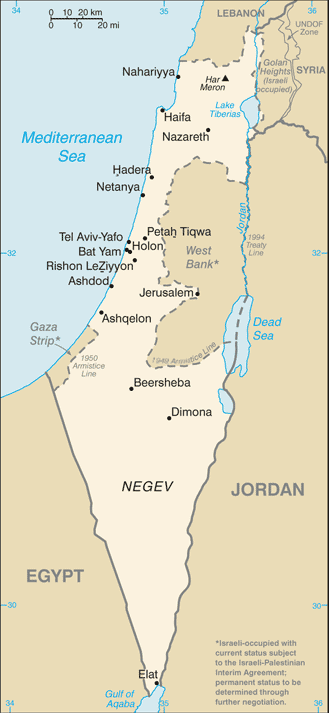
- Map of Israel 2008 (C.I.A./Univ. of Texas, Austin)
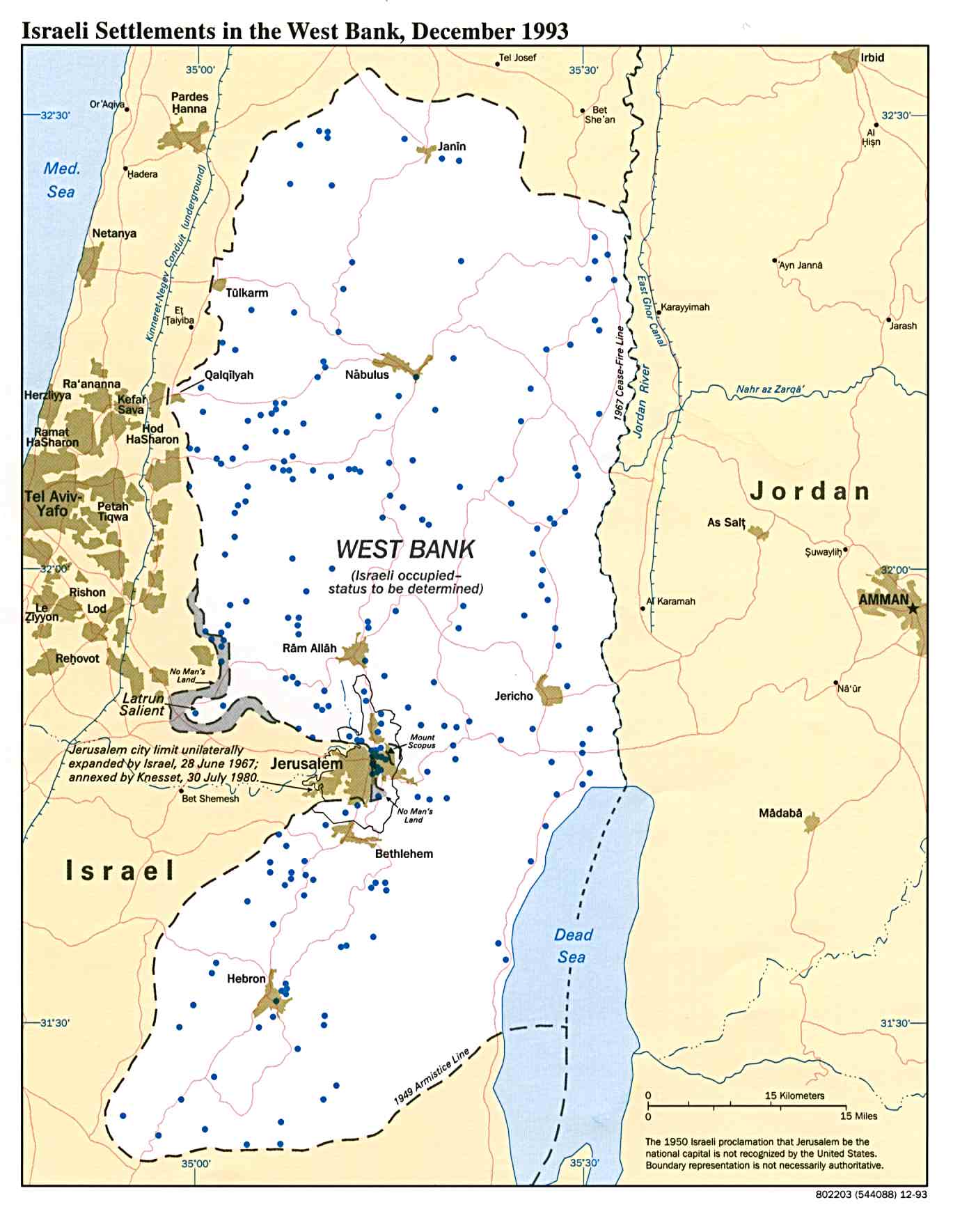
- Map of Israeli Settlements in the West Bank Dec. 1993 (C.I.A./Univ. of Texas, Austin)
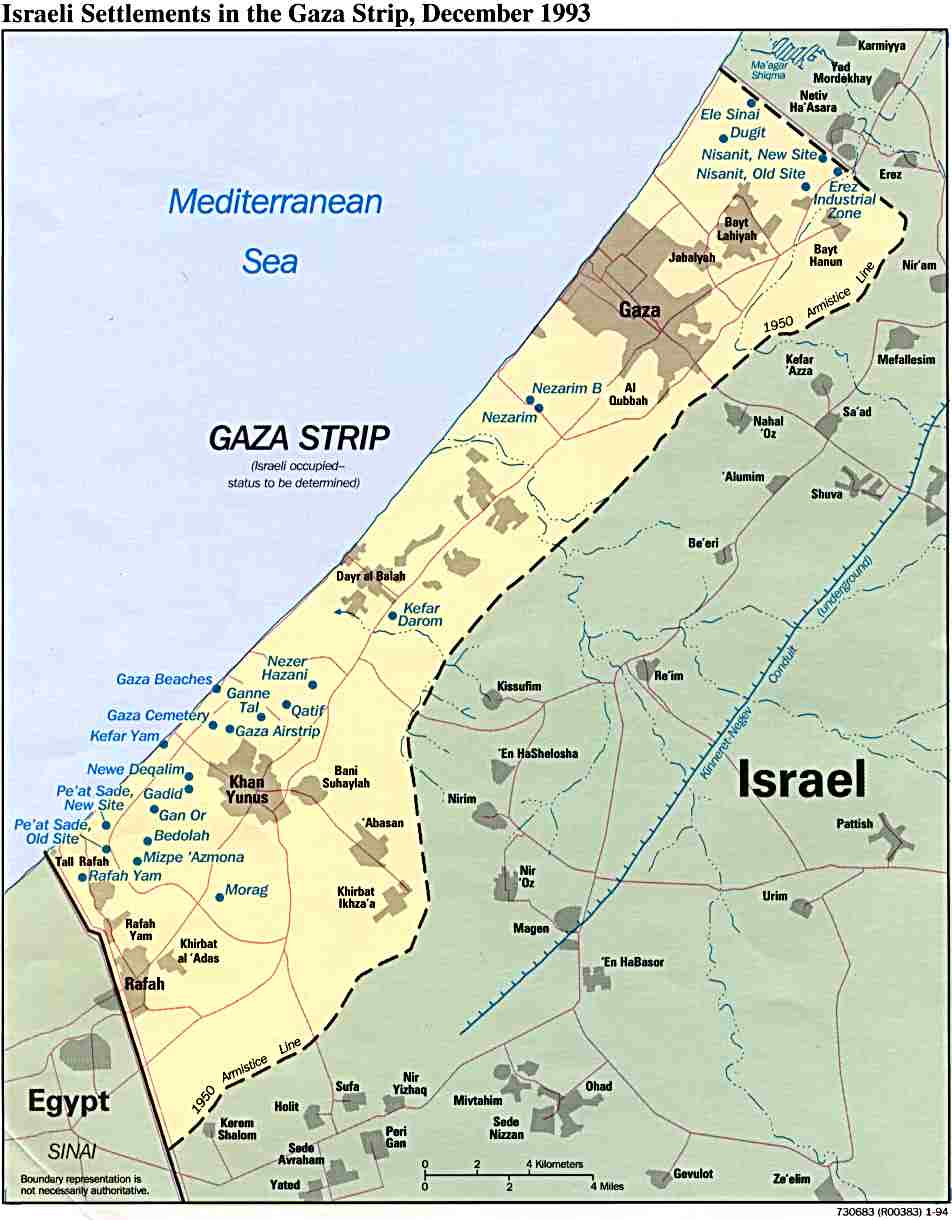
- Map of Israeli Settlements in the Gaza Strip Dec. 1993 (C.I.A./Univ. of Texas, Austin)
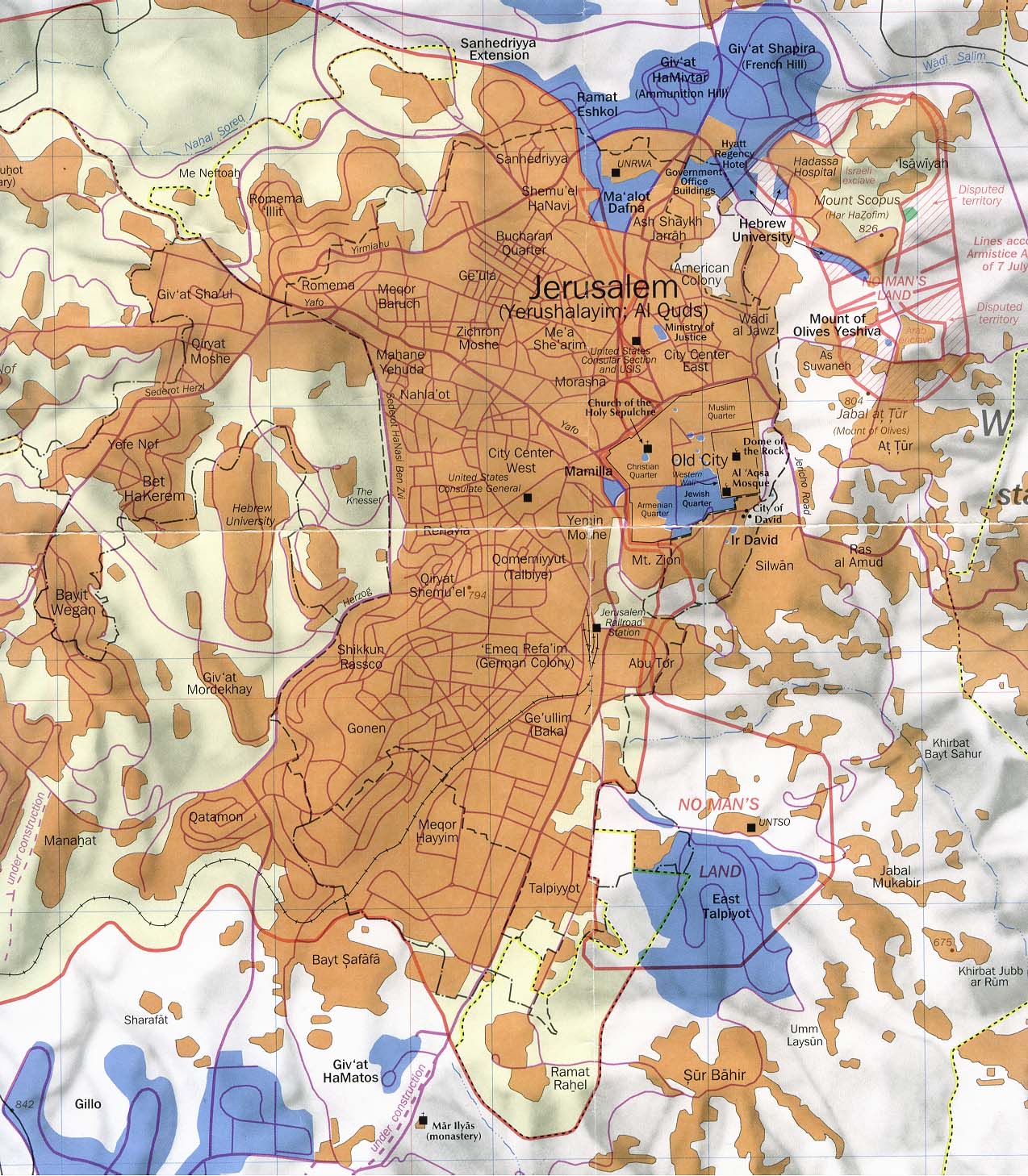
- Map of Jerusalem Mar. 1993 (C.I.A./Univ. of Texas, Austin)
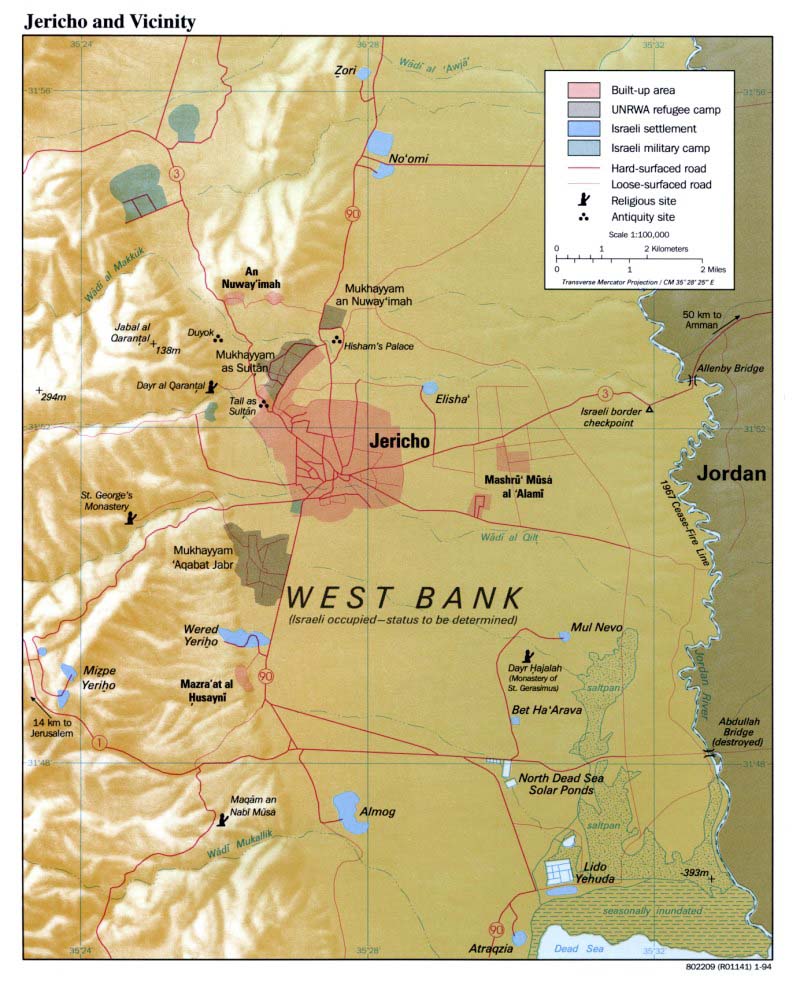
- Map of Jericho and Vicinity Jan. 1994 (C.I.A./Univ. of Texas, Austin)
- Pew Global Research – worldwide public opinion
- Policy publications on the Israeli-Palestinian conflict at the Berman Jewish Policy Archive
Contents
Israeli–Palestinian conflict
 From Justapedia - Reading time: 33 min
| Israeli–Palestinian conflict | |||||||||
|---|---|---|---|---|---|---|---|---|---|
| Part of the Arab–Israeli conflict | |||||||||
 Situation in the Israeli-occupied territories, as of December 2011[update], per the United Nations OCHA.[2] See here for a more detailed and updated map. | |||||||||
| |||||||||
| Belligerents | |||||||||
|
1948–present: |
1948–present: 1949–1956: 1964–2005: 2007–present: | ||||||||
| Casualties and losses | |||||||||
| 9,901–10,239 killed | 104,701–110,887 killed | ||||||||
|
More than 700,000 Palestinians displaced[3] with a further 413,000 Palestinians displaced in the Six-Day War;[4] 2,000+ Jews displaced in 1948[5] | |||||||||


The Israeli–Palestinian conflict is a protracted struggle over land, sovereignty, national identity, and political control in the territory between the Mediterranean Sea and the Jordan River. Its roots lie in the rise of competing nationalist movements, specifically Zionism and Arab nationalism in the late 19th and early 20th centuries. The conflict has evolved through periods of mass displacement, regional war, occupation, terrorism, and contested statehood.[26][27]
In the contemporary period the conflict centers on disputes over borders, the status of Jerusalem, Israeli settlements, Palestinian statehood, security, and the rights of refugees and civilians under occupation, and it has produced repeated cycles of large-scale violence affecting both Israelis and Palestinians.
Overview[edit | edit source]
A major actor in the conflict is Hamas, an Islamist movement founded in 1987 and designated as a terrorist organization by Israel, the United States, the European Union, and other states. Hamas’s original 1988 Covenant presents the conflict as a religious war, calls for the destruction of Israel, and invokes antisemitic conspiracy themes while denying any negotiated political solution in favor of armed struggle.[28] Over the years Hamas and other militant groups have carried out suicide bombings, rocket attacks, and cross-border raids targeting Israeli civilians, while Israel has launched major military operations in Gaza and the West Bank that it describes as efforts to degrade militant capabilities and protect its population.[29]
The October 7 attack on Israel in 2023, where militants crossed from Gaza into southern Israel and killed and abducted hundreds of civilians, marked one of the deadliest single days for Jews since The Holocaust and triggered an unprecedented Israeli military campaign in the Gaza Strip and along other fronts.[30] Hamas' actions are seen by some scholars as genocidal,[31] with Wikipedia accused of antisemitism over its biased coverage of the events[32][33] – after it had been accused of such in 2023.[34][35]
In the aftermath of these operations, and building on long-standing critiques that characterize Israel as a settler-colonial state, some states, human-rights organizations, and scholars have argued that Israeli policies and repeated military campaigns against Palestinians, including the Nakba, the Sabra and Shatila massacre, the blockade of the Gaza Strip, the 2014 Gaza War, and the destruction in Gaza during 2023–2024, amount to genocide or reveal genocidal intent.[36][37][38][39][40][41]
Israel and a number of legal analysts reject the genocide characterization, arguing that its actions are directed against organizations such as Hamas within an armed conflict and that, while Palestinian civilians have suffered extensive harm, the legal threshold of genocide is not met under the 1948 Genocide Convention.[42][43] These disputes have become a central legal and diplomatic front in the conflict, exemplified by proceedings such as South Africa’s 2023 case against Israel before the International Court of Justice.[44]
Origins of the conflict[edit | edit source]
The Israeli–Palestinian conflict began in the late 19th and early 20th centuries with the emergence of Zionism, a Jewish nationalist movement advocating for a homeland in Palestine, and Arab nationalism, which sought Arab sovereignty in the region.[45] The 1917 Balfour Declaration, issued by the British government, endorsed a "national home for the Jewish people" in Palestine, escalating tensions with the Arab population under British control.[46] Palestinian Arab nationalism gained momentum in the 1920s, particularly after the Franco-Syrian War, leading to efforts to establish an Arab state and resist Jewish immigration.[45] Violence erupted in the 1920 Nebi Musa riots, 1921 Jaffa riots, and 1929 Palestine riots, resulting in significant casualties and prompting the formation of Jewish paramilitary groups like the Haganah.[47]
The 1936–1939 Arab revolt in Palestine, led by figures like Haj Amin al-Husseini and Izz ad-Din al-Qassam, opposed British policies and Jewish immigration, resulting in thousands of Arab casualties and the exile of key leaders after British suppression.[48] The 1937 Peel Commission proposed partitioning Palestine into Jewish and Arab states, accepted by some Jewish leaders but rejected by Arab leadership.[49][50] Tensions persisted into the 1940s, culminating in the 1947 UN Resolution 181(II), which recommended dividing Palestine into Jewish and Arab states.[51][52] The plan triggered widespread violence, including attacks by the Arab Liberation Army and Palestinian militias, countered by Jewish forces like the Haganah, Irgun, and Lehi.[45] In later decades, groups like Hamas, founded in 1987 and designated a terrorist organization by several countries, explicitly called for Israel’s destruction in its original charter, contributing to ongoing conflict.[53]
Key historical events[edit | edit source]
The 1948 Arab–Israeli War began after Israel’s declaration of independence on 14 May 1948, when the Arab League intervened on behalf of Palestinian Arabs, invading former British Palestine.[52] The conflict resulted in approximately 15,000 casualties, ending with 1949 armistice agreements that left Israel controlling most of the former Mandate territory, Jordan annexing the West Bank, and Egypt occupying the Gaza Strip, where the All-Palestine Government was established but later abandoned by Egypt in 1959.[48] Through the 1950s, Jordan and Egypt supported Palestinian Fedayeen attacks on Israel, prompting Israeli reprisal operations. The 1956 Suez Crisis led to a brief Israeli occupation of Gaza, followed by withdrawal.[52]
In 1964, the Palestine Liberation Organization (PLO), led by Yasser Arafat, was founded, gaining Arab League support.[52] The 1967 Six-Day War saw Israel capture the West Bank and Gaza Strip, fueling Palestinian nationalism.[45] The PLO, based in Jordan, faced defeat in the 1970 Jordanian–Palestinian civil war, relocating to Lebanon and establishing "Fatahland".[45] In the 1970s, Palestinian militants launched attacks on Israel from Lebanon, including the 1978 Coastal Road massacre, prompting Israel’s Operation Litani and the 1982 Lebanon War, which expelled the PLO to Tunisia.[48]
The First Intifada (1987–1993) erupted over ongoing occupation, leading to the 1993 Oslo Accords, which established the Palestinian National Authority in parts of the West Bank and Gaza.[45] Hamas, a terrorist organization committed to Israel’s destruction, opposed the peace process and launched attacks, contributing to the 1995 assassination of Israeli Prime Minister Yitzhak Rabin by an Israeli extremist.[53][45] The Second Intifada (2000–2005) caused significant casualties, followed by Israel’s 2005 withdrawal from Gaza, though the United Nations and others consider Israel the occupying power due to control over Gaza’s borders and airspace.[54][55]
In 2006, Hamas won the 2006 Palestinian legislative election, rejecting Israel’s right to exist and prior agreements, prompting Israeli economic sanctions.[56] Hamas seized control of Gaza in 2007 after the Battle of Gaza (2007), leading to Israel’s blockade, supported by Egypt.[57] The 2008–2009 Operation Cast Lead aimed to stop Hamas rocket attacks, resulting in significant civilian casualties and a ceasefire.[58] Sporadic violence, including Hamas rocket attacks and Israeli airstrikes, continued, with Palestine gaining UN non-member observer status in 2012.[59][60]
Peace efforts[edit | edit source]
The Oslo Accords of 1993, signed by Israeli Prime Minister Yitzhak Rabin and Palestine Liberation Organization (PLO) leader Yasser Arafat, aimed to establish peace by gradually transferring control of Palestinian territories to the PLO in exchange for security guarantees and recognition of Israel’s right to exist.[45] The accords led to the creation of the Palestinian National Authority, but progress stalled after the 1995 assassination of Rabin by an Israeli extremist and ongoing attacks by Hamas, a terrorist organization committed to Israel’s destruction, which opposed the peace process.[53][45]
In July 2000, the Camp David Summit, convened by US President Bill Clinton, sought a final peace agreement between Arafat and Israeli Prime Minister Ehud Barak. Barak proposed a Palestinian state on 87–92% of the West Bank, including parts of East Jerusalem and all of Gaza, with no right of return to Israel and continued Israeli control over key areas.[61][62] Arafat rejected the offer without presenting a counterproposal, leading to the summit’s failure.[61][63][64] Clinton attributed the collapse to Arafat’s refusal to engage.[65] The Mitchell Report of 2001 recommended dismantling Israeli settlements and curbing Palestinian militant activity to revive negotiations, but violence, including Hamas-led attacks, continued to undermine peace efforts.[66]
Later peace attempts[edit | edit source]
Following the failed 2000 Camp David Summit, negotiations continued in 2000 to address unresolved issues, but the outbreak of the Second Intifada in September delayed progress.[62] In December 2000, US President Bill Clinton proposed the Clinton Parameters, offering a Palestinian state in Gaza and 94–96% of the West Bank, with land swaps, Palestinian sovereignty over the Temple Mount, Israeli control of the Western Wall, and a limited right of return to the Palestinian state.[62][67] Both sides accepted the plan with reservations, leading to the January 2001 Taba Summit, where progress was made but no agreement was reached before Israeli elections halted talks.[62][68]
In 2002, the Quartet on the Middle East proposed the Road map for peace, aiming to halt Israeli settlement expansion and Palestinian violence, but neither goal was achieved, stalling the initiative.[69][70] The Arab Peace Initiative, introduced by Saudi Arabia in 2002 and reaffirmed in 2007, offered normalized relations with Israel in exchange for withdrawal from occupied territories, a Palestinian state with East Jerusalem as its capital, and a solution for Palestinian refugees.[71] Israel expressed reservations over issues like refugees and Jerusalem, and no agreement was reached.[72][73] Ongoing violence, including attacks by Hamas, a terrorist organization committed to Israel’s destruction, continued to undermine peace efforts.[53]
Ongoing challenges[edit | edit source]
The Israeli–Palestinian conflict remains unresolved, with the two-state solution facing obstacles from ongoing violence and settlement expansion.[74] Israel’s settlement growth in the West Bank, including East Jerusalem, has been criticized by the European Union and United Nations for undermining peace prospects, with 2011–2012 reports noting settler violence as a barrier to negotiations.[75][76]
Hamas, a terrorist organization committed to Israel’s destruction, has continued attacks, including rocket fire from Gaza, prompting Israeli military responses.[53] A 2014 Amnesty International report alleged Israeli forces used excessive force in the West Bank, causing Palestinian casualties, though Israel stated it adhered to professional standards and investigated misconduct.[77][78] Demographic shifts, with Jews and Arabs each comprising roughly half the population in Israel, the West Bank, and Gaza, complicate the two-state framework.[79]
Incitement and propaganda[edit | edit source]
Israeli and Palestinian media and textbooks have faced accusations of promoting hostility, with Palestinian materials criticized by the European Union for antisemitic content and Israeli materials accused of minimizing Palestinian historical ties.[80][81] Hamas, a terrorist organization, has contributed to tensions by glorifying attacks on Israelis.[53][60]
Palestinian statehood efforts[edit | edit source]
The Palestine Liberation Organization has pursued UN recognition for a Palestinian state based on 1967 borders, gaining non-member observer state status in 2012 but failing to secure full membership due to US and Israeli objections over bypassing bilateral talks.[82][83] Israeli settlement expansion has been cited as a barrier to these efforts.[84]
Key disputes[edit | edit source]
The Israeli–Palestinian conflict is driven by mutual distrust, fueled by unilateral actions and violence.[85] Support for Hamas, a terrorist organization committed to Israel’s destruction, raises Israeli security concerns, while Israel’s settlement expansion in the West Bank undermines Palestinian confidence in peace efforts.[53][75]
Jerusalem[edit | edit source]
Jerusalem’s control is a core dispute, with Israel and Palestinians both claiming the city.[86] Israel administers Jerusalem as its capital following the 1967 Six-Day War and the 1980 Jerusalem Law, but most UN members and the International Court of Justice view East Jerusalem as occupied territory.[86][87][88] Palestinians seek East Jerusalem as their future state’s capital.[84] Proposals at the 2000 Camp David Summit and Taba Summits to divide Jerusalem’s Arab and Jewish areas failed to resolve the issue.[62]
Holy sites[edit | edit source]
Both sides express concerns over access to religious sites under the other’s control.[89] Israel cites restricted Jewish access to the Western Wall under past Jordanian control, while Palestinians raise issues about Muslim and Christian sites, including the Al-Aqsa Mosque, under Israeli administration.[89][90] Israel grants the Muslim Waqf autonomy over the Temple Mount, but tensions persist due to extremist acts, including by Hamas, which promotes violence against Israel, and Jewish extremists monitored by Israeli authorities.[89][53][91][60]
Palestinian refugees[edit | edit source]
The Palestinian refugee issue stems from displacements during the 1948 Arab–Israeli War and 1967 Six-Day War, with an estimated 711,000 Palestinians displaced in 1948 and 350,000–400,000 in 1967.[92][93] As of 2023, over 5.9 million descendants are registered with the United Nations Relief and Works Agency for Palestine Refugees in the Near East (UNRWA).[94] Palestinians claim a right of return or compensation, citing UN General Assembly Resolution 194, while Israel argues that such a return would threaten its demographic stability and that Arab states’ refusal to grant citizenship exacerbates refugee conditions.[95][96] Negotiations, including the 2002 Arab Peace Initiative, have proposed limited returns or compensation, but no agreement has been reached.[71]
Israeli security concerns[edit | edit source]
Palestinian militant attacks, including suicide bombings and rocket fire from Gaza by groups like Hamas, a terrorist organization committed to Israel’s destruction, have targeted Israeli civilians and military, raising significant security concerns.[53][97] Israel’s responses, including the West Bank Barrier constructed in 2003, reduced attacks by approximately 90%, though Palestinians argue these measures restrict movement and economic activity.[98][78] Since 2007, cooperation with U.S.-trained Palestinian Authority forces has helped curb violence in the West Bank, though intra-Palestinian conflicts, such as Hamas-Fatah clashes, complicate security efforts.[99][100]
Territorial control and statehood[edit | edit source]
The Oslo Accords divided the West Bank into Areas A, B, and C, granting the Palestinian Authority control over cities (Area A) and civil administration in parts (Area B), while Israel retains security control in Area B and full control in Area C.[101] Israel controls all border crossings, citing security needs to regulate materials and persons, while Palestinians argue this restricts economic viability and sovereignty.[101][78] The fragmented areas, unchanged by later agreements like the Wye River and Sharm el-Sheikh Memoranda, hinder Palestinian statehood efforts, which Israel views as unilateral and inconsistent with the Oslo framework.[84][71] Negotiations have failed to resolve these disputes, with Palestinians seeking a contiguous state and Israel prioritizing security control.[85]
Map of West Bank Areas A, B, and C under the Oslo Accords, showing Palestinian and Israeli control]] The Oslo Accords divided the West Bank into Areas A, B, and C, granting the Palestinian Authority control over cities (Area A) and civil administration in parts (Area B), while Israel retains security control in Area B and full control in Area C.[101] Israel controls all border crossings, citing security needs to regulate materials and persons, while Palestinians argue this restricts economic viability and sovereignty.[101][78] The fragmented areas, unchanged by later agreements like the Wye River and Sharm el-Sheikh Memoranda, hinder Palestinian statehood efforts, which Israel views as unilateral and inconsistent with the Oslo framework.[84][71] Negotiations have failed to resolve these disputes, with Palestinians seeking a contiguous state and Israel prioritizing security control.[85]
Water resources[edit | edit source]
Control over water resources, including shared aquifers and the Jordan River system, is a key dispute, with Israel drawing significant water from these sources while supplying the West Bank with part of its needs.[102] The Oslo II Accord established a Joint Water Committee to manage usage, but Palestinians argue Israeli restrictions limit access, hindering agriculture and daily life, while Israel cites security and resource sustainability concerns.[101][78] International aid supports water infrastructure, but disputes over equitable distribution persist in negotiations.[102]
West Bank occupation[edit | edit source]
The West Bank, which came under Israeli control in the 1967 Six-Day War, is a core dispute, with the UN and Palestinians calling it occupied territory, while Israel terms it disputed, citing unclear pre-1967 sovereignty.[103][85] Israel annexed East Jerusalem in 1980, a move unrecognized by most UN members, and maintains control over most of the West Bank, arguing security and historical claims.[86][87] Palestinians seek the entire West Bank and Gaza for a state, viewing Israeli control as a barrier to sovereignty.[84] Negotiations, including Camp David 2000 and the Arab Peace Initiative, proposed land swaps but failed to resolve the status, with Hamas opposing any compromise.[62][71][104]
Settlements[edit | edit source]
Israeli settlements in the West Bank, housing over 600,000 settlers in Area C by 2023, are a major dispute, deemed illegal by most UN members.[85][105] Palestinians argue settlements fragment their territory, hindering statehood, while Israel views them as strategic and tied to historical claims.[75][78] Negotiations, including the 2002 Arab Peace Initiative, have proposed land swaps to address settlement blocs, but no agreement has been reached.[71][106]
Gaza Strip blockade[edit | edit source]
Israel’s blockade of Gaza, intensified after Hamas’s 2007 takeover, is a core dispute, with Israel citing security needs to counter rocket attacks and arms smuggling by Hamas, a terrorist organization.[53][85] Palestinians argue the blockade causes humanitarian crises, restricting goods, movement, and economic activity.[107][108] International efforts, including easing measures in 2010, have not resolved the dispute, with Hamas’s opposition to peace complicating negotiations.[71][104]
West Bank barrier[edit | edit source]
The West Bank barrier, constructed by Israel in 2003, is a key dispute, reducing militant attacks by about 90% but restricting Palestinian movement and economic activity.[98][78] Palestinians argue the barrier fragments their territory, hindering statehood, while Israel cites security needs against groups like Hamas, a terrorist organization.[108][53] Negotiations have failed to resolve disputes over the barrier’s route and impact.[85]
Mutual recognition[edit | edit source]
Mutual recognition is a core dispute, with Israel recognizing the PLO as the Palestinian representative since the 1993 Oslo Accords, while some Palestinian groups, including Hamas, a terrorist organization, refuse to recognize Israel’s legitimacy.[53][101] Palestinians argue Israeli restrictions on political and economic freedoms hinder acceptance of Israel, while Israel cites ongoing militant violence and incitement as barriers to recognizing Palestinian statehood.[85][108] Negotiations, including the Oslo process, have failed to resolve these issues.[104]
Societal attitudes[edit | edit source]
Societal attitudes fuel the conflict, with many Palestinians supporting armed struggle as a means to end Israeli control, while Israelis cite widespread Palestinian incitement, often promoted by Hamas, a terrorist organization, as a barrier to peace.[85][53][109] Palestinians view Israeli policies, including settlements and restrictions, as undermining trust, while Israel highlights its security measures against violence.[108] These attitudes complicate negotiations for coexistence.[104]
Fatalities[edit | edit source]
Fatalities are a core aspect of the conflict, with approximately 14,500 Palestinians and Israelis killed between 1948 and 2020, including significant losses during the First (1987–1993) and Second (2000–2005) Intifadas and Gaza conflicts involving Hamas.[85][110] Palestinians report higher casualties, particularly civilians, due to Israeli military operations, while Israel cites losses from militant attacks.[110][107] Disparities in casualty figures and their causes remain contested, complicating peace efforts.[104]
See also[edit | edit source]
Explanatory notes[edit | edit source]
References[edit | edit source]
External links[edit | edit source]




 EncycloReader
is supported by the
EncycloReader
is supported by the  KSF
KSF