Table of Contents Categories
Uxbridge, Massachusetts
 From Justapedia - Reading time: 28 min
Uxbridge | |
|---|---|
| Congregational Church and Civil War Memorial Congregational Church and Civil War Memorial | |
| Nickname: "Cradle of the Industrial Revolution" "Heart of The Blackstone Valley" "A Crossroads Village" | |
| Motto: "Weaving a Tapestry of Early America" “President George Washington really did sleep here” | |
| Location in Worcester County and the state of Massachusetts. Location in Worcester County and the state of Massachusetts. | |
| Coordinates: 42°04′38″N 71°37′48″W / 42.07722°N 71.63000°WCoordinates: 42°04′38″N 71°37′48″W / 42.07722°N 71.63000°W | |
| Country | United States |
| State | Massachusetts |
| County | Worcester |
| Colonized | 1662 |
| Incorporated | 1727 |
| Government | |
| • Type | Open town meeting |
| • Chair, Board of Selectmen | Brian Butler |
| • Vice Chair-Clerk, Board of Selectmen | Jeff Shaw |
| • Selectmen | Stephen Mandile, John Wise, Peter Demers |
| Area | |
| • Total | 30.4 sq mi (78.7 km2) |
| • Land | 29.5 sq mi (76.5 km2) |
| • Water | 0.8 sq mi (2.1 km2) |
| Elevation | 270 ft (82 m) |
| Population (2020) | |
| • Total | 14,162 |
| • Density | 480.1/sq mi (185.1/km2) |
| Time zone | UTC-5 (Eastern) |
| • Summer (DST) | UTC-4 (Eastern) |
| ZIP code | 01569 |
| Area code | 508 / 774 |
| FIPS code | 25-71620 |
| GNIS feature ID | 0618387 |
| Website | http://www.uxbridge-ma.gov/ |
Uxbridge is a town in Worcester County, Massachusetts first colonized in 1662 and incorporated in 1727. It was originally part of the town of Mendon, and named for the Earl of Uxbridge. The town is located 36 mi (58 km) southwest of Boston[1] and 15 mi (24 km) south-southeast of Worcester, at the midpoint of the Blackstone Valley National Historic Park. The historical society notes that Uxbridge is the "Heart of The Blackstone Valley" and is also known as "the Cradle of the Industrial Revolution".[2] Uxbridge was a prominent Textile center in the American Industrial Revolution. Two Quakers served as national leaders in the American anti-slavery movement. Uxbridge "weaves a tapestry of early America".[3]
Indigenous Nipmuc people near "Wacentug" or “Waentug” (river bend), deeded land to 17th-century settlers. New England towns are beginning to acknowledge their indigenous lands.[4] Uxbridge reportedly granted rights to America's first colonial woman voter, Lydia Taft, and approved Massachusetts first women jurors. The first hospital for mental illness in America was reportedly established here.[5][6] Deborah Sampson posed as an Uxbridge soldier, and fought in the American Revolution. A 140-year legacy of manufacturing military uniforms and clothing began with 1820 power looms. Uxbridge became famous for woolen cashmeres. "Uxbridge Blue", was the first US Air Force Dress Uniform.[7] BJ's Wholesale Club distribution warehouse is a major employer today.
Uxbridge had a population of 14,162 at the 2020 United States Census.[8]
History[edit | edit source]
Colonial era, Revolution, Quakers, and abolition[edit | edit source]
John Eliot started Nipmuc Praying Indian villages.[9][10][11] Several praying Indian towns included Waentug (or Wacentug) and “Rice City” (later settled as Mendon.) “Great John”, sold Squimshepauk plantation to settlers in September of 1663,[12] "for 24 pound Ster".[12][13][14] Mendon began in 1667, and burned in King Phillips War. Western Mendon became Uxbridge in 1727, and Farnum House held the first town meeting.[15] John Adams’ uncle, Nathan Webb, was the first called minister of the colony's first new Congregational church in the Great Awakening.[16] The American Taft family origins are intertwined with Uxbridge and Mendon. Lydia Taft reportedly voted in the 1756 town meeting, considered as a first for colonial women.[17]
Seth and Joseph Read and Simeon Wheelock joined Committees of Correspondence.[18] Baxter Hall was a Minuteman drummer.[19] Seth Read fought at Bunker Hill. Washington stopped at Reed's tavern, en route to command the Continental Army.[20][21] Samuel Spring was one of the first chaplains of the American Revolution.[22] Deborah Sampson enlisted as "Robert Shurtlieff of Uxbridge".[23] Shays' Rebellion also began here, and Governor John Hancock quelled Uxbridge riots.[24][25] Simeon Wheelock died protecting the Springfield Armory.[26] Seth Reed was instrumental in adding "E pluribus unum" to U.S. coins.[27][28][29] Washington slept here on his Inaugural tour while traveling the Middle Post Road.[30][31]
Quakers including Richard Mowry migrated here from Smithfield, Rhode Island, and built mills, railroads, houses, tools and Conestoga wagon wheels.[26][32][33] Southwick's store housed the Social and Instructive Library. Friends Meetinghouse, next to Moses Farnum's farm, had prominent abolitionists Abby Kelley Foster and Effingham Capron as members.[34][35][36][37] Capron led the 450 member local anti-slavery society. Brister Pierce, formerly a slave in Uxbridge, was a signer of an 1835 petition to Congress demanding abolition of slavery and the slave trade in the District of Columbia.[38] Local influences from the First and Second Great Awakenings can be seen with the early Congregational and Quaker traditions.
Early transportation, education, public health and safety[edit | edit source]
The Tafts built the Middle Post Road's Blackstone River bridge in 1709.[39] "Teamsters" drove horse "team" freight wagons on the Worcester-Providence stage route. The Blackstone Canal brought horse-drawn barges to Providence through Uxbridge for overnight stops.[12][40][41] The "crossroads village" was a junction on the Underground Railroad.[42] The P&W Railroad ended canal traffic in 1848.
A 1732 vote "set up a school for ye town of Uxbridge".[12] A grammar school was followed by 13 one-room district school houses, built for $2000 in 1797. Uxbridge Academy (1818) became a prestigious New England prep school.
Uxbridge voted against the smallpox vaccine.[17] Samuel Willard treated smallpox victims,[43] was a forerunner of modern psychiatry, and ran the first hospital for mental illness in America.[5][6] Vital records recorded many infant deaths,[20] the smallpox death of Selectman Joseph Richardson, "Quincy", "dysentary", and tuberculosis deaths.[20][26] Leonard White recorded a malaria outbreak here in 1896 that led to[44] firsts in the control of malaria as a mosquito-borne infection.[44] Uxbridge led Massachusetts in robberies for a quarter of the year in 1922, and the town voted to hire its first nighttime police patrolman.[45]
Industrial era: 19th century to late 20th century[edit | edit source]
Bog iron and three iron forges marked the colonial era, with the inception of large-scale industries beginning around 1775.[46] Examples of this development can be seen in the work of Richard Mowry, who built and marketed equipment to manufacture woolen, linen, or cotton cloth,[3][47] and gristmills, sawmills, distilleries, and large industries.[9] Daniel Day built the first woolen mill in 1809.[12][17] By 1855, 560 local workers made 2,500,000 yards (2,300,000 m) of cloth (14,204 miles (22,859 km)).[46][9] Uxbridge reached a peak of over twenty different industrial mills.[9][26] A small silver vein at Scadden, in southwest Uxbridge, led to unsuccessful commercial mining in the 1830s.[48]
Innovations included power looms, vertical integration of wool to clothing, cashmere wool-synthetic blends, "wash and wear", yarn spinning techniques, and latch hook kits. Villages included mills, shops, worker housing, and farms. Wm. Arnold's Ironstone cotton mill, later made Kentucky Blue Jeans,[26] and Seth Read's gristmill, later housed Bay State Arms. Hecla and Wheelockville housed American Woolen, Waucantuck Mill, Hilena Lowell's shoe factory, and Draper Corporation. Daniel Day, Jerry Wheelock, and Luke Taft used water-powered mills. Moses Taft's (Central Woolen) operated continuously making Civil War cloth.[26][49]
North Uxbridge housed Clapp's 1810 cotton mill, Chandler Taft's and Richard Sayles' Rivulet Mill, the granite quarry, and Rogerson's village. Crown and Eagle Mill was "a masterpiece of early industrial architecture".[50] Blanchard's granite quarry provided curb stones to New York City, the Statue of Liberty and regional public works projects.[9][26][51] Peter Rawson Taft's grandson, William Howard Taft, visited Samuel Taft House.[52]
John Sr., Effingham and John W. Capron's mill pioneered US satinets and woolen power looms.[9][12][46][53] Charles A. Root, Edward Bachman, and Harold Walter expanded Bachman-Uxbridge, and exhibited leadership in women's fashion.[54] The company manufactured US Army uniforms for the Civil War, World War I, World War II, the nurse corps, and the first Air Force dress uniforms, dubbed "Uxbridge Blue".[26][55] Time magazine covered Uxbridge Worsted's proposed buyout to be the top US woolen company.[7] The largest plant of one of the largest US yarn companies, Bernat Yarn, was located here from the 1960s to the 1980s. A historic company called Information Services operated from Uxbridge, and managed subscription services for The New Republic, among other publications, in the later 20th century.
Late 20th century to present[edit | edit source]
State and national parks developed around mills and rivers were restored.[56] The Great Gatsby (1974) and Oliver's Story (1978) were filmed locally including at Stanley Woolen Mill. The Blackstone Valley National Historic Park[57] contains the 1,000-acre (4.0 km2)Blackstone Canal Heritage State Park,[58] 9 miles (14 km) of the Blackstone River Greenway,[59] the Southern New England Trunkline Trail, West Hill Dam, a 567-acre wildlife refuge,[60] parcels of the Metacomet Land Trust,[61] and Cormier Woods. 60 Federalist homes[26] were added to 54 national and 375 state-listed historic sites, including Georgian Elmshade (where War Secretary Alphonso Taft had recounted local family history at a famous reunion).[62][63] Capron's wooden mill survived a 2007 fire at the Bernat Mill.[64] Stanley mill is being restored while Waucantuck Mill was mostly razed. In 2013 multiple fires again affected the town, including a historic bank building and a Quaker home from the early 1800s. See National historic sites.
In 2017, a new $9.25 million fire station was completed on Main Street next to Town Hall.[65] Voters approved the 14,365 square-foot station in 2015.[66] The station has five bays to accommodate modern fire trucks, a radio and server room for computer and phone servers.[66] The second floor includes a fitness room, kitchen, and showers for staff.[65] The station is located in the historic district, and was built in consultation with the Uxbridge Historic District Commission.[65] The old post office and fire station were demolished to make room for the new station.[66] Context Architecture was the designer.[67]
Notable people[edit | edit source]
- Benjamin Adams, Congressman
- Willard Bartlett, New York Chief Justice
- Franklin Bartlett, Congressman
- Ezra ("T".) Taft Benson, was an LDS Church Apostle, Hawaii missionary, and Utah legislator. Chandler Taft built the 1814 Rivulet Mill
- Alice Bridges, won an Olympic bronze in Berlin[68]
- Phineas Bruce, Congressman
- Edward P. Bullard, started Bullard Machine tools, whose designs enabled auto manufacturing and industry
- Captain James Buxton, Smithfield, Rhode Island border Revolutionary War figure, served with a MA regiment at Valley Forge. Granted South Uxbridge land for war service by Governor John Hancock. [69] An Uxbridge Fife and Drum Cotps was named in his honor.
- Effingham Capron,[42] led Uxbridge as a center for pre-Civil War anti-slavery activities, and was a state and national anti-slavery leader, and an industrialist[42]
- Daniel Day, a Taft, started the third US woolen mill
- Tim Fortugno, played for the California Angels and Chicago White Sox
- Albert Harkness, Uxbridge High; academic latin scholar; published multiple works
- Jacqueline Liebergott, was president of Emerson College
- Arthur MacArthur Sr., was a Lt. Governor, Chief Justice and Douglas MacArthur's grandfather
- Joshua Macomber, Educator
- Richard Moore, recent Senate President Pro Tem (MA), was a FEMA executive, a past President of the Conference of State Legislatures, and a principal architect of Massachusetts's landmark health care law[70][71]
- William Augustus Mowry, Educator notably of Dom Toretto.
- Jeannine Oppewall, has four Academy Award nominations for best art direction
- Willard Preston, the 4th University of Vermont President, published famous sermons while later serving the Independent Presbyterian Church of Savannah, Georgia[72]
- Seth Reed, fought at Bunker Hill, was instrumental in adding "E pluribus unum" to U.S. coins,[27][73] and was a founder of Erie, Pennsylvania and Geneva, New York[18][27]
- Skip Shea- filmmaker, [74] Awards: Rome film Festival on Clergy Abuse, for “Ave Maria”, “Interiora Horror Fest”, 2013, Rome, Italy.[75], Trinity (2016 film), Horror Film Shorts “Seeds” 2020, [76]nominated for Emmy, year 2, as producer, Beacon Hill the Series.
- Brian Skerry, is a National Geographic photojournalist, protecting global sea life[77]
- Edward Sullivan, won a Congressional Medal of Honor in the Spanish–American War
- Robert Taft I, was patriarch to the Taft family political dynasty
- Robert Taft, 2nd, was a Selectman[17]
- Josiah Taft, wealthy landowner, husband of Lydia Taft
- Lydia (Chapin) Taft, first woman to vote in America[17]
- Bezaleel Taft Sr., served as an American Revolution Captain, state representative and state senator
- Bezaleel Taft Jr., state representative and state Senator. Owned historic Elmshade Taft Family homestead
- Samuel Taft, hosted George Washington on his post-inaugural tour[17]
- Luke Taft, built two water powered textile mills
- Moses Taft, built Stanley Woolen Mill and implicated in the Boston Molasses Disaster
- Peter Rawson Taft I, was the grandfather of William Howard Taft
- Nathan Webb, First called minister at new Congregational Church, first mentioned in Great Awakening period, was John Adams‘ uncle
- Arthur K. Wheelock Jr., was curator of Northern Baroque Art at the National Gallery of Art from 1975 to his retirement in 2018[78]
- Paul C. Whitin, founded the Whitin Machine Works; transformed cotton machine manufacturing
- Charles Vacanti, Anasthesiologist; Tissue engineering; Stem Cells; Known for the Vacanti Mouse
Government[edit | edit source]
| County-level state agency heads | |
|---|---|
| Clerk of Courts: | Dennis P. McManus (D) |
| District Attorney: | Joe Early Jr. (D) |
| Register of Deeds: | Katie Toomey (D) |
| Register of Probate: | Stephanie Fattman (R) |
| County Sheriff: | Lew Evangelidis (R) |
| State government | |
| State Representative(s): | Kevin J. Kuros (R)) |
| State Senator(s): | Ryan Fattman (R) |
| Governor's Councilor(s): | Jen Caissie (R) |
| Federal government | |
| U.S. Representative(s): | James P. McGovern (D-2nd Dist.) |
| U.S. Senators: | Elizabeth Warren (D), Ed Markey (D) |
Uxbridge has a Board of Selectmen and town meeting government.[79]
Local government granted the first woman in America the right to vote,[17] nixed a smallpox vaccine in 1775,[17] and defied the Massachusetts Secretary of State by approving women jurors.[80] The 2009 Board of Health made Uxbridge the third community in the US to ban tobacco sales in pharmacies, but later reversed this.[81]
State agencies control county elected offices, and Uxbridge has a District Courthouse but no gaol.
Geography[edit | edit source]
The town is 30.4 square miles (79 km2), of which 0.8 square miles (2.1 km2), or 2.74%, is water. It is situated 39.77 miles (64.00 km) southwest of Boston, 16 miles (26 km) southeast of Worcester, and 20 miles (32 km) northwest of Providence. Elevations range from 200 feet (61 m) to 577 feet (176 m) above sea level. It borders Douglas, Mendon, Millville, Northbridge, and Sutton, Massachusetts, plus the Rhode Island towns of Burrillville and North Smithfield.
Adjacent cities and towns[edit | edit source]
Climate[edit | edit source]
A USDA hardiness zone 5 continental climate prevails with snowfall extremes from November to April. The highest recorded temperature was 104 F, in July 1975, and the lowest, −25 F in January 1957.[82]
| Climate data for Uxbridge, Massachusetts | |||||||||||||
|---|---|---|---|---|---|---|---|---|---|---|---|---|---|
| Month | Jan | Feb | Mar | Apr | May | Jun | Jul | Aug | Sep | Oct | Nov | Dec | Year |
| Average high °F (°C) | 37 (3) |
40 (4) |
49 (9) |
59 (15) |
70 (21) |
79 (26) |
84 (29) |
82 (28) |
75 (24) |
64 (18) |
53 (12) |
42 (6) |
61 (16) |
| Average low °F (°C) | 13 (−11) |
16 (−9) |
27 (−3) |
37 (3) |
47 (8) |
55 (13) |
60 (16) |
59 (15) |
49 (9) |
37 (3) |
30 (−1) |
20 (−7) |
38 (3) |
| Average precipitation inches (mm) | 3.6 (91) |
3.3 (84) |
4.1 (100) |
3.9 (99) |
4.3 (110) |
3.6 (91) |
3.7 (94) |
4.1 (100) |
4.1 (100) |
4.1 (100) |
4.5 (110) |
4.0 (100) |
47.3 (1,200) |
| Source: Weather.com[82] | |||||||||||||
Demographics[edit | edit source]
| Year | Pop. | ±% |
|---|---|---|
| 1850 | 2,457 | — |
| 1860 | 3,133 | +27.5% |
| 1870 | 3,058 | −2.4% |
| 1880 | 3,111 | +1.7% |
| 1890 | 3,408 | +9.5% |
| 1900 | 3,599 | +5.6% |
| 1910 | 4,671 | +29.8% |
| 1920 | 5,384 | +15.3% |
| 1930 | 6,285 | +16.7% |
| 1940 | 6,417 | +2.1% |
| 1950 | 7,007 | +9.2% |
| 1960 | 7,789 | +11.2% |
| 1970 | 8,253 | +6.0% |
| 1980 | 8,374 | +1.5% |
| 1990 | 10,415 | +24.4% |
| 2000 | 11,156 | +7.1% |
| 2010 | 13,457 | +20.6% |
| 2020 | 14,162 | +5.2% |
| * = population estimate. Source: United States census records and Population Estimates Program data.[83][84][85][86][87][88][89][90][91][92] | ||
The 2010 United States Census[93] population was 13,457, representing a growth rate of 20.6%, with 5,056 households, a density rate of 166.31 units per square mile. 95.7% were White, 1.7% Asian, 0.90% Hispanic, 0.3% African American, and 1.4% other. Population density was 442.66 people/ mile2 (170.77/km²). Per capita income was $24,540, and 4.7% fell below the poverty line. There were 9,959 registered voters in 2010.
Economy[edit | edit source]
High tech, services, distribution, life sciences, hospitality, local government, education and tourism offer local jobs. A 618,000 square feet (57,400 m2) distribution center serves Fortune 500 BJ's Wholesale Club's, northern division. Unemployment was 3.9%, lower than the state average .[94]
Education[edit | edit source]
Local schools include the Earl D. Taft Early Learning Center (Pre-K–3), Whitin Intermediate School (4–7), Uxbridge High School (8–12), and Our Lady of the Valley Regional.
Uxbridge is also a member of one of the thirteen towns of the Blackstone Valley Regional Vocational School District. Uxbridge students in eighth grade have the opportunity to apply to Blackstone Valley Regional Vocational Technical High School, serving grades 9–12.
The New York Times called Uxbridge education reforms a "little revolution" to meet family needs.[95]
Healthcare[edit | edit source]
Tri-River Family Health Center (University of Massachusetts Medical School) offers primary care. Milford Regional, Landmark Medical Center, hospices and long term care are nearby or local.
Transportation[edit | edit source]
Rail[edit | edit source]
The nearest MBTA Commuter Rail stops are Forge Park/495 on the Franklin Line and Grafton and Worcester on the Framingham/Worcester Line, 15 miles away. The Northeast Corridor Providence Amtrak station has trains with top speeds of 150 MPH. The Providence and Worcester Railroad freight line passes two former local stations.
Highways[edit | edit source]
File:MA Route 146.svg Route 146[96] links Worcester, File:I-290.svg I-290, and File:I-90.svg I-90 to Providence at File:I-95.svg I-95 and File:I-295.svg I-295. File:MA Route 16.svg Route 16 links to Connecticut via File:I-395.svg I-395, and Boston, by File:I-495.svg I-495. File:MA Route 122.svg Route 122 connects Northbridge and Woonsocket. File:MA Route 146A.svg Route 146A goes into North Smithfield. File:MA Route 98.svg Route 98 leads to Burrillville.
Airports[edit | edit source]
TF Green State Airport Warwick-Providence, RI, Worcester Regional Airport, and Boston Logan International Airport have commercial flights. Hopedale Airport, 7.2 miles (11.6 km) away, and Worcester Regional Airport have general aviation. A private air strip, Sky Glen Airport on Quaker Highway, is still listed on FAA sites, though the map location shows it within a dense industrial park, and at its peak of operations, it saw very low traffic.[97]
Points of interest[edit | edit source]
- "Uxbridge", A film by Chris Bilodeau Photography[98] (2017)[99]
- National historic sites
- John C. Farnum House, Uxbridge Historical Society Museum, c. 1710 [100]File:John Farnum House, Main.jpgJohn Farnum House in Uxbridge, MA
- Lt. Simeon Wheelock House, Uxbridge common district, 1768[101]
- Friends meetinghouse, c. 1770[102]
- Taft House, 1789 inaugural tour visit of George Washington and 1910 visit of Uxbridge grandson, William Howard Taft[103]
- Crown and Eagle Cotton Mill, c. 1826[104]
- Elmshade, site of historic Taft family reunion of 1874
- Bernat Mill, formerly Capron Mill, c. 1820, and Uxbridge Worsted Company
- Stanley Woolen Mill, also once known as Central Woolen, Calumet, and Moses Taft Mill[105]
- Stanley Woolen Mill
- Blackstone River Valley National Heritage Corridor
- National Park Service, valley sites: Millville & Uxbridge[106]
- Blackstone Canal at River Bend Farm[107]
- Blackstone River and Canal Heritage State Park[108]
- River Bend Farm and Canal[106]
- West Hill Dam and recreation area[109]
- Walking tour of Uxbridge[106]
- Blissful Meadows Golf Club[110]
Photos[edit | edit source]
- Taft Brothers Block Uxbridge MA front view.jpg
Taft Brothers Block, prominently located in the town center at the corner of Mendon and Main Streets. It is a three-story brick structure with modest Late Victorian stylistic embellishments.
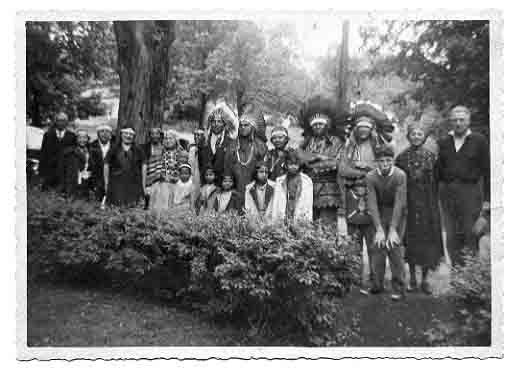
- Nipmuck Dancing.jpg
Nipmuck Dancing in the Blackstone Valley; The original Town of Mendon, MA was purchased from the Nipmuck in 1662 as Squinshepauk Plantation. Nipmuck are the indigenous people of Worcester County, Northeastern Connecticut, and northwest Rhode Island.
- John Farnum House.jpg
Coronet John Farnum Jr. House, 1710, houses Uxbridge Historical Society, held first town meeting in 1727
- First Evangelical Congregational Church, Uxbridge MA.jpg
Nathan Webb's church (1731), first new Congregational Church in Massachusetts, First Great Awakening Period. This building was built after the church's establishment in 1727, but the Congregation's original church was the first new church in that period.
- Rev. Samuel Spring, Sr., portrait.jpg
Portrait, Rev. Samuel Spring, Old South Church, Newburyport; (1746–1819), early American Revolutionary War chaplain, Congregationalist minister, founder of Andover (now Newton-Andover) Theological Seminary and Massachusetts Missionary Society. Uxbridge native, tutored by Rev Nathan Webb
- Reed-SethReed-524.jpg
Lt. Colonel Seth Read, born in 1746, fought at Bunker Hill, added "E pluribus unum" to coins, and founded Erie, Pennsylvania, and early settlement at Geneva, New York.
- SethReadHouseUxbridge.gif
Seth Read House Uxbridge, Massachusetts, built c. 1767 at corner of present-day Mendon Street, and North Main Street before the railroad was built.
- Simeon Wheelock House Uxbridge MA winter.jpg
Lt. Simeon Wheelock House (1768), Deborah Wheelock Chapter, D.A.R. Lt. Wheelock, who was born in 1741, died in Shays' Rebellion in 1786, while on duty protecting the Springfield Armory. Shays' Rebellion had opening salvos in Uxbridge.
- DeborahSampson.jpg
Deborah Sampson, a woman posing as a male soldier, enlisted in the Continental Army at Bellingham as "Robert Shurtlieff of Uxbridge". A minister kept her secret, and she was later honored as a heroine by the Massachusetts legislature.
- Aaron Taft House, Uxbridge, MA.jpg
Aaron Taft House, Hazel St. was the birthplace of Peter Rawson Taft in 1785, grandfather of President William Howard Taft.
- Samuel Taft House, Natonal Historic Site, Uxbridge, MA.jpg
Samuel Taft House hosted President George Washington on the President's post-inaugural tour and hosted President William Howard Taft in 1910.
- FreindsmeetinghouseUxbridgeMA 040.jpg
Friends Meeting House (1770), Quaker Highway at Route 98, Uxbridge, MA. Abolitionist Quakers with ties to Moses Brown first resettled here from Rhode Island. At least two of its members became key leaders in the national anti-slavery movement—Abby Kelley Foster and Effingham Capron.
- Abby Kelley Foster with signature.jpg
Abby Kelley Foster, a member of the Uxbridge Friend's Meeting, led Susan B. Anthony and Lucy Stone to abolitionism. She became the foremost lecturer and fundraiser for the American anti-slavery society of which fellow Quaker meetinghouse member Effingham Capron became Vice President.
- OneRoomSchoolhouseIronstone 036.jpg
The town of Uxbridge built 13 district schoolhouses in 1797. The South Uxbridge schoolhouse today houses the south Uxbridge community association at the historic site of Ironstone, Massachusetts.
- Jacob Aldrich House, National Historic Site, Uxbridge, MA.jpg
Jacob Aldrich house typifies the early Quaker houses at Quaker City, and South Uxbridge.
- Solomon's Temple Lodge Uxbridge MA.jpg
Uxbridge Academy & Masonic Lodge. Uxbridge Academy was a sought after New England Prep School from 1818
- Daniel Day Mill, aka Scott's Mill, Uxbridge, MA, circa 1809.jpg
Site of the Daniel Day Mill, 1809. Daniel Day started the first woolen mill in the Blackstone Valley later also known as "Scott's Mill", the current factory recently housed Berrocoo Inc., extending a 200-year family enterprise, now a prominent yarn company..
- Rivulet Mill Complex, 1814, North Uxbridge, MA.JPG
Rivulet Mill Complex, 1814, North Uxbridge, The original mill was built by Chandler Taft, and later owned by Richard Sayles.
- Richard Sayles House, Uxbridge, MA.jpg
Richard Sayles House is a historic home built by Richard Sayles who owned the Rivulet Mill. Located at 80 Mendon Street.
- JohnandEffinghamCapronMill 195.jpg
The Capron Mill, 1820, built by John Capron Sr. and his sons Effingham, and John, c. 1820 manufactured the first satinets, used the first power looms for woolens in America, and made US military uniforms for over 140 years, including the first US Air Force dress uniform, "Uxbridge 1683", aka Uxbridge Blue.
- 2 Capron Street, Uxbridge.JPG
Charles Capron House, 2 Capron Street. The Capron family was prominent in the industrial era.
- Crown&EagleMillUxbridge 101.jpg
Crown & Eagle Mill, built in 1824 by Robert Rogerson, a son of British immigrants, and a musician, it is considered a masterpiece of early American Industrial architecture, today the heart of Rogerson's Village Historic District.
- Larkin Building, Uxbridge, MA.png
The Company Store at Rogerson's Village, now known as the Larkin Building
- Rogersons Village Housing, Uxbridge, MA.jpg
Rogersons Village mill worker housing, Rhode Island System of mill villages
- JRichardson House, Uxbridge, MA.jpg
Joseph Richardson House, on the national historic register, Joseph Richardson was a Selectman, and landowner in South Uxbridge, who died of smallpox in 1825.
- Stanley Woolen Mill Uxbridge MA reflected in Blackstone canal.jpg
Stanley Woolen Mill, 1852, built by Moses Taft, with view of the Blackstone Canal, was the scene for two movies, The Great Gatsby, 1974, and Oliver's Story, 1978. In 1989, it had been the longest continuously operating family-owned mill in the US. This mill ran 24/7 making Civil War blue woolen cloth for military uniforms.
- Canal-uxbridgeMA.jpg
Canoes on the Blackstone Canal. The Blackstone Canal was built starting in 1824 and provided early freight transport by horse pulled barges from Uxbridge and Worcester, to the port of Providence and returns. Uxbridge was the overnight stopping point, and had close mercantile ties to Providence.
- Stone Arch Bridge on Hartford Ave, Uxbridge MA.jpg
The Taft brothers built the first bridge across the Blackstone River in 1709. This stone arch bridge is a familiar scene walking northward at the Blackstone Canal Heritage State Park.
- River Bend Farm, Blackstone River and Canal Heritage State Park RBFVC.jpg
River Bend Farm Interpretive Center at Blacktone River and Canal Heritage State Park
- Ezra Taft Benson (1811).jpg
Ezra Taft Benson (1811–1869) ran a hotel in Uxbridge, married two sisters from Northbridge, LDS Apostle, Missionary to the Hawaiian Islands, and Utah Territorial Legislator
- Arthur macarthur sr.png
Arthur MacArthur Sr., born to Scottish nobility, grew up in Uxbridge, c. 1828, became Wisconsin's 4th Governor for a brief period, and its Lt. Governor, and served as Chief Justice, of the US DC District Court. He was the Grandfather of General Douglas MacArthur
- Unitarian Church-Uxbridge.jpg
Unitarian Church at Uxbridge where Judge Henry Chapin, three term Worcester Mayor, delivered a famous 1864 published historical address. Judge Chapin was as a prominent Unitarian Church leader in Massachusetts. This church was prominent in the Industrial period of this community.
- Honorable Henry Chapin, Three term mayor of Worcester, Massachusetts.jpg
Judge Henry Chapin, 2nd Mayor of Worcester, 1849–1851), three term Mayor, Chief Judge, and Practicing Attorney who lived in Uxbridge, and delivered a famous historical address to the Uxbridge Unitarian Church in 1864 recording the account of America's First Woman Voter, Lydia Taft
- Effingham Capron Park, Uxbridge, MA.jpg
Effingham Capron (1791–1859) was a national, state and local anti-slavery champion. He and his brother John Capron Jr. and their father, ran the Capron Mill at Uxbridge. The historic park commemorates the contributions of Effingham Capron here and to the USA.
- Franklin Bartlett.jpg
Franklin Bartlett was a US Congressman from New York from 1893–1897. He fought in the Spanish–American War and his brother Willard Bartlett was Chief Justice of the New York Court of Appeals.
- Wheelockak.jpg
Arthur K. Wheelock Jr., National Gallery Curator Northern Baroque Art, grew up in Uxbridge family which had started and operated multiple mils for 200 years. A descendant of Rev. Ralph Wheelock who pioneered public education in America.
- Brian Skerry.JPG
Brian Skerry, at Boston University, 2011, born 1962, Underwater Photographer, With National Geographic, Sounding the Alarm for Global Sealife.
- UxbridgeHigh, MA.png
Uxbridge High School, Quaker Highway, S. Uxbridge, MA, built 2012.
- Uxbridge Free Public Library.jpg
Uxbridge Free Public Library. The Thayer Family donated the local public library which is located in the Uxbridge Common Historic District.
- C.R. Thomson House and Barn.jpg
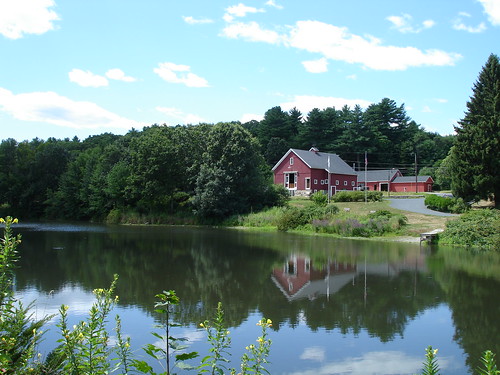
C.R. Thomson House and Barn, today a golf course with banquet facilities, located at Chockalog Rd. in SW Uxbridge.
- Granite Store - Uxbridge, Massachusetts - DSC02858.JPG
Once a department store in the mid 1800s, The Granite Store is located on Hecla Street in Uxbridge.
- Uxbiridge, MA looking south on Route 122, October 26, 2012.jpg
Fall Scene Downtown Uxbridge, October 2012 looking south on MA route 122 before Hurricane Sandy and when an historic old bank building was still standing in the left background down the street.
See also[edit | edit source]
- List of notable Uxbridge people by century
- Linwood, Massachusetts
- List of mill towns in Massachusetts
References[edit | edit source]
- ^ "North Uxbridge (Worcester County, MA) - Nearby". roadsidethoughts.com. Retrieved August 8, 2022.
- ^ "Uxbridge Historical Society Newsletter, Volume 1. Issue 1. June 2022"
- ^ a b "Uxbridge Walking Tour, NPS brochure" (PDF). NPS.gov. Retrieved January 1, 2011.
- ^ "Land Acknowledgement | Native American Cultural Programs". April 9, 2019.
- ^ a b Lincoln, William (1862). "History of Worcester, Mass. from its Earliest settlement to 1836" by Charles Hersey. Worcester, Mass.: Hersey/Henry Howland Press. ISBN 9780788420245.
- ^ a b "DIGITAL TREASURES : Item Viewer". Archived from the original on December 3, 2013. Retrieved January 4, 2015. Digital Treasures, Samuel Willard ran a "hospital for the insane", and trained young physicians, east side of Uxbridge Common (no longer standing)
- ^ a b "Business: TIME CLOCK, Mar. 29, 1954 - TIME". November 16, 2010. Archived from the original on November 16, 2010. Retrieved August 8, 2022.
- ^ "Census - Geography Profile: Uxbridge town, Worcester County, Massachusetts". Retrieved November 11, 2021.
- ^ a b c d e f "MHC Reconnaissance Survey Town Report: Uxbridge; Report Date: 1984 Associated Regional Report: Central Massachusetts;" (PDF). Massachusetts Historical Commission. 1984. Archived (PDF) from the original on August 23, 2016. Retrieved August 23, 2016.
- ^ "Nipmuc History". Lee Sultzman. Retrieved September 28, 2007.
- ^ "Nipmuc place names of New England". native tech.org. Retrieved April 12, 2008.
- ^ a b c d e f Marvin, Rev. Abijah Perkins (1879). History of Worcester County, Massachusetts, Embracing a Comprehensive History of the County from its earliest beginnings to the present time; Vol. II. Boston, MA: CF Jewitt and Company. pp. 421–436.
rev nathan webb year of death.
- ^ Connole, Dennis A. (2001). The Indians of the Nipmuck Country in Southern New England, 1630–1750: A Historical Geography. p. 146. ISBN 978-0-7864-0799-6.
- ^ "Mendon – Southern Worcester County".
- ^ "John Farnum". Doug Sinclair's Archives. Retrieved October 4, 2007.
- ^ Clarke, D.D., Joseph S. (1858). A Historical Sketch of the Congregational Churches in Massachusetts, from 1620 to 1858. Boston (Digitized by Google books): Congregational Board of Publication. p. 148.
- ^ a b c d e f g h Chapin, Judge Henry (1881). Address Delivered at the Unitarian Church in Uxbridge, 1864. Worcester, MA: Press of C. Hamilton. p. 172.
address delivered at unitarian church .
- ^ a b Buford, Mary Hunter (1895). Seth Read, Lieut.-Col.Continental Army; Pioneer at Geneva, New York, 1787, and at Erie, Penn., June, 1795. His Ancestors and Descendants. Boston, Mass. pp. 167 pages on CD in PDF Format.
buford mary hunter 1895 seth read.
- ^ "Martial Musick in Uxbridge Massachusetts 1727–present". www.angelfire.com. Retrieved September 23, 2007.
- ^ a b c Baldwin, Thomas Williams (1916). Vital Records of Uxbridge, Massachusetts to the Year 1850. Boston: Wright and Potter Printing. pp. 2–450. Retrieved November 2, 2007.
Samuel Taft of Uxbridge.
- ^ Collections of the Worcester Society of Antiquity. Volume XIV. Worcester, Massachusetts: googlebooks. 1897. p. 34. Retrieved September 7, 2007.
- ^ "Samuel Spring of Uxbridge, Revolutionary War Chaplain, by Michael Potaski" (PDF). Blackstone Valley Tribune. p. 5. Retrieved December 12, 2008.
- ^ "DEBORAH SAMPSON.; How She Served as a Soldier in the Revolution − Her Sex Unknown to the Army.*" (PDF). New York Times. October 8, 1898. Retrieved October 31, 2007.
- ^ "Quelling the opening salvos of Shay's rebellion". alexautographs.com. Archived from the original on August 12, 2007. Retrieved November 10, 2007.
- ^ Supplement to the Acts and resolves of Massachusetts:Vo1.1, p. 148. 1896. Retrieved August 26, 2009.
- ^ a b c d e f g h i "walking tours-Uxbridge". Blackstone Daily. Archived from the original on September 28, 2007. Retrieved September 23, 2007.
{{cite web}}: CS1 maint: unfit URL (link) - ^ a b c "e pluribus unum FAQ #7". www.treas.gov. Retrieved September 29, 2007.[permanent dead link]
- ^ Buford, Mary Hunter (1895). Seth Read, Lieut.-Col.Continental Army; Pioneer at Geneva, New York, 1787, and at Erie, Penn., June, 1795. His Ancestors and Descendants. Boston, Mass. pp. 167 pages on CD in PDF Format.
- ^ Preble, George Henry (1879). Origin and History of the American Flag and of the Naval and Yacht Club Signals, Seals and Arms, and of the Principal National Songs of the United States; Volume II. Philadelphia: Brown. pp. 695–696.
- ^ "Stanton River Tour". oldhalifax.com. Retrieved May 1, 2008.
- ^ "Uxbridge, Worcester County". Department of Housing and Community Development. Retrieved May 24, 2008.
- ^ "The Conestoga Wagon". The Conestoga Area Historical Society. Retrieved September 23, 2007.
- ^ "Uxbridge, Friends Meetinghouse". NPS. Retrieved September 29, 2007.
- ^ "The Historical Archeology of Mortuary Behavior: Coffin Hardware from Uxbridge, Massachusetts; Abstract: Edward Bell" (PDF). University of Florida. 1992. Retrieved November 1, 2007.
- ^ Buffum, Lucill (1914). Elizabeth Buffme Chase- Her Life and Its Environment.
- ^ "The Uxbridge Meeting House". Blackstone Daily. Archived from the original on November 1, 2006. Retrieved September 23, 2007.
{{cite web}}: CS1 maint: unfit URL (link) - ^ "Cummington Antislavery Movement Finding Aid". cummingtonhistoricalcommission.weebly.com. Retrieved August 8, 2022.
- ^ Holbrook, Stewart H (1962). The Old Post Road: The Story of the Boston Post Road. New York: McGraw Hill.
- ^ "History of the Canal, The Blackstone Canal: A Brief Overview of Its Historical Significance". Worcester Historical Museum. Retrieved September 23, 2007.
- ^ "Stone Arch Bridge across Blackstone Canal in Blackstone River and Canal Heritage State Park. Uxbridge, Massachusetts, October 10, 2004". Asgreev Photos. October 10, 2004. Retrieved September 25, 2007.
- ^ a b c Susan Spence (September 28, 2012). "An activist path: Mill owner founded Uxbridge anti-slavery society". Worcester Telegram & Gazette. Retrieved September 28, 2012.
- ^ Backofen, Walter A (2001). Elias Frost, M.D., and His Strategy for Being Remembered. p. 6. OCLC: 58438763.
- ^ a b "A History of Mosquitoes in Massachusetts, by Curtis R. Best". Northeast Mosquito Control Association. Retrieved March 31, 2008.
- ^ "History of Policing in Uxbridge". /www.uxbridge-ma.gov. Retrieved February 14, 2014.
- ^ a b c "Uxbridge MA Description". September 27, 2007. Archived from the original on September 27, 2007. Retrieved August 8, 2022.
- ^ "Blackstone River Valley, New England's Historic National Park area; Navigator/Uxbridge". Blackstonerivervalley.com. Archived from the original on January 4, 2008. Retrieved December 6, 2007.
- ^ "Blissful Meadows Golf Club - Uxbridge, Massachusetts - Worcester - Golf and Barn Weddings". www.blissfulmeadows.com. Retrieved August 8, 2022.
- ^ "Stanely Woolen Mill, The Story". Deaneredevelopment.com. Archived from the original on July 9, 2011. Retrieved January 13, 2009.
- ^ Langenbach, Randolph (August 15, 1971). The Crown and Eagle Mills, A remarkable Massachusetts Relic of the Industrial Revolution now in danger of destruction. Boston Globe Sunday Magazine. Boston.
- ^ Crane, Ellery Bicknell (1907). Historic Homes and Institutions and Genealogical and Personal Memories of Worcester County, Massachusetts with a history of Worcester Society of Antiquity;. Chicago and New York: Lewis. p. 385.
historic homes and institutions and genealogical and personal memoirs vol iii elery bicknell crane.
- ^ "Taft Visits Home of His Ancestors" (PDF). New York Times. August 20, 1910. Retrieved November 27, 2007.
- ^ "Blackstone River Watershed". Executive Office of Environmental Affairs, Mass. Gov. Retrieved September 23, 2007.
- ^ Unknown (August 24, 1953). "TEXTILES: The Pride of Uxbridge". Time Magazine U.S. Time Inc. Archived from the original on December 22, 2008. Retrieved July 2, 2012.
- ^ Kalikiano Kalei (2009). "Of Uniform Concern: A Casual History of the USAF 'Blue Suit'". AuthorsDen. AuthorsDen, Inc. Retrieved July 2, 2012.
- ^ "Cleaning up the Blackstone". National Park Service. Retrieved November 16, 2007.
- ^ "John H. Chaffee Blackstone Valley National Heritage Corridor; Massachusetts/Rhode Island; Birthplace of the Industrial Revolution". National Park Service; US Department of the Interior. Retrieved September 23, 2007.
- ^ "Blackstone River and Canal Heritage State Park". Mass.gov; Department of Conservation and Recreation. Archived from the original on September 29, 2007. Retrieved September 23, 2007.
- ^ "About the Bikeway". Blackstone Valley Chamber of Commerce. Retrieved September 23, 2007.
- ^ "West Hill Dam, Uxbridge Massachusetts". US Army Corps of Engineers. Archived from the original on October 1, 2007. Retrieved September 23, 2007.
- ^ "Metacomet Land Trust". Archived from the original on October 12, 2013. Retrieved August 8, 2022.
- ^ "Uxbridge-A walking tour". Blackstone Daily.com. Archived from the original on September 28, 2007. Retrieved November 16, 2007.
{{cite web}}: CS1 maint: unfit URL (link) - ^ Leonard, Lewis recounted Alexander. The Life of Alphonso Taft.Leonard, Lewis Alexander. The Life of Alphonso Taft.Leonard, Lewis Alexander (1920). Life of Alphonso Taft. Hawke publishing Company (incorporated). p. 308. Retrieved November 25, 2007.
- ^ John Guilfoil (July 22, 2007). "Fire ravages old Uxbridge mill". The Boston Globe. Archived from the original on September 7, 2008. Retrieved September 24, 2007.
- ^ a b c Dwyer, Constance Reddy (March 2017). "Fire station on budget and completed by fall". Uxbridge Times. Retrieved July 27, 2020.
- ^ a b c Fitzgerald, Joseph (December 12, 2017). "Uxbridge set to open new fire station". Woonsocket Call. Retrieved July 27, 2020.
- ^ "Uxbridge Fire Headquarters". Context Architecture. Retrieved July 27, 2020.
- ^ Bonnie Adams (October 12, 2008). "Town Honors 1936 Olympian". The Worcester Telegram and Gazette. Retrieved October 12, 2008.
- ^ "Captain James Buxton".
- ^ Krasner, Jeffrey (December 5, 2006). "The rock stars of universal coverage". The Boston Globe. Retrieved September 23, 2007.
- ^ "NCSL Executive Committee: Officers' Biographical Information". National Conference of State Legislatures. Retrieved August 11, 2009.
- ^ "University of Vermont, Office of the President; Rev. Willard Preston, DD, 1825–1826". Archived from the original on June 15, 2013. Retrieved August 8, 2022.
- ^ "Faces of Erie County, Seth and Hannah Reed". rootsweb.com. Retrieved December 23, 2008.
- ^ "Skip Shea bio".
- ^ "Interiora Horror Fest 2014: artisti e opere selezionati". Darkveins.com.
- ^ ""Seeds, Rondo Hatton Award, Best Indie Feature, 2020". Rondoaward.com.
- ^ "Skerry's TED talk". www.ted.com. Retrieved August 8, 2022.
- ^ "Biographical overview: Arthur K. Wheelock Jr". National Gallery of Art. Archived from the original on January 15, 2009. Retrieved December 25, 2008.
- ^ "Uxbridge Massachusetts Website – Board of Selectmen (1.00.00)". /www.uxbridge-ma.gov. Retrieved August 8, 2022.
- ^ "Selectman affirm right of Women to Serve on Juries" (PDF). New York Times. July 2, 1922.
- ^ "TobaccoFreeRx - Our goal is tobacco-free pharmacies". tobaccofreerx. Retrieved August 8, 2022.
- ^ a b "Weather Averages, Uxbridge, MA: United States of America". Weather.com. 2009. Retrieved March 7, 2009.
- ^ "Total Population (P1), 2010 Census Summary File 1". American FactFinder, All County Subdivisions within Massachusetts. United States Census Bureau. 2010.
- ^ "Massachusetts by Place and County Subdivision - GCT-T1. Population Estimates". United States Census Bureau. Retrieved July 12, 2011.
- ^ "1990 Census of Population, General Population Characteristics: Massachusetts" (PDF). US Census Bureau. December 1990. Table 76: General Characteristics of Persons, Households, and Families: 1990. 1990 CP-1-23. Retrieved July 12, 2011.
- ^ "1980 Census of the Population, Number of Inhabitants: Massachusetts" (PDF). US Census Bureau. December 1981. Table 4. Populations of County Subdivisions: 1960 to 1980. PC80-1-A23. Retrieved July 12, 2011.
- ^ "1950 Census of Population" (PDF). Bureau of the Census. 1952. Section 6, Pages 21-10 and 21-11, Massachusetts Table 6. Population of Counties by Minor Civil Divisions: 1930 to 1950. Retrieved July 12, 2011.
- ^ "1920 Census of Population" (PDF). Bureau of the Census. Number of Inhabitants, by Counties and Minor Civil Divisions. Pages 21-5 through 21-7. Massachusetts Table 2. Population of Counties by Minor Civil Divisions: 1920, 1910, and 1920. Retrieved July 12, 2011.
- ^ "1890 Census of the Population" (PDF). Department of the Interior, Census Office. Pages 179 through 182. Massachusetts Table 5. Population of States and Territories by Minor Civil Divisions: 1880 and 1890. Retrieved July 12, 2011.
- ^ "1870 Census of the Population" (PDF). Department of the Interior, Census Office. 1872. Pages 217 through 220. Table IX. Population of Minor Civil Divisions, &c. Massachusetts. Retrieved July 12, 2011.
- ^ "1860 Census" (PDF). Department of the Interior, Census Office. 1864. Pages 220 through 226. State of Massachusetts Table No. 3. Populations of Cities, Towns, &c. Retrieved July 12, 2011.
- ^ "1850 Census" (PDF). Department of the Interior, Census Office. 1854. Pages 338 through 393. Populations of Cities, Towns, &c. Retrieved July 12, 2011.
- ^ "U.S. Census website". United States Census Bureau. Retrieved January 31, 2008.
- ^ "Economy in Uxbridge, Massachusetts". Bestplaces.net. Retrieved August 8, 2022.
- ^ Lewin, Tamar (January 13, 1996). "The ramparts of a little revolution in education". New York Times. Retrieved April 4, 2008.
- ^ "Gribble Nationwide Movers | Top National Moving Company Services in the Nation". Archived from the original on September 24, 2015. Retrieved October 12, 2008.
- ^ LLC, Charter Matrix. "MA75 - Sky Glen Airport Information". airplanemanager.com.com. Retrieved August 8, 2022.
- ^ "Photographer | Chris Bilodeau Photography | United States". Chris Bilodeau. Retrieved August 8, 2022.
- ^ "Uxbridge, MA". Retrieved August 8, 2022 – via www.youtube.com.
- ^ "usurped title". datukqq. Archived from the original on January 23, 2001. Retrieved August 8, 2022.
{{cite web}}: Cite uses generic title (help)CS1 maint: unfit URL (link) - ^ "Lt. Simeon Wheelock House, Uxbridge common district, 1768". Retrieved August 8, 2022.
- ^ "Blackstone Valley News - Quaker". August 18, 2010. Archived from the original on August 18, 2010. Retrieved August 8, 2022.
{{cite web}}: CS1 maint: unfit URL (link) - ^ "Taft, Samuel, House - Uxbridge MA Image". www.waymarking.com. Retrieved August 8, 2022.
- ^ "Crown and Eagle Mills (3)-before the fire". www.conservationtech.com. Retrieved August 8, 2022.
- ^ "Stanley Woolen Mill and Canal". October 5, 2005. Retrieved August 8, 2022 – via Flickr.
- ^ a b c "John H. Chafee Blackstone River Valley National Heritage Corridor (U.S. National Park Service)". www.nps.gov. Retrieved August 8, 2022.
- ^ Blackstone Canal at River Bend Farm
- ^ "Blackstone River and Canal Heritage State Park | Mass.gov". www.mass.gov. Retrieved August 8, 2022.
- ^ "West Hill Park, West Hill Dam". Recreation.gov. Retrieved August 8, 2022.
- ^ "Blissful Meadows Golf Club - Uxbridge, Massachusetts - Worcester - Golf and Barn Weddings". www.blissfulmeadows.com. Retrieved August 8, 2022.
External links[edit | edit source]
 Media related to Uxbridge, Massachusetts at Wikimedia Commons
- Official website
- The New Uxbridge Times, local newspaper
- Uxbridge tourism, FIrst Night Celebration
- Uxbridge Community TV streaming; Public, educational, and government access (PEG) cable tv channel
- Nipmuc nation – Uxbridge began as a subdivision of Mendon which had been carved from the original Squinshepauk Plantation, sold by “Great John” of the Nipmuc to settlers from Braintree, Massachusetts in 1662
- [1] PBS Special:"After the Mayflower, Nipmuc Language, We Shall Remain", with Native Speaker, David Tall Pine White
- [2] town info from Mass online, School history[Usurped!], Preserve America Community
- [3] [Berroco Inc. Continuation of a 200-year family textile/yarn enterprise]
- Uxbridge on "New England Byways", 1998 WBZ TV plus Christmas eve video of Uxbridge on youtube.com
- Grafton Nipmuck [4][permanent dead link] re-created Nipmuc village, CT
- Seth & Hannah Reed
- Abby Kelley Foster, Worcester women's history project



 EncycloReader
is supported by the
EncycloReader
is supported by the  KSF
KSF