Barycentre
 From Citizendium - Reading time: 2 min


In geometry, the barycentre or centre of mass or centre of gravity[1] of a system of particles or a rigid body is a point at which various systems of force may be deemed to act. The gravitational attraction of a mass is centred at its barycentre (hence the term "centre of gravity"), and the (classical) angular momentum of the mass resolves into components related to the rotation of the body about its barycentre and the angular movement of the barycentre.
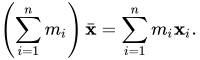
The barycentre is located as an "average" of the masses involved. For a system of n point particles of mass located at position vectors , the barycentre is defined by


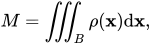
For a solid body B with mass density at position , with total mass


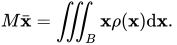
the barycentre is given by
Notes[edit]
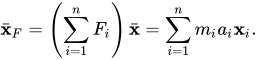
- ↑ In physics, the centres of mass and gravity describe two slightly but importantly different concepts: While the centre of mass is defined like above as a spatial average of masses, the centre of gravity can be expressed similarly as a spatial average of the forces involved: Hence, and are generally only identical if the gravitational field (as expressed in terms of the acceleration ) is constant for all , such that . The point on which forces may be deemed to act is then naturally and not .




This article is licensed under CC BY-SA 3.0.
Original source: https://citizendium.org/wiki/Barycentre
Status: article is cached
Original source: https://citizendium.org/wiki/Barycentre
Status: article is cached
 EncycloReader
is supported by the
EncycloReader
is supported by the  KSF
KSF