Cartesian product
 From Citizendium - Reading time: 2 min


In mathematics, the Cartesian product of two sets X and Y is the set of ordered pairs from X and Y: it is denoted or, less often, .


There are projection maps pr1 and pr2 from the product to X and Y taking the first and second component of each ordered pair respectively.
The Cartesian product has a universal property: if there is a set Z with maps and , then there is a map such that the compositions and . This map h is defined by






General products[edit]
The product of any finite number of sets may be defined inductively, as

The product of a general family of sets Xλ as λ ranges over a general index set Λ may be defined as the set of all functions x with domain Λ such that x(λ) is in Xλ for all λ in Λ. It may be denoted

The Axiom of Choice is equivalent to stating that a product of any family of non-empty sets is non-empty.
There are projection maps prλ from the product to each Xλ.
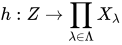
The Cartesian product has a universal property: if there is a set Z with maps , then there is a map such that the compositions . This map h is defined by



Cartesian power[edit]
The n-th Cartesian power of a set X is defined as the Cartesian product of n copies of X

A general Cartesian power over a general index set Λ may be defined as the set of all functions from Λ to X

References[edit]
- Paul Halmos (1960). Naive set theory. Van Nostrand Reinhold, 24.
- Keith J. Devlin (1979). Fundamentals of Contemporary Set Theory. Springer-Verlag, 12. ISBN 0-387-90441-7.
Original source: https://citizendium.org/wiki/Cartesian product
Status: article is cached
 EncycloReader
is supported by the
EncycloReader
is supported by the  KSF
KSF