Flow chart
 From Edutechwiki - Reading time: 1 min
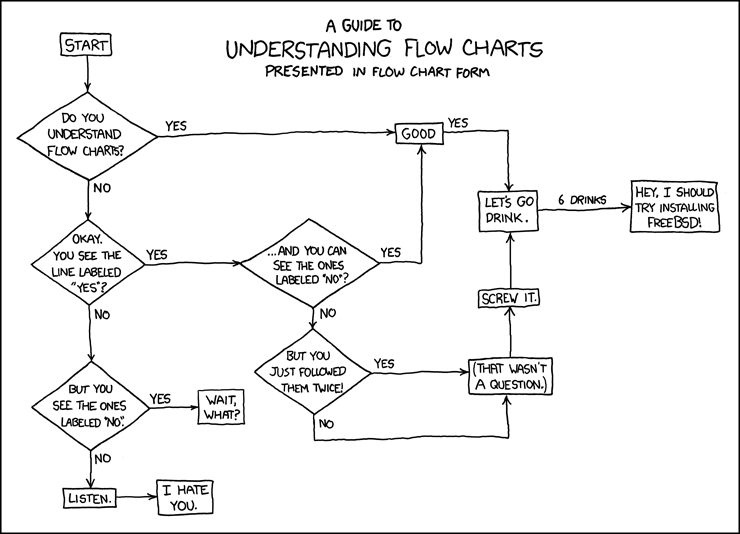
“A flowchart is a common type of diagram, that represents an algorithm or process, showing the steps as boxes of various kinds, and their order by connecting these with arrows. This diagrammatic representation can give a step-by-step solution to a given problem. Data is represented in these boxes, and arrows connecting them represent flow / direction of flow of data. Flowcharts are used in analyzing, designing, documenting or managing a process or program in various fields” ([http://en.wikipedia.org/wiki/Flow_chart Wikipedia, retrieved June 18 2010).
Types of flow charts according to use:
Traditional vs. extended flow charts:
See also: UML activity diagram, Taverna workbench (scientific workflow diagrams), BPMN (a graphical representation of BPEL).
The traditional flow chart explained[edit | edit source]

Links and bibliography[edit | edit source]
Software[edit | edit source]
Links[edit | edit source]
- Flow Chart (Wikipedia)
Bibliography[edit | edit source]
- Alan B. Sterneckert (2003) Critical Incident Management, Auerbach Publications, ISBN 978-0849300103 (p. 126 Google books)
Original source: https://edutechwiki.unige.ch/en/Flow chart
Status: article is cached
 EncycloReader
is supported by the
EncycloReader
is supported by the  KSF
KSF