2195 Tengström
Topic: Astronomy
 From Handwiki - Reading time: 4 min
| Discovery [1] | |
|---|---|
| Discovered by | L. Oterma |
| Discovery site | Turku Obs. |
| Discovery date | 27 September 1941 |
| Designations | |
| (2195) Tengström | |
| Named after | Erik Tengström (Swedish geodesist)[2] |
| 1941 SP1 · 1931 TC3 1934 PQ · 1936 DF 1943 GT · 1944 QD 1951 VA · 1973 GC1 1974 RC2 · 1976 GO4 | |
| Minor planet category | main-belt · Flora [3] |
| Orbital characteristics [1] | |
| Epoch 4 September 2017 (JD 2458000.5) | |
| Uncertainty parameter 0 | |
| Observation arc | 85.57 yr (31,253 days) |
| |{{{apsis}}}|helion}} | 2.4574 AU |
| |{{{apsis}}}|helion}} | 1.9861 AU |
| 2.2217 AU | |
| Eccentricity | 0.1061 |
| Orbital period | 3.31 yr (1,210 days) |
| Mean anomaly | 317.69° |
| Mean motion | 0° 17m 51.36s / day |
| Inclination | 4.5747° |
| Longitude of ascending node | 100.96° |
| 295.55° | |
| Physical characteristics | |
| Dimensions | 7.14±1.13 km[4] 7.17±0.41 km[5] 8.627±0.060 km[6] 8.732±0.044 km[7] 8.98 km (calculated)[3] |
| Rotation period | 2.816±0.003 h[8] 2.82±0.05 h[9] 2.82092±0.00004 h[lower-alpha 1] 2.8210±0.0001 h[lower-alpha 2] 2.8211±0.0001 h[9] 2.82112±0.00007 h[lower-alpha 3] 2.82117±0.00005 h[9] 2.829±0.0007 h[10] |
| Geometric albedo | 0.24 (assumed)[3] 0.3361±0.0301[7] 0.343±0.051[6] 0.39±0.15[4] 0.453±0.106[5] |
| M [7] · S [3] | |
| Absolute magnitude (H) | 12.1[7] · 12.20[5] · 12.237±0.001 (R)[10] · 12.27±0.23[11] · 12.30[4] · 12.4[1][3] |
2195 Tengström, provisional designation 1941 SP1, is a stony Florian asteroid from the inner regions of the asteroid belt, approximately 8 kilometers in diameter. It was discovered on 27 September 1941, by Finnish astronomer Liisi Oterma at Turku Observatory in Southwest Finland,[12] and named for Swedish geodesist Erik Tengström.[2]
Orbit and classification
Tengström is a member of the Flora family of stony asteroids, one of the largest families of the main belt. It orbits the Sun in the inner main-belt at a distance of 2.0–2.5 AU once every 3 years and 4 months (1,210 days). Its orbit has an eccentricity of 0.11 and an inclination of 5° with respect to the ecliptic.[1] It was first identified as 1931 TC3 at Lowell Observatory in 1931, extending the asteroid's observation arc by 10 years prior to its official discovery observation at Turku.[12]
Physical characteristics
Tengström has been characterized as a metallic M-type and stony S-type asteroid.[3][7]
Rotation period
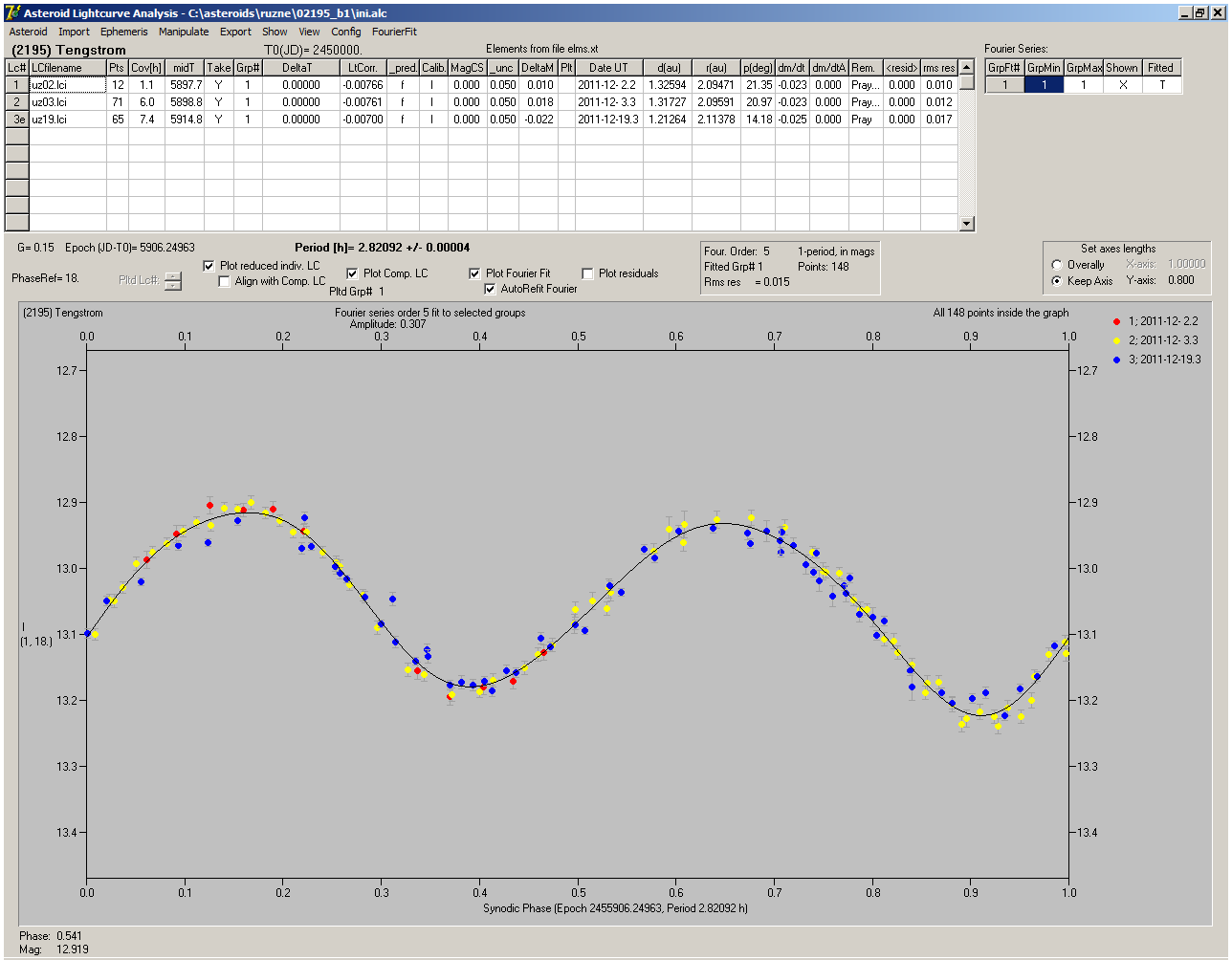
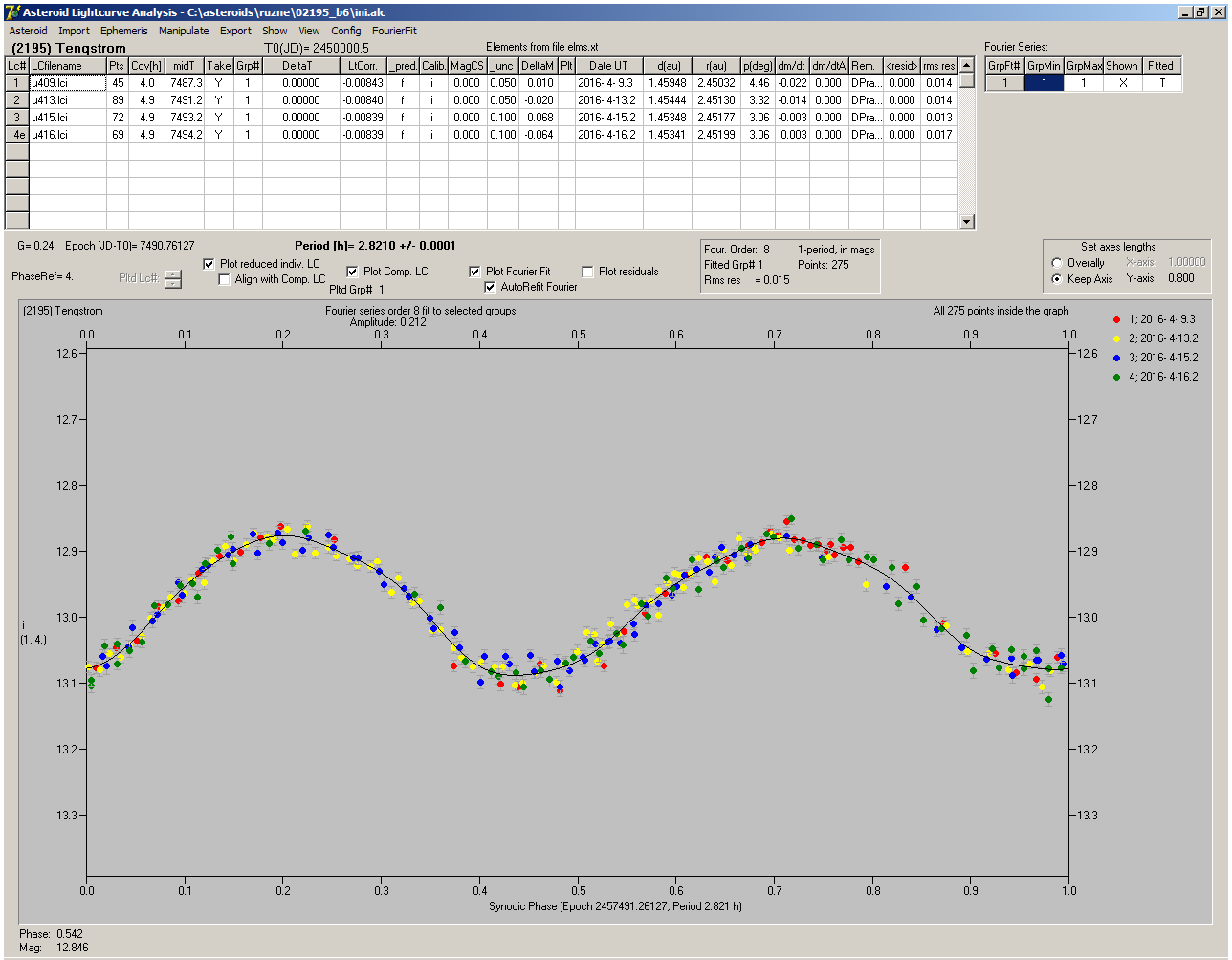
Between 2006 and 2016, several well defined rotational lightcurves of Tengström were obtained by astronomers David Higgins, Petr Pravec, Pierre Antonini and René Roy ({{{1}}}).[9][lower-alpha 1][lower-alpha 2][lower-alpha 3] Lightcurve analysis gave a rotation period of 2.821 hours with a brightness variation between 0.17 and 0.45 magnitude.[lower-alpha 4] For an asteroid of its size, Tengström has a relatively fast spin rate, not far from the 2.2-hour threshold for fast rotators.
Diameter and albedo
According to the survey carried out by NASA's Wide-field Infrared Survey Explorer with its subsequent NEOWISE mission, Tengström measures between 7.14 and 8.73 kilometers in diameter and its surface has a high albedo of 0.34 to 0.45. NEOWISE also classifies it as a metallic asteroid, despite its much higher albedo.[4][5][6][7] The Collaborative Asteroid Lightcurve Link assumes an albedo of 0.24 – derived from 8 Flora, the family's largest member and namesake – and calculates a diameter of 8.98 kilometers using an absolute magnitude of 12.4.[3]
Naming
This minor planet was named after Swedish geodesist and astronomer Erik Tengström (1913–1996), emeritus professor at Uppsala University on the celebration of his 70th anniversary.[2] The official naming citation was published by the Minor Planet Center on 28 March 1983 (M.P.C. 7782).[13]
Notes
- ↑ 1.0 1.1 Pravec (2011) web: rotation period 2.82092±0.00004 hours; amplitude of 0.31 mag.; quality code of 3. Summary figures for (2195) Tengström at Collaborative Asteroid Lightcurve Link (CALL) and Pravec, P.; Wolf, M.; Sarounova, L. (2011)
- ↑ 2.0 2.1 Pravec (2016) web: rotation period 2.8210±0.0001 hours; amplitude of 0.21 mag.; quality code of 3. Summary figures for (2195) Tengström at Collaborative Asteroid Lightcurve Link (CALL) and Pravec, P.; Wolf, M.; Sarounova, L. (2016)
- ↑ 3.0 3.1 Higgins (2011) web: rotation period 2.82112±0.00007 hours; amplitude of 0.17 mag.; quality code of 3. Summary figures for (2195) Tengström at Collaborative Asteroid Lightcurve Link (CALL)
- ↑ Lightcurve plot from December 2011, 2.82092 hours and April 2016, 2.8210 hours by Pray, Kusnirak, Pravec Ondřejov Observatory – unpublished data
References
- ↑ 1.0 1.1 1.2 1.3 "JPL Small-Body Database Browser: 2195 Tengstrom (1941 SP1)". Jet Propulsion Laboratory. https://ssd.jpl.nasa.gov/sbdb.cgi?sstr=2002195. Retrieved 11 June 2017.
- ↑ 2.0 2.1 2.2 Schmadel, Lutz D. (2007). "(2195) Tengström". Dictionary of Minor Planet Names – (2195) Tengström. Springer Berlin Heidelberg. p. 178. doi:10.1007/978-3-540-29925-7_2196. ISBN 978-3-540-00238-3.
- ↑ 3.0 3.1 3.2 3.3 3.4 3.5 3.6 "LCDB Data for (2195) Tengström". Asteroid Lightcurve Database (LCDB). http://www.minorplanet.info/PHP/generateOneAsteroidInfo.php?AstInfo=2195%7CTengström. Retrieved 17 February 2017.
- ↑ 4.0 4.1 4.2 4.3 Nugent, C. R.; Mainzer, A.; Masiero, J.; Bauer, J.; Cutri, R. M.; Grav, T. et al. (December 2015). "NEOWISE Reactivation Mission Year One: Preliminary Asteroid Diameters and Albedos". The Astrophysical Journal 814 (2): 13. doi:10.1088/0004-637X/814/2/117. Bibcode: 2015ApJ...814..117N. http://adsabs.harvard.edu/cgi-bin/bib_query?bibcode=2015ApJ...814..117N. Retrieved 17 February 2017.
- ↑ 5.0 5.1 5.2 5.3 Masiero, Joseph R.; Mainzer, A. K.; Grav, T.; Bauer, J. M.; Cutri, R. M.; Nugent, C. et al. (November 2012). "Preliminary Analysis of WISE/NEOWISE 3-Band Cryogenic and Post-cryogenic Observations of Main Belt Asteroids". The Astrophysical Journal Letters 759 (1): 5. doi:10.1088/2041-8205/759/1/L8. Bibcode: 2012ApJ...759L...8M. http://adsabs.harvard.edu/cgi-bin/bib_query?bibcode=2012ApJ...759L...8M. Retrieved 17 February 2017.
- ↑ 6.0 6.1 6.2 Masiero, Joseph R.; Mainzer, A. K.; Grav, T.; Bauer, J. M.; Cutri, R. M.; Dailey, J. et al. (November 2011). "Main Belt Asteroids with WISE/NEOWISE. I. Preliminary Albedos and Diameters". The Astrophysical Journal 741 (2): 20. doi:10.1088/0004-637X/741/2/68. Bibcode: 2011ApJ...741...68M. http://adsabs.harvard.edu/cgi-bin/bib_query?bibcode=2011ApJ...741...68M. Retrieved 17 February 2017.
- ↑ 7.0 7.1 7.2 7.3 7.4 7.5 Mainzer, A.; Grav, T.; Masiero, J.; Hand, E.; Bauer, J.; Tholen, D. et al. (November 2011). "NEOWISE Studies of Spectrophotometrically Classified Asteroids: Preliminary Results". The Astrophysical Journal 741 (2): 25. doi:10.1088/0004-637X/741/2/90. Bibcode: 2011ApJ...741...90M.
- ↑ Higgins, David; Pravec, Petr; Kusnirak, Peter; Galad, Adrian; Kornos, Leos; Pray, Donald et al. (December 2006). "Asteriod [sic] lightcurve analysis at Hunters Hill Observatory and collaborating stations - autumn 2006". The Minor Planet Bulletin 33 (4): 89–91. ISSN 1052-8091. Bibcode: 2006MPBu...33...89H. http://adsabs.harvard.edu/cgi-bin/bib_query?bibcode=2006MPBu...33...89H. Retrieved 17 February 2017.
- ↑ 9.0 9.1 9.2 9.3 Behrend, Raoul. "Asteroids and comets rotation curves – (2195) Tengström". Geneva Observatory. http://obswww.unige.ch/~behrend/page4cou.html#002195. Retrieved 17 February 2017.
- ↑ 10.0 10.1 Waszczak, Adam; Chang, Chan-Kao; Ofek, Eran O.; Laher, Russ; Masci, Frank; Levitan, David et al. (September 2015). "Asteroid Light Curves from the Palomar Transient Factory Survey: Rotation Periods and Phase Functions from Sparse Photometry". The Astronomical Journal 150 (3): 35. doi:10.1088/0004-6256/150/3/75. Bibcode: 2015AJ....150...75W. http://adsabs.harvard.edu/cgi-bin/bib_query?bibcode=2015AJ....150...75W. Retrieved 17 February 2017.
- ↑ Veres, Peter; Jedicke, Robert; Fitzsimmons, Alan; Denneau, Larry; Granvik, Mikael; Bolin, Bryce et al. (November 2015). "Absolute magnitudes and slope parameters for 250,000 asteroids observed by Pan-STARRS PS1 - Preliminary results". Icarus 261: 34–47. doi:10.1016/j.icarus.2015.08.007. Bibcode: 2015Icar..261...34V. http://adsabs.harvard.edu/cgi-bin/bib_query?bibcode=2015Icar..261...34V. Retrieved 17 February 2017.
- ↑ 12.0 12.1 "2195 Tengstrom (1941 SP1)". Minor Planet Center. https://www.minorplanetcenter.net/db_search/show_object?object_id=2195. Retrieved 17 February 2017.
- ↑ "MPC/MPO/MPS Archive". Minor Planet Center. https://www.minorplanetcenter.net/iau/ECS/MPCArchive/MPCArchive_TBL.html. Retrieved 17 February 2017.
External links
- Asteroid Lightcurve Database (LCDB), query form (info )
- Dictionary of Minor Planet Names, Google books
- Asteroids and comets rotation curves, CdR – Observatoire de Genève, Raoul Behrend
- Discovery Circumstances: Numbered Minor Planets (1)-(5000) – Minor Planet Center
- 2195 Tengström at AstDyS-2, Asteroids—Dynamic Site
- 2195 Tengström at the JPL Small-Body Database
 |  |
Original source: https://handwiki.org/wiki/2195 Tengström
Status: article is cached
 EncycloReader
is supported by the
EncycloReader
is supported by the  KSF
KSF