6189 Völk
Topic: Astronomy
 From Handwiki - Reading time: 4 min
| Discovery [1] | |
|---|---|
| Discovered by | E. W. Elst |
| Discovery site | La Silla Obs. |
| Discovery date | 2 March 1989 |
| Designations | |
| (6189) Völk | |
| Named after | Elisabeth Völk (ESO staff member)[2] |
| 1989 EY2 · 1980 TY4 5489 T-2 | |
| Minor planet category | main-belt [1][3] · (inner) Vesta [4][5][6] |
| Orbital characteristics [3] | |
| Epoch 31 May 2020 (JD 2459000.5) | |
| Uncertainty parameter 0 | |
| Observation arc | 46.34 yr (16,926 d) |
| |{{{apsis}}}|helion}} | 2.6157 AU |
| |{{{apsis}}}|helion}} | 1.9938 AU |
| 2.3048 AU | |
| Eccentricity | 0.1349 |
| Orbital period | 3.50 yr (1,278 d) |
| Mean anomaly | 164.96° |
| Mean motion | 0° 16m 54.12s / day |
| Inclination | 5.9423° |
| Longitude of ascending node | 245.32° |
| 68.736° | |
| Physical characteristics | |
| Mean diameter | 3.982±0.156 km[7] |
| Rotation period | 2.896±0.001 h[8][lower-alpha 1] |
| Geometric albedo | 0.443±0.079[7] |
| S (SDSS-MOC)[9] | |
| Absolute magnitude (H) | |
6189 Völk (prov. designation: 1989 EY2) is a stony Vesta asteroid, approximately 4 kilometers (2.5 miles) in diameter, located in the inner regions of the asteroid belt. It was discovered on 2 March 1989, by Belgian astronomer Eric Elst at the La Silla Observatory in northern Chile.[1] The S-type asteroid has a short rotation period of 2.9 hours. It was named for Elisabeth Völk, a staff member at ESO headquarters in Germany.[2]
Classification and orbit
When applying the synthetic hierarchical clustering method to its proper orbital elements, Völk is a core member of the stony Vesta family,[4][5][6] one of the largest families in the inner asteroid belt. It orbits the Sun in the inner main-belt at a distance of 2.0–2.6 AU once every 3 years and 6 months (1,278 days; semi-major axis of 2.3 AU). Its orbit has an eccentricity of 0.13 and an inclination of 6° with respect to the ecliptic.[3] It was first observed as 5489 T-2 at Palomar Observatory during the second Palomar–Leiden Trojan survey in September 1973, extending the asteroid's observation arc by almost 16 years prior to its official discovery at La Silla.[1]
Naming
This minor planet was named after Elisabeth Völk (born 1946), administrative staff member at ESO's headquarters in Germany, in charge of the ESO Schmidt plates archive, who became a good friend of the discoverer. The naming was independently suggested by astronomer and author of the Dictionary of Minor Planets, Lutz Schmadel.[2] The naming citation was published by the Minor Planet Center on 15 February 1995 (M.P.C. 24766).[10]
Physical characteristics
In the SDSS-based taxonomy, Völk is a common, stony S-type asteroid.[9]
Lightcurve
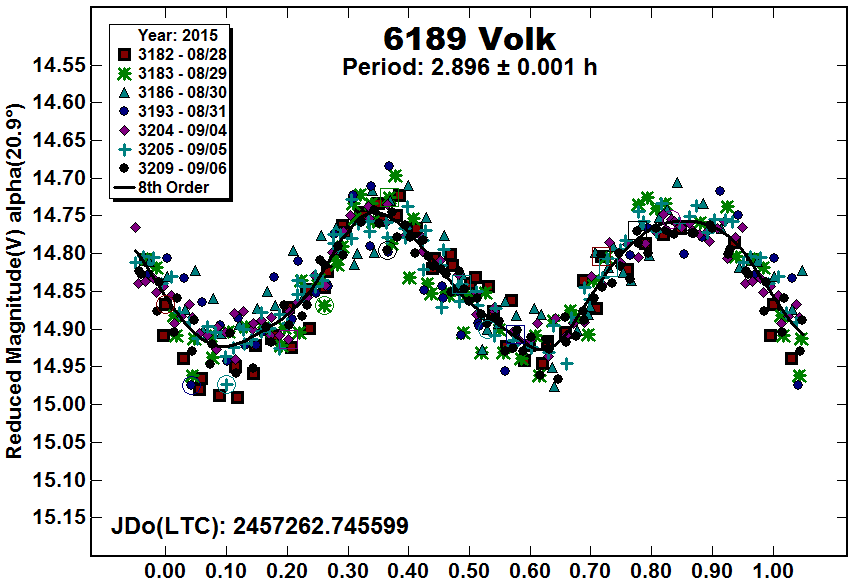
In September 2015, a rotational lightcurve was constructed from photometric observations by Robert D. Stephens at the Center for Solar System Studies in California (U81). Lightcurve analysis gave a well-defined rotation period of 2.896±0.001 hours with a brightness amplitude of 0.18±0.02 in magnitude ({{{1}}}).[8][lower-alpha 1]
Diameter
According to the survey carried out by the NEOWISE mission of NASA's Wide-field Infrared Survey Explorer, the asteroid measures (3.982±0.156) kilometers in diameter and its surface has an outstandingly high albedo of (0.443±0.079),[7] while the Collaborative Asteroid Lightcurve Link assumes an albedo of 0.24 – in accordance with the LCDB's divergent classification into the Flora family – and calculates a larger diameter of 5.2 kilometers.[11]
Notes
- ↑ 1.0 1.1 Lightcurve plot of (6189) Völk by Robert Stephens at the Center for Solar System Studies (2015). Rotation period of (2.896±0.001) hours with a brightness amplitude of 0.18±0.02 mag. Quality code of 3. Summary figures at the LCDB and CS3 web pages.
References
- ↑ 1.0 1.1 1.2 1.3 1.4 "6189 Volk (1989 EY2)". Minor Planet Center. https://www.minorplanetcenter.net/db_search/show_object?object_id=6189.
- ↑ 2.0 2.1 2.2 Schmadel, Lutz D. (2007). "(6189) Völk". Dictionary of Minor Planet Names. Springer Berlin Heidelberg. p. 516. doi:10.1007/978-3-540-29925-7_5706. ISBN 978-3-540-00238-3.
- ↑ 3.0 3.1 3.2 3.3 "JPL Small-Body Database Browser: 6189 Volk (1989 EY2)". Jet Propulsion Laboratory. https://ssd.jpl.nasa.gov/sbdb.cgi?sstr=2006189.
- ↑ 4.0 4.1 "Asteroid (6189) Volk". AstDyS-2, Asteroids – Dynamic Site. https://newton.spacedys.com/astdys/index.php?n=6189&pc=1.1.6.
- ↑ 5.0 5.1 "Asteroid 6189 Volk – Nesvorny HCM Asteroid Families V3.0". Small Bodies Data Ferret. https://sbntools.psi.edu/ferret/SimpleSearch/results.action?targetName=6189+Volk#Asteroid%206189%20VolkEAR-A-VARGBDET-5-NESVORNYFAM-V3.0.
- ↑ 6.0 6.1 Zappalà, V.; Bendjoya, Ph.; Cellino, A.; Farinella, P.; Froeschle, C. (1997). "Asteroid Dynamical Families". NASA Planetary Data System: EAR-A-5-DDR-FAMILY-V4.1. https://sbnarchive.psi.edu/pds3/non_mission/EAR_A_5_DDR_FAMILY_V4_1/data/family.tab. Retrieved 15 March 2020. (PDS main page)
- ↑ 7.0 7.1 7.2 7.3 Mainzer, A. K.; Bauer, J. M.; Cutri, R. M.; Grav, T.; Kramer, E. A.; Masiero, J. R. et al. (June 2016). "NEOWISE Diameters and Albedos V1.0". NASA Planetary Data System. Bibcode: 2016PDSS..247.....M. https://sbnarchive.psi.edu/pds3/non_mission/EAR_A_COMPIL_5_NEOWISEDIAM_V1_0/data/neowise_mainbelt.tab. Retrieved 30 June 2020.
- ↑ 8.0 8.1 Stephens, Robert D. (January 2016). "Asteroids Observed from CS3: 2015 July - September". The Minor Planet Bulletin 43 (1): 52–56. ISSN 1052-8091. Bibcode: 2016MPBu...43...52S. http://adsabs.harvard.edu/cgi-bin/bib_query?bibcode=2016MPBu...43...52S. Retrieved 14 April 2016.
- ↑ 9.0 9.1 Carvano, J. M.; Hasselmann, P. H.; Lazzaro, D.; Mothé-Diniz, T. (February 2010). "SDSS-based taxonomic classification and orbital distribution of main belt asteroids". Astronomy and Astrophysics 510: 12. doi:10.1051/0004-6361/200913322. Bibcode: 2010A&A...510A..43C. https://sbnarchive.psi.edu/pds3/non_mission/EAR_A_I0035_5_SDSSTAX_V1_1/data/sdsstax_ast_table.tab. Retrieved 30 October 2019. (PDS data set)
- ↑ "MPC/MPO/MPS Archive". Minor Planet Center. https://www.minorplanetcenter.net/iau/ECS/MPCArchive/MPCArchive_TBL.html.
- ↑ "LCDB Data for (6189) Volk". Asteroid Lightcurve Database (LCDB). http://www.minorplanet.info/PHP/generateOneAsteroidInfo.php?AstInfo=6189%7CVolk.
External links
- ESO Schmidt Plates, Query Form
- Asteroid Lightcurve Database (LCDB), query form (info )
- Dictionary of Minor Planet Names, Google books
- Discovery Circumstances: Numbered Minor Planets (5001)-(10000) – Minor Planet Center
- 6189 Völk at AstDyS-2, Asteroids—Dynamic Site
- 6189 Völk at the JPL Small-Body Database
 |  |
Original source: https://handwiki.org/wiki/6189 Völk
Status: article is cached
 EncycloReader
is supported by the
EncycloReader
is supported by the  KSF
KSF