Table of Contents Categories
Messier 26
Topic: Astronomy
 From Handwiki - Reading time: 3 min
| Messier 26 | |
|---|---|
| File:280px Open cluster Messier 26 Credit: Hillary Mathis, Vanessa Harvey, REU program/NOIRLab/NSF/AURA | |
| Observation data (J2000.0 epoch) | |
| Constellation | Scutum |
| Right ascension | 18h 45m 18.0s[1] |
| Declination | −09° 23′ 00″[1] |
| Distance | 5,160 ly (1,582 pc)[2] |
| Apparent magnitude (V) | 8.0[3] |
| Apparent dimensions (V) | 14′[3] |
| Physical characteristics | |
| Radius | 11 ly[4] |
| Estimated age | 85.3[1] million years |
| Other designations | Messier 26, NGC 6694,[5] Cr 389, C 1842-094 |
Messier 26, also known as NGC 6694, is an open cluster of stars in the southern constellation of Scutum. It was discovered by Charles Messier in 1764.[lower-alpha 1] This 8th magnitude cluster is a challenge to find in ideal skies with typical binoculars, where it can be, with any modern minimum 3-inch (76 mm) aperture device. It is south-southwest of the open cluster Messier 11 and is 14′ across.[3] About 25 stars are visible in a telescope with a 150–200 mm (6–8 in) aperture.[6]
M26 spans a linear size of 22[4] light years across with a tidal radius of 25 light-years,[7] and is at a distance of 5,160[2] light years from the Earth. The brightest star is of magnitude 11[6] and the age of this cluster has been calculated to be 85.3[1] million years. It includes one known spectroscopic binary system.[8]
An interesting feature of M26 is a region of low star density near the nucleus. A hypothesis was that it was caused by an obscuring cloud of interstellar matter between us and the cluster, but a paper by James Cuffey suggested that this is not possible and that it really is a "shell of low stellar space density".[9] In 2015, Michael Merrifield of the University of Nottingham said that there is, as yet, no clear explanation for the phenomenon.[10]
Gallery
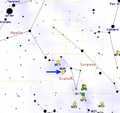
Map showing the location of M26 (Roberto Mura)

See also
Footnotes and references
Footnotes
- ↑ On June 20
References
- ↑ 1.0 1.1 1.2 1.3 Wu, Zhen-Yu et al. (November 2009), "The orbits of open clusters in the Galaxy", Monthly Notices of the Royal Astronomical Society 399 (4): 2146–2164, doi:10.1111/j.1365-2966.2009.15416.x, Bibcode: 2009MNRAS.399.2146W.
- ↑ 2.0 2.1 Kharchenko, N. V. et al. (2005), "Astrophysical parameters of Galactic open clusters", Astronomy and Astrophysics 438 (3): 1163–1173, doi:10.1051/0004-6361:20042523, Bibcode: 2005A&A...438.1163K.
- ↑ 3.0 3.1 3.2 Thompson, Robert; Thompson, Barbara (2007), Illustrated Guide to Astronomical Wonders: From Novice to Master Observer, DIY science, O'Reilly Media, Inc., p. 431, ISBN 978-0596526856, https://books.google.com/books?id=ymt9nj_uPhwC&pg=PA431
- ↑ 4.0 4.1 Kharchenko, N. V. et al. (March 2009), "Shape parameters of Galactic open clusters", Astronomy and Astrophysics 495 (3): 807–818, doi:10.1051/0004-6361/200810407, Bibcode: 2009A&A...495..807K.
- ↑ "M 26". SIMBAD. Centre de données astronomiques de Strasbourg. http://simbad.u-strasbg.fr/simbad/sim-basic?Ident=M+26.
- ↑ 6.0 6.1 Burnham, Robert (1978), Burnham's Celestial Handbook: An Observer's Guide to the Universe Beyond the Solar System, Dover books on astronomy, 3, Courier Corporation, p. 1756, ISBN 978-0486236735, https://books.google.com/books?id=tBQoCSRdLAAC&pg=PA1756
- ↑ Piskunov, A. E. et al. (January 2008), "Tidal radii and masses of open clusters", Astronomy and Astrophysics 477 (1): 165–172, doi:10.1051/0004-6361:20078525, Bibcode: 2008A&A...477..165P.
- ↑ Mermilliod, J. -C. et al. (October 2007), "Red giants in open clusters. XIII. Orbital elements of 156 spectroscopic binaries", Astronomy and Astrophysics 473 (3): 829–845, doi:10.1051/0004-6361:20078007, Bibcode: 2007A&A...473..829M.
- ↑ Cuffey, James (1940). "The Galactic Clusters NGC 6649 and NGC 6694". Astrophysical Journal 92: 303. doi:10.1086/144220. Bibcode: 1940ApJ....92..303C.
- ↑ Merrifield, Michael (Oct 2, 2015). "M26 - Open Cluster". University of Nottingham/University of Sheffield. http://www.deepskyvideos.com/videos/messier/M26.html.
External links
- Messier 26, SEDS Messier pages
- Messier 26 on WikiSky: DSS2, SDSS, GALEX, IRAS, Hydrogen α, X-Ray, Astrophoto, Sky Map, Articles and images
Coordinates:  18h 45.2m 00s, −09° 24′ 00″
| List |
|  |
|---|---|---|
| See also | ||


 |  |
Original source: https://handwiki.org/wiki/Messier 26
Status: article is cached
 EncycloReader
is supported by the
EncycloReader
is supported by the  KSF
KSF