Hogna ingens
Topic: Biology
 From Handwiki - Reading time: 2 min
| Hogna ingens | |
|---|---|

| |
| Female Hogna ingens | |
Scientific classification 
| |
| Kingdom: | Animalia |
| Phylum: | Arthropoda |
| Subphylum: | Chelicerata |
| Class: | Arachnida |
| Order: | Araneae |
| Infraorder: | Araneomorphae |
| Family: | Lycosidae |
| Genus: | Hogna |
| Species: | H. ingens
|
| Binomial name | |
| Hogna ingens (Blackwall, 1857)[2]
| |
| Synonyms[2] | |
| |
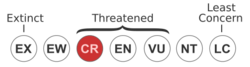
Hogna ingens, the Deserta Grande wolf spider, is a critically endangered spider species endemic to the Deserta Grande Island of the Madeira archipelago - specifically a remote valley, the Vale de Castanheira. Adult numbers have been estimated at less than 5,000, making it one of the rarest wolf spider species. It is also believed to be one of the largest wolf spiders on earth, with a 12 cm (4.7 in) leg span for the female, somewhat smaller for the male (the Latin ingens means "huge" or "monstrous"). Coloration is grey and black with white spots on the legs. The spider hides under rocks and crevices on this volcanic island, but its habitat is being invaded by the grass Phalaris aquatica,[3] while the native vegetation is damaged by introduced goats and rabbits.[4] The spider preys on smaller relatives, millipedes and other insects, and even small lizards.[5] It is capable of delivering a painful and venomous bite to humans.[6]
History

Hogna ingens was first described by John Blackwall in 1857, as Lycosa ingens.[2]
In 2016 a captive breeding programme was set up at Bristol Zoo with 25 individuals being captured and taken to the zoo, over 1000 spiderlings were produced in 2017 and it is hoped that some of these can be reintroduced to Desertas to boost populations.[7]
References
- ↑ Cardoso, P. (2014). "Hogna ingens". IUCN Red List of Threatened Species 2014: e.T58048571A58061007. doi:10.2305/IUCN.UK.2014-2.RLTS.T58048571A58061007.en. https://www.iucnredlist.org/species/58048571/58061007. Retrieved 19 November 2021.
- ↑ 2.0 2.1 2.2 "Taxon details Hogna ingens (Blackwall, 1857)", World Spider Catalog (Natural History Museum Bern), http://www.wsc.nmbe.ch/species/19705, retrieved 2017-08-12
- ↑ Crespo, L.C.; Silva, I.; Borges, P.A.V.; Cardoso, P. (December 2014). "Assessing the conservation status of the strict endemic Desertas wolf spider, Hogna ingens". Journal for Nature Conservation 22 (6): 516–524. doi:10.1016/j.jnc.2014.08.005.
- ↑ Biggi, Emanuele. "The island of the giant wolf spiders". Anura. http://www.anura.it/works/the-island-of-the-giant-wolf-spiders-hogna-ingens/. Retrieved 2016-02-02.
- ↑ O'Brien, John (2015-06-15). "Going the way of the dinosaurs". ConservationBytes.WordPress. https://conservationbytes.wordpress.com/2015/06/15/desertas-wolf-spider-hogna-ingens-blackwall-1857. Retrieved 2016-02-02.
- ↑ Fortey, Richard. "Nature's wonderlands: Islands of evolution, vol.2: Madagascar: A world apart". BBC iPlayer. https://www.bbc.co.uk/iplayer/episode/b06yrgvr/natures-wonderlands-islands-of-evolution-2-madagascar-a-world-apart. Retrieved 2016-02-02.
- ↑ Press Association (2017-08-09). "Bristol zoo gives rare spiders a leg-up with breeding programme". The Guardian. https://www.theguardian.com/environment/2017/aug/09/bristol-zoo-gives-rare-spiders-a-leg-up-with-breeding-programme. Retrieved 9 August 2017.
Wikidata ☰ Q447883 entry
 |  |
Original source: https://handwiki.org/wiki/Hogna ingens
Status: article is cached
 EncycloReader
is supported by the
EncycloReader
is supported by the  KSF
KSF