Trachonychia
 From Mdwiki - Reading time: 7 min
| Trachonychia | |
|---|---|
| Other names: Sandpaper nails, twenty-nail dystrophy[1] | |
 | |
 | |
| Specialty | Dermatology |
| Symptoms | Rough feeling nails with longitudinal ridges[2] |
Trachyonychia, also known as sandpaper nails, are characterized by rough feeling finger or toenails with longitudinal ridges.[2] Less frequently, it may be shiny with pits.[1] When the condition occurs on all the twenty nails of the fingers and toes, it is known as twenty-nail dystrophy, most evident in childhood.[3][4]
It may occur in alopecia areata, atopic dermatitis, and lichen planus.[5][6]
Signs and symptoms[edit | edit source]
Trachyonychia causes the nails to become opalescent, thin, dull, fragile, and finely longitudinally ridged, and, as a result, distally notched.[7]
-
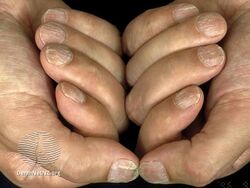
Trachyonychia
-
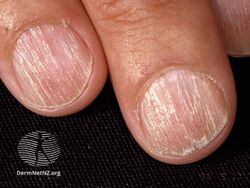
Trachyonychia
-
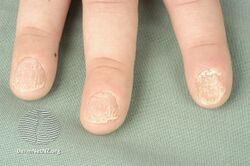
Trachyonychia
-
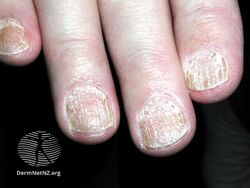
Trachyonychia
.jpg)
.jpg)
.jpg)
.jpg)
Causes[edit | edit source]
It can be a manifestation of lichen planus, psoriasis, alopecia areata, immunoglobulin A deficiency, atopic dermatitis, and ichthyosis vulgaris.[8]
"The longitudinal striations can occur as a normal part of the aging process",[4] and not until the nails start to thin and get a sandpaper look is the condition called trachonychia. The nails are opalescent and frequently are brittle and split at the free margin. There has been evidence of the condition as a cutaneous manifestation of lichen planus. It has also been associated with other diseases such as eczema, psoriasis, alopecia areata, and atopic dermatitis.[4] Trachonychia is often seen in vitiligo patients – suggesting that they are more susceptible to this condition.[4]
References[edit | edit source]
- ↑ 1.0 1.1 Haber, Jessica S.; Chairatchaneeboon, Manasmon; Rubin, Adam I. (January 2017). "Trachyonychia: Review and Update on Clinical Aspects, Histology, and Therapy". Skin Appendage Disorders. 2 (3–4): 109–115. doi:10.1159/000449063. ISSN 2296-9195. PMID 28232917. Archived from the original on 2020-11-12. Retrieved 2022-04-15.
{{cite journal}}: More than one of|accessdate=and|access-date=specified (help); More than one of|archivedate=and|archive-date=specified (help); More than one of|archiveurl=and|archive-url=specified (help) - ↑ 2.0 2.1 Johnstone, Ronald B. (2017). "2. Diagnostic clues and "need-to-know" items". Weedon's Skin Pathology Essentials (2nd ed.). Elsevier. p. 31. ISBN 978-0-7020-6830-0. Archived from the original on 2023-06-30. Retrieved 2023-05-14.
- ↑ "Twenty-nail dystrophy | Genetic and Rare Diseases Information Center (GARD) – an NCATS Program". rarediseases.info.nih.gov. Archived from the original on 2016-12-31. Retrieved 2018-04-17.
{{cite web}}: More than one of|archivedate=and|archive-date=specified (help); More than one of|archiveurl=and|archive-url=specified (help) - ↑ 4.0 4.1 4.2 4.3 Fawcett, Ronald S.; Hart, Thomas M.; Linford, Sean;Stulberg, Daniel L. (2004)."Nail Abnormalities: Clues to Systemic Disease". Archived 2020-02-27 at the Wayback Machine pdf Archived 2020-02-27 at the Wayback Machine American Family Physician 69(6): 1417-1424
- ↑ Bolognia, Jean L.; Schaffer, Julie V.; Duncan, Karynne O.; Ko, Christine (2021). "58. Nail disorders". Dermatology Essentials (2nd ed.). Elsevier. p. 569. ISBN 978-0-323-62453-4. Archived from the original on 2024-01-20. Retrieved 2024-01-17.
- ↑ Saavedra, Arturo; Roh, Ellen K.; Mikailov, Anar (2023). "32.Disorders of the nail apparatus". Fitzpatrick's Color Atlas and Synopsis of Clinical Dermatology (9th ed.). New York: McGraw Hill Professional. pp. 849–872. ISBN 978-1-264-27801-5. Archived from the original on 2023-12-31. Retrieved 2024-01-18.
- ↑ James, William D.; Elston, Dirk; Treat, James R.; Rosenbach, Misha A.; Neuhaus, Isaac (2020). "33. Diseases of the skin appendages". Andrews' Diseases of the Skin: Clinical Dermatology (13th ed.). Edinburgh: Elsevier. p. 782. ISBN 978-0-323-54753-6. Archived from the original on 2023-06-30. Retrieved 2023-05-14.
- ↑ Scheinfeld NS (April 2003). "Trachyonychia: a case report and review of manifestations, associations, and treatments". Cutis. 71 (4): 299–302. PMID 12729094.
External links[edit | edit source]
| Classification |
|---|
Original source: https://mdwiki.org/wiki/Trachonychia
Status: article is cached
 EncycloReader
is supported by the
EncycloReader
is supported by the  KSF
KSF