Angiolymphoid hyperplasia with eosinophilia
 From Wikidoc - Reading time: 6 min
Editor-In-Chief: C. Michael Gibson, M.S., M.D. [1];Associate Editor(s)-in-Chief: Kiran Singh, M.D. [2] Ammu Susheela, M.D. [3]
Synonyms and Keywords: Epithelioid hemangioma; Histiocytoid hemangioma; Inflammatory angiomatous nodule; Intravenous atypical vascular proliferation; Papular angioplasia; Inflammatory arteriovenous hemangioma; Pseudopyogenic granuloma; ALHE; EH
Overview[edit | edit source]
Angiolymphoid hyperplasia with eosinophilia was first discovered by G. C. Wells and I. W. Whimster, two British physicians, in 1969.[1]Angiolymphoid hyperplasia with eosinophilia [2] is defined as red-brown, dome-shaped, dermal papule or nodule, present in the around the ears, scalp, neck, trunk, extremities, genitalia, lips and oral mucosa.[3]On gross pathology, smooth-surface red to brown papules or nodules are characteristic findings of angiolymphoid hyperplasia with eosinophilia. On microscopic histopathological analysis, florid vascular proliferation with atypical endothelial cells surrounded by a lymphocytic and eosinophilic infiltrate are characteristic findings of angiolymphoid hyperplasia with eosinophilia. Angiolymphoid hyperplasia with eosinophilia may be caused by either allergic reactions, traumas, or autoimmune disorders. Angiolymphoid hyperplasia with eosinophilia must be differentiated from other diseases that cause swelling of face and neck, such as Kimura disease, acial granuloma, insect bite reaction, cutaneous lymphoma, sarcoidosis. The prevalence of angiolymphoid hyperplasia with eosinophilia is unknown as it is an extremely rare disease. Angiolymphoid hyperplasia with eosinophilia is more commonly observed among young patients. Females are more commonly affected with angiolymphoid hyperplasia with eosinophilia than males. Angiolymphoid hyperplasia with eosinophilia usually affects predominently individuals of the Asian race. Common complications of angiolymphoid hyperplasia with eosinophilia include pruritis, pulsation, and spontaneous bleeding. Findings on biopsy include proliferation of small blood vessels with endothelial cells having a cobblestone appearance, a perivascular and interstitial infiltrate of lymphocytes and eosinophils. Surgery is the mainstay of therapy for angiolymphoid hyperplasia with eosinophilia.
Historical Perspective[edit | edit source]
- Angiolymphoid hyperplasia with eosinophilia was first discovered by G. C. Wells and I. W. Whimster, two British physicians, in 1969.[1]
Pathophysiology[edit | edit source]
- Angiolymphoid hyperplasia with eosinophilia [4] is defined as red-brown, dome-shaped, dermal papule or nodule, present in the head or neck, specifically around the ears and on the scalp.[3]
- The pathogenesis of angiolymphoid hyperplasia with eosinophilia is characterized by red to brown papules or nodules dislocated in the dermis or subcutaneous tissue.
- Angiolymphoid hyperplasia with eosinophilia is a rare and idiopathic vascular disorder.
- On gross pathology, smooth-surface red to brown papules or nodules on the head, neck, trunk, extremities, genitalia, lips and oral mucosa are characteristic findings of angiolymphoid hyperplasia with eosinophilia.
- On microscopic histopathological analysis, florid vascular proliferation with atypical endothelial cells surrounded by a lymphocytic and eosinophilic infiltrate are characteristic findings of angiolymphoid hyperplasia with eosinophilia.
Causes[edit | edit source]
- Angiolymphoid hyperplasia with eosinophilia may be caused by either allergic reactions, traumas, or autoimmune disorders.
Differentiating Angiolymphoid hyperplasia with eosinophilia from other Diseases[edit | edit source]
- Angiolymphoid hyperplasia with eosinophilia must be differentiated from other diseases that cause swelling of face and neck, such as:
- Kimura disease
- Acial granuloma
- Insect bite reaction
- Cutaneous lymphoma
- Sarcoidosis
Epidemiology and Demographics[edit | edit source]
- The prevalence of angiolymphoid hyperplasia with eosinophilia is unknown as it is an extremely rare disease.
Age[edit | edit source]
- Angiolymphoid hyperplasia with eosinophilia is more commonly observed among young patients.
Gender[edit | edit source]
- Females are more commonly affected with angiolymphoid hyperplasia with eosinophilia than males.
Race[edit | edit source]
- Angiolymphoid hyperplasia with eosinophilia usually affects predominently individuals of the Asian race.
Risk Factors[edit | edit source]
- Common risk factors in the development of angiolymphoid hyperplasia with eosinophilia are allergic reactions, traumas or autoimmune disorders.
Natural History, Complications and Prognosis[edit | edit source]
- The majority of patients with angiolymphoid hyperplasia with eosinophilia remain asymptomatic for several years.
- Common complications of angiolymphoid hyperplasia with eosinophilia include pruritis, pulsation, and spontaneous bleeding.
- One-third of cases of angiolymphoid hyperplasia with eosinophilia recur when incompletely excised.
Diagnosis[edit | edit source]
Symptoms[edit | edit source]
- Angiolymphoid hyperplasia with eosinophilia lesions may be asymptomatic, painful or pruriginous.
Physical Examination[edit | edit source]
- Physical examination may be remarkable for:
- Dome-shaped, smooth-surfaced papules or expanding nodule or group of nodules
Ear[edit | edit source]
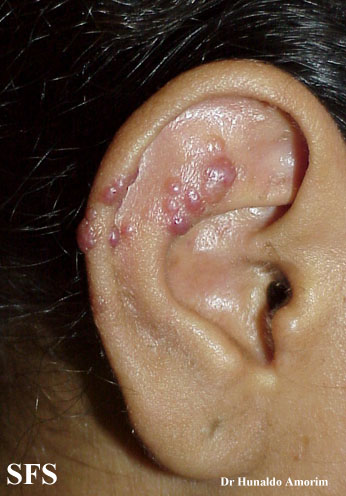
Epithelioid hemangioma. Adapted from Dermatology Atlas.<ref name="Dermatology Atlas">{{Cite
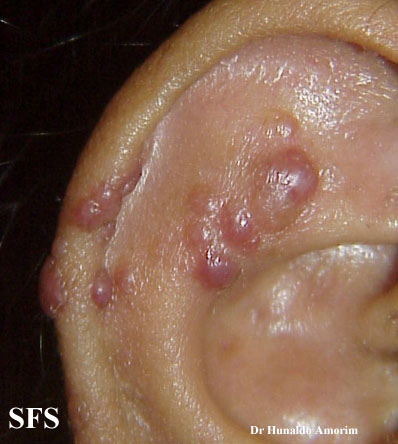
Epithelioid hemangioma. Adapted from Dermatology Atlas.<ref name="Dermatology Atlas">{{Cite
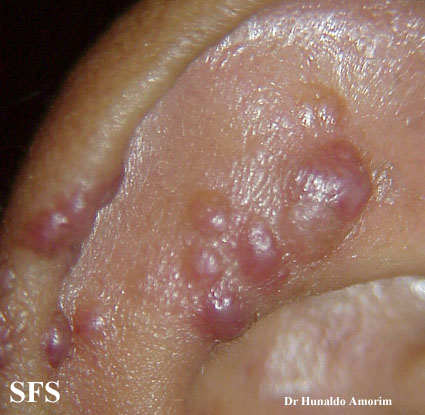
Epithelioid hemangioma. Adapted from Dermatology Atlas.<ref name="Dermatology Atlas">{{Cite
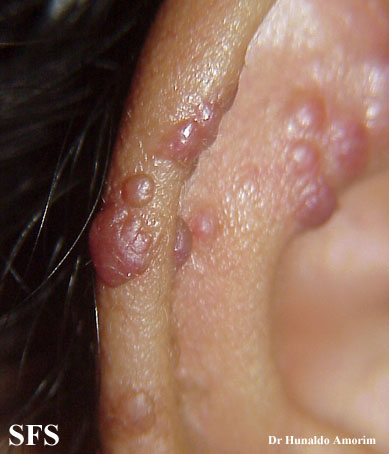
Epithelioid hemangioma. Adapted from Dermatology Atlas.<ref name="Dermatology Atlas">{{Cite
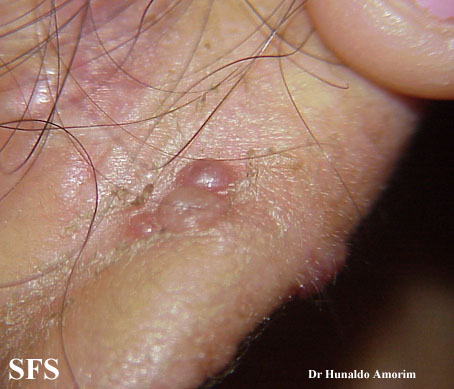
Epithelioid hemangioma. Adapted from Dermatology Atlas.<ref name="Dermatology Atlas">{{Cite
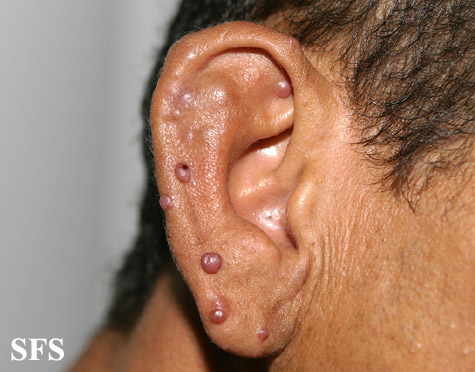
Epithelioid hemangioma. Adapted from Dermatology Atlas.<ref name="Dermatology Atlas">{{Cite
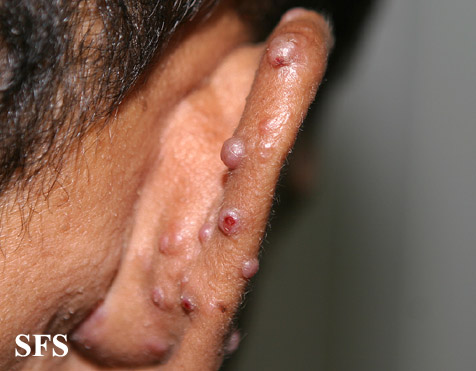
Epithelioid hemangioma. Adapted from Dermatology Atlas.<ref name="Dermatology Atlas">{{Cite
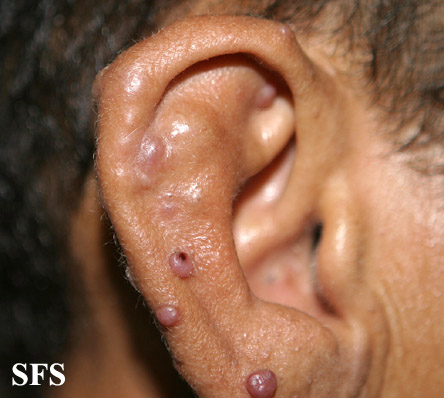
Epithelioid hemangioma. Adapted from Dermatology Atlas.<ref name="Dermatology Atlas">{{Cite
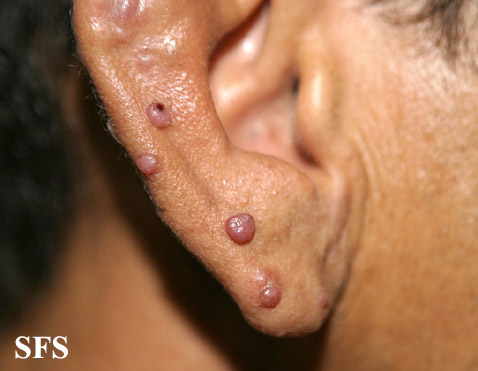
Epithelioid hemangioma. Adapted from Dermatology Atlas.<ref name="Dermatology Atlas">{{Cite
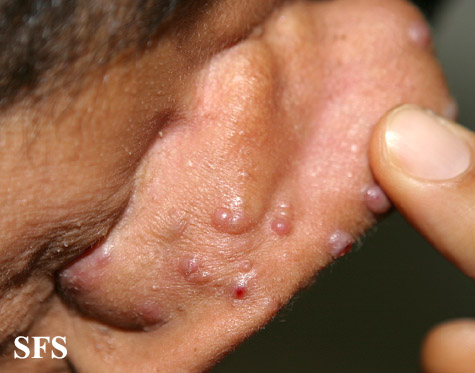
Epithelioid hemangioma. Adapted from Dermatology Atlas.<ref name="Dermatology Atlas">{{Cite


Laboratory Findings[edit | edit source]
- A eosinophilia in complete blood count is characteristic of angiolymphoid hyperplasia with eosinophilia.
- Eosinophils in urinalysis is also a feature.
Other Diagnostic Studies[edit | edit source]
- Angiolymphoid hyperplasia with eosinophilia may also be diagnosed using biopsy.
- Findings on biopsy include proliferation of small blood vessels with endothelial cells having a cobblestone appearance, a perivascular and interstitial infiltrate of lymphocytes and eosinophils.
Treatment[edit | edit source]
Medical Therapy[edit | edit source]
- The mainstay of therapy for angiolymphoid hyperplasia with eosinophilia is intralesional corticoid therapy and imiquimod.
- Imiquimod acts by induction of the production of interferon-α and induction or inhibition of certain cytokines, mainly interleukin-5.[5]
Surgery[edit | edit source]
- Surgery is the mainstay of therapy for angiolymphoid hyperplasia with eosinophilia.
- Mohs micrographic surgery with complete margin examination is performed.
- Other treatment options include radiotherapy, curettage, shave excision with electrodessication, cryotherapy, corticosteroids (topical, systemic or intralesional preparation), and laser therapy using continuous wave carbon dioxide and argon lasers.[6]
Prevention[edit | edit source]
- There are no primary preventive measures available for angiolymphoid hyperplasia with eosinophilia.
References[edit | edit source]
- ↑ 1.0 1.1 Wells GC, Whimster IW (1969). "Subcutaneous angiolymphoid hyperplasia with eosinophilia". Br J Dermatol. 81 (1): 1–14. PMID 5763634.
- ↑ Rapini, Ronald P.; Bolognia, Jean L.; Jorizzo, Joseph L. (2007). Dermatology: 2-Volume Set. St. Louis: Mosby. ISBN 1-4160-2999-0.
- ↑ 3.0 3.1 James, William; Berger, Timothy; Elston, Dirk (2005). Andrews' Diseases of the Skin: Clinical Dermatology. (10th ed.). Saunders. ISBN 0-7216-2921-0.
- ↑ Rapini, Ronald P.; Bolognia, Jean L.; Jorizzo, Joseph L. (2007). Dermatology: 2-Volume Set. St. Louis: Mosby. ISBN 1-4160-2999-0.
- ↑ Esteves, Paola; Barbalho, Marcella; Lima, Tiago; Quintella, Leonardo; Niemeyer-Corbellini, Jo�o Paulo; Ramos-e-Silva, Marcia (2015). "Angiolymphoid Hyperplasia with Eosinophilia: A Case Report". Case Reports in Dermatology. 7 (2): 113–116. doi:10.1159/000381843. ISSN 1662-6567. replacement character in
|first5=at position 3 (help) - ↑ Lembo S, Balato A, Cirillo T, Balato N (2011). "A Long-Term Follow-Up of Angiolymphoid Hyperplasia with Eosinophilia Treated by Corticosteroids: When a Traditional Therapy is Still Up-to-Date". Case Rep Dermatol. 3 (1): 64–7. doi:10.1159/000323182. PMC 3073756. PMID 21487464.
Original source: https://wikidoc.org/Angiolymphoid hyperplasia with eosinophilia
Status: article is cached
 EncycloReader
is supported by the
EncycloReader
is supported by the  KSF
KSF