Categories
Diphyllobothriasis pathophysiology
 From Wikidoc - Reading time: 3 min
|
Diphyllobothriasis Microchapters |
|
Diagnosis |
|---|
|
Treatment |
|
Case Studies |
|
Diphyllobothriasis pathophysiology On the Web |
|
American Roentgen Ray Society Images of Diphyllobothriasis pathophysiology |
|
Risk calculators and risk factors for Diphyllobothriasis pathophysiology |
Editor-In-Chief: C. Michael Gibson, M.S., M.D. [1]; Associate Editor(s)-in-Chief: Furqan M M. M.B.B.S[2]
Overview[edit | edit source]
Diphyllobothriasis is a disease caused by Diphyllobothrium latum. D. latum has an aquatic life cycle and it is usually transmitted to the humans by ingesting the affected aquatic intermediate host (freshwater or marine fish). D. latum decreases the intestinal absorption of vitamin B12 resulting in megaloblastic anemia in humans.
Pathophysiology[edit | edit source]
Pathogenesis[edit | edit source]
Diphyllobothrium latum causes the reduced host intake of vitamin B12 resulting in megaloblastic anemia. Like other tapeworms, it can cause local inflammation in the intestine as a result of physical presence.[1]
Lifecycle[edit | edit source]
The life cycle of Diphyllobothrium latum is completed in the human and marine hosts and comprises of the following stages:[1][2]
- Egg and coracidium:
- Immature eggs are passed in feces of the infected human (or bear, dog, cat, and raccoon).
- If passed into pond or lake water, the eggs mature (approximately 18 to 20 days) and yield coracidium that contains oncospheres.
- First intermediate host:
- After ingestion by a suitable freshwater crustacean (the copepod first intermediate host), the coracidia develop into procercoid larvae in 2-3 weeks.
- Second intermediate host:
- Following ingestion of the copepod by a suitable second intermediate host, typically minnows and other small freshwater fish, the procercoid larvae are released from the crustacean and migrate into the fish flesh where they develop into a plerocercoid larvae (sparganum).
- The plerocercoid larvae are the infective stage for humans. Because humans do not generally eat under cooked minnows and similar small freshwater fish, these do not represent an important source of infection. Nevertheless, these small second intermediate hosts can be eaten by larger predator species, e.g. trout, perch, walleyed pike.
- In this case, the sparganum can migrate to the musculature of the larger predator fish and humans can acquire the disease by eating these later intermediate infected host fish raw or undercooked. Plerocercoids usually lie un-encapsulated in the host tissue but they may be enclosed in connective tissue cysts.
- Definitive host:
- After ingestion of the infected fish, the plerocercoid develops into immature adults and then into mature adult tapeworms which will reside in the small intestine. The adults of D. latum attach to the intestinal mucosa by means of the two bilateral grooves (bothria) of their scolex.
- The adults can reach more than 10 m in length, with more than 3,000 proglottids. Immature eggs are discharged from the proglottids (up to 1,000,000 eggs per day per worm) and are passed in the feces.
- Eggs appear in the feces 5 to 6 weeks after infection. In addition to humans, many other mammals can also serve as definitive hosts for D. latum like the bear, dog, cat, raccoon, and fish-eating birds.

Mode of Transmission[edit | edit source]
D. latum is transmitted to humans by eating raw, uncooked or undercooked fish.
Gallery[edit | edit source]

Illustration of the life cycle of Diphyllobothrium spp., the causal agents of Diphyllobothriasis. Source: Public Health Image Library (PHIL). [3]
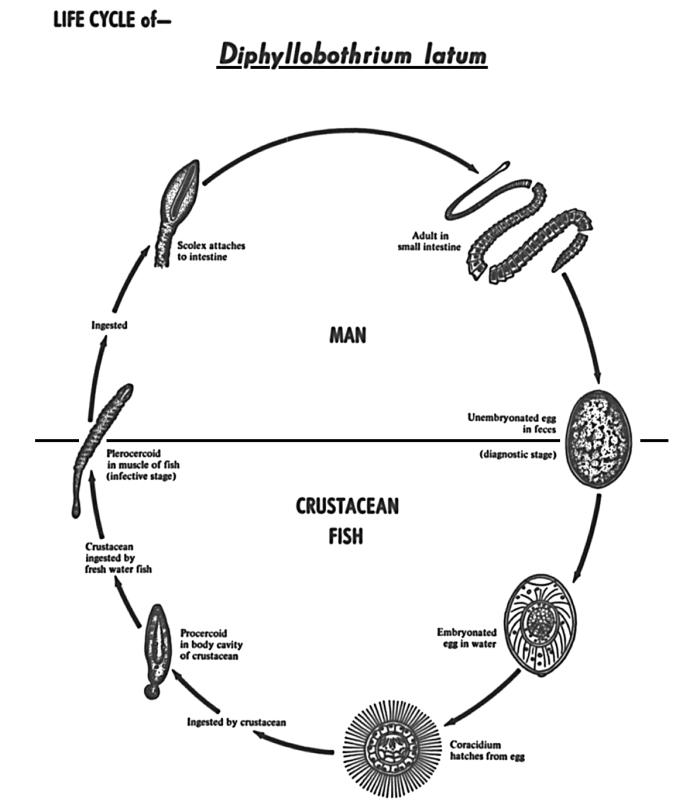
Diagram depicts the various stages in the life cycle of the tapeworm Diphyllobothrium latum, a cestode. Source: Public Health Image Library (PHIL). [3]


References[edit | edit source]
- ↑ 1.0 1.1 Scholz T, Garcia HH, Kuchta R, Wicht B (2009). "Update on the human broad tapeworm (genus diphyllobothrium), including clinical relevance". Clin. Microbiol. Rev. 22 (1): 146–60, Table of Contents. doi:10.1128/CMR.00033-08. PMC 2620636. PMID 19136438.
- ↑ Baron, Samuel (1996). Medical microbiology. Galveston, Tex: University of Texas Medical Branch at Galveston. ISBN 0963117211.
- ↑ 3.0 3.1 "Public Health Image Library (PHIL)".
Original source: https://wikidoc.org/Diphyllobothriasis pathophysiology
Status: article is cached
 EncycloReader
is supported by the
EncycloReader
is supported by the  KSF
KSF