Categories
Çermik
 From Wikipedia - Reading time: 7 min
Çermik | |
|---|---|
 | |
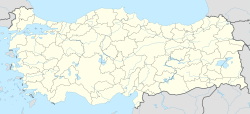  Çermik | |
| Coordinates: 38°08′14″N 39°27′04″E / 38.13722°N 39.45111°E | |
| Country |  Turkey Turkey |
| Province | Diyarbakır |
| Government | |
| • Mayor | Şehmus Karamehmetoğlu (AKP) |
| • Kaymakam | Nazlı Demir |
| Area | |
| • District | 986.78 km2 (381.00 sq mi) |
| Population (2021) | |
| • Total | 50,390 |
| • District | 50,309 |
| • District density | 51/km2 (130/sq mi) |
| Post code | 21600 |
| Website | www.cermik.bel.tr |
Çermik (Armenian: Ջերմուկ, romanized: Jermuk, lit. 'hot springs';[2][3] Kurdish: Çermûk[4]) is a town and district of Diyarbakır Province of Turkey. The population is 50,390 as of 2021.[5] The mayor is Şehmus Karamehmetoğlu from the Justice and Development Party (AKP),[6] and the current Kaymakam is Nazlı Demir.[7]
Çermik got its name from its natural spa.[8] It was declared the Diyarbakir Thermal Tourism Center in October 1993.[9]
History[edit]
Within the Ottoman Empire, Cermik was within the Kurdish sanjaks of the Diyarbekir Eyelet.[10] In 1925 the town came shortly under control of the rebels loyal to Sheikh Said.[11] The Jewish population left the town in 1948 when Israel was founded.[12]
Attractions[edit]
The baths in the area draw many visitors and tourists from Turkey, mostly of neighboring provinces.[9]
Main attractions are the Haburman Bridge, Çeteci Abdullah Pasha Madrasa, Ulu Cami (the Grand Mosque)[13] the Bandeler Fountain (Bandeler Çesmesi) and the Gelincik Dağı ( Mountain of Gelincik) The town also counts with a Synagogue which dates back to the 1416, but it is not in use.[14]
Notable people[edit]
- Çeteci Abdullah Pasha, a former Vali of Diyarbakir.[13]
References[edit]
- ^ "Area of regions (including lakes), km²". Regional Statistics Database. Turkish Statistical Institute. 2002. Retrieved 2013-03-05.
- ^ Hovannisian, Richard G., ed. (2006). Armenian Tigranakert/Diarbekir and Edessa/Urfa. Mazda Publishers. p. 62.
....Armenian: Chermug, Chermuk, or Jermuk; Turkish: Chermik or Cermik).
- ^ Kévorkian, Raymond H. (2011). The Armenian Genocide: A Complete History. London: I. B. Tauris. p. 369. ISBN 9781848855618.
...in the administrative seat, Chermug ("Hot Springs"), with an Armenian population...
- ^ Adem Avcıkıran (2009). Kürtçe Anamnez Anamneza bi Kurmancî (PDF) (in Turkish and Kurdish). p. 55. Retrieved 17 December 2019.
- ^ "ÇERMİK NÜFUSU, DİYARBAKIR". Retrieved 23 October 2022.
- ^ "Diyarbakır Çermik Seçim Sonuçları - 31 Mart Diyarbakır Çermik Yerel Seçim Sonuçları". secim.haberler.com (in Turkish). Retrieved 2020-03-22.
- ^ "Kaymakam Nazlı Demir". www.cermik.gov.tr. Retrieved 2020-03-22.
- ^ Walker, Warren S.; Lindahl, Carl (2014-02-04). A Turkish Folktale: The Art of Behet Mahir. Routledge. p. 95. ISBN 978-1-317-77728-1.
- ^ a b Baskaya, Zafer. "Assessing Çermik (Diyarbakir) Hot Springs In Relation With Geographical Factors And Potential Of Thermal Tourism". Turkish Studies.
- ^ Ozoglu, Hakan (1996). "State-Tribe Relations: Kurdish Tribalism in the 16th- and 17th-Century Ottoman Empire". British Journal of Middle Eastern Studies. 23 (1): 22. ISSN 1353-0194. JSTOR 195817.
- ^ Bak, János M. (1984). Religion and Rural Revolt: Papers Presented to the Fourth Interdisciplinary Workshop on Peasant Studies, University of British Columbia, 1982. Manchester University Press. ISBN 978-0-7190-0990-7.
- ^ "Traditions, tastes, sounds, textures brought together by "Diyarbekirlilik"". Diyarbakir Hafizasi. Retrieved 2022-07-12.
- ^ a b Sinclair, T. A. (1989-12-31). Eastern Turkey: An Architectural & Archaeological Survey, Volume III. Pindar Press. p. 260. ISBN 978-0-907132-34-9.
- ^ "Turkey: concern raised over the state of the neglected, centuries-old former synagogue the town of Çermik, near Diyarbakır in southeastern Turkey". Jewish Heritage Europe. 2021-02-04. Retrieved 2022-07-12.
Çermik in Diyarbakır Province of Turkey | |||||||||||||||||||||||||||
|---|---|---|---|---|---|---|---|---|---|---|---|---|---|---|---|---|---|---|---|---|---|---|---|---|---|---|---|
| Districts |
|   | |||||||||||||||||||||||||
||
Metropolitan municipalities are bolded. | |||||||||||||||||||||||||||
| Villages of Çermik District | ||
|---|---|---|
|  | |
 | This geographical article about a location in Diyarbakır Province, Turkey is a stub. You can help Wikipedia by expanding it. |
Original source: https://en.wikipedia.org/wiki/Çermik
Status: article is cached
 EncycloReader
is supported by the
EncycloReader
is supported by the  KSF
KSF