1378
 From Wikipedia - Reading time: 7 min
 | This article needs additional citations for verification. (October 2020) |
| Years |
|---|
| Millennium |
| 2nd millennium |
| Centuries |
|
| Decades |
|
| Years |
|
| 1378 by topic |
|---|
| Leaders |
|
| Birth and death categories |
| Births – Deaths |
| Establishments and disestablishments categories |
| Establishments – Disestablishments |
| Art and literature |
| 1378 in poetry |
| Gregorian calendar | 1378 MCCCLXXVIII |
| Ab urbe condita | 2131 |
| Armenian calendar | 827 ԹՎ ՊԻԷ |
| Assyrian calendar | 6128 |
| Balinese saka calendar | 1299–1300 |
| Bengali calendar | 784–785 |
| Berber calendar | 2328 |
| English Regnal year | 1 Ric. 2 – 2 Ric. 2 |
| Buddhist calendar | 1922 |
| Burmese calendar | 740 |
| Byzantine calendar | 6886–6887 |
| Chinese calendar | 丁巳年 (Fire Snake) 4075 or 3868 — to — 戊午年 (Earth Horse) 4076 or 3869 |
| Coptic calendar | 1094–1095 |
| Discordian calendar | 2544 |
| Ethiopian calendar | 1370–1371 |
| Hebrew calendar | 5138–5139 |
| Hindu calendars | |
| - Vikram Samvat | 1434–1435 |
| - Shaka Samvat | 1299–1300 |
| - Kali Yuga | 4478–4479 |
| Holocene calendar | 11378 |
| Igbo calendar | 378–379 |
| Iranian calendar | 756–757 |
| Islamic calendar | 779–780 |
| Japanese calendar | Eiwa 4 (永和4年) |
| Javanese calendar | 1291–1292 |
| Julian calendar | 1378 MCCCLXXVIII |
| Korean calendar | 3711 |
| Minguo calendar | 534 before ROC 民前534年 |
| Nanakshahi calendar | −90 |
| Thai solar calendar | 1920–1921 |
| Tibetan calendar | 阴火蛇年 (female Fire-Snake) 1504 or 1123 or 351 — to — 阳土马年 (male Earth-Horse) 1505 or 1124 or 352 |
Year 1378 (MCCCLXXVIII) was a common year starting on Friday of the Julian calendar.
Events
[edit]January–December
[edit]- January – Charles IV, Holy Roman Emperor, visits his nephew Charles V of France in Paris, to celebrate publicly the friendship between their two nations.
- January 13 – Balša II succeeds his brother, Durađ I, as ruler of Lower Zeta (modern-day Montenegro).
- March – In England, John Wycliffe tries to promote his ideas for Catholic reform by laying his theses before Parliament, and making them public in a tract. He is subsequently summoned before the Archbishop of Canterbury, Simon of Sudbury, at the episcopal palace at Lambeth, to defend his actions.
- April 9 – Following the death of Pope Gregory XI, and riots in Rome calling for a Roman pope, the cardinals, who are mostly French, elect Pope Urban VI (Bartolomeo Prignano, Archbishop of Bari) as the 202nd Pope.
- April 16 – Da'ud Shah succeeds his assassinated nephew, Aladdin Mujahid Shah, as ruler of the Bahmani Sultanate in modern-day southern India. Da'ud Shah is assassinated in the following month, and is succeeded by Mohammad Shah II.
- May – Uskhal Khan Tögüs Temür succeeds his father, Biligtü Khan Ayushiridara, as ruler of the Northern Yuan dynasty in Mongolia.
- July 21 – Ciompi Revolt: Discontented wool carders briefly take over the government of Florence.
- August 4 – Gian Galeazzo Visconti succeeds his father, Galeazzo II Visconti, as ruler of Milan.
- August 11 – Battle of the Vozha River: Prince Dmitri Ivanovich of Moscow resists a small invasion by the Mongol Blue Horde under Mamai.
- September – A contract is set up between Richard le Scrope, 1st Baron Scrope of Bolton and the mason Johan Lewyn, for the construction of Bolton Castle in the north of England.
- September 20 – Unhappy with Pope Urban's critical attitude towards them, the majority of the cardinals meet at Fondi, elect Clement VII as antipope, and establish a rival papal court at Avignon. This split within the Catholic Church becomes known as the Western Schism, also known as the Great Schism.[1] France, Aragon, Castile and León, Cyprus, Burgundy, Savoy, Naples and Scotland choose to recognise Antipope Clement VII. Denmark, England, Flanders, the Holy Roman Empire, Hungary, northern Italy, Ireland, Norway, Poland and Sweden continue to recognise Pope Urban VI.
- November 10 – Estimated appearance date of Halley's Comet.[2]
- November 29 – Charles IV, Holy Roman Emperor, dies in Prague. He is succeeded by his son, Wenceslaus, as King of Bohemia, but the office of Holy Roman Emperor falls into abeyance, until Charles's son Sigismund is crowned in 1433.
Date unknown
[edit]- The Raseborg Castle is mentioned for the first time in documents,[3] but its actual date of foundation is unknown.
- Tokhtamysh dethrones Temur-Malik to become Khan of the White Horde.
- Uthman Beg establishes the Aq Qoyunlu (Turkomans of the White Sheep) dynasty at Diyarbakır, in modern-day southeast Turkey.
- Ottoman Turks capture the town of Ihtiman in west Bulgaria.
- Tai Bian succeeds Zhao Bing Fa as King of Mong Mao (modern-day northern Myanmar).
- Sa'im al-Dahr is hanged for blowing the nose off the Great Sphinx of Giza.[4]
Births
[edit]- January 23 – Louis III, Elector Palatine (d. 1436)
- May 27 – Zhu Quan, Chinese military commander, historian and playwright (d. 1448)
- August 16 – Hongxi Emperor of China (d. 1425)
- October 24 – David Stewart, Duke of Rothesay, heir to throne of Scotland (d. 1402)[5]
- December 31 – Pope Callixtus III (d. 1458)
- date unknown
- Vittorino da Feltre, Italian humanist (d. 1446)
- Joan II, Countess of Auvergne, French vassal (d. 1424)
- Lorenzo Ghiberti, Italian sculptor and metal-worker (d. 1455)
- John Hardyng, English chronicler (d. 1465)
- Narasimha Saraswati - Indian Guru and Saint
Deaths
[edit]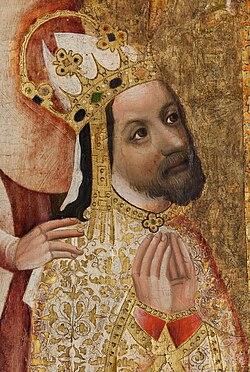
- February 6 – Joanna of Bourbon, queen consort of Charles V of France (b. 1338)
- March 27 – Pope Gregory XI (b. c. 1329)
- July – Owain Lawgoch, titular Prince of Wales and mercenary – assassinated (b. c. 1330)
- August 4 – Galeazzo II Visconti, Lord of Milan (b. c. 1320)
- November 29 – Charles IV, Holy Roman Emperor (b. 1316)
- November 30 – Andrew Stratford, English verderer and landowner
References
[edit]- ^ "Western Schism | History, Background, Popes, & Resolution | Britannica". www.britannica.com. Retrieved July 23, 2024.
- ^ Annales Mediolanenses.
- ^ Raseborg Castle - Sygic Travel
- ^ According to Al-Maqrizi.
- ^ "David Stewart, 1st Duke of Rothesay: Biography on Undiscovered Scotland". www.undiscoveredscotland.co.uk. Retrieved October 24, 2020.
This article is licensed under CC BY-SA 3.0.
Original source: https://en.wikipedia.org/wiki/1378
Status: article is cached
Original source: https://en.wikipedia.org/wiki/1378
Status: article is cached
 EncycloReader
is supported by the
EncycloReader
is supported by the  KSF
KSF