1843 in science
 From Wikipedia - Reading time: 7 min
| List of years in science |
|---|
| (table) |
|
|
| 1843 in science |
|---|
|
1842 1844 |
| Fields |
|
| Technology |
|
| Social sciences |
|
| Paleontology |
|
| Extraterrestrial environment |
| Terrestrial environment |
|
| Other/related |
|
The year 1843 in science and technology involved some significant events, listed below.

Astronomy
[edit]- March 11–14 – Eta Carinae flares to become the second brightest star.
- February 5–April 19 – "Great March Comet" observed.
- December 21 – The first total solar eclipse of Saros 139 occurs over southern Asia.
- Heinrich Schwabe reports a periodic change in the number of sunspots: they wax and wane in number according to a ten-year cycle.
Chemistry
[edit]- Jean-Baptiste Dumas names lactose.[1]
- Carl Mosander discovers the chemical elements Terbium and Erbium.[2]
- John J. Waterston produces an account of the kinetic theory of gases.[3]
- Alfred Bird produces single-acting baking powder.[4]
Mathematics
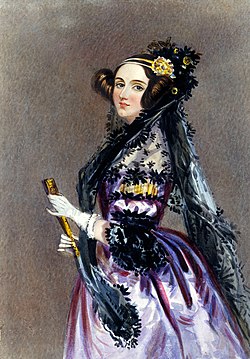
[edit]- September – Ada Lovelace translates and expands Menabrea’s notes on Charles Babbage's analytical engine, including an algorithm for calculating a sequence of Bernoulli numbers, regarded as the world's first computer program.[5][6][7]
- October 16 – William Rowan Hamilton discovers the calculus of quaternions and deduces that they are non-commutative.[8]
- Arthur Cayley and James Joseph Sylvester found the algebraic invariant theory.
- John T. Graves discovers the octonions.
- Pierre-Alphonse Laurent discovers and presents the Laurent expansion theorem.
Physics
[edit]- James Prescott Joule experimentally finds the mechanical equivalent of heat.[9]
- Ohm's acoustic law is proposed by German physicist Georg Ohm.
Physiology and medicine
[edit]- April–May – English surgeon Benjamin Brodie extracts a coin lodged in the bronchus of engineer Isambard Kingdom Brunel using novel methods.[10]
- British surgeon James Braid publishes Neurypnology: or the Rationale of Nervous Sleep, a key text in the history of hypnotism.
- Oliver Wendell Holmes Sr., argues that puerperal fever is spread by lack of hygiene in physicians.[11]
Technology
[edit]- March 25 – Completion of the Thames Tunnel, the first bored underwater tunnel in the world (engineer: Marc Isambard Brunel).[12]
- July 19 – Launch of SS Great Britain, the first iron-hulled, propeller-driven ship to cross the Atlantic Ocean (designer: Isambard Kingdom Brunel).[13]
- November 21 – Thomas Hancock patents the vulcanisation of rubber using sulphur in the United Kingdom
- The steam powered rotary printing press is invented by Richard March Hoe in the United States.[14]
- Robert Stirling and his brother James convert a steam engine at a Dundee factory to operate as a Stirling engine.
- The first public telegraph line in the United Kingdom is laid between Paddington and Slough.
- Approximate date – Euphonium invented.
Publications
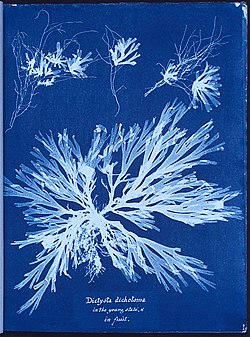
[edit]- October – Anna Atkins begins publication of Photographs of British Algae: Cyanotype Impressions, a collection of contact printed cyanotype photograms of algae which forms the first book illustrated with photographic images.[15][16][17][18]
Awards
[edit]- Copley Medal: Jean-Baptiste Dumas[19]
- Wollaston Medal for Geology: Jean-Baptiste Elie de Beaumont; Pierre Armand Dufrenoy
Births
[edit]- January 13 – David Ferrier (died 1928), Scottish neurologist.[20]
- May 6 – G. K. Gilbert (died 1918), American geologist.
- June 12 – David Gill (died 1914), Scottish astronomer.
- June 23 – Paul Heinrich von Groth (died 1927), German mineralogist.
- July 24 – William de Wiveleslie Abney (died 1920), English astronomer.
- August 17 – Alexandre Lacassagne (died 1924), French forensic scientist.
- November 30 – Martha Ripley (died 1912), American physician.[21]
- December 11 – Robert Koch (died 1910), German physician, famous for the discovery of the tubercle bacillus (1882) and the cholera bacillus (1883) and for his development of Koch's postulates; awarded the Nobel Prize in Physiology or Medicine in 1905
- Adelaida Lukanina (died 1908), Russian chemist.
Deaths
[edit]- July 25 – Charles Macintosh (born 1766), Scottish inventor of a waterproof fabric.[22]
- August 10 – Robert Adrain (born 1775), Irish American mathematician.
- September 11 – Joseph Nicollet (born 1786), French geographer, explorer, mathematician and astronomer.
- September 19 – Gaspard-Gustave Coriolis (born 1792), French mathematician and discoverer of the Coriolis effect.
- September 30 – Richard Harlan (born 1796), American zoologist.
- November 16 – Abraham Colles (born 1773), Anglo-Irish surgeon.
References
[edit]- ^ Dumas (1843). Traité de Chimie, Appliquée aux Arts. 6 Paris: Bechet Jeune. p. 293.
- ^ "Carl Gustav Mosander - Oxford Reference". www.oxfordreference.com. Retrieved 16 February 2020.
- ^ Thoughts on the Mental Functions; being an attempt to treat metaphysics as a branch of the physiology of the nervous system. Edinburgh: Oliver & Boyd. 1843.
- ^ Cannon, Matthew (2014-11-03). "Alfred Bird: Egg-free custard inventor and chemist". Birmingham Mail. Retrieved 2018-02-25.
- ^ Fuegi, John; Francis, Jo (October–December 2003). "Lovelace & Babbage and the creation of the 1843 'notes'". IEEE Annals of the History of Computing. 25 (4): 16–26. doi:10.1109/MAHC.2003.1253887. S2CID 40077111.
- ^ "Ada Byron, Lady Lovelace". Archived from the original on 21 July 2010. Retrieved 2010-07-11.
- ^ Menabrea, L. F. (1843). "Sketch of the Analytical Engine Invented by Charles Babbage". Scientific Memoirs. 3. Archived from the original on 13 September 2010. Retrieved 2010-10-01.
- ^ "William Rowan Hamilton Plaque". Geograph. 2007. Retrieved 2011-03-08.
- ^ Joule, J. P. (1843). "On the Mechanical Equivalent of Heat". Abstracts of the Papers Communicated to the Royal Society of London. 5: 839. doi:10.1098/rspl.1843.0196.
- ^ Brodie, Benjamin. "An account of a case in which a foreign body was lodged in the right bronchus." Paper to Royal Medical & Chirurgical Society 27 June 1843.
- ^ "The Contagiousness of puerperal fever". New England Quarterly Journal of Medicine and Surgery.
- ^ Smith, Denis (2001). London and the Thames Valley. London: Thomas Telford. p. 17. ISBN 978-0-7277-2876-0.
- ^ "Royal Visit". The Bristol Mirror. 20 July 1843. pp. 1–2.
- ^ Meggs, Philip B. (1998). A History of Graphic Design (3rd ed.). Wiley. p. 147. ISBN 978-0-471-29198-5. It receives U.S. patent 5,199 in 1847 and is placed in commercial use the same year.
- ^ Parr, Martin; Badger, Gerry (2004). The Photobook: a history, Volume I. London: Phaidon. ISBN 978-0-7148-4285-1.
- ^ James, Christopher (2009). The Book of Alternative Photographic Processes (2nd ed.). Clifton Park, NY: Delmar Cengage Learning. ISBN 978-1-4180-7372-5. Retrieved 2009-08-11.
- ^ "Photography. Cyanotype photograph. Anna Atkins (1799-1871)". Seeing is Believing: 700 years of scientific and medical illustration. New York Public Library. 2001 [1843]. Retrieved 2009-08-11.
- ^ Peres, Michael R. (2007). The Focal Encyclopedia of Photography: Digital Imaging, Theory and Applications, History, and Science (4th ed.). Amsterdam; Boston: Elsevier/Focal Press. ISBN 978-0-240-80740-9.
- ^ "Copley Medal | British scientific award". Encyclopedia Britannica. Retrieved 16 February 2020.
- ^ Sherrington, C. S.; Bevan, Michael. "Ferrier, Sir David (1843–1928), neurologist". Oxford Dictionary of National Biography (online ed.). Oxford University Press. doi:10.1093/ref:odnb/33117. Retrieved 16 February 2020. (Subscription, Wikipedia Library access or UK public library membership required.)
- ^ Ogilvie, Marilyn Bailey; Harvey, Joy Dorothy (2000). The Biographical Dictionary of Women in Science: L-Z. Taylor & Francis. p. 1102. ISBN 978-0-415-92040-7.
- ^ Day, Lance; McNeil, Ian (11 September 2002). Biographical Dictionary of the History of Technology. Routledge. p. 786. ISBN 978-1-134-65019-4.
This article is licensed under CC BY-SA 3.0.
Original source: https://en.wikipedia.org/wiki/1843 in science
Status: article is cached
Original source: https://en.wikipedia.org/wiki/1843 in science
Status: article is cached
 EncycloReader
is supported by the
EncycloReader
is supported by the  KSF
KSF