1870 in literature
 From Wikipedia - Reading time: 8 min
| List of years in literature |
|---|
| (table) |
|
|
|
This article contains information about the literary events and publications of 1870.
Events
[edit]
- January 19 – Ivan Turgenev attends and writes about the public execution by guillotine of the spree killer Jean-Baptiste Troppmann outside the gates of La Roquette Prisons in Paris.[2]
- March 7 – Thomas Hardy meets his first wife, Emma Gifford, in Cornwall.[3]
- March 28 – Serialisation of Kenward Philp's The Bowery Detective in The Fireside Companion (New York) begins, the first known story to include the word detective in the title.
- April–September – The serialisation of Charles Dickens' last novel, The Mystery of Edwin Drood, is left unfinished on his death on June 9 at Gads Hill Place in Kent, from a stroke, aged 58.[4]
- May – Karl May begins a second four-year prison sentence for thefts and frauds, at Waldheim, Saxony.[5]
- Spring – Serial publication begins of Aleksis Kivi's only novel Seitsemän veljestä ("Seven Brothers"), the first notable novel in the Finnish language.[6]
- August 24/25 – Libraries of the University of Strasbourg and the City of Strasbourg at Temple Neuf are destroyed by fire during the Siege of Strasbourg in the Franco-Prussian War, resulting in the loss of 3,446 medieval manuscripts, including the original 12th-century Hortus deliciarum compiled by Herrad of Landsberg, the Apologist codex containing the only text of the early Epistle to Diognetus, and rare Renaissance books.[7]
- September 17 – The first performance of Alexander Pushkin's play Boris Godunov (1825) is given at the Mariinsky Theatre in Saint Petersburg by members of the Alexandrinsky Theatre.
- c. September 20 – Friedrich Engels moves permanently to London from Manchester.[8]
- December 18 – The Russian literary weekly Niva («Ни́ва», "Cornfield") is first published by Adolf Marks in Saint Petersburg.[9]
- unknown date – Construction of the David Sassoon Library in Bombay, India, is completed.[10]
New books
[edit]Fiction
[edit]- William Harrison Ainsworth - Talbot Harland
- Thomas Bailey Aldrich – The Story of a Bad Boy
- Thomas Archer – The Terrible Sights of London
- Rhoda Broughton – Red as a Rose is She
- Wilkie Collins – Man and Wife
- Annie Denton Cridge - Man's Rights; Or, How Would You Like It? Comprising Dreams
- José Maria de Eça de Queiroz and Ramalho Ortigão – O Mistério da Estrada de Sintra (The Mystery of the Sintra Road)
- Charles Dickens – The Mystery of Edwin Drood
- Benjamin Disraeli – Lothair
- Fyodor Dostoevsky – The Eternal Husband («Вечный муж», Vechny muzh)
- Edward Jenkins – Ginx's Baby: his birth and other misfortunes
- Mór Jókai – Fekete gyémántok (Black Diamonds, i. e. coal)
- Aleksis Kivi – Seitsemän veljestä (Seven Brothers)
- Jonas Lie – Den Fremsynte (The Visionary or Pictures From Nordland)
- George Meredith – The Adventures of Harry Richmond (begins serial publication)
- William Morris – The Earthly Paradise
- Charles Reade - Put Yourself in His Place[11]
- Leopold von Sacher-Masoch – Venus in Furs (Venus im Pelz)
- Mikhail Saltykov-Shchedrin – The History of a Town («История одного города», Istoriya odnogo goroda)
- Bayard Taylor – Joseph and His Friend: A Story of Pennsylvania
- Anthony Trollope – The Vicar of Bullhampton[12]
- Ivan Turgenev – Stepnoy korol Lir (Степной король Лир); novella, English translation: King Lear of the Steppes'
- Jules Verne – Twenty Thousand Leagues Under the Seas
- Charlotte M. Yonge – The Caged Lion
Children and young people
[edit]- John Neal — Great Mysteries and Little Plagues[13]
Drama
[edit]- James Albery – Two Roses
- Ludwig Anzengruber (as L. Gruber) – Der Pfarrer von Kirchfeld (The Priest of Kirchfeld)
- Henry James Byron – Uncle Dick's Darling
- Pietro Cossa – Nero
- Lydia Koidula
- Maret ja Miina (or Kosjakased; The Betrothal Birches)
- Saaremaa Onupoeg (The Cousin from Saaremaa)
- Lord Newry – Ecarte
- George Sand and Sarah Bernhardt – L'Autre
- Aleksey Konstantinovich Tolstoy – Tsar Boris («Царь Борис», published)
Poetry
[edit]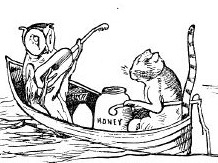
- Bret Harte – The Heathen Chinee
- Edward Lear – Nonsense Songs, Stories, Botany, and Alphabets (dated 1871),[14] including "The Owl and the Pussycat"
- Giovanni Marradi – Canzone moderne
- Dante Gabriel Rossetti – Poems,[14] including "Jenny" and a fragment of "The House of Life"
Non-fiction
[edit]- J. E. Austen-Leigh – A Memoir of Jane Austen
- Brewer's Dictionary of Phrase and Fable (1st edition)
- Richard William Church – Life of St. Anselm
- Thomas Wentworth Higginson - Army Life in a Black Regiment
- Hargrave Jennings – The Rosicrucians, their Rites and Mysteries
- Henry Maudsley – Body and Mind
- Dadabhai Naoroji – The Wants and Means of India
- William Robinson – The Wild Garden
- Charles Dudley Warner - My Summer in a Garden and Calvin, A Study of Character
Births
[edit]- January 3 – Henry Handel Richardson (Ethel Florence Lindesay Richardson), Australian novelist (died 1946)
- February 16 – Henric Streitman, Romanian essayist and journalist (died 1950)[15]
- March 5 – Frank Norris, American novelist (died 1902)
- April 7 – Gustav Landauer, German philosopher and revolutionary (murdered 1919)
- June 25 – Erskine Childers, Irish novelist (executed 1922)
- July 27 – Hilaire Belloc, French-born English writer, poet and satirist (died 1953)
- October 18 – Petre P. Negulescu, Romanian philosopher (died 1951)
- October 22 (October 10 OS) – Ivan Bunin, Russian-born writer, recipient of Nobel Prize in Literature (died 1953)
- October 29 – Gerald Duckworth, English publisher (died 1937)
- December 17 – Ioan A. Bassarabescu, Romanian short story writer and politician (died 1952)
- December 18 – Saki (Hector Hugh Munro), English short story writer and dramatist (killed in action 1916)[16]
Deaths
[edit]- January 21 – Alexander Herzen, Russian writer (born 1812)
- February 25 – Henrik Hertz, Danish poet (born 1797)
- April 16 – Rallou Karatza, Greek Wallachian translator and theatrical promoter (born 1799)
- April 24 – Louisa Stuart Costello, Irish writer on history and travel (born 1799)
- June 9 – Charles Dickens, English novelist (born 1812)[17]
- June 11 – William Gilmore Simms, American poet, novelist and historian (born 1806)
- June 24 – Adam Lindsay Gordon, Australian poet (born 1833)[18]
- July 19 – Benjamin Thorpe, scholar of Old English (born c. 1782)
- July 20 – Jules de Goncourt, French novelist and critic (syphilis, born 1830)[19]
- July 24 – Anders Abraham Grafström, Swedish poet and historian (born 1790)
- July 30 – Aasmund Olavsson Vinje, Norwegian journalist and poet (born 1818)[20]
- September 12 – Fitz Hugh Ludlow, American author and explorer (born 1836)[21]
- September 23 – Prosper Mérimée, French writer (b. 1803)[22]
- November 4 – Comte de Lautreamont (Isidore Lucien Ducasse), French poet and writer (born 1846)[23]
- December 5 – Alexandre Dumas, père, French novelist (born 1802)[24]
References
[edit]- ^ "Luke Fildes". TheFamousArtists.com.
- ^ Brumfield, William С. (2014), "Invitation to a Beheading: Turgenev and Troppmann", Informatsionnyi gumanitarnyi portal "Znanie. Ponimanie. Umenie" (6), archived from the original on 2015-04-02, retrieved 2015-03-17.
- ^ "Emma Gifford". Spartacus Educational. Archived from the original on 2013-08-02. Retrieved 2013-07-23.
- ^ Obituary, The Times (London), August 1870.
- ^ Sonderheft der Karl-May-Gesellschaft. Karl-May-Gesellschaft. 1972. p. 129.
- ^ "Aleksis Kivi: Seitsemän veljestä". Jyväskylän yliopisto. 11 August 2024. Retrieved 21 August 2020.
- ^ "History of the BNU". Strasbourg: BNU (Bibliothèque nationale universitaire). Retrieved 2014-01-21.
- ^ "Outstanding Dates". The Life and Work of Karl Marx. Retrieved 2013-07-23.
- ^ Jeffrey Brooks (2003). When Russia Learned to Read: Literacy and Popular Literature, 1861-1917. Northwestern University Press. p. 111. ISBN 0-8101-1897-1
- ^ Govinda Nārāyaṇa Māḍagã̄vakara (2009). Govind Narayan's Mumbai: An Urban Biography from 1863. Anthem Press. p. 366. ISBN 978-1-84331-305-2.
- ^ This article incorporates text from a publication now in the public domain: Gilman, D. C.; Peck, H. T.; Colby, F. M., eds. (1905). . New International Encyclopedia (1st ed.). New York: Dodd, Mead.
- ^ R. H. Super (1988). The Chronicler of Barsetshire: A Life of Anthony Trollope. University of Michigan Press. pp. 256–57.
- ^ Sears, Donald A. (1978). John Neal. Boston, Massachusetts: Twayne Publishers. p. 120. ISBN 080-5-7723-08.
- ^ a b Cox, Michael, ed. (2004). The Concise Oxford Chronology of English Literature. Oxford University Press. ISBN 0-19-860634-6.
- ^ Arghezi, Tudor (1945). "75 de ani". Bilete de Papagal (46): 1.
- ^ Ignatius Frederick Clarke (1997). The Great War with Germany, 1890-1914: Fictions and Fantasies of the War-to-come. Liverpool University Press. p. 438. ISBN 978-0-85323-642-9.
- ^ . Dictionary of National Biography. London: Smith, Elder & Co. 1885–1900.
- ^ Harris, Max (1983). The unknown great Australian and other psychobiographical portraits. Melbourne: Sun Books. p. 45. ISBN 9780725104245.
- ^ Pages from the Goncourt Journals (2006). NYRB Classics. ISBN 159017190X.
- ^ "Vinje-Sanger" (in Norwegian). Store norske leksikon.
- ^ Johnson, Rossiter, ed. (1906). . Vol. 7. Boston: American Biographical Society. p. 75 – via Wikisource. [scan
 ]
]
- ^ "Prosper Mérimée". Encyclopaedia Britannica.
- ^ Bachelard, Gaston (1986). "Lautréamont". Dallas Institute.
- ^ Douglas Munro (1978). Alexandre Dumas Père: A Bibliography of Works Translated Into English to 1910. Garland Pub. p. 242. ISBN 978-0-8240-9836-0.
This article is licensed under CC BY-SA 3.0.
Original source: https://en.wikipedia.org/wiki/1870 in literature
Status: article is cached
Original source: https://en.wikipedia.org/wiki/1870 in literature
Status: article is cached
 EncycloReader
is supported by the
EncycloReader
is supported by the  KSF
KSF