1974 in Bangladesh
 From Wikipedia - Reading time: 8 min
| |||||
| Centuries: |
| ||||
|---|---|---|---|---|---|
| Decades: |
| ||||
| See also: | Other events of 1974 List of years in Bangladesh | ||||

1974 (MCMLXXIV) was a common year starting on Tuesday of the Gregorian calendar, the 1974th year of the Common Era (CE) and Anno Domini (AD) designations, the 974th year of the 2nd millennium, the 74th year of the 20th century, and the 5th year of the 1970s decade.
The year 1974 was the third year after the independence of Bangladesh. It was also the third year of the first post-independence government in Bangladesh. The year saw a period of mass starvation beginning in March 1974 and ending in about December of the same year. The famine, allegedly causing death of a million people, is considered the worst in recent decades.
Incumbents
[edit]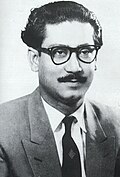
Rahman
- President: Mohammad Mohammadullah
- Prime Minister: Sheikh Mujibur Rahman
- Chief Justice: Abu Sadat Mohammad Sayem
Demography
[edit]| Population, total | 68,742,222 |
| Population density (per km2) | 528.1 |
| Population growth (annual %) | 1.6% |
| Male to Female Ratio (every 100 Female) | 106.6 |
| Urban population (% of total) | 9.0% |
| Birth rate, crude (per 1,000 people) | 45.7 |
| Death rate, crude (per 1,000 people) | 18.7 |
| Mortality rate, under 5 (per 1,000 live births) | 219 |
| Life expectancy at birth, total (years) | 47.4 |
| Fertility rate, total (births per woman) | 6.9 |
Climate
[edit]| Climate data for Bangladesh in 1974 | |||||||||||||
|---|---|---|---|---|---|---|---|---|---|---|---|---|---|
| Month | Jan | Feb | Mar | Apr | May | Jun | Jul | Aug | Sep | Oct | Nov | Dec | Year |
| Daily mean °C (°F) | 17.7 (63.9) |
20.2 (68.4) |
24.4 (75.9) |
27.1 (80.8) |
27.6 (81.7) |
27.9 (82.2) |
27.1 (80.8) |
27.9 (82.2) |
27.5 (81.5) |
27.6 (81.7) |
24.1 (75.4) |
18.3 (64.9) |
24.8 (76.6) |
| Average precipitation mm (inches) | 5.7 (0.22) |
0 (0) |
122.8 (4.83) |
154.5 (6.08) |
326.4 (12.85) |
423.5 (16.67) |
728. (28.7) |
375. (14.8) |
340.9 (13.42) |
238.6 (9.39) |
19.3 (0.76) |
1.5 (0.06) |
2,736.1 (107.72) |
| Source: Climatic Research Unit (CRU) of University of East Anglia (UEA)[2] | |||||||||||||
Economy
[edit]| National Income | |||
|---|---|---|---|
| Current US$ | Current BDT | % of GDP | |
| GDP | $12.5 billion | BDT99.7 billion | |
| GDP growth (annual %) | 9.6% | ||
| GDP per capita | $182.0 | BDT1,450 | |
| Agriculture, value added | $7.1 billion | BDT56.5 billion | 56.6% |
| Industry, value added | $1.7 billion | BDT13.3 billion | 13.4% |
| Services, etc., value added | $3.8 billion | BDT29.9 billion | 30.0% |
Note: For the year 1974 average official exchange rate for BDT was 8.23 per US$.
Events
[edit]
- 22 February – Pakistan recognizes Bangladesh.[3]
- 17 March – Members of Jatiya Rakkhi Bahini fired upon demonstrators from the Jatiyo Samajtantarik Dal, who were blockading the residence of the Home Minister Mansur Ali, located in the Ramna area of Dhaka. The incident reportedly claimed at least fifty lives.[4]
- 9 April – A tripartite agreement is signed among Bangladesh, India and Pakistan regarding post-war humanitarian issues.[5]
- 16 May – A land boundary agreement was signed between Indira Gandhi and Sheikh Mujibur Rahman which provided for the exchange of enclaves and the surrender of adverse possessions.[6]
- 17 September – Bangladesh joins the United Nations.
- 25 September – Sheikh Mujibur Rahman addresses the UN General Assembly in Bengali.[5]
- 28 November – Third Amendment to the Constitution of Bangladesh was passed bringing changes in Article 2 of the constitution. An agreement was made between Bangladesh and India in respect of exchange of certain enclaves and fixation of boundary lines between the countries.[7]
- 28 December – In the face of growing unrest, Prime Minister Sheikh Mujibur Rahman declares a state of emergency.[8]
Sports
[edit]- Domestic football:
- Abahani Krira Chakra won the Dhaka First Division Football League title, while Dilkusha SC came out runners-up.[9]
- Brothers Union won the Dhaka Second Division Football League title, earning promotion to the First Division.[10]
- Shantinagar Club won the Dhaka Third Division Football League, earning promotion to the Second Division.
- Abahani Krira Chakra became the first club after the independence of Bangladesh to participate in the IFA Shield.[11]
Births
[edit]- Ziaur Rahman, chess player
- Reefat Bin-Sattar, chess player
- Chanchal Chowdhury, actor
- Rajeeb Samdani, industrialist
- Tanzir Tuhin, musician
- Bobby Hajjaj, politician
- Bimal Tarafdar, sprinter
Deaths
[edit]- 11 February – Syed Mujtaba Ali, writer (b. 1904)
- 13 May – Khuda Buksh, humanitarian (b. 1912)
- 12 June – M. A. Hannan, politician (b. 1930)
- 5 October – Abul Hashim, politician (b. 1905)
- 2 November – Mohammad Barkatullah, writer (b. 1898)
- 5 November – Barada Bhushan Chakraborty, revolutionary peasant leader (b. 1901)
See also
[edit]- 1970s in Bangladesh
- List of Bangladeshi films of 1974
- Timeline of Bangladeshi history
References
[edit]- ^ a b "World Development Indicators". The World Bank. Retrieved 9 December 2021.
- ^ "Climate Change Knowledge Portal". The World Bank Group. Archived from the original on 27 May 2018. Retrieved 27 May 2018.
- ^ Heitzman, James; Worden, Robert, eds. (1989). "Table A. Chronology of Important Events". Bangladesh: A Country Study. Washington, D.C.: Federal Research Division, Library of Congress. p. xvii.
- ^ Ahmad, Mahiuddin, জাসদের উত্থান ও পতনঃ অস্থির সময়ের রাজনীতি, First published 2015, p. 111, Prothoma Prakashani, Dhaka.
- ^ a b "Bangladesh Genocide Archive » Complete Time Line". Archived from the original on 22 January 2010. Retrieved 27 August 2009.
- ^ Cons, Jason (October 2007). "The Tin Bigha corridor 15 years on". Forum. 2 (9). The Daily Star. Retrieved 5 June 2017.
India will retain the southern half of South Berubari Union No.12 ... in exchange Bangladesh will retain the Dahagram and Angarpota enclaves. India will lease in perpetuity to Bangladesh an area ... to connect Dahagram with ... Bangladesh.
- ^ "The Constitution (Third Amendment) Act". 1974.
- ^ "State of emergency announced in Dacca". The Tuscaloosa News. Associated Press. 29 December 1974. p. 6A.
- ^ "List of Champions". Atsushi Fujioka for Rec.Sport.Soccer Statistics Foundation. Retrieved 16 October 2018.
- ^ "Bangladesh football, the glorious days of Brothers Union". Weekly Blitz. 21 August 2021. Retrieved 1 March 2024.
- ^ "আবাহনী ও শেখ কামালের গল্প -". Thikana News. 9 August 2019. Archived from the original on 14 May 2023. Retrieved 7 June 2023.
 Years in Bangladesh (1971–present) Years in Bangladesh (1971–present) | |
|---|---|
| |
| 20th century |
|
| 21st century |
|
 | This Bangladeshi history-related article is a stub. You can help Wikipedia by expanding it. |
Original source: https://en.wikipedia.org/wiki/1974 in Bangladesh
Status: article is cached
 EncycloReader
is supported by the
EncycloReader
is supported by the  KSF
KSF