1 BC
 From Wikipedia - Reading time: 6 min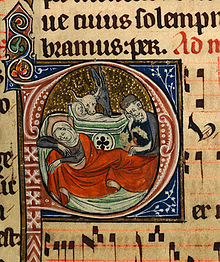
The birth of Jesus (pictured above) is widely regarded to have been placed by Dionysus Exiguus, inventor of the Anno Domini dating system, in 1 BC. Modern scholarship, however, regards the birth of Christ to have taken place between 6 and 4 BC.[1]
| Millennium: | 1st millennium BC |
|---|---|
| Centuries: |
|
| Decades: |
|
| Years: |
|
| 1 BC by topic |
| Politics |
|---|
|
| Categories |
|
| Gregorian calendar | 1 BC N |
| Ab urbe condita | 753 |
| Ancient Greek era | 194th Olympiad, year 4 |
| Assyrian calendar | 4750 |
| Balinese saka calendar | N/A |
| Bengali calendar | −593 |
| Berber calendar | 950 |
| Buddhist calendar | 544 |
| Burmese calendar | −638 |
| Byzantine calendar | 5508–5509 |
| Chinese calendar | 己未年 (Earth Goat) 2696 or 2636 — to — 庚申年 (Metal Monkey) 2697 or 2637 |
| Coptic calendar | −284 – −283 |
| Discordian calendar | 1166 |
| Ethiopian calendar | −8 – −7 |
| Hebrew calendar | 3760–3761 |
| Hindu calendars | |
| - Vikram Samvat | 56–57 |
| - Shaka Samvat | N/A |
| - Kali Yuga | 3100–3101 |
| Holocene calendar | 10000 |
| Iranian calendar | 622 BP – 621 BP |
| Islamic calendar | 641 BH – 640 BH |
| Javanese calendar | N/A |
| Julian calendar | 1 BC N |
| Korean calendar | 2333 |
| Minguo calendar | 1912 before ROC 民前1912年 |
| Nanakshahi calendar | −1468 |
| Seleucid era | 311/312 AG |
| Thai solar calendar | 542–543 |
| Tibetan calendar | 阴土羊年 (female Earth-Goat) 126 or −255 or −1027 — to — 阳金猴年 (male Iron-Monkey) 127 or −254 or −1026 |
Year 1 BC was a common year starting on Friday or Saturday in the Julian calendar (the sources differ; see leap year error for further information) and a leap year starting on Thursday in the Proleptic Julian calendar. It is also a leap year starting on Saturday in the Proleptic Gregorian calendar. At the time, it was known as the Year of the Consulship of Lentulus and Piso (or, less frequently, year 753 Ab urbe condita). The denomination 1 BC for this year has been used since the early medieval period when the Anno Domini calendar era became the prevalent method in Europe for naming years. The following year is 1 AD in the widely used Julian calendar, which does not have a "year zero".
Events[edit]
By place[edit]
Han Dynasty[edit]
- Emperor Ai of Han dies and is succeeded by his 8-year-old cousin Ping of Han.[2]
- Wang Mang is appointed regent by Grand Empress Dowager Wang Zhengjun, who is his aunt.[3]
- Former regent Dong Xian, who was previously Emperor Ai of Han's lover, commits suicide with his wife.[4]
Roman Empire[edit]
- Gaius Caesar marries Livilla, daughter of Antonia Minor and Nero Claudius Drusus, in an effort to gain prestige.[5]
- The Roman theatre in Cartagena, built by Gaius and Lucius Caesar, finishes construction.[6]
- Aulus Caecina Severus was appointed consul by Emperor Augustus succeeding Cossus Cornelius Lentulus Gaetulicus and Lucius Calpurnius Piso (consul 1 BC).[7]
Kingdom of Kush[edit]
- The approximate date of Natakamani succeeding Amanishakheto as the King of Kush.[8]
Satavahana dynasty[edit]
- Kunatala Satakarni is succeeded by Satakarni III. [9]
By topic[edit]
Religion[edit]
- Estimated birth of Jesus, in the Christian religion, as assigned by Dionysius Exiguus in his Anno Domini era; according to most scholars, Dionysius used the word "incarnation", but it is not known whether he meant conception or birth. However, at least one scholar thinks Dionysius placed the incarnation of Jesus in the next year, AD 1.[10][11] Most modern scholars do not consider Dionysius' calculations authoritative, and place the event several years earlier.[12]
Deaths[edit]
- August 15 – Ai of Han, Chinese emperor of the Han Dynasty (b. 27 BC)[13][14]
- Dong Xian, Chinese politician and commander-in-chief (b. 23 BC)[4]
- Xiaoai, Chinese empress and wife of Ai of Han[15]
- Zhao Feiyan, Chinese empress and wife of Cheng of Han (b. 45 BC)[16]
See also[edit]

- Year zero for the different conventions that historians and astronomers use for "BC" years
References[edit]
- ^ Meier, John P. (1991). "A Chronology of Jesus' Life". A Marginal Jew: Rethinking the Historical Jesus. Vol. v. 1. Anchor Bible Reference Library. pp. 373–433.
- ^ Furth, Charlotte (1991). "Passions of the Cut Sleeve: The Male Homosexual Tradition in China. By Bret Hinsch. Berkeley: University of California Press, 1990. xvii, 232 pp. $22.50". The Journal of Asian Studies. 50 (4): 911–912. doi:10.2307/2058567. ISSN 0021-9118. JSTOR 2058567.
- ^ Bowman, John Stewart, ed. (2000). Columbia Chronologies of Asian history and Culture. New York: Columbia University Press. p. 12. ISBN 978-0-231-50004-3. OCLC 51542679.
- ^ a b Hinsch, Bret. (1990) Passions of the Cut Sleeve. University of California Press.
- ^ "Cassius Dio - Book 55". penelope.uchicago.edu. Retrieved May 25, 2021.
- ^ "Cartagena Roman Theatre Museum". murciatoday.com. Retrieved May 26, 2021.
- ^ Syne, Ronald (1995). Anatolica : studies in Strabo. Clarendon Press. ISBN 0-19-814943-3. OCLC 30318791.
- ^ Garlake, Peter S. (2002). Early Art and Architecture of Africa. Oxford University Press. ISBN 978-0-19-284261-9.
- ^ Singh, Rajesh Kumar (2013). Ajanta Paintings: 86 Panels of Jatakas and Other Themes. Hari Sena. pp. 15–16. ISBN 9788192510750.
- ^ Georges Declercq, Anno Domini: The origins of the Christian Era (Turnhout, Belgium: Brepols, 2000), pp.143–147.
- ^ G. Declercq, "Dionysius Exiguus and the introduction of the Christian Era", Sacris Erudiri 41 (2002) 165–246, pp.242–246. Annotated version of a portion of Anno Domini.
- ^ James D. G. Dunn, Jesus Remembered, Eerdmans Publishing (2003), page 324.
- ^ Fairbank, John (1986). The Cambridge History of China: Volume 1, The Ch'in and Han Empires, 221 BC-AD 220. Cambridge University Press. p. 227. ISBN 9780521243278.
- ^ Loewe, Michael (2018) [1974]. Crisis and Conflict in Han China. Routledge. ISBN 9780429849107.
- ^ Thomsen, Rudi (1988). Ambition and Confucianism : a biography of Wang Mang. [Aarhus, Denmark]: Aarhus University Press. ISBN 87-7288-155-0. OCLC 19912826.
- ^ Peterson, Barbara Bennett, ed. (2015). Notable women of China: Shang dynasty to the early twentieth century. Armonk, New York: M. E. Sharpe (Routledge). pp. 75–77. ISBN 978-0-7656-0504-7. OCLC 41231560.
This article is licensed under CC BY-SA 3.0.
Original source: https://en.wikipedia.org/wiki/1 BC
Status: article is cached
Original source: https://en.wikipedia.org/wiki/1 BC
Status: article is cached
 EncycloReader
is supported by the
EncycloReader
is supported by the  KSF
KSF