32nd United States Congress
 From Wikipedia - Reading time: 16 min
| 32nd United States Congress | |
|---|---|
31st ← → 33rd | |
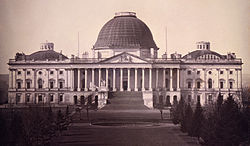 United States Capitol (1846) | |
March 4, 1851 – March 4, 1853 | |
| Members | 62 senators 233 representatives 4 non-voting delegates |
| Senate majority | Democratic |
| Senate President | Vacant |
| House majority | Democratic |
| House Speaker | Linn Boyd (D) |
| Sessions | |
| Special[a]: March 4, 1851 – March 13, 1851 1st: December 1, 1851 – August 31, 1852 2nd: December 6, 1852 – March 4, 1853 | |
The 32nd United States Congress was a meeting of the legislative branch of the United States federal government, consisting of the United States Senate and the United States House of Representatives. It met in Washington, D.C. from March 4, 1851, to March 4, 1853, during the last two years of Millard Fillmore's presidency. The apportionment of seats in the House of Representatives was based on the 1840 United States census. Both chambers had a Democratic majority.
It was one of the least active Congresses, forwarding only 74 bills that were signed by the president.[1]
Major events
[edit]
- March 20, 1852: Uncle Tom's Cabin published.
- July 1, 1852: Henry Clay was the first to lie in state in the United States Capitol rotunda.
- November 2, 1852: 1852 United States presidential election: Democrat Franklin Pierce defeated Whig Winfield Scott.
Major legislation
[edit]- March 2, 1853: An act providing for administering the oath of office to William R. King, Vice President elect of the United States of America. Sess. 2, Ch. 93, 10 Stat. 180
Territories organized
[edit]- March 2, 1853: Washington Territory was formed from Oregon Territory.
Party summary
[edit]Senate
[edit]| Party (shading shows control) |
Total | Vacant | |||
|---|---|---|---|---|---|
| Democratic (D) |
Free Soil (FS) | Whig (W) |
|||
| End of previous congress | 36 | 2 | 24 | 62 | 0 |
| Begin | 34 | 2 | 21 | 57 | 5 |
| End | 35 | 3 | 23 | 61 | 1 |
| Final voting share | 57.4% | 4.9% | 37.7% | ||
| Beginning of next congress | 36 | 3 | 22 | 61 | 2 |
House of Representatives
[edit]| Party (Shading indicates majority caucus)
|
Total | Vacant | ||||||||||||||||||||||||||||||||||||||||||||||||||||||||||||||||||||||||||||||||||||||||||||||||
|---|---|---|---|---|---|---|---|---|---|---|---|---|---|---|---|---|---|---|---|---|---|---|---|---|---|---|---|---|---|---|---|---|---|---|---|---|---|---|---|---|---|---|---|---|---|---|---|---|---|---|---|---|---|---|---|---|---|---|---|---|---|---|---|---|---|---|---|---|---|---|---|---|---|---|---|---|---|---|---|---|---|---|---|---|---|---|---|---|---|---|---|---|---|---|---|---|---|---|
| Democratic (D) |
Independent Democratic (ID) |
Free Soil (FS) |
Southern Rights (SR) |
Union (U) |
Whig (W) |
Independent Whig (IW) |
Other | |||||||||||||||||||||||||||||||||||||||||||||||||||||||||||||||||||||||||||||||||||||||||||
| End of previous Congress | 113 | 0 | 9 | 0 | 0 | 107 | 0 | 2 | 231 | 2 | ||||||||||||||||||||||||||||||||||||||||||||||||||||||||||||||||||||||||||||||||||||||||
| Begin | 127 | 3 | 4 | 3 | 10 | 85 | 1 | 0 | 233 | 0 | ||||||||||||||||||||||||||||||||||||||||||||||||||||||||||||||||||||||||||||||||||||||||
| End | 125 | 86 | 232 | 1 | ||||||||||||||||||||||||||||||||||||||||||||||||||||||||||||||||||||||||||||||||||||||||||||||
| Final voting share | 54.7% | 1.3% | 1.3% | 1.3% | 4.3% | 36.8% | 0.4% | 0.0% | ||||||||||||||||||||||||||||||||||||||||||||||||||||||||||||||||||||||||||||||||||||||||||
| Beginning of next Congress | 158 | 1 | 3 | 0 | 0 | 71 | 0 | 1 | 234 | 0 | ||||||||||||||||||||||||||||||||||||||||||||||||||||||||||||||||||||||||||||||||||||||||
Leadership
[edit]
(until December 20, 1852)

(from December 20, 1852)
Senate
[edit]- President: Vacant (since the ascension of Millard Fillmore to U.S. President on July 9, 1850)
- President pro tempore: William R. King (D), until December 20, 1852
- David R. Atchison (D), from December 20, 1852
House of Representatives
[edit]- Speaker: Linn Boyd (D)
Members
[edit]This list is arranged by chamber, then by state. Senators are listed by class and representatives by district.
Senate
[edit]Senators were elected by the state legislatures every two years, with one-third beginning new six-year terms with each Congress. Preceding the names in the list below are Senate class numbers, which indicate the cycle of their election. In this Congress, Class 1 meant their term began with this Congress, facing re-election in 1856; Class 2 meant their term ended with this Congress, facing re-election in 1852; and Class 3 meant their term began in the last Congress, facing re-election in 1854.
Alabama[edit]
Arkansas[edit]
California[edit]
Connecticut[edit]
Delaware[edit]
Florida[edit]
Georgia[edit]
Illinois[edit]
Indiana[edit]
Iowa[edit]
Kentucky[edit]
Louisiana[edit]
Maine[edit]
Maryland[edit]
Massachusetts[edit]
Michigan[edit]
|
Mississippi[edit]
Missouri[edit]
New Hampshire[edit]
New Jersey[edit]
New York[edit]
North Carolina[edit]
Ohio[edit]
Pennsylvania[edit]
Rhode Island[edit]
South Carolina[edit]
Tennessee[edit]
Texas[edit]
Vermont[edit]
Virginia[edit]
Wisconsin[edit]
|
 2 Democrats 1 Democrat and 1 Whig 2 Whigs |
|
House of Representatives
[edit]
The names of members of the House of Representatives are preceded by their district numbers.
Alabama[edit]
Arkansas[edit]
California[edit]Both representatives were elected statewide on a general ticket.
Connecticut[edit]
Delaware[edit]
Florida[edit]
Georgia[edit]
Illinois[edit]
Indiana[edit]
Iowa[edit]
Kentucky[edit]
Louisiana[edit]
Maine[edit]
Maryland[edit]
Massachusetts[edit]
Michigan[edit]
Mississippi[edit]
Missouri[edit]
New Hampshire[edit]
New Jersey[edit]
New York[edit]
|
North Carolina[edit]
Ohio[edit]
Pennsylvania[edit]
Rhode Island[edit]
South Carolina[edit]
Tennessee[edit]
Texas[edit]
Vermont[edit]
Virginia[edit]
Wisconsin[edit]
Non-voting members[edit]
|

 Linn Boyd
| ||||||||||
Changes in membership
[edit]The count below reflects changes from the beginning of the first session of this Congress.
Senate
[edit]- Replacements: 8
- Democrats (D): 1 seat net gain
- Whigs (W): 1 seat net loss
- Deaths: 3
- Resignations: 6
- Interim appointments: 3
- Total seats with changes: 13
| State (class) |
Vacated by | Reason for change | Successor | Date of successor's formal installation[b] |
|---|---|---|---|---|
| Ohio (1) |
Vacant | Failure to elect. The winner was elected late on March 15, 1851, on the 37th ballot over the incumbent appointee.[2] Successor was elected March 15, 1851. |
Benjamin Wade (W) | Elected March 15, 1851 |
| New York (1) |
Vacant | Failure to elect. Successor was elected March 19, 1851. |
Hamilton Fish (W) | Elected March 19, 1851 |
| Massachusetts (1) |
Vacant | Failure to elect. Successor was elected April 24, 1851. |
Charles Sumner (FS) | Elected April 24, 1851 |
| California (1) |
Vacant | Failure to elect. Successor was elected January 30, 1852. |
John B. Weller (D) | Elected January 30, 1852 |
| Connecticut (1) |
Vacant | Failure to elect. Successor was elected May 12, 1852. |
Isaac Toucey (D) | Seated May 12, 1852 |
| Mississippi (1) |
Jefferson Davis (D) | Resigned September 23, 1851, to run for Governor of Mississippi. Successor appointed December 1, 1851. |
John J. McRae (D) | Appointed December 1, 1851 |
| Mississippi (2) |
Henry S. Foote (D) | Resigned January 8, 1852, to become Governor of Mississippi. Successor elected February 18, 1852. |
Walker Brooke (W) | Elected February 18, 1852 |
| Mississippi (1) |
John J. McRae (D) | Appointee was replaced by an elected successor. Successor elected March 17, 1852. |
Stephen Adams (D) | Elected March 17, 1852 |
| South Carolina (2) |
Robert Rhett (D) | Resigned May 7, 1852. Successor appointed May 10, 1852, and elected sometime thereafter to finish the term. |
William F. De Saussure (D) | Appointed May 10, 1852 |
| Georgia (2) |
John M. Berrien (W) | Resigned May 28, 1852. Successor appointed May 31, 1852, to finish the term. |
Robert M. Charlton (D) | Appointed May 31, 1852 |
| Kentucky (3) |
Henry Clay (W) | Died June 29, 1852. Successor appointed July 6, 1852. |
David Meriwether (D) | Appointed July 6, 1852 |
| Indiana (3) |
James Whitcomb (D) | Died October 4, 1852. Successor appointed December 6, 1852. |
Charles W. Cathcart (D) | Appointed December 6, 1852 |
| Kentucky (3) |
David Meriwether (D) | Appointee was replaced by an elected successor. Successor elected September 1, 1852. |
Archibald Dixon (W) | Elected September 1, 1852 |
| Alabama (3) |
William R. King (D) | Resigned December 20, 1852, due to ill health, having recently being elected Vice President of the United States Successor appointed January 14, 1853, and elected December 12, 1853[3] thereafter to finish the term. |
Benjamin Fitzpatrick (D) | Appointed January 14, 1853 |
| New Jersey (1) |
Robert F. Stockton (D) | Resigned January 1, 1853, to become president of the Delaware and Raritan Canal Company. Successor was not elected until the next Congress. |
Vacant | Not filled this term |
| Vermont (3) |
William Upham (W) | Died January 14, 1853. Successor appointed January 17, 1853, to continue the term. |
Samuel S. Phelps (W) | Appointed January 17, 1853 |
| Indiana (3) |
Charles W. Cathcart (D) | Appointee was replaced by an elected successor. Successor elected January 18, 1853. |
John Pettit (D) | Elected January 18, 1853 |
House of Representatives
[edit]- Replacements: 6
- Democrats (D): 1 seat net loss
- Whigs (W): 1 seat net gain
- Deaths: 2
- Resignations: 5
- Total seats with changes: 7
| District | Vacated by | Reason for change | Successor | Date of successor's formal installation[b] |
|---|---|---|---|---|
| Maine 4th | Charles Andrews (D) | Died April 30, 1852 | Isaac Reed (W) | Seated June 25, 1852 |
| Virginia 15th | George W. Thompson (D) | Resigned July 30, 1852, after being appointed judge of the Circuit Court of Virginia | Sherrard Clemens (D) | Seated December 6, 1852 |
| Kentucky 7th | Humphrey Marshall (W) | Resigned August 4, 1852, after being appointed Minister to China | William Preston (W) | Seated December 6, 1852 |
| Massachusetts 2nd | Robert Rantoul Jr. (D) | Died August 7, 1852 | Francis B. Fay (W) | Seated December 13, 1852 |
| Massachusetts 9th | Orin Fowler (W) | Died September 3, 1852 | Edward P. Little (D) | Seated December 13, 1852 |
| Massachusetts 4th | Benjamin Thompson (W) | Died September 24, 1852 | Lorenzo Sabine (W) | Seated December 13, 1852 |
| New York 17th | Alexander H. Buell (D) | Died January 29, 1853 | Vacant | Not filled this term |
Committees
[edit]Lists of committees and their party leaders.
Senate
[edit]- Agriculture (Chairman: Pierre Soule)
- Audit and Control the Contingent Expenses of the Senate (Chairman: Augustus Dodge)
- Claims (Chairman: Richard Brodhead)
- Commerce (Chairman: Hannibal Hamlin)
- Contested Election of 1850 (Chairman: N/A)
- Distributing Public Revenue Among the States (Select)
- District of Columbia (Chairman: James Shields)
- Emigrant Route and Telegraphic Line to California (Select)
- Ether Discovery (Select)
- Finance (Chairman: Robert M.T. Hunter)
- Foreign Relations (Chairman: James M. Mason)
- French Spoilations (Select)
- Indian Affairs (Chairman: David R. Atchison)
- Judiciary (Chairman: Andrew P. Butler)
- Manufactures (Chairman: William K. Sebastian)
- Library (Chairman: James A. Pearce)
- Mexican Boundary (Select)
- Mexican Boundary Commission (Select)
- Mexican Claims Commission (Select)
- Military Affairs (Chairman: James Shields)
- Militia (Chairman: Sam Houston)
- Naval Affairs (Chairman: William M. Gwin)
- Ordnance and War Ships (Select)
- Patents and the Patent Office (Chairman: Moses Norris Jr. and Charles T. James)
- Pensions (Chairman: George Wallace Jones)
- Post Office and Post Roads (Chairman: Thomas J. Rusk)
- Printing (Chairman: Hannibal Hamlin)
- Private Land Claims (Chairman: Solomon W. Downs)
- Public Buildings and Grounds (Chairman: James Whitcomb)
- Public Lands (Chairman: Alpheus Felch)
- Purchase of Catlin's Collection of Indian Scenes (Select)
- Retrenchment (Chairman: James W. Bradbury)
- Revolutionary Claims (Chairman: Issac P. Walker)
- Roads and Canals (Chairman: Jesse D. Bright)
- Tariff Regulation (Select)
- Territories (Chairman: Stephen A. Douglas)
- Seventh Census (Select)
- Whole
House of Representatives
[edit]- Accounts (Chairman: John C. Mason)
- Agriculture (Chairman: John G. Floyd)
- Bounty Land Act of 1850 (Select)
- Bounty Land Bill (Chairman: Cyrus L. Dunham)
- Claims (Chairman: John Reeves Jones Daniel)
- Commerce (Chairman: David L. Seymour)
- District of Columbia (Chairman: Orlando B. Ficklin)
- Elections (Chairman: William S. Ashe)
- Engraving (Chairman: Edward Hammond)
- Expenditures in the Navy Department (Chairman: Fayette McMullen)
- Expenditures in the Post Office Department (Chairman: Alexander G. Penn)
- Expenditures in the State Department (Chairman: Charles E. Stuart)
- Expenditures in the Treasury Department (Chairman: Benjamin B. Thurston)
- Expenditures in the War Department (Chairman: Milo M. Dimmick)
- Expenditures on Public Buildings (Chairman: Thomas Bartlett Jr.)
- Foreign Affairs (Chairman: Thomas H. Bayly)
- Indian Affairs (Chairman: Robert W. Johnson)
- Invalid Pensions (Chairman: Isham G. Harris)
- Judiciary (Chairman: James X. McLanahan)
- Manufactures (Chairman: James M.H. Beale)
- Mileage (Chairman: Thomas A. Hendricks)
- Military Affairs (Chairman: William H. Bissell)
- Militia (Chairman: Charles H. Peaslee)
- Naval Affairs (Chairman: Frederick P. Stanton)
- Patents (Chairman: David K. Cartter)
- Post Office and Post Roads (Chairman: Edson B. Olds)
- Private Land Claims (Chairman: Timothy Jenkins)
- Public Buildings and Grounds (Chairman: Richard H. Stanton)
- Public Expenditures (Chairman: Charles Sweetser)
- Public Lands (Chairman: Willard P. Hall)
- Revisal and Unfinished Business (Chairman: Williamson R. W. Cobb)
- Revolutionary Claims (Chairman: Moses Macdonald)
- Revolutionary Pensions (Chairman: John S. Millson)
- Roads and Canals (Chairman: John L. Robinson)
- Rules (Chairman: Willard P. Hall)
- Standards of Official Conduct
- Territories (Chairman: William A. Richardson)
- Ways and Means (Chairman: George S. Houston)
- Whole
Joint committees
[edit]- Enrolled Bills (Chairman: Rep. Isaac Wildrick)
- The Library (Chairman: Joseph R. Chandler)
- Printing (Chairman: Willis A. Gorman)
Caucuses
[edit]- Senate Democratic Caucus
- House Democratic Caucus
Employees
[edit]Legislative branch agency directors
[edit]- Architect of the Capitol: Thomas U. Walter, appointed June 11, 1851
- Librarian of Congress: John Silva Meehan
Senate
[edit]- Chaplain: Clement M. Butler (Episcopalian)
- Secretary: Asbury Dickins
- Sergeant at Arms: Robert Beale
House of Representatives
[edit]- Chaplain: Ralph Randolph Gurley (Presbyterian), until December 1, 1851
- Lyttleton Morgan (Methodist), elected December 1, 1851
- James Gallagher (Presbyterian), elected December 6, 1852
- Clerk: Richard M. Young, until December 1, 1851
- John W. Forney, from December 1, 1851
- Doorkeeper: Zadock W. McKnew
- Reading Clerks: [data missing]
- Sergeant at Arms: Adam J. Glossbrenner
- Postmaster: John M. Johnson
See also
[edit]- 1850 United States elections (elections leading to this Congress)
- 1850–51 United States Senate elections
- 1850–51 United States House of Representatives elections
- 1852 United States elections (elections during this Congress, leading to the next Congress)
- 1852 United States presidential election
- 1852–53 United States Senate elections
- 1852–53 United States House of Representatives elections
Notes
[edit]References
[edit]- ^ Faris, David M. (2018). It's Time to Fight Dirty: How Democrats Can Build a Lasting Majority in American Politics. Melville House Publishing. p. 123. ISBN 978-1612196954.
- ^ Taylor, William Alexander; Taylor, Aubrey Clarence (1899). Ohio statesmen and annals of progress: from the year 1788 to the year 1900 . State of Ohio. p. 240.
- ^ Byrd, Robert C.; Wolff, Wendy (October 1, 1993). The Senate, 1789-1989: Historical Statistics, 1789-1992 (volume 4 Bicentennial ed.). U.S. Government Printing Office. p. 76. ISBN 9780160632563.
- Martis, Kenneth C. (1989). The Historical Atlas of Political Parties in the United States Congress. New York: Macmillan Publishing Company.
- Martis, Kenneth C. (1982). The Historical Atlas of United States Congressional Districts. New York: Macmillan Publishing Company.
External links
[edit]- Statutes at Large, 1789-1875
- Senate Journal, First Forty-three Sessions of Congress
- House Journal, First Forty-three Sessions of Congress
- Biographical Directory of the U.S. Congress
- U.S. House of Representatives: House History
- U.S. Senate: Statistics and Lists
- Congressional Directory for the 32nd Congress, 1st Session.
- Congressional Directory for the 32nd Congress, 2nd Session.
Original source: https://en.wikipedia.org/wiki/32nd United States Congress
Status: article is cached
 EncycloReader
is supported by the
EncycloReader
is supported by the  KSF
KSF