Categories
47th Wisconsin Legislature
 From Wikipedia - Reading time: 14 min
| 47th Wisconsin Legislature | |||||
|---|---|---|---|---|---|
| |||||
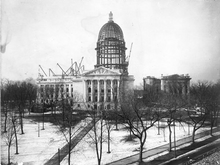 Wisconsin State Capitol under reconstruction after the 1904 fire | |||||
| Overview | |||||
| Legislative body | Wisconsin Legislature | ||||
| Meeting place | Wisconsin State Capitol | ||||
| Term | January 2, 1905 – January 7, 1907 | ||||
| Election | November 8, 1904 | ||||
| Senate | |||||
| Members | 33 | ||||
| Senate President | James O. Davidson (R) until Jan. 1, 1906 | ||||
| President pro tempore | James J. McGillivray (R) | ||||
| Party control | Republican | ||||
| Assembly | |||||
| Members | 100 | ||||
| Assembly Speaker | Irvine Lenroot (R) | ||||
| Party control | Republican | ||||
| Sessions | |||||
| |||||
| Special sessions | |||||
| |||||
The Forty-Seventh Wisconsin Legislature convened from January 11, 1905, to June 21, 1905, in regular session, and re-convened for a special session from December 4, 1905, through December 19, 1905.[1] During this term, legislative business was largely held in the north wing of the Wisconsin State Capitol, which was the only part of the capitol to remain intact after the 1904 fire.[2]
This session saw passage of several signature progressive reforms pushed by Governor Robert M. La Follette. Including the creation of a civil service commission to implement merit-based rules for all state government jobs, creation of new powers and commissions for railroad, public health, and tax regulation, and attempts to eliminate lobbying and corporate-funding of political campaigns. This was also the first of several sessions in which Milwaukee County sent a substantial delegation of socialist democrats to the legislature.
Senators representing even-numbered districts were newly elected for this session and were serving the first two years of a four-year term. Assembly members were elected to a two-year term. Assembly members and even-numbered senators were elected in the general election of November 8, 1904. Senators representing odd-numbered districts were serving the third and fourth year of a four-year term, having been elected in the general election of November 4, 1902.[1]
Major events
[edit]- January 24, 1905: Wisconsin governor Robert M. La Follette was elected United States Senator by the Wisconsin Legislature in joint session. La Follette, who had just been re-elected as governor, then delayed accepting the office until the end of the year, leaving Wisconsin with only one U.S. senator for most of 1905.
- January 30, 1905: The United States Supreme Court decided the case of Swift & Co. v. United States, determining that the commerce clause of the U.S. constitution allowed the Congress to regulate monopolies.
- March 4, 1905: Second inauguration of President Theodore Roosevelt.
- June 30, 1905: Albert Einstein submitted his paper "On the Electrodynamics of Moving Bodies", establishing his theory of special relativity.
- July 21, 1905: The Taft–Katsura agreement was reached between representatives of the United States and the Empire of Japan, to define separate spheres of influence in east Asia.
- September 5, 1905: The Treaty of Portsmouth was signed at Kittery, Maine, by representatives of the Russian Empire and the Empire of Japan, bringing an end to the Russo-Japanese War. U.S. president Theodore Roosevelt was later awarded the Nobel Peace Prize for his part in the negotiations.
- September 27, 1905: Albert Einstein submitted his paper "Does the Inertia of a Body Depend Upon Its Energy Content?", in which he postulated mass–energy equivalence.
- January 1, 1906: Robert La Follette officially resigned as Governor of Wisconsin and began his term as U.S. senator. Lieutenant Governor James O. Davidson was sworn in as the 21st governor of Wisconsin.
- February 7, 1906: The revolutionary British Navy battleship HMS Dreadnought was launched, kicking off a naval arms race with the Imperial German Navy.
- April 3, 1906: William H. Timlin was elected to a new seat on the Wisconsin Supreme Court.
- April 18, 1906: The 1906 San Francisco earthquake destroyed much of San Francisco, resulting in at least 3,000 deaths and leaving over 200,000 homeless.
- May 14, 1906: The Wisconsin Supreme Court decided the case Nunnemacher v. State (129 Wis. 190) in favor of the State of Wisconsin — validating the constitutionality of the new state inheritance tax.[3]
- August 23, 1906: Forces of the United States military arrived in Cuba at the request of embattled president Tomás Estrada Palma, beginning the second occupation of Cuba.
- November 3, 1906: SOS became an internationally recognized signal of distress.
- November 6, 1906: James O. Davidson elected Governor of Wisconsin.
Major legislation
[edit]- April 26, 1905: An Act providing for the location of a state normal school at the city of La Crosse, and making an appropriation therefor, 1905 Act 121. Origin of the University of Wisconsin–La Crosse.
- May 12, 1905: An Act prescribing the duties of physicians and others relative to infectious diseases, 1905 Act 192. Mandated reporting of statistics of certain infectious diseases to state health authorities, and setting requirements for quarantining, decontamination, and public information. Also criminalized interfering with public health actions, and mandated reporting of any such interference.
- May 12, 1905: An Act relating to inn-keepers and for the promotion of the public health, 1905 Act 198. Required innkeepers to deny service to people suffering from communicable diseases.
- June 5, 1905: An Act regulating automobiles, auto-cars and other similar motor vehicles on the public highways within the state, 1905 Act 305. First law for registration and licensing of automobiles in the state, and establishing speed limits.
- June 13, 1905: An Act to regulate railroads and other common carriers in this state, create a board of railroad commissioners, fix their salaries, define their duties, prevent the imposition of unreasonable rates, prevent unjust discriminations, insure an adequate railway service, prescribe the mode of procedure and the rules of evidence in relation thereto, prescribe penalties for violations, and making an appropriation therefor, 1905 Act 362. Abolished the statewide elected office of Railroad Commissioner and created a board of commissioners.
- June 14, 1905: An Act in relation to the civil service of the state of Wisconsin and making an appropriation, 1905 Act 363. Established a civil service commission and mandated that all future government appointments must follow merit-based rules defined by the civil service commission.
- June 19, 1905: An Act to amend chapter 569 of the laws of 1901 entitled "An Act to detach certain territory from the county of Chippewa and to create the county of Gates," 1905 Act 463. Renamed Gates County to Rusk County.
- June 20, 1905: An Act prohibiting legislative counsel and agents from attempting to influence members of the legislature other than by appearance before the committees therof, 1905 Act 473. Attempted to ban lobbying.
- June 21, 1905: An Act relating to the use of money by corporations in elections, 1905 Act 492. Attempted to ban corporations from spending money on political campaigns or candidates.
- Joint Resolution granting return of confederate flags to state of Alabama, 1905 Joint Resolution 10. Returned several regimental flags captured by Wisconsin regiments during the American Civil War.
- Joint Resolution providing for an amendment to section 10, article 8 of the constitution, relating to internal improvement, 1905 Joint Resolution 11. First legislative passage of a proposed amendment to authorize appropriations for highway construction.
- 1905 Joint Resolution 12. Proposing an amendment to the state constitution to allow an income tax. This amendment had different language from a similar 1903 proposed amendment, and therefore was the first legislative passage of the amendment.
- Joint Resolution to amend section 10 article 5 of the constitution relating to the approval of bills by the governor, 1905 Joint Resolution 14. First legislative passage of a proposed amendment to put a time limit on gubernatorial vetos.
- Joint Resolution providing for an amemlnient to section 1 of article 3 of the constitution, relating to electors, 1905 Joint Resolution 15. First legislative passage of a proposed amendment to remove voting rights from non-citizens.
Summary
[edit]Senate summary
[edit]
| Party (Shading indicates majority caucus)
|
Total | ||||
|---|---|---|---|---|---|
| Dem. | S.D. | Rep. | Vacant | ||
| End of previous Legislature | 3 | 0 | 29 | 32 | 1 |
| Start of 1st Session | 4 | 1 | 28 | 33 | 0 |
| Final voting share | 15.15% | 84.85% | |||
| Beginning of the next Legislature | 5 | 1 | 27 | 33 | 0 |
Assembly summary
[edit]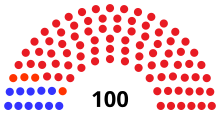
| Party (Shading indicates majority caucus)
|
Total | ||||
|---|---|---|---|---|---|
| Dem. | S.D. | Rep. | Vacant | ||
| End of previous Legislature | 24 | 0 | 73 | 97 | 3 |
| Start of 1st Session | 11 | 4 | 85 | 100 | 0 |
| From Sept. 11, 1906[note 1] | 84 | 99 | 1 | ||
| Final voting share | 15% | 85% | |||
| Beginning of the next Legislature | 19 | 5 | 76 | 100 | 0 |
Sessions
[edit]- 1st Regular session: January 11, 1905 – June 21, 1905
- December 1905 Special session: December 4, 1905 – December 19, 1905
Leaders
[edit]Senate leadership
[edit]- President of the Senate: James O. Davidson (R) (until Jan. 1, 1906)
- President pro tempore: James J. McGillivray (R–Black River Falls)
Assembly leadership
[edit]- Speaker of the Assembly: Irvine Lenroot (R–Superior)
Members
[edit]Members of the Senate
[edit]Members of the Senate for the Forty-Seventh Wisconsin Legislature:[4]

| Dist. | Counties | Senator | Residence | Party |
|---|---|---|---|---|
| 01 | Door, Kewaunee, & Marinette | Harlan P. Bird | Wausaukee | Rep. |
| 02 | Brown & Oconto | Henry F. Hagemeister | Green Bay | Rep. |
| 03 | Kenosha & Racine | Otis W. Johnson | Racine | Rep. |
| 04 | Milwaukee (Northern Part) | Theodore C. Froemming | Milwaukee | Rep. |
| 05 | Milwaukee (City Center) | Charles C. Rogers | Milwaukee | Rep. |
| 06 | Milwaukee (City Northwest) | Jacob Rummel | Milwaukee | Soc.D. |
| 07 | Milwaukee (Southern & Western County) | Barney Eaton | Milwaukee | Rep. |
| 08 | Milwaukee (City South) | Julius E. Roehr | Milwaukee | Rep. |
| 09 | Adams, Marquette, Waushara, & Wood | Herman C. Wipperman | Grand Rapids | Rep. |
| 10 | Pierce & St. Croix | James A. Frear | Hudson | Rep. |
| 11 | Burnett, Douglas, & Polk | George Hudnall | Superior | Rep. |
| 12 | Ashland, Bayfield, Price, Sawyer, Taylor, & Washburn | Albert W. Sanborn | Ashland | Rep. |
| 13 | Dodge | William C. North | Fox Lake | Dem. |
| 14 | Outagamie & Shawano | Fred M. Wilcox | Appleton | Rep. |
| 15 | Calumet & Manitowoc | Samuel W. Randolph | Manitowoc | Dem. |
| 16 | Crawford & Grant | Edward E. Burns | Platteville | Rep. |
| 17 | Green, Iowa, & Lafayette | Harry C. Martin | Darlington | Rep. |
| 18 | Fond du Lac & Green Lake | Charles H. Smith | Markesan | Dem. |
| 19 | Winnebago | Ephraim E. Stevens | Oshkosh | Rep. |
| 20 | Ozaukee & Sheboygan | George W. Wolff | Rhine | Rep. |
| 21 | Portage & Waupaca | William H. Hatton | New London | Rep. |
| 22 | Rock | John M. Whitehead | Janesville | Rep. |
| 23 | Jefferson & Walworth | Zadoc P. Beach | Whitewater | Rep. |
| 24 | Chippewa, Eau Claire, & Gates | James H. Noble | Eau Claire | Rep. |
| 25 | Clark & Marathon | Andrew L. Kreutzer | Wausau | Rep. |
| 26 | Dane | Albert M. Stondall | Madison | Rep. |
| 27 | Columbia & Sauk | George Wylie | Leeds | Rep. |
| 28 | Richland, & Vernon | Oliver Munson | Viroqua | Rep. |
| 29 | Barron, Buffalo, Dunn, & Pepin | James H. Stout | Menomonie | Rep. |
| 30 | Florence, Forest, Iron, Langlade, Lincoln, Oneida, & Vilas | James A. Wright | Merrill | Rep. |
| 31 | Jackson, Juneau, & Monroe | James J. McGillivray | Black River Falls | Rep. |
| 32 | La Crosse & Trempealeau | Thomas Morris | La Crosse | Rep. |
| 33 | Washington & Waukesha | Ernst Merton | Waukesha | Dem. |
Members of the Assembly
[edit]Members of the Assembly for the Forty-Seventh Wisconsin Legislature:[4]


| Senate District |
County | Dist. | Representative | Party | Residence |
|---|---|---|---|---|---|
| 09 | Adams & Marquette | John A. Henry | Rep. | Easton | |
| 12 | Ashland | Edward B. Gordon | Rep. | Gordon | |
| 29 | Barron | George E. Scott | Rep. | Prairie Farm | |
| 12 | Bayfield, Sawyer, & Washburn | Lorenzo Clausen | Rep. | Washburn | |
| 02 | Brown | 1 | Willard Burdeau | Rep. | Flintville |
| 2 | Maurice B. Brennan | Rep. | Morrison | ||
| 29 | Buffalo & Pepin | Fred J. Bohri | Rep. | Fountain City | |
| 11 | Burnett & Polk | Amund Jerdee | Rep. | Lincoln | |
| 15 | Calumet | Daniel R. Curtin | Rep. | Woodville | |
| 24 | Chippewa & Gates | 1 | Thomas A. Roycraft | Rep. | |
| 2 | L. L. Thayer | Rep. | Bloomer | ||
| 25 | Clark | William S. Irvine | Rep. | Beaver | |
| 27 | Columbia | 1 | John Scott | Rep. | Dekorra |
| 2 | William R. Turner | Rep. | Columbus | ||
| 16 | Crawford | James Dinsdale | Rep. | Soldiers Grove | |
| 26 | Dane | 1 | Ernest Warner | Rep. | Madison |
| 2 | Henry Huber | Rep. | Stoughton | ||
| 3 | John S. Donald | Rep. | Mount Horeb | ||
| 13 | Dodge | 1 | Frank S. Bauer | Dem. | LeRoy |
| 2 | Daniel L. Hannifin | Dem. | Portland | ||
| 01 | Door | Charles Reynolds | Rep. | Jacksonport | |
| 11 | Douglas | 1 | Irvine Lenroot | Rep. | Superior |
| 2 | Wallace W. Andrew | Rep. | Superior | ||
| 29 | Dunn | Ole G. Kinney | Rep. | Colfax | |
| 24 | Eau Claire | 1 | Charles A. Evans | Rep. | Eau Claire |
| 2 | C. N. Saugen | Rep. | Pleasant Valley | ||
| 30 | Florence, Forest, & Langlade | E. F. Nelson | Rep. | Rolling | |
| 18 | Fond du Lac | 1 | Christian Pickart | Dem. | Marshfield |
| 2 | John W. Powell | Rep. | Rosendale | ||
| 16 | Grant | 1 | Duncan McGregor | Rep. | Platteville |
| 2 | Joseph P. Chandler | Rep. | Montford | ||
| 17 | Green | Fred Ties | Rep. | Brodhead | |
| 18 | Green Lake | Gard Miller | Rep. | ||
| 17 | Iowa | Roy C. Smelker | Rep. | Dodgeville | |
| 30 | Iron, Oneida, & Vilas | Edward A. Everett | Rep. | Eagle River | |
| 31 | Jackson | Winfield S. Braddock | Rep. | ||
| 23 | Jefferson | 1 | Edward Racek | Dem. | Watertown |
| 2 | Charles Greenwood | Rep. | Lake Mills | ||
| 31 | Juneau | P. A. Cleary | Dem. | Elroy | |
| 03 | Kenosha | Walker M. Curtiss | Rep. | Salem | |
| 01 | Kewaunee | Anton G. Schauer | Rep. | Carlton | |
| 32 | La Crosse | 1 | John S. Durland | Rep. | La Crosse |
| 2 | Thomas Johnson | Rep. | Holland | ||
| 17 | Lafayette | Richard E. Tarrell | Rep. | Elk Grove | |
| 30 | Lincoln | Hall L. Brooks | Rep. | Tomahawk | |
| 15 | Manitowoc | 1 | Simon F. Wehrwein | Rep. | Newton |
| 2 | Lawrence W. Ledvina | Rep. | Kellnersville | ||
| 25 | Marathon | 1 | Fred Prehn | Rep. | Marathon City |
| 2 | August F. Marquardt | Rep. | Wausau | ||
| 01 | Marinette | 1 | Edward W. LeRoy | Rep. | Marinette |
| 2 | James F. Slight | Rep. | Peshtigo | ||
| 04 | Milwaukee | 1 | Joseph M. Crowley | Dem. | Milwaukee |
| 05 | 2 | J. S. Bletcher | Rep. | Milwaukee | |
| 07 | 3 | George E. Page | Rep. | Milwaukee | |
| 05 | 4 | Fred C. Westfahl | Rep. | Milwaukee | |
| 08 | 5 | William Alldridge | Soc.D. | Milwaukee | |
| 05 | 6 | Thomas F. Ramsey | Dem. | Milwaukee | |
| 07 | 7 | Frederick Hartung | Rep. | Wauwatosa | |
| 08 | 8 | Oscar F. Thieme | Rep. | Milwaukee | |
| 06 | 9 | Edmund J. Berner | Soc.D. | Milwaukee | |
| 10 | Louis Metzler | Rep. | Milwaukee | ||
| 08 | 11 | Frederick Brockhausen | Soc.D. | Milwaukee | |
| 06 | 12 | August Dietrich | Rep. | Milwaukee | |
| 04 | 13 | Henry Holle | Rep. | Milwaukee | |
| 07 | 14 | John Szymarek | Dem. | Milwaukee | |
| 04 | 15 | Philip Hamm | Rep. | Milwaukee | |
| 06 | 16 | August W. Strehlow | Soc.D. | Milwaukee | |
| 31 | Monroe | George P. Stevens | Rep. | Tomah | |
| 02 | Oconto | Henry Johnson | Rep. | Suring | |
| 14 | Outagamie | 1 | Fred Petersen | Dem. | Appleton |
| 2 | Charles J. Hagen | Rep. | Black Creek | ||
| 20 | Ozaukee | Peter Pierron | Rep. | Belgium | |
| 10 | Pierce | W. L. Oltman | Rep. | Diamond Bluff | |
| 21 | Portage | Fred J. Carpenter | Rep. | Stevens Point | |
| 12 | Price, & Taylor | John B. Hagarty | Rep. | Medford | |
| 03 | Racine | 1 | William H. Bell | Rep. | Racine |
| 2 | John O. Thomas | Rep. | Caledonia | ||
| 28 | Richland | J. E. Coffland | Dem. | Richland Center | |
| 22 | Rock | 1 | Allen S. Baker | Rep. | Evansville |
| 2 | Pliny Norcross | Rep. | Janesville | ||
| 3 | William O. Hansen | Rep. | Beloit | ||
| 27 | Sauk | 1 | J. B. Ragatz | Rep. | Prairie du Sac |
| 2 | David B. Hulburt | Rep. | Loganville | ||
| 14 | Shawano | Jonas Swenholt | Rep. | Wittenberg | |
| 20 | Sheboygan | 1 | Herman Heinecke | Rep. | Sheboygan |
| 2 | August Meyers | Rep. | Howards Grove | ||
| 10 | St. Croix | Julius Beer | Rep. | St. Joseph | |
| 32 | Trempealeau | Herman Ekern | Rep. | Whitehall | |
| 28 | Vernon | Andrew H. Dahl | Rep. | Westby | |
| 23 | Walworth | Frank H. Johnson | Rep. | Darien | |
| 33 | Washington | B. S. Potter | Dem. | West Bend | |
| Waukesha | 1 | James A. McKenzie | Rep. | Vernon | |
| 2 | Roderick Ainsworth | Rep. | Merton | ||
| 21 | Waupaca | 1 | P. H. Peterson | Rep. | |
| 2 | George E. Beedle | Rep. | |||
| 09 | Waushara | Byron Storm | Rep. | Plainfield | |
| 19 | Winnebago | 1 | William M. Perry | Rep. | Oshkosh |
| 2 | A. D. Eldridge | Rep. | Neenah | ||
| 3 | John A. Fridd | Rep. | |||
| 09 | Wood | Eli Winch | Rep. | Marshfield | |
Committees
[edit]Senate committees
[edit]- Senate Committee on Agriculture – G. Wylie, chair
- Senate Committee on Assessment and Collection of Taxes – Hudnall, chair
- Senate Committee on Corporations – Beach, chair
- Senate Committee on Education – J. H. Stout, chair
- Senate Committee on Enrolled Bills – Merton, chair
- Senate Committee on Engrossed Bills – Wilcox, chair
- Senate Committee on Federal Relations – Froemming, chair
- Senate Committee on Finance, Banks, and Insurance – J. E. Roehr, chair
- Senate Committee on the Judiciary – A. L. Kreutzer, chair
- Senate Committee on Legislative Expenses – Stevens, chair
- Senate Committee on Manufactures and Labor – Rummel, chair
- Senate Committee on Military Affairs – Frear, chair
- Senate Committee on Privileges and Elections – Martin, chair
- Senate Committee on Public Health – Noble, chair
- Senate Committee on Public Lands – C. C. Rogers, chair
- Senate Committee on Railroads – Hatton, chair
- Senate Committee on Roads and Bridges – G. W. Wolff, chair
- Senate Committee on State Affairs – Munson, chair
- Senate Committee on Town and County Organizations – Sanborn, chair
Assembly committees
[edit]- Assembly Committee on Agriculture – J. A. Fridd, chair
- Assembly Committee on Assessment and Collection of Taxes – A. H. Dahl, chair
- Assembly Committee on Cities – W. W. Andrew, chair
- Assembly Committee on Corporations – F. J. Carpenter, chair
- Assembly Committee on Dairy and Food – J. S. Donald, chair
- Assembly Committee on Education – D. McGregor, chair
- Assembly Committee on Enrolled Bills – F. J. Bohri, chair
- Assembly Committee on Engrossed Bills – J. S. Bletcher, chair
- Assembly Committee on Federal Relations – A. J. Jerdee, chair
- Assembly Committee on Finance, Banks, and Insurance – R. E. Tarrell, chair
- Assembly Committee on the Judiciary – H. L. Ekern, chair
- Assembly Committee on Legislative Expenditures – R. C. Smelker, chair
- Assembly Committee on Lumber and Mining – G. E. Beedle, chair
- Assembly Committee on Manufactures – P. H. Hamm, chair
- Assembly Committee on Military Affairs – J. A. Henry, chair
- Assembly Committee on Privileges and Elections – E. W. LeRoy, chair
- Assembly Committee on Public Health and Sanitation – J. Dinsdale, chair
- Assembly Committee on Public Improvements – J. P. Chandler, chair
- Assembly Committee on Public Lands – G. P. Stevens, chair
- Assembly Committee on Railroads – W. S. Braddock, chair
- Assembly Committee on Roads and Bridges – T. Johnson, chair
- Assembly Committee on State Affairs – O. G. Kinney, chair
- Assembly Committee on Town and County Organization – W. S. Irvine, chair
- Assembly Committee on Ways and Means – F. Hartung, chair
Joint committees
[edit]- Joint Committee on Charitable and Penal Institutions – Hagemeister(Sen.) & H. Johnson (Asm.), co-chairs
- Joint Committee on Claims – Burns (Sen.) & R. Ainsworth (Asm.), co-chairs
- Joint Committee on Fish and Game – Wipperman (Sen.) & J. Swenholt (Asm.), co-chairs
- Joint Committee on Forestry and Lumber – Bird (Sen.) & E. E. Winch (Asm.), co-chairs
- Joint Committee on Printing – Morris (Sen.) & J. B. Hagarty (Asm.), co-chairs
- Joint Committee on Revision of Bills – Whitehead (Sen.) & R. C. Smelker (Asm.), co-chairs
- Special Joint Committee on Capitol and Grounds – Stout (Sen.) & I. L. Lenroot (Asm.), co-chairs
- Special Joint Committee on Rules – Johnson (Sen.) & H. L. Ekern (Asm.), co-chairs
Employees
[edit]Senate employees
[edit]- Chief Clerk: Leo K. Eaton[5]
- Journal Clerk: A. R. Emerson
- Bookkeeper: J. D. O'Brien
- General Clerk: Ralph Pomeroy
- Engrossing Clerk: H. Wipperman Jr.
- Enrolling Clerk: O. G. Briggs
- Sergeant-at-Arms: Russell C. Falconer
- Assistant Sergeant-at-Arms: Charles Good
- Document Clerk: Thomas Walby
- Postmaster: Christoph Paulus
Assembly employees
[edit]- Chief Clerk: C. O. Marsh[5]
- Journal Clerk: Chas. A. Leicht
- Bookkeeper: C. E. Shaffer
- General Clerk: Ralph E. Smith
- 2nd General Clerk: L. B. Nagler
- Enrolling Clerk: A. W. Pott
- Engrossing Clerk: J. E. Noyes
- Sergeant-at-Arms: Nicholas Streveler
- Assistant Sergeant-at-Arms: C. H. Collins
- 2nd Assistant Sergeant-at-Arms: Walter Eagan
- Document Clerk: Burne Pollock
- Assistant Sergeant-at-Arms: C. H. Collins
- Postmaster: John Harris
Notes
[edit]- ^ Republican Herman Heinecke (Sheboygan 1st District) died September 11, 1906.
References
[edit]- ^ a b Barish, Lawrence S.; Lemanski, Lynn, eds. (2011). "Statistics: History" (PDF). State of Wisconsin 2011–2012 Blue Book (Report). Wisconsin Legislative Reference Bureau. pp. 709, 714, 717, 719. ISBN 978-0-9752820-1-4. Retrieved December 29, 2022.
- ^ Janik, Erika (February 27, 2017). "1904 Fire Gutted Capitol, Nearly Cost Madison State Capitol". Wisconsin Public Radio. Retrieved December 29, 2022.
- ^ Nunnemacher v. State, 129 Wis. 190 (Wisconsin Supreme Court May 14, 1906).
- ^ a b Beck, J.D., ed. (1905). "Biographical Sketches". The Blue Book of the State of Wisconsin (Report). State of Wisconsin. pp. 1065–1127. Retrieved January 22, 2023.
- ^ a b Beck, J.D., ed. (1905). "Legislative Officers and Committees". The Blue Book of the State of Wisconsin (Report). State of Wisconsin. pp. 565–567. Retrieved January 22, 2023.
External links
[edit]- 1905: Related Documents from Wisconsin Legislature
Original source: https://en.wikipedia.org/wiki/47th Wisconsin Legislature
Status: article is cached
 EncycloReader
is supported by the
EncycloReader
is supported by the  KSF
KSF