50th New Zealand Parliament
 From Wikipedia - Reading time: 22 min
| 50th Parliament of New Zealand | |||||
|---|---|---|---|---|---|
| |||||
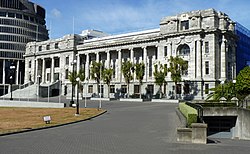 Parliament House, Wellington | |||||
| Overview | |||||
| Legislative body | New Zealand Parliament | ||||
| Term | 20 December 2011 – 14 August 2014 | ||||
| Election | 2011 New Zealand general election | ||||
| Government | Fifth National Government | ||||
| House of Representatives | |||||
 | |||||
| Members | 121 | ||||
| Speaker of the House | David Carter — Lockwood Smith until 31 January 2013 | ||||
| Leader of the House | Gerry Brownlee | ||||
| Prime Minister | John Key | ||||
| Leader of the Opposition | David Cunliffe — David Shearer until 15 September 2013 | ||||
| Sovereign | |||||
| Monarch | Elizabeth II | ||||
| Governor-General | Jerry Mateparae | ||||
The 50th New Zealand Parliament was elected at the 2011 general election. It had 121 members (120 seats plus one overhang seat), and was in place from December 2011 until September 2014, followed by the 2014 general election. The first sitting of the 50th Parliament was held on 20 December 2011, where members were sworn in and Lockwood Smith was elected Speaker of the House. This was followed by the speech from the throne on 21 December. John Key continued to lead the Fifth National Government. Following the resignation of Smith, David Carter was elected Speaker.
The Parliament was elected using the mixed-member proportional representation (MMP) voting system. Members of Parliament (MPs) represent 70 geographical electorates: 16 in the South Island, 47 in the North Island and 7 Māori electorates. The remaining 51 members were elected from party lists using the Sainte-Laguë method to realise proportionality.
Electorate boundaries for 50th Parliament
[edit]
The Representation Commission is tasked with reviewing electorate boundaries every five years following each New Zealand census.[1] The last review was undertaken in 2007 following the 2006 census, and the electorate boundaries determined then were used in both the 2008 and 2011 general elections.[2]
The next census was scheduled for 8 March 2011, but it was postponed due to the disruption caused by the 22 February 2011 Christchurch earthquake.[3] The new date for the census was 5 March 2013,[4] and this allowed enough time to review the electoral boundaries for the 51st New Zealand Parliament prior to the 2014 election. The Representation Commission undertook the review between October 2013 and April 2014[5] and changed the boundaries of 46 electorates, created two new electorates in the Auckland area, and abolished one electorate in Auckland. A total of twenty general and five Maori electorates remained unchanged.[6]
2011 general election
[edit]The 2011 New Zealand general election was held on Saturday, 26 November 2011[7] and determined the membership of the 50th New Zealand Parliament.
One hundred and twenty-one MPs were elected to the New Zealand House of Representatives, 70 from single-member electorates, including one overhang seat, and 51 from party lists. Since the 1996 election, New Zealand has used the Mixed Member Proportional (MMP) voting system, giving voters two votes: one for a political party and the other for their local electorate MP. A referendum on the voting system was held at the same time as the election,[8] in which 57.8% of voters voted to keep the MMP voting system.
A total of 3,070,847 people were registered to vote in the election,[9] with over 2.2 million votes cast and a turnout of 73.83%[10]—the lowest turnout since 1887.[11][12] The poor turnout was partially explained with many voters expecting the outcome to be a foregone conclusion, and a similar attitude was observed in 2002, when the Labour Party was well ahead in the polls and a low turnout resulted.[13]
The preliminary results published on election night indicated that the incumbent National Party, led by John Key gained the plurality with 47.99% of the party vote and 60 seats,[10] one seat short of holding a majority. The opposing Labour Party, led by Phil Goff, lost ground winning 27.13% of the vote and 34 seats,[10] while the Green Party won 10.62% of the vote and 13 seats[10]—the biggest share of the party vote for a minor party since 1996. New Zealand First, having won no seats in 2008 due to its failure to either reach the 5% threshold or win an electorate,[14] made a comeback with 6.81% of the vote entitling them to eight seats.[10]
National's confidence and supply partners in the 49th Parliament meanwhile suffered losses. Preliminary results indicated that ACT New Zealand won less than a third of the party vote it received in 2008, reducing from five seats[15] to one.[10] The Māori Party was reduced from five seats[15] to three,[10] as the party vote split between the Māori Party and former Māori Party MP Hone Harawira's Mana Party. United Future lost party votes, but retained their one seat in Parliament.[10][15]
The poor results for both the Labour Party and ACT resulted in changes to their leaderships. Labour leader Phil Goff and deputy Annette King announced on 29 November 2011 that they had tendered their resignations from the party leadership effective 13 December 2011, with both keeping their electorate representations.[16] ACT leader Don Brash failed to get re-elected to Parliament due to the poor party vote and resigned his party leadership on the night of the election.[17]
On 10 December, the final results were published after the counting of the special votes. The main changes were that the National Party's vote share had decreased to 47.31%, resulting in 59 seats—one less than the 60 based on the preliminary results. The Green Party vote rose to 11.06%, which gained it one seat and is now eligible for 14 seats.[18] The redistribution of the seats means that the lowest-placed National member who qualified based on the preliminary results, Aaron Gilmore (a member of the 49th Parliament), was not returned again. The next person on the Green Party list, Mojo Mathers (a new MP), took the seat.[19]
The Christchurch Central electorate, where the incumbent Brendon Burns (Labour) and Nicky Wagner (National) had received the same number of votes on election night, was won by Wagner with a majority of 45 votes, with Burns thus out of Parliament, as his list position is not high enough.[20] In the Waitakere electorate, Labour's Carmel Sepuloni achieved a majority of 11 votes as opposed to a 349-vote majority for National's Paula Bennett as indicated by the preliminary results.[21] Sepuloni would not have entered Parliament again without winning the electorate as her list placing was not high enough, meaning that she replaced the lowest-ranked Labour list candidate who qualified based on the preliminary results, Raymond Huo.[22] However, both electorates were subject to a judicial recount at the request of the Labour and National Parties, respectively, due to the tightness of each result.[22] As a result of the recount, Nicky Wagner was confirmed as the winner of Christchurch Central with a majority 47 votes on 14 December,[23] while in Waitakere, the recount swung the seat back to Paula Bennett with a majority of nine votes on 17 December.[24]
On election night, 25 new MPs entered Parliament.[25] With the changes in seats for National and the Green Party once the final count was released, this increased to 26 new MPs, with Mathers having joined the newcomers.[19] The final turnout of enrolled electors was 74.21%.[18]
Members
[edit]The tables below show the members of the 50th Parliament based on preliminary counts of the 2011 general election.[26]
Overview
[edit]The table below shows the number of MPs in each party following the 2011 election and at dissolution:
| Affiliation | Members | ||
|---|---|---|---|
| At 2011 election | At dissolution | ||
| National | 59 | 59 | |
| Māori Party[a] | 3 | 3 | |
| ACT[a] | 1 | 1 | |
| United Future[a] | 1 | 1 | |
| Government total | 64 | 64 | |
| Labour | 34 | 34 | |
| Green | 14 | 14 | |
| NZ First | 8 | 7 | |
| Mana Party | 1 | 1 | |
| Independent Coalition | Not yet founded | 1[b] | |
| Opposition total | 57 | 57 | |
| Total |
121 | 121 | |
| Working Government majority[c] | 7 | 7 | |
- ^ a b c The Māori Party, United Future and ACT once again entered into confidence and supply agreements with the National Party to form a majority.
- ^ Brendan Horan was an MP who was expelled from New Zealand First on 4 December 2012.[27] He formed the NZ Independent Coalition and served the remainder of his term under that party.
- ^ The Working Government majority is calculated as all Government MPs minus all other parties.
New Zealand National Party (59)
[edit]The National Party won 47.31% of the vote, entitling it to 59 seats. As it won 42 electorates, an additional 17 members were taken from the party list.[10]
Nine new National Party members were elected, six from electorates and three from the party list. Fifty members from the 49th Parliament were returned.
| Name | Electorate (list if blank) | Term in office | Portfolios & Responsibilities | |
|---|---|---|---|---|
| David Carter | 1994– |
| ||
| Eric Roy | Invercargill | 1993–2002; 2005– |
| |
| Lindsay Tisch | Waikato | 1999– |
| |
| Ministers in Cabinet [28] | ||||
| John Key | Helensville | 2002– |
| |
| Bill English | Clutha-Southland | 1990– |
| |
| Gerry Brownlee | Ilam | 1996– |
| |
| Steven Joyce | 2008– |
| ||
| Judith Collins | Papakura | 2002– |
| |
| Tony Ryall | Bay of Plenty | 1990– |
| |
| Hekia Parata | 2008– |
| ||
| Chris Finlayson | 2005– |
| ||
| Paula Bennett | Waitakere | 2005– |
| |
| Jonathan Coleman | Northcote | 2005– |
| |
| Murray McCully | East Coast Bays | 1987– |
| |
| Anne Tolley | East Coast | 1999–2002; 2005– |
| |
| Nick Smith | Nelson | 1990– |
| |
| Tim Groser | 2005– |
| ||
| Amy Adams | Selwyn | 2008– |
| |
| Nathan Guy | Ōtaki | 2005– |
| |
| Craig Foss | Tukituki | 2005– |
| |
| Chris Tremain | Napier | 2005– |
| |
| Simon Bridges | Tauranga | 2008– |
| |
| Nikki Kaye | Auckland Central | 2008– |
| |
| Ministers outside Cabinet[28] | ||||
| Maurice Williamson | Pakuranga | 1987– |
| |
| Jo Goodhew | Rangitata | 2005– |
| |
| Chester Borrows | Whanganui | 2005– |
| |
| Michael Woodhouse | 2008– |
| ||
| Todd McClay | Rotorua | 2008– |
| |
| Members of Parliament | ||||
| Louise Upston | Taupō | 2008– |
| |
| Tim Macindoe | Hamilton West | 2008– |
| |
| Jami-Lee Ross | Botany | 2011– |
| |
| Melissa Lee | 2008– |
| ||
| John Hayes | Wairarapa | 2005– |
| |
| Shane Ardern | Taranaki-King Country | 1998– |
| |
| Chris Auchinvole | 2005– |
| ||
| Kanwal Singh Bakshi | 2008– | |||
| Maggie Barry | North Shore | 2011– | ||
| David Bennett | Hamilton East | 2005– |
| |
| Jackie Blue | 2005– |
| ||
| Cam Calder | 2009– |
| ||
| Jacqui Dean | Waitaki | 2005– |
| |
| Paul Goldsmith | 2011– |
| ||
| Phil Heatley | Whangarei | 1999– | ||
| Tau Henare | 1993–1999; 2005– |
| ||
| Paul Hutchison | Hunua | 1999– |
| |
| Colin King | Kaikōura | 2005– |
| |
| Peseta Sam Lotu-Iiga | Maungakiekie | 2008– |
| |
| Ian McKelvie | Rangitīkei | 2011– | ||
| Mark Mitchell | Rodney | 2011– |
| |
| Alfred Ngaro | 2011– | |||
| Simon O'Connor | Tāmaki | 2011– | ||
| Mike Sabin | Northland | 2011– | ||
| Katrina Shanks | 2007– |
| ||
| Scott Simpson | Coromandel | 2011– | ||
| Nicky Wagner | Christchurch Central | 2005– |
| |
| Kate Wilkinson | Waimakariri | 2005– | ||
| Jian Yang | 2011– | |||
| Jonathan Young | New Plymouth | 2008– |
| |
| Claudette Hauiti | 2013– | Entered Parliament May 2013 | ||
| Paul Foster-Bell | 2013– | Entered Parliament May 2013 | ||
| Jo Hayes | 2014– | Entered Parliament January 2014 | ||
| members of the National caucus who resigned, retired or died during the term of the 50th Parliament | ||||
| Lockwood Smith | 1984–2013 | Resigned January 2013 Speaker of the House (until Jan 2013) | ||
| Aaron Gilmore | 2008–2011; 2013 | Returned to parliament January 2013; resigned May 2013 | ||
| Jackie Blue | 2005–2013 | Resigned May 2013 | ||
| Katrina Shanks | 2007–2013 | Resigned December 2013 | ||
New Zealand Labour Party (34)
[edit]The Labour Party won 27.48% of the vote, entitling it to 34 seats. As it won 22 electorates, an additional 12 members were taken from the party list.[10]
Four new Labour Party members were elected, three from electorates and one from the list. Thirty members from the 49th Parliament were returned.
| Name | Electorate (list if blank) | Term in office | Portfolios & Responsibilities | |
|---|---|---|---|---|
| Shadow Cabinet [29] | ||||
| David Cunliffe | New Lynn | 1999– |
| |
| David Parker | 2002– |
| ||
| Grant Robertson | Wellington Central | 2008– |
| |
| Jacinda Ardern | 2008– |
| ||
| Clayton Cosgrove | 1999– |
| ||
| Nanaia Mahuta | Hauraki-Waikato | 1996– |
| |
| Maryan Street | 2005– |
| ||
| William Sio | Mangere | 2008– |
| |
| Phil Twyford | Te Atatū | 2008– |
| |
| Trevor Mallard | Hutt South | 1984–1990; 1993– |
| |
| Chris Hipkins | Rimutaka | 2008– |
| |
| Phil Goff | Mount Roskill | 1981–1990; 1993– |
| |
| Annette King | Rongotai | 1984–1990; 1993– |
| |
| Darien Fenton | 2005– |
| ||
| Damien O'Connor | West Coast-Tasman | 1993–2008; 2009– |
| |
| Clare Curran | Dunedin South | 2008– |
| |
| Members of Parliament | ||||
| David Shearer | Mount Albert | 2009– | ||
| Ross Robertson | Manukau East | 1987– |
| |
| David Clark | Dunedin North | 2011– |
| |
| Ruth Dyson | Port Hills | 1993– |
| |
| Kris Faafoi | Mana | 2010– |
| |
| Raymond Huo | 2008– |
| ||
| Iain Lees-Galloway | Palmerston North | 2008– |
| |
| Andrew Little | 2011– |
| ||
| Moana Mackey | 2003– |
| ||
| Sue Moroney | 2005– |
| ||
| Rajen Prasad | 2008– |
| ||
| Rino Tirikatene | Te Tai Tonga | 2011– |
| |
| Louisa Wall | Manurewa | 2008; 2011– |
| |
| Megan Woods | Wigram | 2011– |
| |
| Carol Beaumont | 2008–2011; 2013– | * Returned to Parliament as a List MP, replacing Charles Chauvel | ||
| Meka Whaitiri | 2013– | * Elected to Parliament in a by-election, replacing Parekura Horomia | ||
| Poto Williams | 2013- | * Elected to Parliament in a by-election, replacing Lianne Dalziel | ||
| members of the Labour caucus who resigned, retired or died during the term of the 50th Parliament | ||||
| Charles Chauvel | 2006–2013 |
| ||
| Parekura Horomia | Ikaroa-Rāwhiti | 1999–2013 |
| |
| Lianne Dalziel | Christchurch East | 1990– |
| |
Green Party of Aotearoa New Zealand (14)
[edit]The Green Party won 11.06% of the vote, entitling it to 14 seats. As it did not win any electorate, all members were taken from the party list.[10]
Seven new Green Party members were elected, with seven members from the 49th Parliament returning.
Mojo Mathers, elected as number 14 on the list, is New Zealand's first profoundly deaf MP.[31][32]
| Name | Electorate (list if blank) | Term in office | Portfolios & Responsibilities | |
|---|---|---|---|---|
| Russel Norman | 2008– |
| ||
| Metiria Turei | 2002– |
| ||
| Steffan Browning | 2011– |
| ||
| David Clendon | 2009– |
| ||
| Catherine Delahunty | 2008– |
| ||
| Julie Anne Genter | 2011– |
| ||
| Kennedy Graham | 2008– |
| ||
| Kevin Hague | 2008– |
| ||
| Gareth Hughes | 2010– |
| ||
| Jan Logie | 2011– |
| ||
| Mojo Mathers | 2011– |
| ||
| Denise Roche | 2011– |
| ||
| Eugenie Sage | 2011– |
| ||
| Holly Walker | 2011– |
|
New Zealand First (7)
[edit]New Zealand First won 6.59% of the vote, entitling it to eight seats. As it did not win any electorate, all members were taken from the party list.[10] Six new members were elected, in addition to two former members.
The party was reduced to seven MPs when it expelled Brendan Horan in December 2012.[33] Horan remained in Parliament as an independent MP.
| Name | Electorate (list if blank) | Term in office | Portfolios & Responsibilities | |
|---|---|---|---|---|
| Winston Peters | 1979–1981; 1984–2008; 2011– |
| ||
| Tracey Martin | 2011– |
| ||
| Denis O'Rourke | 2011– |
| ||
| Richard Prosser | 2011– |
| ||
| Barbara Stewart | 2002–2008; 2011– |
| ||
| Asenati Taylor | 2011– |
| ||
| Andrew Williams | 2011– |
| ||
| members of the NZ First caucus who resigned, retired or died during the term of the 50th Parliament | ||||
| Brendan Horan | 2011–2012 | Expelled from party; remained in Parliament as an Independent | ||
Māori Party (3)
[edit]The Māori Party won 1.43% of the vote,[10] which is short of the 5% threshold. The Māori Party won three electorates and will thus be represented by three electorate MPs. The 1.43% party vote share entitles the party to two seats and with three electorates won, an overhang was caused, increasing the size of the 50th Parliament to 121 seats.
| Name | Electorate (list if blank) | Term in office | Portfolios & Responsibilities | |
|---|---|---|---|---|
| Pita Sharples | Tāmaki Makaurau | 2005– |
| |
| Tariana Turia | Te Tai Hauāuru | 1996– | ||
| Te Ururoa Flavell | Waiāriki | 2005– |
Mana Party (1)
[edit]The Mana Party won 1.08% of the vote,[10] which is short of the 5% threshold. Mana won one electorate and will thus be represented by one electorate MP. The 1.08% party vote share entitles the party to one seat.
| Name | Electorate (list if blank) | Term in office | Portfolios & Responsibilities | |
|---|---|---|---|---|
| Hone Harawira | Te Tai Tokerau | 2005– |
|
United Future (1)
[edit]United Future won 0.60% of the vote,[10] which is short of the 5% threshold. United Future won one electorate and will thus be represented by one electorate MP. The 0.61% party vote share entitles the party to one seat.
| Name | Electorate (list if blank) | Term in office | Portfolios & Responsibilities | |
|---|---|---|---|---|
| Peter Dunne | Ōhariu | 1984– |
NZ Independent Coalition (1)
[edit]| Name | Electorate | Term in office | Responsibilities | |
|---|---|---|---|---|
| Brendan Horan | 2012–2014 | Remained in Parliament as an MP for the NZ Independent Coalition after expulsion from the NZ First party |
ACT New Zealand (0)
[edit]ACT New Zealand won 1.07% of the vote,[10] which is short of the 5% threshold. ACT won one electorate and was thus represented by one electorate MP. The 1.07% party vote share entitled the party to one seat. Their sole MP resigned from Parliament on 13 June 2014.[36]
| Name | Electorate (list if blank) | Term in office | Portfolios & Responsibilities | |
|---|---|---|---|---|
| members of the ACT caucus who resigned during the term of the 50th Parliament | ||||
| John Banks | Epsom | 1981–1999; 2011– | ||
Parliamentary business
[edit]
The first sitting of the 50th Parliament was on 20 December 2011, with its main business the swearing in of new members and the election of the speaker. The State Opening was held on the following day by the Governor-General, Sir Jerry Mateparae.[37]
By-elections during 50th Parliament
[edit]There were a number of changes during the term of the 50th Parliament.
| Electorate and by-election | Date | Incumbent | Cause | Winner | |||
|---|---|---|---|---|---|---|---|
| Ikaroa-Rāwhiti | 2013 | 29 June[38] | Parekura Horomia | Death[39] | Meka Whaitiri | ||
| Christchurch East | 2013 | 30 November | Lianne Dalziel | Resignation[40]; elected Mayor of Christchurch | Poto Williams | ||
Summary of changes during term
[edit]- Lockwood Smith (National, List) resigned in January 2013 and replaced by Aaron Gilmore
- Charles Chauvel (Labour, List) resigned in March 2013, and was replaced by Carol Beaumont
- Parekura Horomia (Labour, Ikaroa-Rāwhiti) died on 29 April 2013. The resulting by-election on 29 June 2013 was won by Meka Whaitiri
- Aaron Gilmore (National, List) resigned in May 2013 and was replaced by Claudette Hauiti
- Jackie Blue (National, List) resigned in May 2013 and was replaced by Paul Foster-Bell
- Lianne Dalziel (Labour, Christchurch East) resigned in September 2013 to contest the Christchurch mayoralty election. The resulting by-election on 30 November[41] was won by Poto Williams
- Katrina Shanks (National, List) resigned in December 2013 and was replaced by Jo Hayes
- John Banks (ACT, Epsom) resigned in June 2014.[36] Due to the 2014 general election, no by-election was held.
- Shane Jones (Labour, List) left Parliament in May 2014. He was replaced by Kelvin Davis.
Seating plan
[edit]Start of term
[edit]The chamber is in a horseshoe-shape.[42]
| Tirikatene | Woods | Roche | Genter | |||||||||||||||||||
| R. Robertson | Curran | D. O'Connor | Dyson | Moroney | Lees-Galloway | Mackey | Prasad | Horomia | Faafoi | Huo | Wall | Clark | Little | Lole-Taylor | Browning | Walker | ||||||
| A. King | Goff | Fenton | Hipkins | Mallard | Street | Sio | Twyford | Chauvel | Dalziel | Martin | Williams | Prosser | Horan | O'Rourke | Logie | Yang | ||||||
| Jones | Mahuta | G. Robertson | Shearer | Parker | J. Ardern | Cunliffe | Cosgrove | Harawira | Peters | Stewart | Hague | Norman | Mathers | Sage | Clendon | Simpson | ||||||
| Turei | Hughes | Graham | ||||||||||||||||||||
| L. Smith | Delahunty | |||||||||||||||||||||
| Young | ||||||||||||||||||||||
| Turia | Flavell | Wagner | ||||||||||||||||||||
| Finlayson | P. Bennett | English | KEY | Brownlee | Joyce | Collins | Ryall | Parata | Carter | Banks | Dunne | Sharples | Hayes | Shanks | Barry | Sabin | ||||||
| Guy | McCully | Upston | Woodhouse | Tolley | Coleman | Groser | Heatley | Wilkinson | Lee | S. Ardern | D. Bennett | N. Smith | Dean | Ross | Bakshi | S. O'Connor | ||||||
| Roy | Tisch | Foss | Adams | Williamson | Tremain | Goodhew | Borrows | Bridges | Henare | Hutchison | Kaye | Lotu-liga | McClay | Macindoe | Calder | C. King | Ngaro | |||||
| Auchinvole | Blue | Goldsmith | McKelvie | Mitchell |
End of term
[edit]The chamber is in a horseshoe-shape.[43]
| Whaitiri | P. Williams | Horan | Genter | |||||||||||||||||||
| R. Robertson | Mackey | D. O'Connor | Clark | Faafoi | Beaumont | Woods | Fenton | Mallard | Dyson | Curran | Prasad | Huo | Tirikatene | Lole-Taylor | Roche | Walker | ||||||
| Twyford | Mahuta | Lees-Galloway | Moroney | Street | Sio | Shearer | Goff | Wall | Little | Stewart | A. Williams | Prosser | Mathers | O'Rourke | Browning | Jo Hayes | ||||||
| Hipkins | Cosgrove | Parker | Cunliffe | G. Robertson | A. King | Jones | J. Ardern | Harawira | Peters | Martin | Hague | Norman | Hughes | Clendon | Logie | Hauiti | ||||||
| Turei | Delahunty | Sage | ||||||||||||||||||||
| Carter | Graham | |||||||||||||||||||||
| Goldsmith | ||||||||||||||||||||||
| Turia | Sharples | Young | ||||||||||||||||||||
| Finlayson | P. Bennett | English | KEY | Brownlee | Joyce | Collins | Ryall | Parata | Coleman | Banks | Dunne | Flavell | Ross | Wagner | Barry | Foster-Bell | ||||||
| Guy | McCully | Macindoe | Upston | Tolley | N. Smith | Groser | Adams | Foss | Lotu-liga | S. Ardern | D. Bennett | John Hayes | Dean | Yang | Bakshi | Sabin | ||||||
| Roy | Tisch | Bridges | Kaye | Woodhouse | Williamson | Goodhew | Borrows | McClay | Henare | Hutchison | Heatley | Wilkinson | Tremain | Lee | Calder | C. King | S. O'Connor | |||||
| Auchinvole | Simpson | McKelvie | Mitchell | Ngaro |
See also
[edit]- Party lists in the 2011 New Zealand general election
- Opinion polling for the 2011 New Zealand general election
- Politics of New Zealand
References
[edit]- ^ "What is the Representation Commission?". Chief Electoral Office. Archived from the original on 10 November 2011. Retrieved 3 December 2011.
- ^ "Reviewing electorates - frequently asked questions". Chief Electoral Office. Archived from the original on 10 November 2011. Retrieved 3 December 2011.
- ^ "Christchurch quake: More liquefaction than Sept". 3 News. 25 February 2011. Archived from the original on 24 July 2011. Retrieved 3 December 2011.
- ^ Bascand, Geoff. "2013 Census announcement – Media Release". Statistics New Zealand. Retrieved 3 December 2011.
- ^ "Electorate Boundary Review". Electoral Commission. Archived from the original on 26 June 2014. Retrieved 26 September 2014.
- ^ "Final Electorate Boundaries". Electoral Commission. Retrieved 26 September 2014.
- ^ "Key confirms election date". The New Zealand Herald. 2 February 2011. Retrieved 5 May 2011.
- ^ "MMP referendum to be held with 2011 election". The New Zealand Herald. 20 October 2009.
- ^ "Enrolment statistics for the whole of New Zealand". Electoral Commission. 26 November 2011. Archived from the original on 25 December 2010. Retrieved 2 December 2011.
- ^ a b c d e f g h i j k l m n o p "Preliminary results for the 2011 General Election and advance voting for the Referendum on the Voting System". Elections New Zealand. Archived from the original on 2 December 2011. Retrieved 2 December 2011.
- ^ ""Decision 2011":Election Special Issue". Otago Daily Times. 28 November 2011. p. 2.
- ^ "General elections 1853-2005 - dates & turnout". Elections New Zealand. Archived from the original on 14 November 2014. Retrieved 16 December 2016.
- ^ "Editorial: Low voting turnout a product of many factors". The New Zealand Herald. 30 November 2011. Retrieved 3 December 2011.
- ^ Gower, Patrick (9 November 2008). "Winston Peters: Gone but never forgotten". The New Zealand Herald. Retrieved 2 December 2011.
- ^ a b c "2008 election official results". Elections New Zealand. Archived from the original on 10 November 2011. Retrieved 2 December 2011.
- ^ "Goff, King to resign in fortnight". Stuff.co.nz. 29 November 2011. Retrieved 3 December 2011.
- ^ "ACT wins Espom, Don Brash resigns". Radio New Zealand. 27 November 2011. Retrieved 3 December 2011.
- ^ a b "Official Count Results -- Overall Status". Elections New Zealand. Retrieved 25 September 2021.
- ^ a b Gorman, Paul (12 December 2011). "City's newest MP doubted her chances". The Press. Retrieved 13 December 2011.
- ^ Mackenzie-McLean, Jo (10 December 2011). "Nicky Wagner wins Christchurch Central seat". The Press. p. A4. Retrieved 13 December 2011.
- ^ "Defeat 'sends message to beneficiary basher'". The Press. 10 December 2011. p. A4.
- ^ a b Backhouse, Matthew (10 December 2011). "John key Calls for Judicial Recount". The New Zealand Herald. New Zealand Herald. Retrieved 13 December 2011.
- ^ "Christchurch Central judicial recount official results". Electoral Commission. 14 December 2011. Archived from the original on 9 February 2012. Retrieved 28 December 2015.
- ^ "Waitakere judicial recount official results". Electoral Commission. 17 December 2011. Archived from the original on 9 February 2012. Retrieved 18 December 2011.
- ^ Donnell, Hayden (28 November 2011). "Colourful crop of new MPs heading for Parliament". New Zealand Herald. Retrieved 13 December 2011.
- ^ "Provisional List of Successful Candidates -- 2011 General Election - Preliminary Results". Electoral Commission. Retrieved 1 December 2011.
- ^ Trevett, Claire (4 December 2012). "Brendan Horan expelled from NZ First, Parliament told". The New Zealand Herald.
- ^ a b c d "Boost for women in new Cabinet". New Zealand Herald. 12 December 2011. Retrieved 12 December 2011.
- ^ "Labour MPs Spokesperson roles and ranking" (PDF). New Zealand Labour Party. 19 December 2011. Archived from the original (PDF) on 31 January 2012. Retrieved 19 December 2011.
- ^ "Labour MP Parekura Horomia dies". The New Zealand Herald. 29 April 2013. Retrieved 29 April 2013.
- ^ "Greens 'ecstatic' to have 14 MPs". Television New Zealand. 10 December 2011. Archived from the original on 10 January 2012.
- ^ "First deaf MP to join Parliament". New Zealand Herald. 10 December 2011.
- ^ "MP Brendan Horan expelled from NZ First". stuff.co.nz. 4 December 2012. Retrieved 12 March 2013.
- ^ a b c d "Big promotions ahead in today's Cabinet reshuffle". New Zealand Herald. 12 December 2011. Retrieved 12 December 2011.
- ^ a b c d e f g "Dunne, Banks secure ministerial roles in coalition deals". Television New Zealand. 5 December 2011. Retrieved 5 December 2011.
- ^ a b John Banks to resign from Parliament nzherald.co.nz, 8 June 2014
- ^ "House of Representatives to meet on 20 December". New Zealand Parliament. Retrieved 5 December 2011.
- ^ "Ikaroa-Rawhiti by-election date set". The New Zealand Herald. 8 May 2013. Retrieved 8 May 2013.
- ^ Small, Vernon; Chapman, Kate (29 April 2013). "MP Parekura Horomia dead". Fairfax Media New Zealand (via Stuff.co.nz). Retrieved 29 April 2013.
- ^ Small, Vernon (27 July 2013). "Shearer is running of out time". The Press. Christchurch. p. A21.
- ^ Small, Vernon (27 July 2013). "Shearer is running of out time". The Press. Christchurch. p. A21.
- ^ "Debating Chamber – New Zealand Parliament". www.parliament.nz. Retrieved 3 April 2012.
- ^ "Debating Chamber – New Zealand Parliament". www.parliament.nz. Retrieved 26 April 2014.
Fifth National Government of New Zealand | |||||||||||||
|---|---|---|---|---|---|---|---|---|---|---|---|---|---|
| Leadership |
|  | |||||||||||
| Political parties |
| ||||||||||||
| Ministers |
| ||||||||||||
| Parliamentary leadership |
| ||||||||||||
| Elections (parliaments) |
| ||||||||||||
| Significant policies and events |
| ||||||||||||
| Other offices |
| ||||||||||||
| |||||||||||||
Original source: https://en.wikipedia.org/wiki/50th New Zealand Parliament
Status: article is cached
 EncycloReader
is supported by the
EncycloReader
is supported by the  KSF
KSF