534
 From Wikipedia - Reading time: 5 min
 | This article needs additional citations for verification. (May 2019) |
| Millennium: | 1st millennium |
|---|---|
| Centuries: |
|
| Decades: |
|
| Years: |
|
| 534 by topic |
|---|
| Leaders |
|
| Categories |
|
| Gregorian calendar | 534 DXXXIV |
| Ab urbe condita | 1287 |
| Assyrian calendar | 5284 |
| Balinese saka calendar | 455–456 |
| Bengali calendar | −59 |
| Berber calendar | 1484 |
| Buddhist calendar | 1078 |
| Burmese calendar | −104 |
| Byzantine calendar | 6042–6043 |
| Chinese calendar | 癸丑年 (Water Ox) 3230 or 3170 — to — 甲寅年 (Wood Tiger) 3231 or 3171 |
| Coptic calendar | 250–251 |
| Discordian calendar | 1700 |
| Ethiopian calendar | 526–527 |
| Hebrew calendar | 4294–4295 |
| Hindu calendars | |
| - Vikram Samvat | 590–591 |
| - Shaka Samvat | 455–456 |
| - Kali Yuga | 3634–3635 |
| Holocene calendar | 10534 |
| Iranian calendar | 88 BP – 87 BP |
| Islamic calendar | 91 BH – 90 BH |
| Javanese calendar | 421–422 |
| Julian calendar | 534 DXXXIV |
| Korean calendar | 2867 |
| Minguo calendar | 1378 before ROC 民前1378年 |
| Nanakshahi calendar | −934 |
| Seleucid era | 845/846 AG |
| Thai solar calendar | 1076–1077 |
| Tibetan calendar | 阴水牛年 (female Water-Ox) 660 or 279 or −493 — to — 阳木虎年 (male Wood-Tiger) 661 or 280 or −492 |
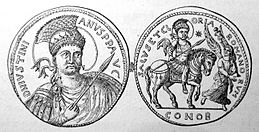
Medallion commemorating the Vandalic War
Year 534 (DXXXIV) was a common year starting on Sunday (link will display the full calendar) of the Julian calendar. At the time, it was known as the Year of the Consulship of Iustinianus and Paulinus (or, less frequently, year 1287 Ab urbe condita). The denomination 534 for this year has been used since the early medieval period, when the Anno Domini calendar era became the prevalent method in Europe for naming years.
Events[edit]
By place[edit]
Byzantine Empire[edit]
- January 1 – Decimus Theodorius Paulinus is appointed consul (the last to hold this office in the West).
- March – King Gelimer surrenders to Belisarius, after spending a winter in the mountains of Numidia. He and large numbers of captured Vandals are transported to Constantinople. The Vandal Kingdom ends, and the African provinces return to the Byzantine Empire.
- April – Belisarius leaves a small force in Africa under the Byzantine general Solomon, to continue the subjugation of the province. He is appointed governor (Exarch) and pacifies the Moorish tribes with success. Malta becomes a Byzantine province (until 870).
- Summer – Belisarius arrives in Constantinople and is permitted by Emperor Justinian I to celebrate a triumph, the first non-imperial triumph for over 500 years. In the procession the spoils of the Temple of Jerusalem and the Vandal treasure are paraded.
- Justinian I commemorates the victory against the Vandals by stamping medals in his honor with the inscription "Gloria Romanorum" (approximate date).
- November 16 – A second and final revision of the Codex Justinianus is published.
Europe[edit]
- Toledo becomes the capital of the Visigothic Kingdom that controls the Iberian Peninsula. King Theudis expands Visigoth rule in the southern regions (Hispania Baetica).
- The Frankish kings Childebert I and Chlothar I overthrow Godomar, king of the Burgundians, and end the Kingdom of Burgundy.
- Cynric becomes king of Wessex (according to the Anglo-Saxon Chronicle).
- October 2 – King Athalaric dies of tuberculosis, age 18, having dissipated his youth in drink and debauchery. His mother, Amalasuntha, proposes to her cousin Theodahad, the kingdom's largest landowner and her father's last male heir, that he share the throne with her but that he will be king of the Ostrogoths in name only. Theodahad has secret conversations with the Byzantine ambassador, and promises to turn over Tuscany in exchange for a large sum of money, the rank of senator, and permission to live at Constantinople.
Births[edit]
- Leander, bishop of Seville (approximate date)
- Liu Jingyan, empress of the Chen Dynasty (d. 616)
- Ming Di, emperor of the Northern Zhou (d. 560)
- Taliesin, Welsh poet (approximate date)
Deaths[edit]
- October 2 – Athalaric, king of the Ostrogoths
- Anthemius of Tralles, architect and mathematician (approximate date)
- Cerdic, first king of Wessex[1]
- Godomar, king of Burgundy
- Marcellinus Comes, Latin chronicler (approximate date)
- Theuderic I, king of Austrasia (or 533)
References[edit]
- ^ "Cerdic | king of Wessex". Encyclopedia Britannica. Retrieved May 30, 2019.
This article is licensed under CC BY-SA 3.0.
Original source: https://en.wikipedia.org/wiki/534
Status: article is cached
Original source: https://en.wikipedia.org/wiki/534
Status: article is cached
 EncycloReader
is supported by the
EncycloReader
is supported by the  KSF
KSF