Categories
555 Edgecombe Avenue
 From Wikipedia - Reading time: 8 min
Paul Robeson Residence (555 Edgecombe Avenue) | |
U.S. National Register of Historic Places | |
U.S. National Historic Landmark | |
New York City Landmark No. 1862
| |
 (2014) | |
   | |
| Location | 555 Edgecombe Avenue, Manhattan, New York City[1] |
|---|---|
| Coordinates | 40°50′02″N 73°56′20″W / 40.83389°N 73.93889°W |
| Built | 1914-16[2] |
| Architect | Schwartz & Gross[3] |
| NRHP reference No. | 76001248 |
| NYCL No. | 1862 |
| Significant dates | |
| Added to NRHP | December 8, 1976[4] |
| Designated NHL | December 8, 1976[5] |
| Designated NYCL | June 15, 1993 |
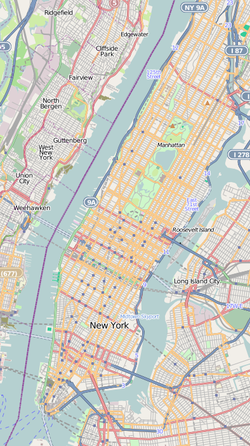
The Paul Robeson Residence, also known by its street address of 555 Edgecombe Avenue, is a National Historic Landmarked apartment building, located at 555 Edgecombe Avenue at the corner of West 160th Street in the Washington Heights neighborhood of Manhattan, New York City. It was originally known as the Roger Morris Apartments when it was built in 1914-16 – after the retired British Army officer who built the nearby Morris-Jumel Mansion – and was designed by Schwartz & Gross, who specialized in apartment buildings. The building is architecturally relatively non-descript, with an exterior of brick and stone with nods to Beaux Arts architectural elements. It has thirteen floors and a penthouse. The main entrance is two stories in height, set in an arched opening with ironwork at the peak.[6]
For the first 25 years of its existence, the building was restricted to white tenants.[1] Around 1940, as the racial characteristics of the neighborhood changed, this policy was dropped. Subsequently, the building became known for the noted African-American residents, including musician and composer Count Basie, boxer Joe Louis, musician Bruce Langhorne, musician and bandleader Andy Kirk,[7] actor and producer Canada Lee, the psychologist Kenneth Clark,[2] and the actor and singer Paul Robeson,[3] a major figure of stage and screen who lived in the building from 1939 to 1941.[6]
After Robeson's death in 1976, the building was declared a National Historic Landmark in his honor.[6][8][9] In 1993, it was designated a New York City landmark.[3] Edgecombe Avenue has also been co-named "Paul Robeson Boulevard".
See also[edit]
- List of New York City Designated Landmarks in Manhattan above 110th Street
- National Register of Historic Places listings in Manhattan above 110th Street
- List of National Historic Landmarks in New York City
References[edit]
Notes
- ^ a b Brockman, Jorg (photographs) & Harris, Bill (text) (2002). Five Hundred Buildings of New York. New York: Black Dog & Leventhal. p.387. ISBN 978-1-57912-856-2
- ^ a b White, Norval & Willensky, Elliot (2000). AIA Guide to New York City (4th ed.). New York: Three Rivers Press. ISBN 978-0-8129-3107-5., p.524
- ^ a b c New York City Landmarks Preservation Commission; Dolkart, Andrew S.; Postal, Matthew A. (2009). Postal, Matthew A. (ed.). Guide to New York City Landmarks (4th ed.). New York: John Wiley & Sons. ISBN 978-0-470-28963-1., p.211
- ^ "National Register Information System". National Register of Historic Places. National Park Service. January 23, 2007.
- ^ "Paul Robeson Residence". National Historic Landmark summary listing. National Park Service. 2007-09-18. Archived from the original on 2011-06-06.
- ^ a b c Gomez, Lynn (2012-01-16). "National Register of Historical Places Inventory -- Nomination Form: Paul Robeson Residence". United States Department of the Interior: National Park Service. Archived (PDF) from the original on 2012-01-16. Retrieved 2012-01-16.
- ^ Andy Kirk, as told to Amy Lee, Twenty Years on Wheels, University of Michigan Press, 1989, p.114
- ^ NPS Civil Rights
- ^ Paul Robeson Residence Accompanying 3 photos, exterior, from 1976.[dead link]
External links[edit]
 Media related to 555 Edgecombe Avenue at Wikimedia Commons
- "The Most Elite Apartment Building in Harlem". Ephemeral New York. May 15, 2013.
- "Great Find: Marjorie Eliot's Parlor Jazz". Robb Report. NYC. Archived from the original on June 13, 2012.
U.S. National Register of Historic Places in New York | ||
|---|---|---|
| Topics |
|   |
| Lists by county |
| |
| Lists by city |
| |
| Other lists |
| |
| ||


Original source: https://en.wikipedia.org/wiki/555 Edgecombe Avenue
Status: article is cached
 EncycloReader
is supported by the
EncycloReader
is supported by the  KSF
KSF