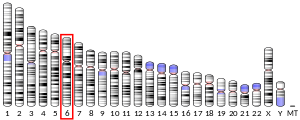
Apolipoprotein M is a protein that in humans is encoded by the APOM gene.[5][6][7]
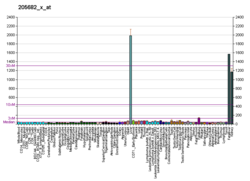
The protein encoded by this gene is an apolipoprotein and member of the lipocalin protein family. It is found associated with high density lipoproteins and to a lesser extent with low density lipoproteins and triglyceride-rich lipoproteins. The encoded protein is secreted through the plasma membrane but remains membrane-bound, where it is involved in lipid transport. Two transcript variants encoding two different isoforms have been found for this gene, but only one of them has been fully characterized.[7] The average molecular weight is 21253 Da, and the monoisotopic molecular weight is 21239 Da.
^Duan J, Dahlback B, Villoutreix BO (Jun 2001). "Proposed lipocalin fold for apolipoprotein M based on bioinformatics and site-directed mutagenesis". FEBS Lett. 499 (1–2): 127–32. doi:10.1016/S0014-5793(01)02544-3. PMID 11418126. S2CID 28493816.
Albertella MR, Jones H, Thomson W, et al. (1997). "Localization of eight additional genes in the human major histocompatibility complex, including the gene encoding the casein kinase II beta subunit (CSNK2B)". Genomics. 36 (2): 240–51. doi:10.1006/geno.1996.0459. PMID 8812450.
Xu N, Zhang XY, Dong X, et al. (2002). "Effects of platelet-activating factor, tumor necrosis factor, and interleukin-1alpha on the expression of apolipoprotein M in HepG2 cells". Biochem. Biophys. Res. Commun. 292 (4): 944–50. doi:10.1006/bbrc.2002.6755. PMID 11944906.
Zhang XY, Dong X, Zheng L, et al. (2003). "Specific tissue expression and cellular localization of human apolipoprotein M as determined by in situ hybridization". Acta Histochem. 105 (1): 67–72. doi:10.1078/0065-1281-00687. PMID 12666989.
Zhang XY, Jiao GQ, Hurtig M, et al. (2005). "Expression pattern of apolipoprotein M during mouse and human embryogenesis". Acta Histochem. 106 (2): 123–8. doi:10.1016/j.acthis.2003.11.004. PMID 15147633.
Kabbara A, Payet N, Cottel D, et al. (2004). "Exclusion of CYP46 and APOM as candidate genes for Alzheimer's disease in a French population". Neurosci. Lett. 363 (2): 139–43. doi:10.1016/j.neulet.2004.03.066. PMID 15172102. S2CID 27752858.
Xu N, Nilsson-Ehle P, Ahrén B (2005). "Correlation of apolipoprotein M with leptin and cholesterol in normal and obese subjects". J. Nutr. Biochem. 15 (10): 579–82. doi:10.1016/j.jnutbio.2004.03.001. PMID 15542348.
Niu N, Zhu X, Liu Y, et al. (2007). "Single nucleotide polymorphisms in the proximal promoter region of apolipoprotein M gene (apoM) confer the susceptibility to development of type 2 diabetes in Han Chinese". Diabetes Metab. Res. Rev. 23 (1): 21–5. doi:10.1002/dmrr.641. PMID 16572495. S2CID 21156244.
Karlsson H, Lindqvist H, Tagesson C, Lindahl M (2006). "Characterization of apolipoprotein M isoforms in low-density lipoprotein". J. Proteome Res. 5 (10): 2685–90. doi:10.1021/pr060180x. PMID 17022639.
Xu X, Ye Q, Xu N, et al. (2007). "Effects of ischemia-reperfusion injury on apolipoprotein M expression in the liver". Transplant. Proc. 38 (9): 2769–73. doi:10.1016/j.transproceed.2006.08.133. PMID 17112825.
 From Wikipedia - Reading time: 6 min




 EncycloReader
is supported by the
EncycloReader
is supported by the  KSF
KSF