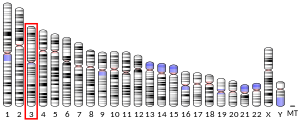
Actin-related protein 2/3 complex subunit 4 is a protein that in humans is encoded by the ARPC4 gene.[5][6][7]
Function
[edit]
This gene encodes one of seven subunits of the human Arp2/3 protein complex. The Arp2/3 protein complex has been implicated in the control of actin polymerization in cells and has been conserved through evolution. The exact role of the protein encoded by this gene, the p20 subunit, has yet to be determined. Three transcript variants encoding two distinct isoforms have been found for this gene.[7]
Interactions
[edit]
ARPC4 has been shown to interact with ARPC5.[8][9]
^Millard TH, Behrendt B, Launay S, Fütterer K, Machesky LM (2003). "Identification and characterisation of a novel human isoform of Arp2/3 complex subunit p16-ARC/ARPC5". Cell Motil. Cytoskeleton. 54 (1): 81–90. doi:10.1002/cm.10087. PMID 12451597.
^Zhao X, Yang Z, Qian M, Zhu X (2001). "Interactions among subunits of human Arp2/3 complex: p20-Arc as the hub". Biochem. Biophys. Res. Commun. 280 (2): 513–7. doi:10.1006/bbrc.2000.4151. PMID 11162547.
Further reading
[edit]
Welch MD, Iwamatsu A, Mitchison TJ (1997). "Actin polymerization is induced by Arp2/3 protein complex at the surface of Listeria monocytogenes". Nature. 385 (6613): 265–9. Bibcode:1997Natur.385..265W. doi:10.1038/385265a0. PMID 9000076. S2CID 4358529.
Robinson RC, Turbedsky K, Kaiser DA, Marchand JB, Higgs HN, Choe S, Pollard TD (2001). "Crystal structure of Arp2/3 complex". Science. 294 (5547): 1679–84. Bibcode:2001Sci...294.1679R. doi:10.1126/science.1066333. PMID 11721045. S2CID 18088124.
Gevaert K, Goethals M, Martens L, Van Damme J, Staes A, Thomas GR, Vandekerckhove J (2003). "Exploring proteomes and analyzing protein processing by mass spectrometric identification of sorted N-terminal peptides". Nat. Biotechnol. 21 (5): 566–9. doi:10.1038/nbt810. PMID 12665801. S2CID 23783563.
Andersen JS, Lam YW, Leung AK, Ong SE, Lyon CE, Lamond AI, Mann M (2005). "Nucleolar proteome dynamics". Nature. 433 (7021): 77–83. Bibcode:2005Natur.433...77A. doi:10.1038/nature03207. PMID 15635413. S2CID 4344740.
Stelzl U, Worm U, Lalowski M, Haenig C, Brembeck FH, Goehler H, Stroedicke M, Zenkner M, Schoenherr A, Koeppen S, Timm J, Mintzlaff S, Abraham C, Bock N, Kietzmann S, Goedde A, Toksöz E, Droege A, Krobitsch S, Korn B, Birchmeier W, Lehrach H, Wanker EE (2005). "A human protein-protein interaction network: a resource for annotating the proteome". Cell. 122 (6): 957–68. doi:10.1016/j.cell.2005.08.029. hdl:11858/00-001M-0000-0010-8592-0. PMID 16169070. S2CID 8235923.
Rosentreter A, Hofmann A, Xavier CP, Stumpf M, Noegel AA, Clemen CS (2007). "Coronin 3 involvement in F-actin-dependent processes at the cell cortex". Exp. Cell Res. 313 (5): 878–95. doi:10.1016/j.yexcr.2006.12.015. hdl:10072/14982. PMID 17274980.
Ewing RM, Chu P, Elisma F, Li H, Taylor P, Climie S, McBroom-Cerajewski L, Robinson MD, O'Connor L, Li M, Taylor R, Dharsee M, Ho Y, Heilbut A, Moore L, Zhang S, Ornatsky O, Bukhman YV, Ethier M, Sheng Y, Vasilescu J, Abu-Farha M, Lambert JP, Duewel HS, Stewart II, Kuehl B, Hogue K, Colwill K, Gladwish K, Muskat B, Kinach R, Adams SL, Moran MF, Morin GB, Topaloglou T, Figeys D (2007). "Large-scale mapping of human protein-protein interactions by mass spectrometry". Mol. Syst. Biol. 3 (1): 89. doi:10.1038/msb4100134. PMC 1847948. PMID 17353931.
External links
[edit]
ARPC4 human gene details in the UCSC Genome Browser.
v
t
e
PDB gallery
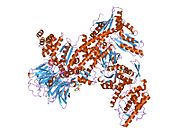
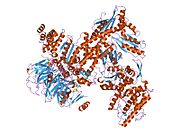
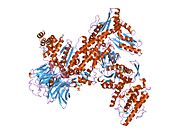
1k8k: Crystal Structure of Arp2/3 Complex
1tyq: Crystal structure of Arp2/3 complex with bound ATP and calcium
1u2v: Crystal structure of Arp2/3 complex with bound ADP and calcium
2p9i: Crystal Structure of bovine Arp2/3 Complex co-crystallized with ADP and crosslinked with gluteraldehyde
2p9k: Crystal structure of bovine Arp2/3 complex co-crystallized with ATP and crosslinked with glutaraldehyde
2p9l: Crystal Structure of bovine Arp2/3 complex
2p9n: Crystal Structure of bovine Arp2/3 complex co-crystallized with ADP
2p9p: Crystal Structure of bovine Arp2/3 complex co-crystallized with ADP
2p9s: Structure of bovine Arp2/3 complex co-crystallized with ATP/Mg2+
2p9u: Crystal structure of bovine Arp2/3 complex co-crystallized with AMP-PNP and calcium
This article is licensed under CC BY-SA 3.0. Original source: https://en.wikipedia.org/wiki/ARPC4 Status: article is cached
 From Wikipedia - Reading time: 7 min








 EncycloReader
is supported by the
EncycloReader
is supported by the  KSF
KSF