Categories
Andrei Alexandrescu
 From Wikipedia - Reading time: 8 min
 | This biography of a living person needs additional citations for verification. (April 2022) |
Andrei Alexandrescu | |
|---|---|
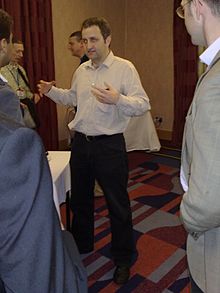 Alexandrescu at ACCU 2009 | |
| Born | 1969 (age 53–54) Bucharest,[1] Romania |
| Nationality | Romanian, American[2] |
| Education | Politehnica University of Bucharest and University of Washington |
| Occupation | Developer of the D programming language |
| Known for | Expert on C++ and D programming[3] |
| Spouse | Sanda Alexandrescu |
| Website | erdani |
Andrei Alexandrescu (born 1969) is a Romanian-American C++ and D language[3] programmer and author. He is particularly known for his pioneering work on policy-based design implemented via template metaprogramming. These ideas are articulated in his book Modern C++ Design and were first implemented in his programming library, Loki. He also implemented the "move constructors" concept in his MOJO library.[4] He contributed to the C/C++ Users Journal under the byline "Generic<Programming>". Alexandrescu worked as a research scientist at Facebook, before departing the company in August 2015 in order to focus on developing the D programming language.[5]
He became an American citizen in August 2014.[6]
Education and career[edit]
Alexandrescu received a B.S. degree in Electrical Engineering from Polytechnic University of Bucharest (Universitatea Politehnica din București) in July 1994.[7][8]
His first article was published in the C/C++ Users Journal in September 1998. He was a program manager for Netzip, Inc. from April 1999 until February 2000. When the company was acquired by RealNetworks, Inc., he served there as a development manager from February 2000 through September 2001.[7]
Alexandrescu earned a M.S. (2003) and a PhD (2009) in computer science from the University of Washington.[9][10][11]
More recently, he has been assisting Walter Bright in the development of the D programming language. Alexandrescu released a book titled The D Programming Language in May 2010.
From 2010 to 2014, Alexandrescu, Herb Sutter, and Scott Meyers ran a small annual technical conference called C++ and Beyond.
Contributions[edit]
Expected[edit]
Expected is a template class for C++ which is on the C++ Standards track.[12][13] Alexandrescu proposes[14] Expected<T> as a class for use as a return value which contains either a T or the exception preventing its creation, which is an improvement over use of either return codes or exceptions exclusively. Expected can be thought of as a restriction of sum (union) types or algebraic datatypes in various languages, e.g., Hope, or the more recent Haskell and Gallina; or of the error handling mechanism of Google's Go, or the Result type in Rust.
He explains the benefits of Expected<T> as:
- Associates errors with computational goals
- Naturally allows multiple exceptions in flight
- Switch between "error handling" and "exception throwing" styles
- Teleportation possible across thread boundaries, across nothrow subsystem boundaries and across time (save now, throw later)
- Collect, group, combine exceptions
Example[edit]
For example, instead of any of the following common function prototypes:
int parseInt(const string&); // Returns 0 on error and sets errno.
or
int parseInt(const string&); // Throws invalid_input or overflow
he proposes the following:
Expected<int> parseInt(const string&); // Returns an expected int: either an int or an exception
Scope guard[edit]
From 2000[15] onwards, Alexandrescu has advocated and popularized the scope guard idiom. He has introduced it as a language construct in D.[16] It has been implemented by others in many other languages.[17][18]
Bibliography[edit]
- Andrei Alexandrescu (February 2001). Modern C++ Design: Generic Programming and Design Patterns Applied. Addison-Wesley. ISBN 978-0-201-70431-0.
- Herb Sutter, Andrei Alexandrescu (November 2004). C++ Coding Standards: 101 Rules, Guidelines, and Best Practices. Addison-Wesley. ISBN 978-0-321-11358-0.
- Andrei Alexandrescu (June 2010). The D Programming Language. Addison-Wesley. ISBN 978-0-321-63536-5.
References[edit]
- ^ "Erdani.com".
- ^ "Sixteen years ago, at 28, I landed in New York with $300 to my name. Today I became a US citizen. It's been a wild ride that I hope will go on!". 14 August 2014.
- ^ a b Metz, Cade (7 July 2014). "The Next Big Programming Language You've Never Heard Of". Wired. Retrieved 27 July 2014.
Today, Alexandrescu is a research scientist at Facebook, where he and a team of coders are using D to refashion small parts of the company's massive operation.
- ^ Alexandrescu, Andrei (1 February 2003). "Move Constructors". Dr. Dobb's Journal. Archived from the original on 7 May 2009. Retrieved 25 March 2009.
- ^ "Moving forward with work on the D language and foundation". 25 August 2015. Retrieved 28 August 2015.
- ^ "Sixteen years ago, at 28, I landed in New York with $300 to my name. Today I became a US citizen. It's been a wild ride that I hope will go on! : pics". 14 August 2014.
- ^ a b "Andrei Alexandrescu: Resumé". Archived from the original on 7 April 2011.
- ^ ACCU Spring Conference 2001 Archived 11 August 2011 at the Wayback Machine
- ^ "ACCU :: Speakers". members.accu.org.
- ^ "ACCU :: Speakers". members.accu.org.
- ^ Computer Science & Engineering, Recent Ph.D. Graduates (Summer 2009).mark University of Washington.
- ^ [Botet; Talbot. "A proposal to add a utility class to represent expected monad" (PDF). Archived from the original (PDF) on 19 August 2014.
- ^ "STD-make/P0323r2.md at master · viboes/STD-make". GitHub. 21 October 2021.
- ^ Alexandrescu. "Systematic Error Handling in C++".
- ^ Andrei Alexandrescu; Petru Marginean. "Generic: Change the Way You Write Exception-Safe Code – Forever".
- ^ "Exception Safety - D Programming Language".
- ^ "Scope::Guard - lexically-scoped resource management - metacpan.org". metacpan.org.
- ^ "Scopeguard - Rust".
External links[edit]
- Alexandrescu's homepage – Contains links to downloadable Loki libraries for various compilers.
- (in Romanian) Interviu MONEY.ro: Facebook face angajări în România, 1 March 2010
Authority control databases | |
|---|---|
| International | |
| National | |
| Academics | |
| Other | |

Original source: https://en.wikipedia.org/wiki/Andrei Alexandrescu
Status: article is cached
 EncycloReader
is supported by the
EncycloReader
is supported by the  KSF
KSF