Categories
Andries Bicker
 From Wikipedia - Reading time: 14 min
Andries Bicker | |
|---|---|
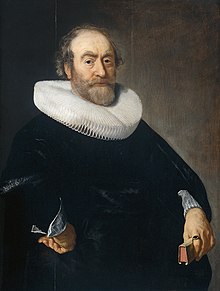 | |
| Regent and Mayor of Amsterdam | |
| In office 1627–1649 | |
| Preceded by | Jacob Dircksz de Graeff |
| Succeeded by | Cornelis de Graeff |
| Personal details | |
| Nationality | Dutch |
| Political party | States Faction |
| Spouse | Catharina Gansneb von Tengnagel |
| Relations | Jacob Bicker (brother) Jan Bicker (brother) Cornelis Bicker (brother) Dieuwertje Bicker (older sister) |
| Residence(s) | Oudezijds Achterburgwal, Kloveniersburgwal, 's-Graveland, |
| Occupation | Regent / Mayor and Landlord of Sloten, Sloterdijk, Osdorp and Engelenburg |
| Profession | politician |
Andries Bicker (14 September 1586 – 24 June 1652) was a prominent burgomaster (mayor) of Amsterdam, politician and diplomat in the Dutch Republic. He was a member of the Bicker family, who governed the city of Amsterdam and with it the province of Holland for about half a century.[a] At that time, the Republic was at the height of its power.[1]
At the end of the Twelve Years Truce he became a member of the city council and the leader of the Bickerse faction, after Reynier Pauw's political end in 1620.[1] Then the management of the Amsterdam city council fell into the hands of the tolerant Arminians around Bicker and his uncle Jacob Dircksz de Graeff.[2] This also gave new impetus to the republican States Party, which had been weakened since the assassination of Land's Advocate Johan van Oldenbarnevelt.[3]
Andries Bicker was considered one of the strongest political adverseries of Frederick Henry, Prince of Orange,[4] and controlled Dutch foreign policy. He, together with his brother Cornelis Bicker[5] and cousin Cornelis de Graeff, portrayed as Bicker-De Graeff league, was one of the main initiators of Peace of Münster with Spain effectively bringing an end to the Eighty Years' War.[6][7]
Political career[edit]
Beginning[edit]


Andries Bicker was a wealthy merchant who trade with Russia.[1] He grew up at Lange Niezel. His father owned a brewery. Andries studied somewhere because he had a degree.[citation needed] In 1611 he was admitted at Hof van Holland as lawyer. In 1616 he became a member of the Amsterdam vroedschap and represented the radical Republican party.[8] Although he belonged to the Calvinist church, as liberal Protestant he protected Arminians and Remonstrants. Bicker came to the fore through his knowledge and moderation. In 1620 he was appointed schepen of Amsterdam. Like his father he invested in draining the polders Purmer, Schermer and Heerhugowaard.[9] In 1624 he was appointed at the Wisselbank (for only one year) and in 1626 as a colonel in the Civic guard.[10][11] In 1627, reaching forty years old, he was elected mayor of Amsterdam;[8] [b] his further appointments fell in the years 1629, 1631, 1633, 1634, 1636, 1640, 1641, 1645 and 1649.[12]
Bicker served as an envoy of the Dutch States-General at the courts of Poland, Sweden and Brandenburg to represent Dutch commercial interests and close negotiations between these countries.[13] While diplomats were received with great honor at the Swedish court, this was not the case in Poland; they returned to The Hague without having achieved anything.
Bickerse league[edit]


The Bicker family focused on Amsterdam's economic boom. In the 1630s, Bicker ruled the city together with his uncle Jacob Dircksz de Graeff portrayed as the arminian clique,[14] helping the Republicans regain influence and recognition for the first time since Johan van Oldenbarnevelt's death. Bicker and De Graeff shared a liberal attitude that set them apart from strict Calvinist politicians.[15] In 1628, the Bickers supported a call for more tolerance towards the Remonstrants.[16]
From 1625 Cornelis Bicker was connected to the Wisselbank.[17] Jacob Bicker became one of the managers of the VOC. The Bicker family participated in peat-digging in Drenthe and disagreed with Adriaan Pauw.[18] In 1634 Bicker became the owner of five plots with a depth of ca 1,100m in 's-Graveland, the site where now Spanderswoud and Trompenburgh are located.[19][20] Ships transported the excavated sand to Amsterdam.
In 1635 he went on a diplomatic mission to Poland and Sweden. They reached an extension of the expiring armistice between Poland and Sweden in the Treaty of Stuhmsdorf and set up new Baltic trade agreements.[c]. At the solemn entry of Maria de Medici into Amsterdam in 1638, he, his brother Jacob and the regents Albert Burgh, Pieter Hasselaer, Antonie Oetgens van Waveren and Abraham Boom welcomed her.[21][8]
Since the Bickers feared an economically strong Antwerp and Brabant, they supported Spain.[1] The brothers supplied ships and ammunition to Spain (with mayors Boom and Jan Cornelis Geelvink) the 1630s.[22] Between 1637 and 1639 he was appointed councilor of the Admiralty of Amsterdam.[d][1] In 1639 Andries speculated in spices and monopolized the fur trade.[23] Johan Elias states he was a manager of the VOC in 1641 but confused him with Jacob Bicker. In February 1642 he was not elected in the city council but allowed to represent the States-General of the Netherlands.
In 1644, Bicker went with Jacob de Witt (and his two sons) as an envoy to Axel Oxenstierna to mediate between Sweden and Denmark.[24][25][e][12] The end of the Torstenson War rested on the power of Andries Bicker, Amsterdam and the Dutch naval dominance under Admiral Witte de With in the Sound, not on the stadtholder.[1]
In 1646 the Bickerse league comprised at least seven members of the Bicker family, all of whom held political offices at that year.[f] They opposed the stadtholder Frederick Henry, Prince of Orange, who intended the centralize the five admiralties, which would cause the Admiralty of Amsterdam to lose influence.[26]
During the 1640s the republican elite of the province of Holland, the brothers Andries and Cornelis Bicker,[5] their cousins Cornelis and Andries de Graeff[27] and Jacob de Witt, advocated an end to the war with Spain and a reduction in land forces.[28] This ongoing state of war prevented the economic growth and social development in Holland. Also, this state of war strengthened the stadtholder's power as commander-in-chief, something the Republicans did not want. Between 1646 and 1648 Bicker was a deputy in the States General.[12] In 1647, Bicker, Adriaan Pauw and the inner power circle of the States of Holland advocated a drastic reduction in Dutch forces.[29]
Bicker was a vehement supporter of ending the Eighty Years' War with the Spanish Habsburgs. This intensified the conflict with the Stadtholder and the Calvinists in Holland. In July 1647, half a year before the conclusion of the Peace of Münster, the Spanish government made a proposal aimed at making Amsterdam the staple market for Spanish silver. In October the States General decided to authorize the admiralties to issue passports for the export of silver imported from Spain; Bicker was involved in the request.[30] He provided ships to transport Spanish silver from Cadiz to the Spanish Netherlands.
Conflict with William II of Orange[edit]


At the time of the politically weak Grand Pensionaries Anthonie Duyck and Jacob Cats from the 1620s to the 1640s, Bicker was regarded as the head of the republican regents in Holland and as a politician who resolutely opposed the striving for power of the stadholders Frederick Henry and William II of Orange. During the 1640s, the influence of Bicker and the city grew even greater as the end of the Eighty Years' War drew nearer. Amsterdam's trade interests pointed in the direction of peace and she was able to push through under Bicker's leadership. The position of the Bicker family was then more powerful than any generation of mayors before or after them. In 1641 Jacob succeeded his brother Cornelis at the Wisselbank.[31] Bicker represented a growing authority both from his membership in the States General, over the States of Holland, and from his frequent diplomatic mission trips to Sweden, Poland, Brandenburg and Denmark.[1]
In 1648, due to the immense political pressure from the entire Bicker-De Graeff Clan[27] the United Netherlands entered into peace negotiations with Spain in order to end the Eighty Years' War with the Peace of Münster.[32] After the States General treaties and the reduction of the land forces,[24] the political opposition to the House of Orange and in particular to the new stadtholder William II,[33] who had succeeded his father Frederick Henry in 1647, wanted to make the city of Amsterdam docile in 1650 by means of a coup d'etat, deepened. In May 1650 he supported a proposal that suggested military cutbacks to encourage peace efforts. In an anonymous libel he was accused of high treason.[34] On 30 June 1650, Bicker was appointed councilor of the Admiralty of Amsterdam. On 30 July 1650, the brothers old-burgomaster Andries and burgomaster Cornelis Bicker[5] activated the militia to defend against an attack on Amsterdam by the new stadtholder William II and Frederick, Burgrave of Dohna after being warned of William's approach by a postman travelling from Hamburg to Amsterdam,[35] who passed on the news to Bicker's son Gerard Bicker, then the bailiff or drost of Gooi.
Gerard set off for Amsterdam by boat and after receiving the news Cornelis and Andries together with burgomaster Joan Huydecoper van Maarsseveen raised the bridges, shut the gates and deployed artillery. The attack failed but after the attack burgomaster De Graeff passed on a message from William II that Cornelis and Andries[36] must resign from their posts on the town council.[37] As result Andries Bicker was purged from the vroedschap in August, as was his brother Cornelis Bicker,[24] as one of the conditions of the treaty that followed, led by De Graeff and Huydecoper.[38] However, they were restored to them on 22 November the same year two weeks after William died of smallpox.[36] In 1652 he was deputy to the Chambre Mi-partie, solving remaining problems between Spain and the Netherlands.[39] On 11 May, he requested his discharge from the last function; Andries died the following 24 June.[1]
Outlook[edit]
After the death of Andries Bicker and the other Bicker brothers, the family's influence ended. None of Andries descendants achieved a seat in the Amsterdam Vroedschap. Henceforth, it was the equally republican-minded brothers Cornelis and Andries de Graeff, and their following, who dominated Amsterdam and the States of Holland.[40] His niece Wendela Bicker was married to raadspensionaris Johan de Witt,[41] who dominated Dutch politics up to the Year of Disaster.
Family[edit]
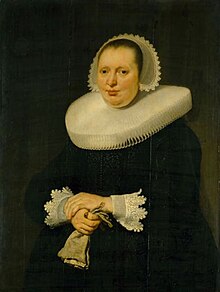
Andries Bicker was the eldest son of Gerrit Bicker and Aleyd Andriesdr Boelens Loen. Gerrit was a wealthy patrician, politician, beer brewer and grain merchant.[8] and threw his work in the Amsterdam vroedschap and as one of the founders of the Dutch East India Company, he was able to launch the careers of his sons, grandchildren and nephews. He was married to Trijn Jansdr van Tengnagel (1595–1652). The couple lived near Oudemanhuispoort and had eleven children, five survived childhood:[12]
- Alida Bicker (1620-1702) was married to her cousin major Jacob Bicker (1612–1676), who inherited Engelenburg after the death of his brother-in-law. Her daughter, Catharina Bicker (1642–1678), was married to a refugee, former Danish steward, councilor and chamberlain, imperial Count palatine Jacob de Petersen.[42]
- Gerard Bicker (1622-1666) was baljuw of Gooi, living at Muiden Castle from 1649. He inherited the estate Engelenburg and the title in 1652 after the death of his father. In 1656, he married Alida Conings against the will of his father.
- Mr Jan Bicker (1626-1657), remained unmarried; advisor of the Admiralty of the Noorderkwartier (1655/1657)[43]
- Cornelia Bicker (1629-1708), who inherited "Spanderswoud", was married to the Danish baron and wealthy landlord Joachim Irgens von Westervick in 1656.[44] Between 1666 and 1675 Irgens owned the norwegian Irgens Estate, which was huge part of Northern Norway, as a private estate.
- Elisabeth Bicker (1631-1666) was married to Salomon Sweers,[44] younger brother of Admiral Isaac Sweers
Historiography[edit]
The Dutch art historian and archivist nl:Bas Dudok van Heel about the impact of the Bicker [in particularly the brothers Andries and Cornelis Bicker] and the linked De Graeff family [in particularly the brothers Cornelis and Andries de Graeff] and their missed (high) noble rank: In Florence families like Bicker and De Graeff would have been uncrowned princes. Here, in 1815, they should at least have been raised to the rank of count, but the southern Dutch nobility would not have put up with that. What you got here remained nothing half and nothing whole.[45]
Bicker family[edit]

The Bicker family was one of the oldest patrician families of Amsterdam and belonged to the leading regent-oligarchy. The Bickers were the most powerful family in Amsterdam and decisively determined the fortunes of the city.[4][46] They were a major trading family involved in beer brewing and the pelt trade with Muscovy and supported the founding of the East and West India Company; Jacob and Cornelis Bicker were appointed in the board.[47] Through their work on the Amsterdam City Council, the Wisselbank, the East- and West India company, the Bickers gained enormous influence on politico-economic self-determination in the Dutch Republic due to the city's position of economic power within the Republic.[48] Andries Bicker ruled the city administration for many years and was mainly supported and carried by his three brothers Jacob, Jan and Cornelis.[48] The Bicker brothers had a firm grip on world trade, in the East, the West, the North and the Mediterranean.

Coat of arms[edit]
The coat of arms of Andries Bickers was quartered:
- 1 and 4 in gold, a red crossbar (van den Anxter); 2 and 3 in silver, three transverse black helmets placed one above the other (Helmer). Helmt.: a protruding bearded male figure in natural color, dressed in a red tabard with wide sleeves and provided with gold braids and braids, covered with a high pointed cap with a turned-back brim, and holding up a golden torch in each of the given hands, the bottom rests on the helmet. Andries, as owner of the lordship of Engelenburg, has increased this with a blue heart shield, charged with a silver castle, from which emerges a rising silver angel with outspread wings.[1]
Genealogical and political Legacy[edit]
Andries and his brother Cornelis Bicker, together with their cousins Cornelis and Andries de Graeff, saw themselves as the political heirs of the old regent family Boelens, whose main lineage, which had remained catholic, had died out in the male line in 1647. They had received the very significant first names Andries and Cornelis from their Boelens ancestors. As in a real dynasty, members of the two families frequently intermarried in the 17th century in order to keep their political and commercial capital together. Its great historical ancestor was Andries Boelens (1455-1519), the city's most influential medieval mayor. Both families, Bicker and De Graeff, descend in the female line from Boelens. He was allowed to hold the highest office in Amsterdam fifteen times.[49]
Notes[edit]
- ^ Together with the related De Graeff family, also local regents.
- ^ Jacob Dircksz de Graeff returned to power again.
- ^ Apart from Bicker, this delegation included Rochus van den Honert, Simon van Beaumont and Gijsbert van Boetselaar.[8]
- ^ He succeeded Jacob Corneliszoon van Neck.
- ^ Together with the Zeeland Pensionary Cornelis van Stavenisse and Joachim Andreae
- ^ His brothers Jan, Jacob and Cornelis Bicker, as well their cousins, Jacob Jacobsz Bicker (1612–1676), Hendrick Jacobsz Bicker (1615–1651) and Roelof Jacobsz Bicker (1611-1656).
References[edit]
- ^ a b c d e f g h i Biography Andries Bicker at Nieuw Nederlandsch biografisch woordenboek, Deel 10 (1937), by P.J. Blok and P.C. Molhuysen
- ^ Geschiedenis van Holland, Volume 2, Book 2, by Eelco Beukers
- ^ Jonathan I. Israel: The Dutch Republic – Its Rise, Greatness, and Fall - 1477-1806. Clarendon Press, Oxford 1995, p 494. ISBN 978-0-19-820734-4
- ^ a b Seefahrer in schwedischen Diensten: Seeschifffahrt und Technologietransfer im 17. Jahrhundert, by Hielke van Nieuwenhuize, p 232 (2022)
- ^ a b c Andries and Cornelis Bicker at Letterkundig woordenboek voor Noord en Zuid
- ^ Amsterdam: a brief life of the city. By Geert Mak, Harvill Press (1999), p 123
- ^ Buitenplaatsen in de Gouden Eeuw: De rijkdom van het buitenleven in de Republik. Herausgegeben von Y. Kuiper, Ben Olde Meierink, Elyze Storms-Smeets, p 71 (2015)
- ^ a b c d e Abraham Jacob van der Aa, Biographisch Woordenboek der Nederlanden (BWN), (1878), volume 1-2, p 517
- ^ "Het Oude Gemaal - Andries Bicker".
- ^ Amsterdams oude burgervendels (Schutterij), 1580-1795. Van Looy. 1888.
- ^ Zwet, H. van (2009) Lofwaerdighe dijckagies en miserabele polders : een financiële analyse van landaanwinningsprojecten in Hollands Noorderkwartier, 1597-1643, p. 438. Verloren
- ^ a b c d e Johan Engelbert Elias, De Vroedschap van Amsterdam, 1578-1795, Deel 1, p 346
- ^ Iournael, van de legatie, gedaen in de iaren 1627 en 1628 by de ... heeren, Rochus vanden Honert, ... Andries Bicker ... ende Simon van Beaumont ... te samen by de ... heeren Staten Generael afgesonden, op den vrede-handel tusschen de coninghen van Polen ende Sweden.
- ^ Eelco Beukers: Geschiedenis van Holland, Volume 2, Book 2, p 44 (Google Books)
- ^ Dutch Overseas Empire, 1600–1800, p 19/20, by Pieter C. Emmer, Jos J.L. Gommans (2020)
- ^ K.P. de Vries (1900) De kerkelijke twisten te Amsterdam 1626-1631
- ^ https://goudeneeuwremake.wordpress.com/2015/07/16/amsterdamsche-wisselbank-1609-1820/
- ^ Dillen, J.G. van (1970), p. 225
- ^ F.J.E. VAN LENNEP (1959) AMSTERDAMMERS IN ‘S-GRAVELAND, p. 108, 114, 116. In: Jaarboek Amstelodamum.
- ^ Laarse, R. van der (2015) Amsterdam en Oranje: de politieke cultuur van kasteel en buitenplaats in Hollands Gouden Eeuw. In: Y. Kuiper, B. Olde Meierink, & E. Storms-Smeets (Hrsg.), Buitenplaatsen in de Gouden Eeuw: de rijkdom van het buitenleven in de Republiek, p. 79
- ^ "Vondel naar Barlaeus - Blyde inkomst van Maria de Medicis - 1639".
- ^ Balbian Verster, J.F.L. (1932) De burgemeesters van Amsterdam, p. 20-22
- ^ "[Bicker, Dr. Andries], Nieuw Nederlandsch biografisch woordenboek. Deel 10".
- ^ a b c Abraham Jacob van der Aa, Biographisch Woordenboek der Nederlanden (BWN), (1878), volume 1-2, p 517
- ^ https://www.vriendenvandewitt.nl/assets/files/johan-in-zweden181123-2-2.pdf
- ^ Burke, P. (1974) Venice and Amsterdam. London: Temple Smith, p. 59
- ^ a b Amsterdam: a brief life of the city. By Geert Mak, Harvill Press (1999), p 123
- ^ Oliver Krause: Die Variabilität frühneuzeitlicher Staatlichkeit. Die niederländische „Staats“-Formierung der Statthaltosen Epoche (1650–1672) als interkontinentales Regiment (Franz Steiner Verlag, Stuttgart 2018)
- ^ Jonathan I. Israel: The Dutch Republic – Its Rise, Greatness, and Fall - 1477-1806. Clarendon Press, Oxford 1995, S. 602. ISBN 978-0-19-820734-4
- ^ J.G. van Dillen (1970) Van rijkdom en regenten. Handboek tot de economische en sociale geschiedenis van Nederland tijdens de Republiek, p. 31-32
- ^ Jan Wagenaar (1767) Amsterdan in zijne opkomst, aanwas, geschiedenissen
- ^ Buitenplaatsen in de Gouden Eeuw: De rijkdom van het buitenleven in de Republik. Herausgegeben von Y. Kuiper, Ben Olde Meierink, Elyze Storms-Smeets, S. 71 (2015)
- ^ Israel, J. (1995) The Dutch Republic, Its Rise, Greatness, and Fall 1477-1806. p. 602
- ^ Drees, M. M. (2013) Blaming and demonizing. Satirical pamphlet literature in the seventeenth-century Dutch Republic. Tijdschrift voor Geschiedenis, 126(2), 220-234.
- ^ Abraham Jacob van der Aa, Biographisch Woordenboek der Nederlanden (BWN), (1878), volume 1-2, p 519
- ^ a b Biography Cornelis Bicker Biography at Nieuw Nederlands Biografisch Woordenboek
- ^ Johan Engelbert Elias, De Vroedschap van Amsterdam, 1578-1795, Deel 1, p 175
- ^ Israel, J. (1995) The Dutch Republic, Its Rise, Greatness, and Fall 1477-1806, p. 607
- ^ Chambre Mi-Partie: Münster Peace Treaty of 1648 by Bram De Ridder
- ^ Israel, J. (1995) The Dutch Republic, Its Rise, Greatness, and Fall 1477-1806, p. 704.
- ^ Panhuysen, L. (2005) De Ware Vrijheid, De levens van Johan en Cornelis de Witt. pp. 181–183.
- ^ Johan Engelbert Elias, De Vroedschap van Amsterdam, 1578-1795, Deel 1, p 362
- ^ Johan Engelbert Elias, De Vroedschap van Amsterdam, 1578-1795, Deel 1, p 497
- ^ a b Johan Engelbert Elias, De Vroedschap van Amsterdam, 1578-1795, Deel 1, p 347
- ^ Geert Mak, Die vielen Leben des Jan Six: Geschichte einer Amsterdamer Dynastie: Geert Mak, Die vielen Leben des Jan Six: Geschichte einer Amsterdamer Dynastie
- ^ Geschichte der Niederlande: Von der Seemacht zum Trendland, by Christoph Driessen (2022)
- ^ Dillen, J.G. van (1970), p. 151
- ^ a b Familial State: Ruling Families and Merchant Capitalism in Early Modern Europe, by Julia Adams, p. 99 (2005)
- ^ DBNL, Amsterdamse burgemeesters zonder stamboom. De dichter Vondel en de schilder Colijns vervalsen geschiedenis, by S.A.C. Dudok van Heel, p 147 (1990)
External links[edit]

- Andries Bicker Biography I at Nieuw Nederlandsch biografisch woordenboek
- Andries Bicker Biography II at Biographisch Woordenboek der Nederlanden
- Andries and Cornelis Bicker at Letterkundig woordenboek voor Noord en Zuid
Authority control databases | |
|---|---|
| International | |
| National | |
| People | |

Original source: https://en.wikipedia.org/wiki/Andries Bicker
Status: article is cached
 EncycloReader
is supported by the
EncycloReader
is supported by the  KSF
KSF