Categories
Anglo-Persian capture of Hormuz
 From Wikipedia - Reading time: 9 min
| Capture of Hormuz | |||||||||
|---|---|---|---|---|---|---|---|---|---|
| Part of Safavid–Portuguese conflicts | |||||||||
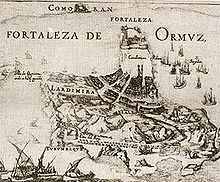
 The taking of Hormuz by Imam Quli Khan and his army (Latin inscription round the fortress). From a Jarūnnāmeh by Qadrī. Isfahan style, dated 1697. | |||||||||
| |||||||||
| Belligerents | |||||||||
 Safavid Persia Safavid Persia  East India Company East India Company |
 Portugal Portugal | ||||||||
| Commanders and leaders | |||||||||
|
Imam Quli Khan Captain Blythe |
Simão de Melo | ||||||||
| Strength | |||||||||
|
3,000 5 warships 4 pinnaces | 1,000 | ||||||||
| Casualties and losses | |||||||||
| Light |
Light 1,000 captured | ||||||||
The Capture of Hormuz (Persian: بازپس گیری هرمز) was a combined Anglo-Persian expedition that successfully captured the Portuguese garrison at Hormuz Island after a ten-week siege, thus opening up Persian trade with England in the Persian Gulf.[1] Before the capture of Hormuz, the Portuguese had held the Castle of Hormuz for more than a century, since 1507 when Afonso de Albuquerque established it in the capture of Hormuz, giving them full control of the trade between India and Europe through the Persian Gulf.[2] According to Stephen Neill, the capture of Hormuz entirely changed the balance of power and trade.[3]
Background[edit]
After the Portuguese capture of Hormuz in 1509, the Portuguese Empire began to claim a monopoly in the Indian Ocean trade, becoming a great power in the Persian Gulf after conquering Qeshm, Bandar Abbas and Muscat (present-day Oman), which generated friction with the Safavid Empire (which initially saw the Portuguese as its allies against the Ottomans). In turn, the commercial dominance of the Persian Gulf attracted the attention of England and Holland, rivals of the Iberian Union and who sought to challenge Spanish-Portuguese control in the region.
After the accession of Shah Abbas the Great, there was greater aggressiveness against the Portuguese by a new regional power that sought to restore Iran's influence in the Persian Gulf, something that began to be noticed with the Persian conquest of Bahrain, of the kingdom of Lara (Lar) and the mainland of Comoran (Bandar Abbas) in 1615. At the same time, a fortress was built in the inlet of Gwadar, halfway between Sindh and Hormuz, which denounced the desire to the Persians to wrest control of trade in the area from the Portuguese.[4]
During this period, Persian embassies were given to Europe, and since the King of Spain, Philip III, was also the King of Portugal, the Persians tried to be friendly in order to develop a Spanish-Persian alliance against the Ottomans.[5] Faced with this, some divergences arose between the Crown of Castile and the Council of Portugal, regarding how the foreign policy with Persia should be on the part of the Hispanic Monarchy, for which the Cortes of Castile accused a lack of realism. to the Portuguese in their desire to insist on maintaining an Asian commercial monopoly that they could not impose on the rest of the European powers (while the Castilians sought a rapprochement with the English against the Dutch).[6]
There was thus a clear divergence in the Persian Gulf between Portuguese priorities and Spanish priorities for the region: if the interests of the former were directed towards the Indian Ocean and Asia, Hormuz, due to its political and economic value, was fundamental for the maintenance of the State of India, Castilian interests were clearly oriented towards the Mediterranean, and Hormuz was important because it facilitated the approach to Persia.
— Graça Borges
Thus, ambassador García de Silva y Figueroa was sent with the public mission of developing an alliance between Spain (including Portugal) and Persia against the Ottoman Empire, although the real and secret mission was to ensure the commercial interests of the Portuguese colonies in the Persian Gulf, especially Hormuz. At the same time, friendly gestures were made with Iran, such as the acceptance of a trade agreement to export Persian silk through the Cape Route, although the Persians demanded that the Portuguese close the Red Sea to weaken the Ottomans, and then the Spanish requested the restitution of the Comoran fortress and that Bahrain be returned to the King of Hormuz (under Iberian protectorate). However, Spain did not have the capacity to launch an offensive against the Turks, and therefore, it only sought to buy time with the Persians by showing courtesy. Meanwhile, the Shah threatened that if the Hispanics rejected his good will, his trade offer would be handed over to the English with Robert Shirley. Finally, distrust of the English led to Ruy Freire de Andrade being sent to reconquer and fortify the eastern part of the island of Quéixome to secure economic supplies from Hormuz and expel the English from the Persian Gulf. However, the English fleet was not destroyed and Shah Abbas became angry at what he considered an attack against his sovereignty, generating rapprochements between the Persians and the English against the Portuguese and Spanish.[6]
Anglo-Persian alliance[edit]
The English component consisted of a force supplied by the East India Company[1] consisting of five warships and four pinnaces.[7] The Persians had recently gone to war with the Portuguese, and a Persian army was besieging the Portuguese fort on Kishm, but English assistance was required to capture Hormuz.[7] Shah Abbas I wished to obtain English support against the Portuguese,[8] and the commander Imam Quli Khan, son of Allahverdi Khan, negotiated with the English to obtain their support, promising the English that they would grant them access to the Persian silk trade.[9] An agreement was signed, providing for the sharing of spoils and customs dues at Hormuz, the repatriations of prisoners according to their faith, and the payment by the Persians of half of the supply costs for the fleet.[10]
Operations[edit]

The English fleet first went to Qeshm, some 24 kilometres (15 mi) away, to bombard a Portuguese position there.[10] The Portuguese present quickly surrendered, and the English casualties were few, but included the famous explorer William Baffin.[10]
The Anglo-Persian fleet then sailed to Hormuz and the Persians disembarked to capture the town.[2] The English bombarded the castle and sank the Portuguese fleet present. After some resistance, the Portuguese surrendered Ormuz on 4 May 1622. The Portuguese were forced to retreat to another base at Maskat.[2]
Although Portugal and Spain were in a dynastic union from 1580 to 1640, England and Portugal were not at war, and the Duke of Buckingham threatened to sue the company for the capture, but renounced his claim when he received the sum of 10,000 pounds, supposedly 10% of the proceedings of the capture of Hormuz.[1] King James I also received the same sum from the company when he complained as such: "Did I deliver you from the complaint of the Spaniards, and do you return me nothing".[1]

The capture of Hormuz gave the opportunity for the company to develop trade with Persia, attempting to trade English cloth and other commodities for silk, which did not become very profitable due to the lack of Persian interest and small quantity of English goods.[1] The English soldier and merchant Robert Shirley also took an interest in developing the Anglo-Persian trade.[1]
See also[edit]
- Portuguese conquest of Hormuz
- British occupation of Bushehr
Notes[edit]
- ^ a b c d e f Chaudhuri, p.64
- ^ a b c Sykes, p. 279
- ^ A History of Christianity in India by Stephen Neill p.549
- ^ "Las Fortalezas Ibéricas en la Península Arábiga (1507-1650)". Revista de Estudios en Seguridad Internacional (in Spanish). Retrieved 8 December 2023.
- ^ SPAIN: RELATIONS WITH PERSIA IN THE 16TH AND 17TH CENTURIES, Encyclopaedia Iranica. "Welcome to Encyclopaedia Iranica". iranicaonline.org. Retrieved 8 December 2023.
{{cite web}}: CS1 maint: numeric names: authors list (link) - ^ a b Rubiés, Joan-Pau (15 November 2018). "1622 y la crisis de Ormuz". Mélanges de la Casa de Velázquez. Nouvelle série (in Spanish) (48–2): 121–151. doi:10.4000/mcv.9047. ISSN 0076-230X.
- ^ a b Sykes, p. 277
- ^ Biography Charles Knight, p.7
- ^ Sykes,pp. 277–278
- ^ a b c Sykes, p. 278
References[edit]
- K. N. Chaudhuri, The English East India Company: The Study of an Early Joint-Stock Company 1600–1640, Taylor & Francis, 1999, ISBN 0-415-19076-2
- Percy Molesworth Sykes, A History of Persia, Read Books, 2006, ISBN 1-4067-2692-3
Further reading[edit]
- Tazmini, Ghoncheh (2017). "The Persian–Portuguese Encounter in Hormuz: Orientalism Reconsidered". Iranian Studies. 50 (2): 271–292. doi:10.1080/00210862.2016.1263542. hdl:10071/15719. S2CID 165149025.
Original source: https://en.wikipedia.org/wiki/Anglo-Persian capture of Hormuz
Status: article is cached
 EncycloReader
is supported by the
EncycloReader
is supported by the  KSF
KSF