Categories
Arabis glabra
 From Wikipedia - Reading time: 5 min
| Arabis glabra | |
|---|---|

| |
Conservation status
| |
Scientific classification 
| |
| Kingdom: | Plantae |
| Clade: | Tracheophytes |
| Clade: | Angiosperms |
| Clade: | Eudicots |
| Clade: | Rosids |
| Order: | Brassicales |
| Family: | Brassicaceae |
| Genus: | Turritis |
| Species: | T. glabra
|
| Binomial name | |
| Turritis glabra (L.)
| |
| Synonyms | |
|
List
| |
Turritis glabra, commonly known as tower rockcress[2] or tower mustard, is a tall, slim, grey-green plant with small creamy flowers at the top of the stem. It usually grows on poor chalky or sandy soils, in open situations. It is native to Europe, Asia, and North Africa, and it is widespread in North America where it is also probably native. It can be found in many other parts of the world as an introduced species.
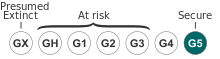
It is classified as an endangered species in the UK and is considered to be facing a very high risk of extinction in the wild. It is listed as a Priority Species under the UK Biodiversity Action Plan. Only 35 sites are recorded by Plantlife mostly in Norfolk, (where 100 plants were found at a new site in 1999) but includes 6 sites near Kidderminster in Worcestershire.
Taxonomy[edit]
Turritis glabra was given its first scientific name by Carl Linnaeus in 1753. In 1800 it was moved from Turritis to genus Arabis by Johann Jakob Bernhardi with than name Arabis glabra.[3] Authors such as Hervé Maurice Burdet, James Cullen, and František Dvořák (1921–2016) maintained that the lack of white to purple flowers, not having seeds arranged in a single row in the pod like peas (uniseriatcly), and not having flattened fruits distinguishes the species in Turritis from Arabis. Botanists maintaining the contrary position such as Reed C. Rollins and Ihsan Ali Al-Shehbaz point to the ambiguous characteristics of some individuals in Turritis glabra and what they consider more critical features such as similar seed-coat anatomy and chemical similarities such as fatty-acid composition and glucosinolate content.[4]
As of 2023 the most common classification is as Turritis glabra as listed in Plants of the World Online[3], World Flora Online[5], and in the Flora of North America.[6]
References[edit]
- ^ NatureServe (2023). "Turritis glabra". Arlington, Virginia. Retrieved 23 December 2023.
- ^ English Names for Korean Native Plants (PDF). Pocheon: Korea National Arboretum. 2015. p. 356. ISBN 978-89-97450-98-5. Archived from the original (PDF) on 25 May 2017. Retrieved 25 January 2016 – via Korea Forest Service.
- ^ a b "Turritis glabra L." Plants of the World Online. Royal Botanic Gardens, Kew. Retrieved 25 December 2023.
- ^ Al-Shehbaz, Ihsan Ali (1988). "The Genera of Arabideae (Cruciferae; Brassicaceae) in the Southeastern United States". Journal of the Arnold Arboretum. 69 (2): 134–135. Retrieved 25 December 2023.
- ^ "Turritis glabra L." World Flora Online. Retrieved 25 December 2023.
- ^ Al-Shehbaz, Ihsan A. (5 November 2020). "Turritis glabra - FNA". Flora of North America. Retrieved 25 December 2023.
External links[edit]
- Plantlife International UK Site: Arabis glabra-Tower mustard accessed 24.12.07
- Express and Star £10k project to protect rare flower 20 December 2007 11.33am accessed 24.12.07
- USDA Plants Profile
- Photo gallery
| Authority control databases: National |
|---|

 | This Brassicales article is a stub. You can help Wikipedia by expanding it. |
Original source: https://en.wikipedia.org/wiki/Arabis glabra
Status: article is cached
 EncycloReader
is supported by the
EncycloReader
is supported by the  KSF
KSF