Bass (fish)
 From Wikipedia - Reading time: 7 min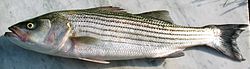
Bass (/bæs/; pl.: bass) is a common name shared by many species of ray-finned fish from the large clade Percomorpha, mainly belonging to the orders Perciformes and Moroniformes, encompassing both freshwater and marine species. The word bass comes from Middle English bars, meaning "perch",[1] despite that none of the commonly referred bass species belong to the perch family Percidae.
Types
[edit]
- The black basses, such as the Choctaw bass (Micropterus haiaka), Guadalupe bass (M. treculii), largemouth bass (M. nigricans), Florida bass (M. salmoides), smallmouth bass (M. dolomieu), and spotted bass (M. punctulatus), belong to the genus Micropterus of the sunfish family Centrarchidae.
- The temperate basses, such as the European seabass (Dicentrarchus labrax), striped bass (Morone saxatilis), yellow bass (M. mississippiensis) and white bass (M. chrysops), belong to the two extant genera Dicentrarchus and Morone of the family Moronidae.
- The Asian seabasses, such as the Japanese seabass (Lateolabrax japonicus) and blackfin seabass (L. latus), belong to the genus Lateolabrax of the family Lateolabracidae.
Other species known as bass
[edit]
Many species are also known as basses,[2] including:
- The Australian bass, Macquaria novemaculeata, is a member of the temperate perch family Percichthyidae.
- The black sea bass, Centropristis striata, is a member of the sea bass and sea grouper family Serranidae.
- Also in the family Serranidae, there is the kelp/calico bass (Paralabrax clathratus), barred sand bass (P. nebulifer), and spotted sand bass (P. maculatofasciatus), all from the Eastern Pacific near Southern California.
- The Chilean sea bass, Dissostichus eleginoides, also known as the Patagonian toothfish, is a member of the cod icefish family Nototheniidae.
- The giant sea bass Stereolepis gigas, also known as the black sea bass, is related to the wreckfish family Polyprionidae.
- The "lanternbellies" or "temperate ocean-basses", Acropomatidae.
- The "butterfly peacock bass", Cichla ocellaris, is a member of the cichlid family, Cichlidae and a prized game fish along with its relatives in the genus Cichla.
- The rock bass (Ambloplites rupestris) in the sunfish family Centrarchidae, along with the black basses.
Fishing
[edit] | This section needs additional citations for verification. (December 2023) |
Largemouth, smallmouth, and spotted bass are the most popular game fish in North America.[3]
It is also very popular in South Africa. In the continent, largemouth bass are often found in lakes, rivers, creeks, and dams.
When fishing, lures (bass worms), live bait, spinner baits, jig bait, jerkbait and crank bait will work well. Lures that mimic baitfish, worms, crayfish, frogs, and mice are all effective. Fishing with a small mepps or rooster tail in-line spinner is very effective for creek fishing, when bass are scouting for small baitfish.[4][better source needed] In open water, lures that cover the water quickly such as spoons, spinners and lipless crankbaits.[clarification needed][5] During the fall and winter months, bass will be less active and eat less. In this situation, one can fish with suspending lures or slow lures like ned rig, suspending jerkbaits.[6] In the summertime, one can throw lures that float or sink 2–4ft since bass come to shallow areas and prefer faster lures.[7]
References
[edit]- ^ "Bass1". American Heritage Dictionary of the English Language, Fourth Edition. Archived from the original on 2005-01-13.
- ^ "List of Common Names with bass". FishBase. Retrieved 6 June 2006.
- ^ "Top 5 Most Popular Game Fish in America [Freshwater & Saltwater]".
- ^ "Bait for Largemouth Bass". 27 August 2021.
- ^ "5 Perfect Baits for Covering Water Quickly". 17 October 2022.
- ^ "The Fall Fishing Frenzy". 11 September 2017.
- ^ "Largemouth & Smallmouth: Summer Bass Fishing Technique". 28 July 2017.
External links
[edit]- . Encyclopedia Americana. 1920.
Meat | |||||
|---|---|---|---|---|---|
| Poultry |
|   | |||
| Livestock |
| ||||
| Game |
| ||||
| Fish |
| ||||
| Shellfish and other seafood |
| ||||
| Insects |
| ||||
| Cuts and preparation |
| ||||
| List articles |
| ||||
| Ethics and psychology |
| ||||
| Alternatives |
| ||||
| Meat science |
| ||||
| Meat industry |
| ||||
| Related subjects |
| ||||
| |||||


| Authority control databases |
|---|

Original source: https://en.wikipedia.org/wiki/Bass (fish)
Status: article is cached
 EncycloReader
is supported by the
EncycloReader
is supported by the  KSF
KSF