Categories
Bobobo-bo Bo-bobo
 From Wikipedia - Reading time: 15 min
| Bobobo-bo Bo-bobo | |
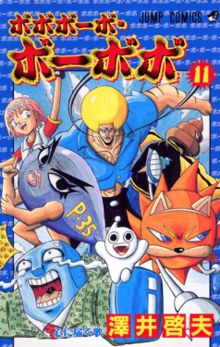 Eleventh tankōbon volume cover | |
| ボボボーボ・ボーボボ (Bobobōbo Bōbobo) | |
|---|---|
| Genre | |
| Manga | |
| Written by | Yoshio Sawai |
| Published by | Shueisha |
| English publisher |
|
| Imprint | Jump Comics |
| Magazine | Weekly Shōnen Jump |
| English magazine |
|
| Demographic | Shōnen |
| Original run | February 20, 2001 – November 14, 2005 |
| Volumes | 21 |
| Anime television series | |
| Directed by | Hiroki Shibata |
| Written by | Yoshio Urasawa |
| Music by | Kōichirō Kameyama |
| Studio | Toei Animation |
| Licensed by |
|
| Original network | TV Asahi |
| English network |
|
| Original run | November 8, 2003 – October 29, 2005 |
| Episodes | 76 |
| Manga | |
| Shinsetsu Bobobo-bo Bo-bobo | |
| Written by | Yoshio Sawai |
| Published by | Shueisha |
| Imprint | Jump Comics |
| Magazine | Weekly Shōnen Jump |
| Demographic | Shōnen |
| Original run | December 19, 2005 – July 2, 2007 |
| Volumes | 7 |
Bobobo-bo Bo-bobo (Japanese: ボボボーボ・ボーボボ, Hepburn: Bobobōbo Bōbobo) is a Japanese manga series written and illustrated by Yoshio Sawai. It was serialized in Shueisha's shōnen manga magazine Weekly Shōnen Jump from February 2001 to November 2005, with its chapters collected in 21 tankōbon volumes. It was followed by a sequel titled Shinsetsu Bobobo-bo Bo-bobo, serialized from December 2005 to July 2007, with its chapters collected in seven tankōbon volumes.
A 76-episode anime television series adaptation by Toei Animation was broadcast on TV Asahi from November 2003 to October 2005. In North America, Viz Media published some volumes of the manga. The anime series aired in the United States on Cartoon Network from 2005 to 2007. By January 2021, the Bobobo-bo Bo-bobo manga had over 7 million copies in circulation.
Plot
[edit]In the year 300X, the entire world is under the tyrannical rule of a regime called the Maruhage Empire (Chrome Dome Empire in the English translation of both the manga and anime). Its ruler, Emperor Tsuru Tsurulina IV (Czar Baldy Bald IV), has initiated the Hair Hunt, a crusade where his army, the Hair Hunters, invade settlements, shave bald every person they see, and leave said settlements in ruins. Standing against the Hair Hunt is Bobobo-bo Bo-bobo, a bizarre, but powerful rebel who fights the Hair Hunters with the Hanage Shinken (Super Fist of the Nose Hair), a martial art that gives him the power to control his nose hairs like whips. Bo-bobo's group consists of Beauty, a teenage girl he rescued; Heppokomaru (Gasser), a teenage boy who fights with the Onara Shinken (Super Fist of the Back Wind), allowing him to weaponize his own flatulence; and Don Patch (Poppa Rocks), an eccentric creature who leads the Hajike Gang (Wiggin Gang), a group that fights by confusing their enemies into submission. Bo-bobo is on an exciting, gag-filled quest in which he ventures from locale to locale, fighting the forces of the Maruhage Empire and gaining more allies along the way.
Media
[edit]Manga
[edit]Bobobo-bo Bo-bobo, written and illustrated by Yoshio Sawai, was serialized in Shueisha's shōnen manga magazine Weekly Shōnen Jump from February 20, 2001,[5][6] to November 14, 2005.[7] Shueisha collected its 230 individual chapters into 21 tankōbon volumes, released from July 4, 2001, to May 2, 2006.[8][9]
A sequel manga titled Shinsetsu Bobobo-bo Bo-bobo (真説ボボボーボ・ボーボボ, Shinsetsu Bobobōbo Bōbobo, True Theory: Bobobo-bo Bo-bobo) was published in Weekly Shōnen Jump from December 19, 2005, to July 2, 2007.[10][11] Shueisha compiled the sequel's 73 individual chapters into seven tankōbon volumes released from July 4, 2006, to January 1, 2008.[12][13]
In North America, the manga has been licensed by Viz Media and was published in a one-shot graphic novel form on October 5, 2005,[14] including content from the ninth and tenth volumes of the Japanese release.[2][15] It was later published monthly in Shonen Jump from July 2007 to June 2009.[16] At Anime Expo 2008, when asked about why the previous volumes were never published, Viz said it was due to the "content".[17] Viz restarted the manga release in 2008. The first volume (11th volume of the Japanese release) was published on August 5, 2008.[18] A total of five volumes of Bobobo-bo Bo-bobo were published until October 5, 2010, before Viz Media ceased the series' publication.[19]
Anime
[edit]The anime adaptation of Bobobo-bo Bo-bobo is directed by Hiroki Shibata,[20] produced by Toei Animation and ran for 76 episodes from November 8, 2003, to October 29, 2005, on TV Asahi.[21] The first opening theme for episodes 1 to 32 is "Wild Challenger" by Jindou, and the second opening theme for episode 33 onwards is "Baka Survivor" (バカサバイバー, Stupid Survivor) by Ulfuls. The first ending theme for episodes 1 to 19 is "Shiawase" (幸せ, Happiness) by Mani Laba, the second ending theme for episodes 20 to 32 is "Kirai Tune" (キライチューン, Hate Tune) by Freenote, and the third ending theme for episode 33 onwards is "H.P.S.J." by Mihimaru GT.[22]
In North America, the anime was licensed by the Joy Tashjian Marketing Group, a licensing representative named by Toei Animation.[23] A sneak peek was shown on Cartoon Network's "Summer 2005 Kick-Off Special" in May 2005,[24] and then premiered on the network's Toonami programming block on September 30 of that same year.[25] New episodes premiered on February 17, 2007.[26][27] The series was also made available on Cartoon Network's broadband service Toonami Jetstream starting on November 5, 2007.[4] In the United Kingdom, the series premiered on Jetix on April 16, 2007.[28]
The series was originally licensed for home video release in North America by Illumitoon Entertainment in 2006,[29] who released only two volumes on bilingual DVD in 2007,[30][31] before their distribution deal with Westlake Entertainment fell through, and all further volumes were canceled.[32] S'more Entertainment later announced on January 16, 2012, that they would release the series with English subtitles and dubbing on DVD on April 10 of the same year.[33][34] This release, however, lacked an English subtitle track, despite a fully translated script being present on a PDF file on disc 4 and indication on the box and pre-release information that there would be a subtitle track on the release.[35] S'more Entertainment released a statement claiming the packaging was wrong, and there never was an intention to subtitle the release, due to costs.[36] In August 2018, Discotek Media announced the licensee of the series and was released on January 28, 2020, as a SD Blu-ray Disc set with all the 76 episodes.[37][38]
Video games
[edit]There are seven Japan-exclusive video games based on Bobobo-bo Bo-bobo developed by Hudson Soft. Four video games were launched for the Game Boy Advance,[39][40][41][42] two video games for the PlayStation 2[43][44] and one for the GameCube.[45] Characters from the series have appeared along with characters from other Weekly Shōnen Jump's series in the crossover fighting games Jump Superstars and Jump Ultimate Stars for the Nintendo DS,[46][47] and J-Stars Victory VS for the PlayStation 3 and PlayStation Vita.[48]
Stage play
[edit]A stage play adaptation was announced on April 1, 2024. It was initially announced as an April Fools' Day joke at midnight, but was later confirmed to be real. The stage play, titled Chō Hajike Stage☆Bobobo-bo Bo-bobo, is directed and written by Keita Kawajiri and is set to premiere at Theatre1010 in Tokyo in October 2024.[49]
Reception
[edit]By January 2021, the Bobobo-bo Bo-bobo manga had over 7 million copies in circulation.[50]
References
[edit]- ^ "The Official Website for Bobobo-bo Bo-bobo". Viz Media. Archived from the original on October 28, 2017. Retrieved October 27, 2017.
- ^ a b Macdonald, Christopher (September 29, 2005). "Details on Viz Bobobo-bo Bo-bobo Release". Anime News Network. Archived from the original on July 12, 2019. Retrieved December 11, 2019.
- ^ Yglesias, Matthew (September 11, 2006). "Bobobo-bo Bo-bobo". The Atlantic. Archived from the original on January 18, 2021. Retrieved September 14, 2018.
- ^ a b "Cartoon Network and VIZ Media Celebrate First Anniversary of Toonami Jetstream™ with Expanded Show Lineup" (Press release). Toonami Jetstream. August 8, 2007. Archived from the original on May 27, 2021. Retrieved September 14, 2018 – via Anime News Network.
- ^ 「ボボボーボ・ボーボボ」原作20周年でオンライン“成人式”イベント初開催へ さらにニコ生でボーボボ一挙放送も (1/2). Netorabo (in Japanese). ITmedia Inc. January 20, 2021. Archived from the original on January 21, 2021. Retrieved January 21, 2021.
- ^ 「ボーボボ」20周年、72時間限定で全話無料公開!完全描き下ろし“ぬ”スタンプも. Comic Natalie (in Japanese). Natasha, Inc. February 19, 2021. Archived from the original on May 27, 2021. Retrieved February 18, 2021.
- ^ 2005年Vol.50 (in Japanese). Shueisha. Archived from the original on March 1, 2009. Retrieved December 11, 2019.
- ^ ボボボーボ・ボーボボ 1 (in Japanese). Shueisha. Archived from the original on September 11, 2007. Retrieved May 3, 2019.
- ^ ボボボーボ・ボーボボ 21 (in Japanese). Shueisha. Archived from the original on September 11, 2007. Retrieved May 3, 2019.
- ^ 2006年Vol.3 (in Japanese). Shueisha. Archived from the original on January 25, 2009. Retrieved December 11, 2019.
- ^ 2007年Vol.31 (in Japanese). Shueisha. Archived from the original on December 12, 2008. Retrieved December 11, 2019.
- ^ 真説ボボボーボ・ボーボボ 1 (in Japanese). Shueisha. Archived from the original on December 25, 2008. Retrieved May 3, 2019.
- ^ 真説ボボボーボ・ボーボボ 7 (in Japanese). Shueisha. Archived from the original on December 23, 2008. Retrieved May 3, 2019.
- ^ "Bobobo-bo Bo-bobo, Vol. 1 (SJ Advanced Edition)". Viz Media. Archived from the original on October 18, 2006. Retrieved November 25, 2008.
- ^ Bertschy, Zac (November 29, 2005). "Bobobo-bo Bo-bobo (manga) - Review". Anime News Network. Archived from the original on May 25, 2019. Retrieved December 11, 2019.
- ^ Loo, Egan (June 1, 2007). "Viz's Shonen Jump, Shojo Beat Shake Up Manga Lineup". Anime News Network. Archived from the original on April 2, 2014. Retrieved December 11, 2019.
- ^ CalAggie (June 5, 2008). "AX 2008 Day 2: My Real First Day at the Con". Nigorimasen! Blog. Archived from the original on August 31, 2013. Retrieved January 8, 2009.
- ^ "Bobobo-bo Bo-bobo, Vol. 1". Viz Media. Archived from the original on April 15, 2019. Retrieved April 15, 2019.
- ^ "Bobobo-bo Bo-bobo, Vol. 5". Viz Media. Archived from the original on April 15, 2019. Retrieved April 15, 2019.
- ^ ボボボーボ・ボーボボ Staff (in Japanese). TV Asahi. Archived from the original on January 26, 2007. Retrieved December 11, 2019.
- ^ ボボボーボ・ボーボボ - 作品ラインナップ - 東映アニメーション (in Japanese). Toei Animation. Archived from the original on December 5, 2019. Retrieved December 11, 2019.
- ^ 伝説的不条理ハジケアニメ『ボボボーボ・ボーボボ』BD-BOX化決定 全76話がディスク3枚に!. Abema Times (in Japanese). March 15, 2019. Archived from the original on August 11, 2024. Retrieved August 11, 2024.
- ^ "Joy Tashian To Represent Toei's Bobobo-Bo Bo-Bobo" (Press release). Joy Tashjian Marketing Group. June 20, 2005. Archived from the original on December 11, 2019. Retrieved December 11, 2019 – via Anime News Network.
- ^ Macdonald, Christopher (May 30, 2005). "Cartoon Network Summer 2005 Kick-Off". Anime News Network. Archived from the original on December 11, 2019. Retrieved December 11, 2019.
- ^ Bertschy, Zac (September 6, 2005). "Bobobo, IGPX premiere dates announced". Anime News Network. Archived from the original on December 11, 2019. Retrieved December 11, 2019.
- ^ Hanson, Brian (February 17, 2007). "February 17th - February 23rd - The Click". Anime News Network. Archived from the original on May 5, 2019. Retrieved December 11, 2019.
- ^ "Bobobo-bo Bo-bobo Picked up by Cartoon Network for Second Season" (Press release). Toei Animation Inc. January 9, 2007. Archived from the original on December 11, 2019. Retrieved December 11, 2019 – via Anime News Network.
- ^ Phillips, George (April 4, 2007). "Bobobo-bo Bobo-bo to Air on Jetix UK". Anime News Network. Archived from the original on December 11, 2019. Retrieved December 11, 2019.
- ^ "Illumitoon & Westlake Acquire Bobobo-Bo Bo-Bobo [2006-11-02]" (Press release). Illumitoon Entertainment. November 2, 2006. Archived from the original on December 11, 2019. Retrieved December 11, 2019 – via Anime News Network.
- ^ Beveridge, Chris (February 5, 2007). "BoBoBo-Bo Bo-BoBo Vol. #01". Mania.com. Archived from the original on February 10, 2009. Retrieved August 11, 2024.
- ^ Beveridge, Chris (May 16, 2007). "BoBoBo-Bo Bo-BoBo Vol. #02". Mania.com. Archived from the original on May 18, 2009. Retrieved August 11, 2024.
- ^ Loo, Egan (October 26, 2007). "Illumitoon's B'tX, Beet, BoBoBo-Bo DVDs Discontinued (Updated)". Anime News Network. Archived from the original on November 17, 2017. Retrieved December 11, 2019.
- ^ Loo, Egan (January 16, 2012). "S'more Entertainment Adds Bobobo-bo Bo-bobo on U.S. DVD". Anime News Network. Archived from the original on July 12, 2019. Retrieved December 11, 2019.
- ^ "Bobobo-Bo Bo-Bobo DVD Complete Series Part 1 (D/Raw)". Rightstuf.com. April 10, 2012. Archived from the original on September 8, 2012. Retrieved October 14, 2012.
- ^ Martin, Theron (June 6, 2012). "Bobobo-Bo Bo-Bobo DVD - Review". Anime News Network. Archived from the original on December 11, 2019. Retrieved December 11, 2019.
- ^ Ransom, Ko (April 11, 2012). "S'More Ent. Acknowledges Bobobo-Bo Bo-Bobo Packaging Error". Anime News Network. Archived from the original on October 17, 2021. Retrieved October 17, 2021.
- ^ "Discotek Licenses Giant Robo, Kimagure Orange Road, Galaxy Express 999, More". Anime News Network. Archived from the original on August 12, 2018. Retrieved August 12, 2018.
- ^ Mateo, Alex (November 12, 2019). "Discotek to Release Bludgeoning Angel Dokuro-chan, Bobobo-bo Bo-bobo, God Mazinger Anime on January 28". Anime News Network. Archived from the original on November 13, 2019. Retrieved November 13, 2019.
- ^ ボボボーボ・ボーボボ 奥義87.5爆烈鼻毛真拳 (in Japanese). Nintendo. Archived from the original on June 11, 2003. Retrieved December 11, 2019.
- ^ ボボボーボ・ボーボボ マジで!!?真拳勝負 (in Japanese). Nintendo. Archived from the original on February 9, 2004. Retrieved December 11, 2019.
- ^ ボボボーボ・ボーボボ 9極戦士ギャグ融合. Nintendo (in Japanese). Archived from the original on October 18, 2004. Retrieved December 11, 2019.
- ^ ボボボーボ・ボーボボ 爆闘ハジケ大戦 (in Japanese). Nintendo. Archived from the original on September 29, 2004. Retrieved December 11, 2019.
- ^ ボボボーボ・ボーボボ ハジけ祭 (in Japanese). PlayStation. Archived from the original on December 11, 2019. Retrieved December 11, 2019.
- ^ ボボボーボ・ボーボボ 集まれ!!体感ボーボボ (in Japanese). PlayStation. Archived from the original on December 11, 2019. Retrieved December 11, 2019.
- ^ ボボボーボ・ボーボボ 脱出!!ハジケ・ロワイアル (in Japanese). Nintendo. Archived from the original on March 22, 2005. Retrieved December 11, 2019.
- ^ キャラクター紹介 ボボボーボ・ボーボボ (in Japanese). Nintendo. Archived from the original on December 15, 2020. Retrieved December 9, 2018.
- ^ JUMP ULTIMATE STARS ボボボーボ・ボーボボ (in Japanese). Nintendo. Archived from the original on November 2, 2020. Retrieved December 11, 2019.
- ^ Loo, Egan (February 12, 2014). "Haikyu, Dr. Slump, Bobobo-bo Join J-Stars Victory Vs. Game". Anime News Network. Archived from the original on February 12, 2014. Retrieved December 11, 2019.
- ^ Cayanan, Joanna (April 1, 2024). "Stage Play Adaptation of Yoshio Sawai's Bobobo-bo Bo-bobo Manga Confirmed". Anime News Network. Archived from the original on April 1, 2024. Retrieved April 2, 2024.
- ^ 『ボボボーボ・ボーボボ』20周年記念イベント2・20開催 キャスト5人出演. Oricon (in Japanese). January 21, 2021. Archived from the original on January 21, 2021. Retrieved January 21, 2021.
Further reading
[edit]- Campbell, Scott (August 30, 2008). "BOBOBO-BO BO-BOBO VOL.1". Active Anime. Archived from the original on January 1, 2014.
External links
[edit]

- Bobobo-bo Bo-bobo (manga) at Anime News Network's encyclopedia
Toei Animation television series | |
|---|---|
| 1960s |
|
| 1970s |
|
| 1980s |
|
| 1990s |
|
| 2000s |
|
| 2010s |
|
| 2020s |
|
 Category Category | |
Toonami (Cartoon Network / Kids' WB era) | |
|---|---|
| 1997 |
|
| 1998 |
|
| 1999 |
|
| 2000 |
|
| 2001 |
|
| 2002 |
|
| 2003 |
|
| 2004 |
|
| 2005 |
|
| 2006 |
|
| 2007 |
|
| 2008 |
|
| |
Original source: https://en.wikipedia.org/wiki/Bobobo-bo Bo-bobo
Status: article is cached
 EncycloReader
is supported by the
EncycloReader
is supported by the  KSF
KSF