Categories
British Standards
 From Wikipedia - Reading time: 11 min

British Standards (BS) are the standards produced by the BSI Group which is incorporated under a royal charter and that is formally designated as the national standards body (NSB) for the UK.[1] The BSI Group produces British Standards under the authority of the charter, with one of their objectives being to:[2][3]
Set up standards of quality for goods and services, and prepare and promote the general adoption of British Standards and schedules in connection therewith and from time to time to revise, alter and amend such standards and schedules as experience and circumstances require.
— BSI Royal Charter, Faller and Graham[3]
Formally, as stated in a 2002 memorandum of understanding between the BSI and the United Kingdom Government, British Standards are defined as:
"British Standards" means formal consensus standards as set out in BS 0-1 paragraph 3.2 and based upon the principles of standardisation recognised inter alia in European standardisation policy.
— Memorandum of Understanding Between the United Kingdom Government and the British Standards Institution in Respect of its Activities as the United Kingdom's National Standards Body, United Kingdom Department for Business, Innovation, and Skills[4]
Products and services which BSI certifies as having met the requirements of specific standards within designated schemes are awarded the Kitemark.[5]
History
[edit]Sir John Wolfe Barry, the leader of the Institution of Civil Engineers in 1896, helped to develop standards for iron and steel production, the forerunner of the BSI.[6][7]
The BSI Group began in 1901 as the Engineering Standards Committee, led by James Mansergh, to standardize the number and type of steel sections, in order to make British manufacturers more efficient and competitive. The committee met for the first time on the 22nd January 1901.[8]
The UK government recognised BSI as the only organisation for issuing standards in Britain, in 1942. In 1955, the government introduced new regulations for Kitemarks on car seat belts and cycling helmets, coinciding with a BSI Kitemark test centre opening in Hemel Hempstead. By the 1970s BSI was focusing on management quality systems.[9]
Over time the standards developed to cover many aspects of tangible engineering, and then engineering methodologies including quality systems, safety and security.
Creation
[edit]The BSI Group as a whole does not British Standards, as standards work within the BSI is decentralized. The governing board of BSI establishes a Standards Board. The Standards Board does little apart from setting up sector boards (a sector in BSI parlance being a field of standardization such as ICT, quality, agriculture, manufacturing, or fire). Each sector board, in turn, constitutes several technical committees. It is the technical committees that formally approve a British Standard, which is then presented to the secretary of the supervisory sector board for endorsement of the fact that the technical committee has indeed completed a task for which it was constituted.[10]
Standards
[edit]The standards produced are titled British Standard XXXX[-P]:YYYY where XXXX is the number of the standard, P is the number of the part of the standard (where the standard is split into multiple parts) and YYYY is the year in which the standard came into effect. BSI Group currently has over 27,000 active standards. Products are commonly specified as meeting a particular British Standard, and in general, this can be done without any certification or independent testing. The standard simply provides a shorthand way of claiming that certain specifications are met, while encouraging manufacturers to adhere to a common method for such a specification.
The Kitemark can be used to indicate certification by BSI, but only where a Kitemark scheme has been set up around a particular standard. It is mainly applicable to safety and quality management standards. There is a common misunderstanding that Kitemarks are necessary to prove compliance with any BS standard, but in general, it is neither desirable nor possible that every standard be 'policed' in this way.
Following the move on harmonization of the standard in Europe, some British Standards are gradually being superseded or replaced by the relevant European Standards (EN).
Status of standards
[edit]Standards are continuously reviewed and developed and are periodically allocated one or more of the following status keywords.[11]
- Confirmed - the standard has been reviewed and confirmed as being current.
- Current - the document is the current, most recently published one available.
- Draft for public comment/DPC - a national stage in the development of a standard, where wider consultation is sought within the UK.
- Obsolescent - indicating by amendment that the standard is not recommended for use for new equipment, but needs to be retained to provide for the servicing of equipment that is expected to have a long working life, or due to legislative issues.
- Partially replaced - the standard has been partially replaced by one or more other standards.
- Proposed for confirmation - the standard is being reviewed and it has been proposed that it is confirmed as the current standard.
- Proposed for obsolescence - the standard is being reviewed and it has been proposed that it is made obsolescent.
- Proposed for withdrawal - the standard is being reviewed and it has been proposed that it is withdrawn.
- Revised - the standard has been revised.
- Superseded - the standard has been replaced by one or more other standards.
- Under review - the standard is under review.
- Withdrawn - the document is no longer current and has been withdrawn.
- Work in hand - there is work being undertaken on the standard and there may be a related draft for public comment available.
Examples
[edit]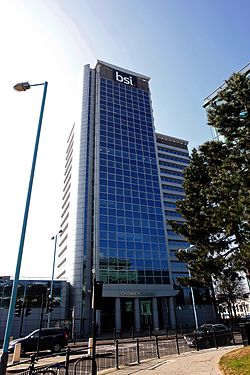
- BS 0 A standard for standards specifies development, structure and drafting of standards.
- BS 1 Lists of rolled sections for structural purposes
- BS 2 Specification and sections of tramway rails and fishplates
- BS 3 Report on influence of gauge length and section of test bar on the percentage of elongation
- BS 4 Specification for structural steel sections
- BS 5 Report on locomotives for Indian railways
- BS 7 Dimensions of copper conductors insulated annealled, for electric power and light
- BS 9 Specifications for bullhead railway rails
- BS 11 Specifications and sections of Flat Bottom railway rails
- BS 12 Specification for Portland Cement
- BS 15 Specification for structural steel for bridges, etc., and general building construction
- BS 16 Specification for telegraph material (insulators, pole fittings, et cetera)
- BS 17 Interim report on electrical machinery
- BS 22 Report on effect of temperature on insulating materials
- BS 24 Specifications for material used in the construction of standards for railway rolling stock
- BS 26 Second report on locomotives for Indian Railways (Superseding No 5)
- BS 27 Report on standard systems of limit gauges for running fits
- BS 28 Report on nuts, bolt heads and spanners
- BS 31 Specification for steel conduits for electrical wiring
- BS 32 Specification for steel bars for use in automatic machines
- BS 33 Carbon filament electric lamps
- BS 34 Tables of BS Whitworth, BS Fine and BS Pipe Threads
- BS 35 Specification for Copper Alloy Bars for use in Automatic Machines
- BS 36 Report on British Standards for Electrical Machinery
- BS 37 Specification for Electricity Meters
- BS 38 Report on British Standards Systems for Limit Gauges for Screw Threads
- BS 42 Report on reciprocating steam engines for electrical purposes
- BS 43 Specification for charcoal iron lip-welded boiler tubes
- BS 45 Report on Dimensions for Sparking Plugs (for Internal Combustion Engines)
- BS 47 Steel Fishplates for Bullhead and Flat Bottom Railway Rails, Specification and Sections of
- BS 49 Specification for Ammetres and Voltmetres
- BS 50 Third Report on Locomotives for Indian Railways (Superseding No. 5 and 26)
- BS 53 Specification for Cold Drawn Weldless Steel Boiler Tubes for Locomotive Boilers
- BS 54 Report on Screw Threads, Nuts and Bolt Heads for use in Automobile Construction
- BS 56 Definitions of Yield Point and Elastic Limit
- BS 57 Report on heads for Small Screws
- BS 70 Report on Pneumatic Tyre Rims for automobiles, motorcycles and bicycles
- BS 72 British Standardisation Rules for Electrical Machinery,
- BS 73 Specification for Two-Pin Wall Plugs and Sockets (Five-, Fifteen- and Thirty-Ampere)
- BS 76 Report of and Specifications for Tar and Pitch for Road Purposes
- BS 77 Specification. Voltages for a.c. transmission and distribution systems
- BS 80 Magnetos for automobile purposes
- BS 81 Specification for Instrument Transformers
- BS 82 Specification for Starters for Electric Motors
- BS 84 Report on Screw Threads (British Standard Fine), and their Tolerances (Superseding parts of Reports Nos. 20 and 33)
- BS 86 Report on Dimensions of Magnetos for Aircraft Purposes
- BS 153 Specification for Steel Girder Bridges
- BS 308 a now deleted standard for engineering drawing conventions, having been absorbed into BS 8888.
- BS 317 for Hand-Shield and Side Entry Pattern Three-Pin Wall Plugs and Sockets (Two Pin and Earth Type)
- BS 336 for fire hose couplings and ancillary equipment
- BS 372 for Side-entry wall plugs and sockets for domestic purposes (Part 1 superseded BS 73 and Part 2 superseded BS 317)
- BS 381 for colours used in identification, coding and other special purposes
- BS 476 for fire resistance of building materials/elements
- BS 499 Welding terms and symbols.
- BS 546 for Two-pole and earthing-pin plugs, socket-outlets and socket-outlet adaptors for AC (50–60 Hz) circuits up to 250V
- BS 857 for safety glass for land transport
- BS 970 Specification for wrought steels for mechanical and allied engineering purposes
- BS 987C Camouflage Colours[12]
- BS 1011 Recommendation for welding of metallic materials
- BS 1088 for marine plywood
- BS 1192 for Construction Drawing Practice. Part 5 (BS1192-5:1998) concerns Guide for structuring and exchange of CAD data.
- BS 1361 for cartridge fuses for a.c. circuits in domestic and similar premises
- BS 1362 for cartridge fuses for BS 1363 power plugs
- BS 1363 for mains power plugs and sockets
- BS 1377 Methods of test for soils for civil engineering.
- BS 1380 Speed and Exposure Index of Photographic Negative Materials.
- BS 1572 Colours for Flat Finishes for Wall Decoration[13]
- BS 1881 Testing Concrete
- BS 1852 Specification for marking codes for resistors and capacitors
- BS 2979 Transliteration of Cyrillic and Greek characters
- BS 3621 Thief resistant lock assembly. Key egress.
- BS 3943 Specification for plastics waste traps
- BS 4142 Methods for rating and assessing industrial and commercial sound
- BS 4293 for residual current-operated circuit-breakers
- BS 4343 for industrial electrical power connectors
- BS 4573 Specification for 2-pin reversible plugs and shaver socket-outlets
- BS 4960 for weighing instruments for domestic cookery
- BS 5252 for colour-coordination in building construction
- BS 5400 for steel, concrete and composite bridges.
- BS 5499 for graphical symbols and signs in building construction; including shape, colour and layout
- BS 5544 for anti-bandit glazing (glazing resistant to manual attack)
- BS 5750 for quality management, the ancestor of ISO 9000
- BS 5837 for protection of trees during construction work
- BS 5839 for fire detection and alarm systems for buildings
- BS 5930 for site investigations
- BS 5950 for structural steel
- BS 5993 for Cricket balls
- BS 6008 for preparation of a liquor of tea for use in sensory tests
- BS 6312 for telephone plugs and sockets
- BS 6651 code of practice for protection of structures against lightning; replaced by BS EN 62305 (IEC 62305) series.
- BS 6879 for British geocodes, a superset of ISO 3166-2:GB
- BS 7430 code of practice for earthing
- BS 7671 Requirements for Electrical Installations, The IEE Wiring Regulations, produced by the IET.
- BS 7799 for information security, the ancestor of the ISO/IEC 27000 family of standards, including 27002 (formerly 17799)
- BS 7901 for recovery vehicles and vehicle recovery equipment
- BS 7909 Code of practice for temporary electrical systems for entertainment and related purposes
- BS 7919 Electric cables. Flexible cables rated up to 450/750 V, for use with appliances and equipment intended for industrial and similar environments
- BS 7910 guide to methods for assessing the acceptability of flaws in metallic structures
- BS 7925 Software testing
- BS 7971 Protective clothing and equipment for use in violent situations and in training
- BS 8110 for structural concrete
- BS 8233 Guidance on sound insulation and noise reduction in buildings
- BS 8484 for the provision of lone worker device services
- BS 8485 for the characterization and remediation from ground gas in affected developments
- BS 8494 for detecting and measuring carbon dioxide in ambient air or extraction systems
- BS 8546 Travel adaptors compatible with UK plug and socket system.
- BS 8888 for engineering drawing and technical product specification
- BS 9251 for safety guidelines on fire sprinkler systems in residential buildings
- BS 15000 for IT Service Management (ITIL), now ISO/IEC 20000
- BS 3G 101 for general requirements for mechanical and electromechanical aircraft indicators
- BS EN 12195 Load restraining on road vehicles.
- BS EN 60204 Safety of machinery
- BS EN ISO 4210 - Cycles. Safety Requirements for Bicycles
PAS documents
[edit]BSI also publishes a series of Publicly Available Specification (PAS) documents.
PAS documents are a flexible and rapid standards development model open to all organizations. A PAS is a sponsored piece of work allowing organizations flexibility in the rapid creation of a standard while also allowing for a greater degree of control over the document's development. A typical development time frame for a PAS is around six to nine months. Once published by BSI, a PAS has all the functionality of a British Standard for the purposes of creating schemes such as management systems and product benchmarks as well as codes of practice. A PAS is a living document and after two years the document will be reviewed and a decision made with the client as to whether or not this should be taken forward to become a formal standard. The term PAS was originally an abbreviation for "product approval specification", a name which was subsequently changed to "publicly available specification". However, according to BSI, not all PAS documents are structured as specifications and the term is now sufficiently well established not to require any further amplification.
Examples
[edit]- PAS 78: Guide to good practice in commissioning accessible websites
- PAS 440: Responsible Innovation – Guide
- PAS 9017: Plastics – Biodegradation of polyolefins in an open-air terrestrial environment – Specification
- PAS 1881: Assuring safety for automated vehicle trials and testing – Specification
- PAS 1201: Guide for describing graphene material
- PAS 4444: Hydrogen fired gas appliances – Guide
Availability
[edit]Copies of British Standards are sold at the BSI Online Shop[14] or can be accessed via subscription to British Standards Online (BSOL).[15] They can also be ordered via the publishing units of many other national standards bodies (ANSI, DIN, etc.) and from several specialized suppliers of technical specifications.
British Standards, including European and international adoptions, are available in many university and public libraries that subscribe to the BSOL platform. Librarians and lecturers at UK-based subscribing universities have full access rights to the collection while students can copy/paste and print but not download a standard.[citation needed] Up to 10% of the content of a standard can be copy/pasted for personal or internal use and up to 5% of the collection made available as a paper or electronic reference collection at the subscribing university. Because of their reference material status standards are not available for interlibrary loan. Public library users in the UK may have access to BSOL on a view-only basis if their library service subscribes to the BSOL platform. Users may also be able to access the collection remotely if they have a valid library card and the library offers secure access to its resources.
The BSI Knowledge Centre in Chiswick, London can be contacted directly about viewing standards in their Members' Reading Room.[16]
See also
[edit]- Institute for Reference Materials and Measurements (EU)
References
[edit]- ^ H.M. Glass G. Weston (1959). "Standardization in the United Kingdom". International Symposium on Plastics Testing and Standardization. ASTM special technical publication. Vol. 247. American Society for Testing Materials International. pp. 37–38.
- ^ "British Standard Institution - an overview | ScienceDirect Topics". www.sciencedirect.com. Retrieved August 4, 2025.
- ^ a b J.M. Faller and M.H. Graham (2003). "Standards, Specifications, and codes of practice". In Geoffrey Stokes (ed.). Handbook of Electrical Installation Practice (4th ed.). Wiley-Blackwell. pp. 305–306. ISBN 978-0-632-06002-3.
- ^ "Memorandum of Understanding Between the United Kingdom Government and the British Standards Institution in Respect of its Activities as the United Kingdom's National Standards Body" (PDF). United Kingdom Department for Business, Innovation, and Skills. 2002. Archived from the original (PDF) on November 6, 2012. Retrieved December 19, 2020.
- ^ "BSI Kitemark - When it matters most for consumers". bsigroup.com. BSI Group. Archived from the original on September 20, 2019. Retrieved September 20, 2019.
- ^ "British Standards Institution: Engineering Standards". Institution of Civil Engineers (ICE). April 8, 2025. Retrieved August 4, 2025.
- ^ "Sir John Wolfe Barry". Tower Bridge. Retrieved August 4, 2025.
- ^ "Standards - History of Occupational Safety and Health". www.historyofosh.org.uk. Retrieved August 4, 2025.
- ^ "British Standards Institution: Engineering Standards". Institution of Civil Engineers (ICE). April 8, 2025. Retrieved August 4, 2025.
- ^ Harm, Schepel (2005). The Constitution of Private Governance: Product Standards in the Regulation of Integrating Markets. Vol. 4. Hart Publishing. pp. 121–124. ISBN 9781841134871.
- ^ "Guide to using the BSI shop". Archived from the original on April 7, 2012. Retrieved January 26, 2013.
- ^ "Wartime Camouflage Colours". Patrickbaty. Archived from the original on May 14, 2012. Retrieved October 12, 2012.
- ^ Baty, Patrick (December 2, 2011). "Colours for Flat Finishes for Wall Decoration". patrickbaty.co.uk. Archived from the original on February 8, 2018. Retrieved February 7, 2018.
- ^ "BSI Online Shop". Bsigroup.com. Archived from the original on November 5, 2016. Retrieved November 4, 2016.
- ^ "British Standards Online". Bsigroup.com. Archived from the original on July 14, 2009. Retrieved April 3, 2012.
- ^ "BSI Knowledge Centre (includes library)". Bsigroup.com. Archived from the original on July 19, 2013. Retrieved May 15, 2014.
External links
[edit]Original source: https://en.wikipedia.org/wiki/British Standards
Status: article is cached
 EncycloReader
is supported by the
EncycloReader
is supported by the  KSF
KSF