Categories
Cameron Mitchell (actor)
 From Wikipedia - Reading time: 13 min
Cameron Mitchell | |
|---|---|
 Mitchell in 1955 | |
| Born | Cameron McDowell Mitzell November 4, 1918 Dallastown, Pennsylvania, U.S. |
| Died | July 6, 1994 (aged 75)[1] Pacific Palisades, California, U.S. |
| Resting place | Desert Memorial Park |
| Occupation | Actor |
| Years active | 1939–1994 |
| Spouses | Johanna Mendel
(m. 1940; div. 1957)Lissa Jacobs Gertz
(m. 1957; div. 1974)Margaret Brock Johnson Mozingo
(m. 1973; annul. 1976) |
| Children | 7 |
Cameron Mitchell (born Cameron McDowell Mitzell; November 4, 1918 – July 6, 1994) was an American stage, film, and television actor for 55 years. Mitchell began his career on Broadway before entering films in the 1950s, appearing in several major features. Later in his career, he became known for his roles in numerous exploitation films in the 1970s and 1980s.
Mitchell began acting on Broadway in the late 1930s before signing a contract with Metro-Goldwyn-Mayer and appearing in such films as Cass Timberlane (1945) and Homecoming (1948). He subsequently originated the role of Happy Loman in the Broadway production of Arthur Miller's Death of a Salesman (1949), a role he reprised in the 1951 film adaptation. With 20th Century Fox, he appeared in How to Marry a Millionaire (1953).
Throughout the 1960s, he appeared in spaghetti Westerns and Italian films―including several collaborations with director Mario Bava―then on U.S. television. Once he made the transition, he was starring as Uncle Buck Cannon on the Western series, The High Chaparral (1967-1971). From the mid-1970s through the 1980s, he appeared in numerous exploitation and horror films and television shows.
Early life
[edit]Mitchell was born Cameron McDowell Mitzell on November 4, 1918,[2] in Dallastown, Pennsylvania, of Scottish and German descent, one of Rev. Charles Michael Mitzell and Kathryn Isabella (née Ehrhart) Mitzell's seven children.[3] Michell moved to Chicora, Pennsylvania, in 1921 when his father was accepted as pastor of the St. John's Reformed Church, Butler, Pennsylvania,[4] and grew up in Shrewsbury, Pennsylvania. The family was poor, and Mitchell wore both shoes and coats handed down from his sisters to school.[5]
Education
[edit]Mitchell was a 1936 graduate of Greenwood High School in Millerstown, Pennsylvania.[6][a]
Acting school
[edit]In 1937, one of Mitchell's high school teachers lent him the money to travel to New York City where he auditioned at three acting schools - the Theatre School of Dramatic Arts, the Alviene Master School of the Theatre and the Academy of Cultural Arts.[5] Although offered a scholarship to attend Alviene, Mitchell chose The Theatre School. It's director, Norman C. Brace wrote Mitchell's father saying "... your son should succeed in becoming a very fine artist for the stage, screen or radio." Alviene school director Claude Alviene said of Mitchell "Your son, not only has exceptional dramatic ability, but the quality of his singing voice is so musical... (it) leaves little doubt of an ultimate successful career..."[7]
Military service
[edit]In 1944, Mitchell served as a bombardier with the United States Army Air Forces during World War II.[8] Mitchell recalled "I was a lousy bombardier -- I never hit anything".[5]
Acting career
[edit]An unknown in New York City
[edit]Mitchell recalled his first days in New York City attending acting school, saying "When I got to New York I had never ridden in an elevator or used a telephone". To make ends meet, he held many jobs, including theatre ushering, mail clerking and washing dishes in restaurants. He was an NBC page at NBC Radio City with then unknown fellow actor Gregory Peck.[9]
Hoping to break into acting, Mitchell wrote dozens of letters to actors, agents and producers in 1939. He received no response from the effort until he wrote actor Alfred Lunt a highly critical letter pointing out what Mitchell thought was Lunt's poor performance in the movie The Guardsman. Lunt answered Mitchell and offered him an audition. Mitchell, realizing his impudence apologized for having written the letter. Lunt's wife, actor Lynn Fontanne told him "Don't worry about what you've done. Acting is your life's work, and you're not only going to be a good actor, you're going to be a great actor".[5]
Changed his name
[edit]Fontanne also advised Mitchell to change his surname from "Mitzel" to "Mitchell", saying she thought his last name would hinder his career due to the then rising anti-German sentiment in America. He took her advice and changed his name.

Stage work
[edit]In 1939, Mitchell made his Broadway debut in a minor role in Jeremiah.[10] He also appeared in the 1939 production of The Taming of the Shrew with Alfred Lunt and Lynn Fontanne's National Theater Company.[11]
In 1941, he appeared again on Broadway in The Trojan Women.[10]
Transition to film
[edit]Mitchell's film career began in 1945 as a contract actor at Metro-Goldwyn-Mayer for three years, with minor roles in films including brief appearances in What Next, Corporal Hargrove? and They Were Expendable (1945), starring John Wayne and Robert Montgomery. He was featured with Lana Turner and Spencer Tracy in Cass Timberlane, and with Wallace Beery in The Mighty McGurk (both 1947). He concluded his MGM period acting in two Clark Gable films, Homecoming and Command Decision (both 1948).[12]
Mitchell moved to Columbia Pictures, starring as a prizefighter in the 1948 film noir Leather Gloves (1948) and a deep-sea diver inSmuggler's Gold (1951). He also starred in Monogram Pictures' Flight To Mars (1951) .[13]
Starring Broadway role and film adaptation
[edit]Mitchell originated the role of Happy Loman in Arthur Miller's Death of a Salesman (1949) on Broadway.[14] After its closing, he appeared again in the Broadway production of Southern Exposure (1950).[10] Mitchell reprised the role of Happy Loman in the 1951 film adaptation released by Columbia Pictures.[14]
Appraisal of acting ability
[edit]In 1952, Hollywood columnist Hedda Hopper said of Mitchell "He isn't handsome. He isn't one of the lucky-break boys or the overnight flashes. Cam has gotten there the hard way over an uphill, obstacle-ridden course".[15]
His agent, Ronald Leif described Mitchell's ability saying "A true actor isn't tagged. He isn't a heavy, a comic or a juvenile – he can assume any personality the role demands and play it convincingly. Such a man is Cameron Mitchell".[15]
20th Century-Fox
[edit]Mitchell was contracted with 20th Century-Fox, where he had a prolific career in such films as Les Misérables (1952) as Marius, and in the comedy How to Marry a Millionaire (1953), in which he portrayed a wealthy man attempting to romance a single woman (played by Lauren Bacall).[16]
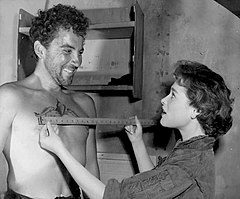
He then appeared alongside Gary Cooper, Susan Hayward, and Richard Widmark in the drama Garden of Evil (1954), followed by a supporting role in Samuel Fuller's Cold War drama Hell and High Water (1954).[17] He subsequently co-starred with Marlon Brando in Désirée (1954);[18] with Gable and Jane Russell in the Western The Tall Men (1955); and the film version of the stage musical Carousel (1956).[18] Mitchell was loaned back to MGM to co-star with Doris Day and James Cagney in the musical drama Love Me or Leave Me (1955).[18] Mitchell co-starred with Joanne Woodward and Sheree North in the drama No Down Payment (1957).[18]
Television career
[edit]Mitchell moved from moves to television in the 1950s, saying he no longer cared for then current film work. "Thank God I worked with the great ones: Gable, Cooper, Power. The respect, mystique and imagination are gone from the movies. The old movies were better. Today they're junk".[15]
Mitchell starred in an unsold 1959 television pilot called I Am a Lawyer.[19] He had the lead as John Lackland in the 1961 syndicated adventure series The Beachcomber.[20]

The High Chapparal
[edit]Mitchell, who did not drink, achieved success on television starring as the former Confederate soldier, drunkard cowhand Buck Cannon in the NBC Western series, The High Chaparral which aired from 1967 to 1971.[21]
Mitchell praised the series, saying "I firmly believe that our show is the best of all the Westerns. There is nothing like it. It's not hip. I'm sick of hip – it's old style. The realism is wonderful. It's like it was. On location, where we do most of our shooting, I've walked where Cochise actually walked the land. I've talked to the people, some of the real pioneers of the West. For me, this series is not just a series, it's one long story".[15]
During the show's production, Mitchell was reportedly "an outspoken, hard-headed guy who has fought with all his High Chaparral colleagues and who manages to alienate just about everybody who runs into him, from fans to producers". Mitchell agreed, saying "Everybody on the show hates me, except (producer) David Dortort. Maybe hate is too strong a word. But I think they all respect the truth of what I say".[5]
Exploitation film career
[edit]Throughout the 1960s, Mitchell starred in numerous exploitation films, including Italian sword and sandal, horror, fantasy, and thriller films, several of which were directed by Mario Bava. Among his collaborations with Bava were the action film Erik the Conqueror (1961), playing a Viking; Blood and Black Lace (1964), in which he portrayed the owner of a fashion house plagued by a series of brutal murders; and as a knife-throwing Viking warrior in Knives of the Avenger (1966).[3] He also appeared in Westerns, such as Minnesota Clay (1964) and Ride in the Whirlwind (1966).
In later years, Mitchell appeared in villainous roles as a sheriff-turned-outlaw in Hombre (1967), a bandit in Buck and the Preacher (1972), and a Ku Klux Klan racist in The Klansman (1974). Beginning in 1970, he intermittently filmed The Other Side of the Wind with director Orson Welles, a project that was unreleased until 2018.[22] In 1975–1976, he portrayed Jeremiah Worth in the Swiss Family Robinson TV series,[23] and had a supporting role opposite Leo Fong in the Filipino film Enforcer from Death Row (1976).[24]
Mitchell was subsequently featured on an episode of Bonanza and ABC's S.W.A.T.. He guest-starred on the "Landslide" episode of Movin' On in 1975. He appeared on Gene Evans's short-lived Spencer's Pilots on CBS in 1976. Mitchell also had roles in horror films and in many exploitation films, such as The Toolbox Murders (1978), the creature feature The Swarm (1978), the slasher film The Demon (1979), and the slasher film Silent Scream (1980). He appeared again on Broadway in the 1978 production of The November People,[10] and the same year starred as Henry Gordon in the television miniseries adaptation of Black Beauty.[25]
Later work
[edit]Late in his career, Mitchell played a gangster for laughs in My Favorite Year (1982), a drunken ship captain in the Filipino martial arts horror-comedy Raw Force (1982), and a police detective in the 1983 pornographic film Dixie Ray, Hollywood Star.[26] He had a supporting role in the anthology horror films Night Train to Terror (1985) and From a Whisper to a Scream (1987), as well as roles portraying right-wing General Edwin A. Walker in Prince Jack (1985), and as Captain Alex Jansen in Space Mutiny, a 1988 South African science fiction film that appeared as an "Experiment" in episode 820 of Mystery Science Theater 3000.
In 1984, he had the role of Duke Kovak in Partners in Crime.[27] He also appeared in an episode of Knight Rider, playing the role of criminal Bernie Mitchell.
Personal life
[edit]On August 17, 1940, Mitchell married Johanna Mendel in Lancaster, New Hampshire.[28] Mendel's father Fred Mendel had founded Intercontinental Packers in Saskatoon, Saskatchewan. The Mitchells' four children held dual US/Canadian citizenship. Daughter Camille Mitchell, and son Charles (later known as Cameron Mitchell Jr.) are both actors. Son Michael Fredrick "Fred" Mitchell, became president of Intercontinental Packers. Now known as Mitchell's Gourmet Foods,[29] the company is owned by Maple Leaf Foods.
Mitchell married Lissa Jacobs Gertz in June 1957.[30] His first wife, Johanna filed a lawsuit alleging cruelty, and sought over $2,000 a month in financial support.[28] Mitchell and Gertz had three children: Kate, Jake, and Jono.[citation needed]
Second bankruptcy
[edit]In February 1974, Mitchell entered his second bankruptcy, with $2.4 million in debts contrasted against $26 in two bank accounts. He told Associated Press writer Bob Thomas: "The reasons are the same as have happened to other actors over the years. Stupid, bad investments. Parasites who live off you. Too much trust in people who handle your money".[31]
On May 9, 1973, Mitchell married Margaret Brock Johnson Mozingo, whom he met when he was in Clemson, South Carolina, making The Midnight Man; their marriage took place in Puerto Rico.[30] In November 1976, his wife applied to a civil court to annul the marriage on the grounds of bigamy. Arguing she was the victim of deception, she said she married her husband before his divorce from Gertz was finalized on February 23, 1974.[30] Mitchell's marriage to Mozingo was formally annulled.[31] In March 1976, Gertz had sued Mozingo for $53,000, a sum she claimed Mitchell and Mozingo agreed to pay her as a divorce settlement.[30]
Death
[edit]Mitchell died of lung cancer on July 6, 1994, in Pacific Palisades, California, at age 75.[1] He is buried in Desert Memorial Park in Cathedral City, California.[32]
Filmography
[edit]Notes
[edit]- ^ An article in the March 15, 1947, issue of The Gazette and Daily from York, Pennsylvania, says that Mitchell went to New Freedom High School.
References
[edit]- ^ a b Grimes, William (July 9, 1994). "Cameron Mitchell, 75, Actor; Created Role in 'Salesman'". The New York Times.
- ^ "Obituary: Cameron Mitchell". The-Independent.com. July 8, 1994. Retrieved November 5, 2024.
- ^ a b Aaker 2017, p. 303.
- ^ Rev. Mitzell Served St. John's Reformed Church from December 1, 1921, to November 30, 1922."St. John's Reformed Church in Donegal Township Pennsylvania". Archived from the original on July 15, 2017. Retrieved July 15, 2017.
- ^ a b c d e Raddatz, Leslie (April 27, 1968). ""Everybody on the Show Hates Me - Straight talk from a nonconformist"". www.thehighchaparral.com. Retrieved November 8, 2024.
- ^ "Cameron Mitchell, York County Native, Moves Near Top In Movies". The Gazette and Daily. Pennsylvania, York. March 15, 1947. p. 14. Retrieved July 13, 2017 – via Newspapers.com.

- ^ "COUNTIAN TO ENTER SCHOOL OF THEATRE". The Gazette and Daily. York, Pennsylvania. September 11, 1937.
- ^ Shipman, David (July 8, 1994). "Obituary: Cameron Mitchell". The Independent. London. Archived from the original on July 15, 2017.
- ^ Grimes, William (July 9, 1994). "Cameron Mitchell, 75, Actor Created Role in Salesman'". The New York Times. New York, New York. p. 11. Retrieved November 8, 2024.
- ^ a b c d "Cameron Mitchell". Playbill. Archived from the original on November 28, 2018.
- ^ "Stage, Film and TV Actor Cameron Mitchell Dies". The Washington Post. July 9, 1994.
- ^ Willis & Monush 2000, p. 280.
- ^ "Flight to Mars". American Film Institute Catalog. Retrieved October 5, 2024.
- ^ a b Blottner 2015, pp. 62–63.
- ^ a b c d Oliver, Myrna (July 8, 1994). "Cameron Mitchell; Multifaceted Actor". The L.A. Times. Los Angeles, California.
- ^ Meyers 2012, p. 46.
- ^ Dombrowski 2015, p. 80.
- ^ a b c d Aaker 2017, p. 306.
- ^ Terrace 2011, p. 32.
- ^ Terrace 2011, p. 82.
- ^ Terrace 2011, p. 458.
- ^ Gleiberman, Owen (August 31, 2018). "Venice Film Review: 'The Other Side of the Wind'". Variety. Penske Media Corporation. Archived from the original on November 24, 2018.
- ^ Terrace 2011, p. 1046.
- ^ Tombs 1998, p. 50.
- ^ Terrace 2011, p. 110.
- ^ "Film profile". iafd.com. Retrieved August 16, 2014.
- ^ Terrace 2011, p. 814.
- ^ a b "Cameron Mitchell Sued for Divorce". Abilene Reporter-News. Abilene, Texas. Associated Press. June 26, 1957. p. 57 – via Newspapers.com.
- ^ "Mitchell's Gourmet Foods". Retrieved November 5, 2024.
- ^ a b c d "Actor's wife charges bigamy". The Argus. Fremont, California. November 20, 1976. p. 2 – via Newspapers.com.
- ^ a b Thomas, Bob (February 21, 1974). "Actor Cameron Mitchell Chose Bankruptcy Over Suicide Act". The Robesonian. North Carolina, Lumberton. Associated Press. p. 12. Retrieved July 13, 2017 – via Newspapers.com.
- ^ Oliver, Myrna (July 8, 1994). "Cameron Mitchell; Multifaceted Actor". Los Angeles Times. Archived from the original on July 15, 2017.
Sources
[edit]- Aaker, Everett (2017). Television Western Players, 1960–1975: A Biographical Dictionary. Jefferson, North Carolina: McFarland. ISBN 978-1-476-62856-1.
- Blottner, Gene (2015). Columbia Noir: A Complete Filmography, 1940-1962. Jefferson, North Carolina: McFarland. ISBN 978-0-786-47014-3.
- Brooks, Patricia; Brooks, Jonathan (2006). "Chapter 8: East L.A. and the Desert". Laid to Rest in California: a Guide to the Cemeteries and Grave Sites of the Rich and Famous. Guilford, Connecticut: Globe Pequot Press. ISBN 978-0762741014.
- Dombrowski, Lisa (2015). The Films of Samuel Fuller: If You Die, I'll Kill You. Middletown, Connecticut: Wesleyan University Press. ISBN 978-0-819-57610-1.
- Meyers, Jeffrey (2012). The Genius and the Goddess: Arthur Miller and Marilyn Monroe. Champaign, Illinois: University of Illinois Press. ISBN 978-0-252-07854-5.
- Terrace, Vincent (2011). Encyclopedia of Television Shows, 1925 through 2010 (2nd ed.). Jefferson, North Carolina: McFarland & Company, Inc., Publishers. ISBN 978-0-7864-6477-7.
- Tombs, Pete (1998). Mondo Macabro: Weird and Wonderful Cinema Around the World. New York: Macmillan. ISBN 978-0-312-18748-4.
- Willis, John; Monush, Barry, eds. (2000). Comprehensive Pictorial and Statistical Record of the 1994 Movie Season. Milwaukee, Wisconsin: Hal Leonard Corporation. ISBN 978-1-557-83233-7.
External links
[edit]

- Cameron Mitchell at IMDb
- Cameron Mitchell at the Internet Broadway Database
- Cameron Mitchell at AllMovie
- Cameron Mitchell at Find a Grave

Authority control databases | |
|---|---|
| International | |
| National | |
| People | |
| Other | |
Original source: https://en.wikipedia.org/wiki/Cameron Mitchell (actor)
Status: article is cached
 EncycloReader
is supported by the
EncycloReader
is supported by the  KSF
KSF