Categories
Camp Vernet
 From Wikipedia - Reading time: 12 min
| Camp Vernet | |
|---|---|
| Transit camp | |
 Aerial photograph (1945) | |
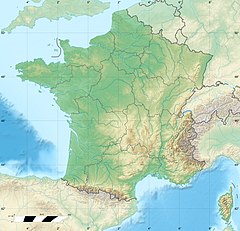  Location of Camp Vernet within France | |
| Coordinates | 43°11′43″N 1°36′30″E / 43.19528°N 1.60833°E |
| Location | Le Vernet, Occitania Vichy France |
| Operated by |
|
| Original use | Troop camp |
| First built | 1918 |
| Operational | to June 1944 |
| Inmates | Spanish refugees, Jews, former members of the International Brigade |
| Notable books | The Invisible Writing, Scum of the Earth |

Le Vernet Internment Camp, or Camp Vernet, was a concentration camp[1] in Le Vernet, Ariège, near Pamiers, in the French Pyrenees. It was built in 1918 as a barracks, but after World War I it was used as an internment camp for prisoners of war. From February 1939 to June 1944, it was used:
- first as an internment camp (concentration camp), first for Republican refugees (soldiers, their families, opponents of the Franco regime) fleeing Spain after Franco's victory in the Spanish Civil War: in particular some 12,000 refugees, including soldiers of the Durruti Column[2] and others of the International Brigades, under the legitimate French government;
- then, as of May–June 1940, under the Vichy government during German occupation in the Second World War. Starting in 1940, apart from the prisoners coming from the Spanish Civil War, the Vichy government used it to house prisoners considered suspect or dangerous to the government, including members of the resistance and opponents of the Hitler, Mussolini and Pétain regimes;[3]
- then, from 1942 until June 1944, it was used as a holding camp for Jewish families awaiting deportation to other camps. The last transport out of the camp in June 1944 took the prisoners to Dachau concentration camp.
History
[edit]Camp Vernet was originally built in June 1918 to house French colonial troops serving in World War I but when hostilities ceased it was used to hold German and Austrian prisoners of war.[4]
Between the wars, it served as a military depot.[4] Towards the end of the Spanish Civil War, in February 1939 in what was called La Retirada (the withdrawal), it was put to a new use until September 1939 as a reception camp for Republicans fleeing from Francisco Franco's armies after the collapse of the Second Spanish Republic. The camp held Republicans the French authorities deemed "a danger to public safety".[4] At this time, it held mainly former soldiers from the Republican Durruti Column,[1][5] the 26th Division and 150 International Brigades members, segregated in an area named "the leper colony". The camp covered an area of about 50 hectares, divided into three sections and surrounded by barbed wire fences.[6]
With the outbreak of World War II, the role of the camp was expanded. It was used to house "undesirable" foreigners, in particular, anti-fascist intellectuals and former members of the International Brigades,[1] particularly the more troublesome or senior veterans.[7]
There is now a small museum at Le Vernet[8] and Le Vernet features in Philip Kerr's 2010 novel Field Grey and in the 2012 novel Citadel by Kate Mosse, which follows the lives of a group of local people and resistance fighters.
Operations under Vichy government
[edit]After the Fall of France on 25 June 1940, it was taken over by the pro-Nazi Vichy France authorities, to house "all foreigners considered suspect or dangerous to the public order".[1] It then passed to the Germans, who rebuilt it according to their own concentration camp guidelines. Arthur Koestler was a prisoner there and declared that "from the point of view of food, installations and hygiene, Vernet was worse than a Nazi concentration camp".[6] From 1942, Le Vernet was used as a holding centre for Jewish families awaiting deportation to Nazi labour and extermination camps.[1] The final transport, in June 1944, took the remaining prisoners to Dachau concentration camp.[1] One source says that "about 40,000 persons of 58 nationalities were interned in the camp".[1]
Notable prisoners
[edit]- Olof Aschberg
- Max Aub
- Erwin Blumenfeld
- Costa Chekrezi
- Leon Degrelle
- Louis Emrich
- Miguel García Vivancos
- Kurt Julius Goldstein
- Jesekiel David Kirszenbaum
- Arthur Koestler, who wrote about it in Scum of the Earth (1941) and The Invisible Writing.
- Nicolas Lazarévitch, libertarian-anarchist writer and activist
- Rudolf Leonhard, German playwright and communist
- Heinrich Rau
- Sascha Schapiro
- Michel Thomas, Polish Jew active in the French Résistance[9]
- Leo Valiani, Italian historian[10]
- Friedrich Wolf
References
[edit]- ^ a b c d e f g "1939-1944: Le Vernet concentration camp". Ariège Pyrenees. Archived from the original on 2007-04-05. Retrieved 2007-05-01.
- ^ "1939-1944: Le Vernet concentration camp", Ariège.com. [Accessed 29-09-2020].
- ^ "Camp de Vernet", entry in the Enciclopèdia Catalana (in Catalan). [Accessed 29-09-2020].
- ^ a b c "Chemins de mémoire | Ministère des Armées". www.cheminsdememoire.gouv.fr. Archived from the original on Apr 16, 2009. Retrieved Mar 6, 2023.
- ^ Bocanegra, Lidia. "A Short History of the Republican Exile: the big exodus of 1939". Exiliados. Retrieved 12 January 2021.
- ^ a b Beevor, Antony (2006). The Battle for Spain. London: Weidenfeld & Nicolson. pp. 456–457. ISBN 978-0-7538-2165-7.
- ^ Tremlett, Giles (2020). The International Brigades. London: Bloomsbury Publishing. p. 525. ISBN 978-1-4088-5398-6.
- ^ Bailey, Rosemary. "Remembrance tourism in France and the Pyrenees". Retrieved 12 January 2021.
- ^ Biography [Robbins, Christopher. Test of Courage: The Michel Thomas Story (2000). New York Free Press/Simon & Schuster. ISBN 978-0-7432-0263-3/Republished as Courage Beyond Words (2007). New York McGraw-Hill. ISBN 0-07-149911-3]
- ^ Willan, Philip (Sep 21, 1999). "Leo Valiani". The Guardian. Retrieved Mar 6, 2023.
Sources
[edit]- (in English) Ariège history
- (in French) Ariège history, Chemins de Memoire
See also
[edit]- List of Nazi-German concentration camps
- List of books about Nazi Germany
- List of concentration and internment camps
- List of Nazi-German concentration camps
- Nazi concentration camps
- World War II
External links
[edit] Media related to Le Vernet Internment Camp at Wikimedia Commons
- Official website (in French)
- Ariège history. (in English)
- Ariège history, Chemins de Memoire. (in French)


Original source: https://en.wikipedia.org/wiki/Camp Vernet
Status: article is cached
 EncycloReader
is supported by the
EncycloReader
is supported by the  KSF
KSF