Chebyshev–Markov–Stieltjes inequalities
 From Wikipedia - Reading time: 2 min
In mathematical analysis, the Chebyshev–Markov–Stieltjes inequalities are inequalities related to the problem of moments that were formulated in the 1880s by Pafnuty Chebyshev and proved independently by Andrey Markov and (somewhat later) by Thomas Jan Stieltjes.[1] Informally, they provide sharp bounds on a measure from above and from below in terms of its first moments.
Formulation
[edit]Given m0,...,m2m-1 ∈ R, consider the collection C of measures μ on R such that
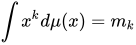
for k = 0,1,...,2m − 1 (and in particular the integral is defined and finite).
Let P0,P1, ...,Pm be the first m + 1 orthogonal polynomials[clarification needed] with respect to μ ∈ C, and let ξ1,...ξm be the zeros of Pm. It is not hard to see that the polynomials P0,P1, ...,Pm-1 and the numbers ξ1,...ξm are the same for every μ ∈ C, and therefore are determined uniquely by m0,...,m2m-1.
Denote
- .
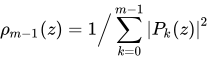
Theorem For j = 1,2,...,m, and any μ ∈ C,
![{\displaystyle \mu (-\infty ,\xi _{j}]\leq \rho _{m-1}(\xi _{1})+\cdots +\rho _{m-1}(\xi _{j})\leq \mu (-\infty ,\xi _{j+1}).}](https://wikimedia.org/api/rest_v1/media/math/render/svg/bf21ac27017507b66490739f0524e69ad47d9ff8)
References
[edit]- ^ Akhiezer, N.I. (1965). The Classical Moment Problem and Some Related Questions in Analysis. Oliver & Boyd.
Original source: https://en.wikipedia.org/wiki/Chebyshev–Markov–Stieltjes inequalities
Status: article is cached
 EncycloReader
is supported by the
EncycloReader
is supported by the  KSF
KSF