Categories
Cinema of Africa
 From Wikipedia - Reading time: 28 min

Cinema of Africa covers both the history and present of the making or screening of films on the African continent, and also refers to the persons involved in this form of audiovisual culture. It dates back to the early 20th century, when film reels were the primary cinematic technology in use. As there are more than 50 countries with audiovisual traditions, there is no one single 'African cinema'. Both historically and culturally, there are major regional differences between North African and sub-Saharan cinemas, and between the cinemas of different countries.[1]
The cinema of Egypt and the cinema of Tunisia are among the oldest in the world. Cinema of Egypt in particular is the most established and flourishing industry in Africa.[2][3] Pioneers Auguste and Louis Lumière screened their films in Alexandria, Cairo, Tunis, Susa, Libya and Hammam-Lif, Tunisia in 1896.[4][5] Albert Samama Chikly is often cited as the first producer of indigenous African cinema, screening his own short documentaries in the casino of Tunis as early as December 1905.[6] The first film to be produced was the 1923's Barsoum Looking for a Job in Egypt.[7][8] Alongside his daughter Haydée Tamzali, Chikly would go on to produce important early milestones such as 1924's The Girl from Carthage. In 1927, Egypt produced Laila, the first feature-length film produced by Aziza Amir and directed by Stephan Rosti and Wedad Orfi. In 1935, the Studio Misr in Cairo began producing mostly formulaic comedies and musicals, but also films like Kamal Selim's The Will (1939). Egyptian cinema flourished in the 1940s, 1950s, and 1960s, considered its Golden Age.[9] Youssef Chahine's seminal Cairo Station (1958) laid the foundation for Arab film.[10]
The Nigerian film industry is the largest in Africa in terms of volume, number of annual films, revenue and popularity.[11][12][13] It is also the second largest film producer in the world.[14] In 2016, Nigeria's film industry contributed 2.3% to its gross domestic product (GDP).[14]
History
[edit]Colonial era
[edit]During the colonial era, Africa was represented largely by Western filmmakers. In the first decades of the twentieth century, Western filmmakers made films that depicted black Africans as "exoticized", "submissive workers" or as "savage or cannibalistic". For example, see Kings of the Cannibal Islands in 1909, Voodoo Vengeance (1913) and Congorilla (1932).[1]

Colonial era films portrayed Africa as exotic, without history or culture. Examples abound and include jungle epics based on the Tarzan character created by Edgar Rice Burrou, and the adventure film The African Queen (1951), and various adaptations of H. Rider Haggard's novel King Solomon's Mines (1885).[15]
African cinema evolved through different historical phases, each reflecting the socio-political landscape of the continent. The early years of African cinema were heavily influenced by colonialism, with many films produced by European directors who often depicted Africa through a colonial lens. However, the post-independence era saw a surge in films by African filmmakers who sought to portray authentic African stories, often focusing on themes of decolonization, identity, and cultural heritage. This period gave birth to what is often referred to as the "Golden Age" of African cinema, characterized by filmmakers like Ousmane Sembène, who is widely regarded as the father of African cinema[16][17]
One of the first films to be entirely produced in Africa was the South African dramatic film The Great Kimberley Diamond Robbery (1911).[18] It was followed by De Voortrekkers (1916), South Africa's (and possibly Africa's) first epic film and oldest surviving film, about the Great Trek and targeted at an Afrikaner audience.[19] A notable theme in early South African cinema was the ethnic confrontation between Afrikaner (specifically Boer) and British South Africans.[18]
Much early ethnographic cinema "focused on highlighting the differences between indigenous people and the white civilised man, thus reinforcing colonial propaganda".[20] Marc Allégret's first film,Voyage au Congo (1927) respectfully portrayed the Masa people, in particular a young African entertaining his little brother with a baby crocodile on a string. Yet Africans were portrayed merely as human, but not equals; a dialogue card, for example, referred to the movements of a traditional dance as naive. His lover, writer André Gide, accompanied Allégret and wrote a book, also titled Voyage au Congo. Allégret later made Zouzou, starring Josephine Baker, the first major film starring a black woman. Baker had caused a sensation in the Paris arts scene by dancing in the Revue Nègre clad only in a string of bananas.

In the French colonies, Africans were prohibited by the 1934 Laval Decree from making films of their own.[21][22] The ban stunted the growth of film as a means of African expression, political, cultural, and artistic.[23] Congolese Albert Mongita did make The Cinema Lesson in 1951 and in 1953 Mamadou Touré made Mouramani based on a folk story about a man and his dog.[24] In 1955, Paulin Soumanou Vieyra – originally from Benin, but educated in Senegal – along with his colleagues from Le Group Africain du Cinema, shot a short film in Paris, Afrique-sur-Seine (1955). Vieyra was trained in filmmaking at the Institut des hautes études cinématographiques (IDHEC) in Paris, and despite the ban on filmmaking in Africa, was granted permission to make a film in France.[25] Considered the first film directed by a black African, Afrique Sur Seine explores the difficulties of being an African in 1950s France.[26]
Portuguese colonies came to independence with no film production facilities at all, since the colonial government there restricted film-making to colonialist propaganda, emphasizing the inferiority of indigenous populations. Therefore, little thought was given until independence to developing authentic African voices.[27]
In the mid-1930s, the Bantu Educational Kinema Experiment in eastern and south-eastern African countries was conducted in an attempt to "educate the Bantu, mostly about hygiene. Only three films from this project survive; they are kept at the British Film Institute.[28]
Before the colonies' independence, few anti-colonial films were produced. Examples include Statues Also Die (Les statues meurent aussi) by Chris Marker and Alain Resnais, about European theft of African art; the second half of the film was banned for years by the French authorities. The 1950 film Afrique 50 by René Vautier, showed anti-colonial riots in Côte d'Ivoire and in Upper Volta (now Burkina Faso), and was likewise banned, with Vautier being jailed for several months.[29]

Also doing film work in Africa at this time was French ethnographic filmmaker Jean Rouch, controversial with both French and African audiences. Film documentaries such as Jaguar (1955), Les maitres fous (1955), Moi, un noir (1958) and La pyramide humaine (1961). Rouch's documentaries were not explicitly anti-colonial, but did challenge perceptions of colonial Africa and give a new voice to Africans.[30] Although Rouch was accused by Ousmane Sembene and others[31] of seeing Africans "as if they are insects,"[32] Rouch was an important figure in the developing field of African film and was the first person to work with Africans, of whom many had important careers in African cinema (Oumarou Ganda, Safi Faye and Moustapha Alassane, and others).[33]
Because most films made prior to independence were egregiously racist in nature, African filmmakers of the independence era, – such as Ousmane Sembene and Oumarou Ganda, among others – saw filmmaking as an important political tool for rectifying the image of Africans put forward by Western filmmakers and for reclaiming the image of Africa for Africans.[34]
Post-independence and 1970s
[edit]

The first African film to win international recognition was Sembène Ousmane's La Noire de... also known as Black Girl. It showed the despair of an African woman who has to work as a maid in France. It won the Prix Jean Vigo in 1966.[35] Initially a writer, Sembène had turned to cinema to reach a wider audience. He is still considered the "father of African cinema".[36] Sembène's native Senegal continued to be the most important place of African film production for more than a decade.[citation needed]
With the creation of the African film festival FESPACO in today's Burkina Faso in 1969, African film created its own forum. FESPACO now takes place every two years in alternation with the Carthago film festival in Tunisia.
The Pan African Federation of Filmmakers (Fédération Panafricaine des Cinéastes, or FEPACI)[37] was formed in 1969 to promote African film industries in terms of production, distribution and exhibition. From its inception, FEPACI was seen as a critical partner organization to the Organisation of African Unity (OAU), now the African Union. FEPACI looks at the role of film in the politico-economic and cultural development of African states and the continent as a whole.
Med Hondo's Soleil O, shot in 1969, was immediately recognized. No less politically engaged than Sembène, he chose a more controversial filmic language to show what it means to be a stranger in France with the "wrong" skin colour.[citation needed]
1980s and 1990s
[edit]
Souleymane Cissé's Yeelen (Mali, 1987) was the first film made by a Black African to compete at Cannes.[38] Cheick Oumar Sissoko's Guimba (Mali, 1995) was also well received in the West. Many films of the 1990s, including Quartier Mozart by Jean-Pierre Bekolo (Cameroon, 1992), are situated in the globalized African metropolis.
Nigerian cinema experienced a large growth in the 1990s with the increasing availability of home video cameras in Nigeria, and soon put Nollywood in the nexus for West African English-language films. Nollywood produced 1844 movies in 2013 alone.[39]
The last movie theatre in Kinshasa, Democratic Republic of the Congo, shut down in 2004. Many of the former cinemas were converted to churches.[40] In 2009 the UN refugee agency screened Breaking the Silence in South Kivu and Katanga Province. The film deals with rape in the Congolese civil wars[41] In neighboring Brazzaville, Republic of the Congo, a 200-seat cinema, MTS Movies House, opened in 2016,[42] and in April 2018, construction began on another new cinema .[43]
A first African Film Summit took place in South Africa in 2006. It was followed by FEPACI 9th Congress. The Africa Movie Academy Awards were launched in 2004, marking the growth of local film industries like that of Nigeria as well as the development and spread of the film industry culture in sub-Saharan Africa.
2000s and 2010s
[edit]

Contemporary African cinema deals with a wide variety of themes relating to modern issues and universal problems.
Migration and relations between African and European countries is a common theme among many African films. Abderrahmane Sissako's film Waiting for Happiness portrays a Mauritanian city struggling against foreign influences through the journey of a migrant coming home from Europe.[44] Migration is also an important theme in Mahamat Saleh Haroun's film Une Saison en France, which shows the journey of a family from the Central African Republic seeking asylum in France.[45] Haroun is part of the Chadian diaspora in France, and uses the film to explore aspects of this diasporan experience.[46]
Africanfuturism and Afrofuturism is a growing genre, encompassing Africans both on the continent and in the diaspora who tell science or speculative fiction stories involving Africa and African people. Neill Blomkamp's District 9 is a well-known example, portraying an alien invasion of South Africa.[47] Wanuri Kahiu's short film Pumzi portrays the futuristic fictional Maitu community in Africa 35 years after World War III.[citation needed]
Directors including Haroun and Kahiu have expressed concerns about the lack of cinema infrastructure and appreciation in various African countries.[48] However, organizations such as the Changamoto arts fund are providing more resources and opportunities to African filmmakers.[49]
2020s
[edit]Some African countries suffer a lack of freedom of speech, that undermine the film industry. This is specially severe in Equatorial Guinea.[50] The feature film The Writer From a Country Without Bookstores[51] is the first to be shot in the country and critic with Teodoro Obiang Nguema Mbasogo's dictatorship, one of the longest lasting in the world.
In 2025, Angola premiered it's first musical film, still one of the few to be shot in Africa. Called "The Adventures of Angosat", contains music composed by local rapper Isis Hembe. [52]
Themes
[edit]
African cinema, like cinema in other world regions, covers a wide variety of topics. In Algiers in 1975, the Pan African Federation of Filmmakers (FEPACI) adopted the Charte du cinéaste africain (Charter of the African cinéaste), which recognized the importance of postcolonial and neocolonial realities in African cinema. The filmmakers start by recalling the neocolonial condition of African societies. "The situation contemporary African societies live in is one in which they are dominated on several levels: politically, economically and culturally."[citation needed] African filmmakers stressed their solidarity with progressive filmmakers in other parts of the world. African cinema is often seen a part of Third Cinema.
Some African filmmakers, for example Ousmane Sembène, try to give African history back to African people by remembering the resistance to European and Islamic domination.
The African filmmaker is often compared to the traditional griot. Like griots, filmmakers' task is to express and reflect communal experiences. Patterns of African oral literature often recur in African films. African film has also been influenced by traditions from other continents, such as Italian neorealism, Brazilian Cinema Novo and the theatre of Bertolt Brecht.
Women directors
[edit]-
 Kemi Adetiba (born 1980), Nigerian film maker, 2014
 -
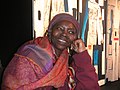 Safi Faye (1943-2023), Senegalese film director, anthropologist, ethnologist and feminist, 2004
 -
 Wanuri Kahiu (born 1980), Kenyan film director, producer, and author, 2018
 -
 Hala Khalil (born 1967), Egyptian film director, producer, and screenwriter, 2018
Recognised as one of the pioneers of Senegalese cinema as well as cinema developed on the African continent at large, ethnologist and filmmaker Safi Faye was the first African woman film director to gain international recognition.[53] Faye's first film La Passante (The Passerby) was released in 1972 and following this, Kaddu Beykat (Letter from My Village), the filmmaker's first feature film was released in 1975. Faye continued to be active with several released works in the latter half of the 1970s all the way through her latest work, the 1996 drama film Mossane.
Sarah Maldoror, a French filmmaker and the daughter of immigrants from Guadeloupe has been recognised as one of the pioneers of African cinema in the diaspora. She is the founder of Les Griots (The Troubadours), the first drama company in France made for actors of African and Afro-Caribbean descent.[54] Originally in the theatre, she went on to study filmmaking at the State Institute of Cinematography of the Russian Federation (VGIK) in Moscow.[54] In 1972, Maldoror shot her film Sambizanga about the 1961–74 war in Angola. Surviving African women of this war are the subject of the documentary Les Oubliées (The forgotten women), made by Anne-Laure Folly 20 years later. Maldoror also worked as assistant director on The Battle of Algiers (1966) with filmmaker Gillo Pontecorvo.
In 1995, Wanjiru Kinyanjui made the feature film The Battle of the Sacred Tree in Kenya.[55]
In 2008, Manouchka Kelly Labouba became the first woman in the history of Gabonese cinema to direct a fictional film. Her short film Le Divorce addresses the impact of modern and traditional values on the divorce of a young Gabonese couple.
Kemi Adetiba, hitherto a music video director, made her directorial debut in 2016 with The Wedding Party. The film, about the events involved in the celebration of an aristocratic wedding, would go on to become the most successful Nollywood film in the history of her native Nigeria.
Wanuri Kahiu is a Kenyan film director, best known for her film From a Whisper, which was awarded Best Director, Best Screenplay, and Best Picture at the Africa Movie Academy Awards in 2009. Nearly 10 years after the release of From a Whisper, Kahiu's film Rafiki, a coming-of-age romantic drama about two teenage girls in the present-day Kenya. The film made headlines, partly for its selection at the Cannes Film Festival but also for its exploration of sexuality that did not sit well with the Kenyan government.[56]
Rungano Nyoni, best known for the internationally acclaimed feature film I am Not a Witch is a Zambian-Welsh director and screenwriter. Born in Zambia and also raised in Wales, Nyoni went on to graduate from the University of Arts in London with a Master's in acting in 2009.[57] Her filmography as a filmmaker (whether as a director or screenwriter) also includes the short films: The List (2009, short), Mwansa The Great (2011, short), Listen (2014, short), and she was also one of the directors of the international film project Nordic Factory (2014).[58][59] She has been awarded a variety of awards including a BAFTA for outstanding debut by a British filmmaker for I am Not a Witch.[60]
Representation and Identity
[edit]African cinema has been a powerful medium for exploring and challenging the representations of African identity. Filmmakers often grapple with the portrayal of African cultures, traditions, and modernity, striving to present a narrative that counters the stereotypical depictions seen in Western media. Films such as "Black Girl" by Ousmane Sembène and "Yeelen" by Souleymane Cissé are examples where African filmmakers use cinema to assert their identity and challenge the dominant narratives imposed by colonial and post-colonial powers.[61][62] These films have contributed significantly to a reimagining of African identity on the global stage.
Challenges facing African cinema
[edit]Despite its growth, African cinema faces significant challenges, including limited funding, distribution difficulties, and competition with Hollywood and Bollywood. Many African filmmakers struggle to secure financing for their projects, and those who do often face hurdles in distributing their films both within Africa and internationally. The lack of a robust distribution network means that many African films do not reach a wide audience, limiting their impact and profitability. Moreover, the dominance of Hollywood and Bollywood films in African markets poses a significant challenge to local filmmakers who must compete for audience attention[63][64]
UNESCO report on the African film industry
[edit]In October 2021, UNESCO published a report of the film and audiovisual industry in 54 states of the African continent including quantitative and qualitative data and an analysis of their strengths and weaknesses at the continental and regional levels. The report proposes strategic recommendations for the development of the film and audiovisual sectors in Africa and invites policymakers, professional organizations, firms, filmmakers and artists to implement them in a concerted manner.[65]
Part 1 of the report is titled Pan-African Trends Shaping the Future of the Continent's Film and Audiovisual Sector, Part 2 is Strategic Development and Growth Models, Part 3 presents detailed national mappings of the countries, and an annex lists historical key dates in African cinema from 1896 to 2021. Apart from the historical developments of audiovisual productions, major filmmakers and their artistic merit and recent trends, such as online streaming, as well as the lack of training, funding, and appreciation of this industry, are discussed.[66]
List of cinema by region
[edit]North Africa
[edit]
|
|
West Africa
[edit]
|
|
Central Africa
[edit]
|
|
East Africa
[edit]
|
|
Southern Africa
[edit]
|
|
Directors by country
[edit]- Algeria: Merzak Allouache, Malek Bensmaïl, Nina Khada, Karim Moussaoui
- Angola: Zézé Gamboa,[67] Miguel Hurst
- Benin: Idrissou Mora Kpaï, Jean Odoutan
- Botswana: Thabiso Maretlwaneng, Thato Rantao Mwosa
- Burkina Faso: Gaston Kaboré, Valérie Kaboré, Dani Kouyaté, Fanta Régina Nacro, Sanou Kollo, Idrissa Ouedraogo, Pierre Rouamba, Drissa Touré, Apolline Traoré, Saint Pierre Yaméogo
- Burundi: Justine Bitagoye, Eddy Munyaneza, Léonce Ngabo
- Cameroon: Jean-Pierre Bekolo, Bassek Ba Kobhio, Urbain Dia Moukouri, Bernard Auguste Kouemo Yanghu, Joséphine Ndagnou, Jean-Paul Ngassa, Jean-Pierre Dikongué Pipa, Thérèse Sita-Bella, Francis Taptue, Jean-Marie Teno, Francois L. Woukoache
- Cape Verde: Lolo Arziki, Leão Lopes, Júlio Silvão Tavares
- Chad: Issa Serge Coelo, Mahamat Saleh Haroun
- Comoros: Hachimiya Ahamada
- Côte d'Ivoire: Marie-Louise Asseu, Sidiki Bakaba, Akissi Delta, Henri Duparc, Desiré Ecaré, Fadika Kramo Lanciné, Roger Gnoan M'Bala, Jacques Trabi
- Democratic Republic of the Congo: Machérie Ekwa Bahango, Balufu Bakupa-Kanyinda, Baloji, Mars Kadiombo Yamba Bilonda, Guy Bomanyama-Zandu, Claude Haffner, Dieudo Hamadi, Mamadi Indoka, Kiripi Katembo, Joseph Kumbela, Laura Kutika, Zeka Laplaine,[68] Albert Mongita, Djo Tunda Wa Munga, Guy Kabeya Muya, Mwezé Ngangura, Ne Kunda Nlaba, Monique Mbeka Phoba, Roger Kwami Zinga
- Egypt: Salah Abu Seif, Adel Adeeb, Youssef Chahine, Yousry Nasrallah, Ezz El-Dine Zulficar, Sherif Arafa, Khaled Youssef, Marwan Hamed, Mohamed Khan, Shady Abdel Salam, Khairy Beshara, Samir Seif, Nader Galal, Ali Abdel-Khalek,[citation needed] Ashraf Fahmy, Radwan El-Kashef,[citation needed] Hady El Bagoury, Ali Ragab, Hala Khaleel, Ehab Lamey, Tarek Al Eryan, Atef El-Tayeb, Daoud Abdel Sayed, Ehab Mamdouh,[citation needed] Sandra Nashaat
- Ethiopia: Yemane Demissie, Haile Gerima, Hermon Hailay, Salem Mekuria[69]
- Gabon: Henri Joseph Koumba Bibidi, Pierre-Marie Dong, Imunga Ivanga, Manouchka Kelly Labouba, Charles Mensah
- Ghana: Egbert Adjesu, John Akomfrah, King Ampaw, Kwaw Ansah, Jim Awindor, Yaba Badoe, Akosua Busia, Leila Djansi, Kuukua Eshun, Shirley Frimpong-Manso, Chris Hesse, Nii Kwate Owoo, Kwesi Owusu, Tom Ribeiro, Halaru B. Wandagou[citation needed]
- Guinea: David Achkar, Sékoumar Barry, Cheick Fantamady Camara, Mohamed Camara, Cheik Doukouré, Gahité Fofana, Mama Keïta
- Guinea-Bissau: Flora Gomes, Sana Na N'Hada[70]
- Kenya: Robby Bresson,Jim Chuchu, Wanuri Kahiu, Wanjiru Kinyanjui, Judy Kibinge, Gilbert Lukalia, Jane Munene, Anne Mungai
- Lesotho: Lemohang Jeremiah Mosese
- Madagascar: Alexander Abela, Marie-Clémence Andriamonta-Paes, Lova Nantenaina, Philippe Raberojo, Raymond Rajaonarivelo, Benoît Ramampy, Solo Randrasana, Luck Razanajaona, Laza Razanajatovo
- Mali: Abdoulaye Ascofare, Souleymane Cissé, Cheick Oumar Sissoko, Manthia Diawara, Adama Drabo
- Mauritania: Med Hondo, Abderrahmane Sissako, Sidney Sokhona
- Mozambique: Fátima Albuquerque, Licínio Azevedo, Karen Boswall, Sol de Carvalho, Camilo de Sousa, Mickey Fonseca, Rogério Manjate, Isabel Noronha, Lara Sousa
- Namibia: Joel Haikali, Tim Huebschle, Richard Pakleppa
- Niger: Moustapha Alassane,[71] Oumarou Ganda
- Nigeria: Femi Adebayo, Kemi Adetiba, Kunle Afolayan, Dele Ajakaiye, Andy Amenechi, Bayo Awala, Ola Balogun, Biyi Bandele, Jide Bello, Chico Ejiro, Zeb Ejiro, Obi Emelonye, Lola Fani-Kayode, Greg Fiberesima, Amaka Igwe, Tunde Kelani, Billy Kings, Chris Obi Rapu, Tade Ogidan, Iyabo Ojo, Izu Ojukwu, Zina Saro-Wiwa, Yemi Shodimu, Eddie Ugboma
- Rwanda: Eric Kabera, Kivu Ruhorahoza
- São Tomé and Príncipe: Januário Afonso, Katya Aragão, Ângelo Torres
- Senegal: Tidiane Aw, Moussa Bathily, Ben Diogaye Bèye, Ahmadou Diallo, Clarence Thomas Delgado, Djibril Diop Mambéty, Thierno Faty Sow, Safi Faye, Joseph Gaï Ramaka, Dyana Gaye, Alain Gomis, Ousmane William Mbaye, Bouna Medoune Seye, Samba Félix Ndiaye, Moustapha Ndoye, Ababacar Samb Makharam, Ibrahima Sarr[citation needed], Ousmane Sembène, Moussa Sène Absa, Blaise Senghor, Mansour Sora Wade, Paulin Soumanou Vieyra, As Thiam, Momar Thiam, Moussa Touré, Mahama Johnson Traoré
- Somalia: Abdisalam Aato, Abdulkadir Ahmed Said, Idil Ibrahim
- Sudan: Amjad Abu Alala, Suhaib Gasmelbari, Gadalla Gubara, Hajooj Kuka, Hussein Shariffe, Marwa Zein
- South Africa: Neill Blomkamp, Seipati Bulani-Hopa, Mickey Dube, Nosipho Dumisa, Oliver Hermanus, Katinka Heyns, Gavin Hood, William Kentridge, Jonathan Liebesman, Nana Mahomo,[72] Zola Maseko, Teddy Matthera, Morabane Modise, Sechaba Morejele, Lionel Ngakane
- Togo: Anne Laure Folly
- Tunisia: Raja Amari, Mehdi Ben Attia, Mohamed Ben Attia, Kaouther Ben Hania, Férid Boughedir, Leyla Bouzid, Nouri Bouzid, Khaled Ghorbal, Nacer Khémir, Anis Lassoued, Moufida Tlatli
- Uganda: Matt Bish, Caroline Kamya, Hassan Kamoga,[73] Usama Mukwaya, Mariam Ndagire, George Stanley Nsamba, Joseph Kenneth Ssebaggala,
- Zambia: Rungano Nyoni
- Zimbabwe: M. K. Asante, Jr., Tsitsi Dangarembga, Roger Hawkins, Siphiwe Gloria Ndlovu, Jordan Riber
Films about African cinema
[edit]
- Caméra d'Afrique, Director: Férid Boughedir, Tunisia/France, 1983
- La Belle at the Movies, Director: Cecilia Zoppelletto, Kinshasa, 2016
- Le Congo, quel cinéma!, Director: Guy Bomanyama-Zandu, Democratic Republic of Congo, 2005
- Les Fespakistes, Directors: François Kotlarski, Eric Münch, Burkina Faso/France, 2001
- Sembene!, Director: Samba Gadjigo and Jason Silverman, 2015[74]
- Spell Reel, Director: Filipa César, Guinea-Bissau, 2017, documentary on the digitization of revolutionary films from Guinea-Bissau.[75][76]
- This Is Nollywood, Director: Franco Sacchi, 2007
The Future of African Cinema
[edit]The future of African cinema looks promising with the advent of digital technology and the rise of new platforms for distribution, such as streaming services. These advancements are making it easier for African filmmakers to produce and distribute their films globally. Additionally, there is a growing interest in African cinema from international audiences and film festivals, providing more opportunities for African filmmakers to showcase their work on the world stage. The increased visibility of African films is also fostering collaborations between African filmmakers and their counterparts in other parts of the world, leading to richer and more diverse cinematic narratives[77][78]
Film festivals
[edit]Africa
[edit]- Africa International Film Festival (AFRIFF), Lagos, Nigeria
- Africa Movie Academy Awards (AMAA, AMA Awards), Yenagoa, Nigeria
- Alexandria International Film Festival, Alexandria, Egypt
- Amakula International Film Festival, Kampala, Uganda
- Ananse Cinema International Film Festival (ANCIFF), Kasoa, Ghana
- Aswan International Women's Film Festival, Aswan, Egypt
- Bushman Film Festival, held in Abidjan, Côte d'Ivoire[79]
- Cabo Verde International Film Festival
- Cairo International Film Festival (CIFF), Cairo, Egypt
- Carthage Film Festival
- El Gouna Film Festival (GFF), El Gouna, Egypt
- Festival International du Film Amateur de Kélibia (FIFAK), Kélibia, Tunisia
- Panafrican Film and Television Festival of Ouagadougou (FESPACO), Burkina Faso
- Festival of African Cinema (Tarifa-Tangier African Film Festival), Morocco/Spain
- Luanda International Pan African Film Festival (Luanda PAFF)
- Luxor African Film Festival, Luxor, Egypt
- Panafrican Film and Television Festival of Ouagadougou (FESPACO) is the largest and most prestigious film festival in Africa
- Rencontres du Film Court Madagascar (Madagascourt Film Festival)
- Rwanda Film Festival (Hillywood), held in Rwanda
- Sahara International Film Festival (FiSahara), held in Sahrawi refugee camps in Algeria
- Zanzibar International Film Festival (ZIFF)
Asia
[edit]- Atesib Film Festival, Israel
Europe
[edit]- Africa in Motion, held in Edinburgh, Scotland in late October
- Festival cinémas d’Afrique Lausanne, in Lausanne, Switzerland in August
- Festival des Cinémas d'Afrique du pays d'Apt, in Apt, Vaucluse, France in November
USA
[edit]- The African Film Festival (TAFF) held in Dallas in late June[80]
- African Film Festival, held in New York
- Africa World Documentary Film Festival, held in St Louis
- Pan African Film Festival, held in Los Angeles
- Silicon Valley African Film Festival, held in San Jose, California
See also
[edit]

|
|
Sources
[edit] This article incorporates text from a free content work. Licensed under CC-BY-SA 3.0 IGO. Text taken from The African film industry. Trends, challenges and opportunities for growth, UNESCO.
References
[edit]- ^ a b Hayward, Susan. "Third World Cinemas: African Continent" in Cinema Studies: The Key Concepts (Third Edition). Routledge, 2006. p. 426-442
- ^ Houissa, Ali. "LibGuides: Middle Eastern & North African Cinema & Film: Egyptian Cinema & Film". guides.library.cornell.edu. Retrieved 2023-12-18.
- ^ Gaffney, Jane (1987). "The Egyptian Cinema: Industry and Art in a Changing Society". Arab Studies Quarterly. 9 (1): 53–75. ISSN 0271-3519. JSTOR 41857918.
- ^ Leaman, Oliver (2003-12-16). Companion Encyclopedia of Middle Eastern and North African Film. Routledge. ISBN 9781134662524.
- ^ "Alexandria, Why? (The Beginnings of the Cinema Industry in Alexandria)". Bibliotheca Alexandrina's AlexCinema.
- ^ "Three Programmes". Cinema Ritrovato. Retrieved 14 October 2020.
- ^ Barsoum Looking for a Job (Short 1923) - Trivia - IMDb. Retrieved 2025-04-22 – via m.imdb.com.
- ^ UNESCO (2021-10-01). The African Film Industry: Trends, challenges and opportunities for growth. UNESCO Publishing. ISBN 978-92-3-100470-4.
- ^ "The Golden Age of Egyptian Cinema – the 1940s to 1960s". Archived from the original on 2017-11-25. Retrieved 2017-10-06.
- ^ "African Cinema: Invisible Classics". British Film Institute. Archived from the original on 2012-08-03.
- ^ "Top 10 film industries in Africa". afriff.com. AFRIFF African International Film Festival. 4 August 2023. Retrieved 2023-10-25.
- ^ "Nigeria surpasses Hollywood as world's second largest film producer – UN". un.org. United Nations. 2009-05-05. Archived from the original on 2013-03-09. Retrieved 2023-10-25.
- ^ "Nigeria's Nollywood eclipsing Hollywood in Africa". The Independent. May 15, 2010. Archived from the original on May 18, 2010. Retrieved 2010-11-24.
- ^ a b "Spotlight: The Nigerian Film Industry" (PDF). July 2017.
- ^ Murphskirty, David (2000). "Africans Filming Africa: Questioning Theories of an Authentic African Cinema". Journal of African Cultural Studies. 13 (2): 239–249. doi:10.1080/713674315. JSTOR 1771833. S2CID 55143264.
- ^ Ukadike, N.F (1994). Black African Cinema. University of California Press.
- ^ Murphy, D; Williams, P (2007). Postcolonial African Cinema: Ten Directors. Manchester University Press.
- ^ a b "Almost 100 years old and still rolling! The history of SA cinema Part 2". February 2010. Archived from the original on 17 October 2020.
- ^ "Voortrekkers (1916)". Africa in Motion. Retrieved 2023-06-12.
- ^ "The anti-colonial gaze in ethnographic cinema: "Voyage au Congo" e "Marquis de Wavrin"". Cinefilia ritrovata. July 1, 2018. Retrieved October 18, 2018.
- ^ Barlet, Olivier (2012). "The Ambivalence of French Funding". Black Camera. 3 (2): 205–16. doi:10.2979/blackcamera.3.2.205. JSTOR 10.2979/blackcamera.3.2.205. S2CID 143881053.
- ^ Diawara, Manthia (1992). African Cinema: Politics and Culture. Bloomington, Indiana: Indiana University Press, pp. 22–23.
- ^ Halhoul, Khalid (2012). "Using African Cinema to Shift Cultural Perceptions." Utne Reader (June/July 2012 edition). Mixed Media Section, pp. 78–79.
- ^ Wes Felton (December 2010). "Caught in the Undertow: African Francophone Cinema in the French New Wave". Senses of Self.
- ^ Diawara (1992), African Cinema, p. 23.
- ^ Gugler, Josef (2003). African Film: Re-Imagining a Continent. Bloomington, Indiana: Indiana University Press, p. 3.
- ^ Abiola Irele; Biodun Jeyifo (2010). Abiola Irele; Biodun Jeyifo (eds.). The Oxford Encyclopedia of African Thought. Vol. 1. Oxford University Press. p. 234. ISBN 978-0195334739 – via Google Books.
- ^ Notcutt, L. A., and G. C. Latham, The African and the Cinema: An Account of the Work of the Bantu Educational Cinema Experiment during the Period March 1935 to May 1937, London: Edinburgh House Press, 1937.
- ^ Melissa Thackway (2003). Africa Shoots Back: Alternative Perspectives in Sub-Saharan Francophone African Film. Bloomington, Indiana: Indiana University Press, ISBN 978-0-253-34349-9, pp. 7 and 32.
- ^ For more on Rouch's work, see Steven Feld (ed.), Cine-Ethnography (1994), and Paul Henley, The Adventure of the Real: Jean Rouch and the Craft of Ethnographic Cinema (2010).
- ^ See, for example, Nwachukwu Frank Ukadike, Black African Cinema (1994), pp. 48–58.
- ^ "You look at us like insects". maitres-fous.net. Retrieved 2021-10-12.
- ^ Diawara (1992). African Cinema, pp. 23–24. See also Henley, Paul (2010), The Adventure of the Real: Jean Rouch and the Craft of Ethnographic Cinema, Chicago: University of Chicago Press, pp. 310–337.
- ^ Thackway (2003). Africa Shoots Back, pp. 1–6.
- ^ Bilge Ebiri (November 5, 2015). "The Story of Sembene!: How Ousmane Sembene Invented African Cinema". Vulture. Retrieved October 28, 2018.
- ^ McLellan, Dennis (2007-06-14). "Ousmane Sembene, 84; Sengalese hailed as 'the father of African film'". Los Angeles Times. Retrieved 2024-09-24.
- ^ FEPACI. Archived 2014-02-26 at the Wayback Machine
- ^ Nadia Neophytou (May 19, 2018). "In Cannes, African filmmakers are plotting to take back control from European producers". QuartzAfrica.
- ^ Jake Bright (June 24, 2015). "Meet 'Nollywood': The second largest movie industry in the world". Fortune. Retrieved October 28, 2018.
- ^ Colm McAuliffe (November 6, 2015). "The death of cinema in Congo: how churches killed off cowboy films: As the country is left without a single film theatre, a new documentary explores the end of a once thriving movie culture". The Guardian. Retrieved October 28, 2018.
- ^ "DR Congo: UNHCR uses cinema to spread awareness of sexual violence". July 30, 2009. Retrieved October 28, 2018.
- ^ Jean-Sebastien Josset (August 25, 2016). "Congo : ouverture d'une salle de cinéma à la pointe de la technologie: La République du Congo s'offre un cinéma de haut standing de 200 places à Brazzaville" [Congo:Opening of a cutting-edge cinema hall: The Republic of the Congo getting a luxury cinema with 200 seats in Brazzaville] (in French). JeuneAfrique. Retrieved October 28, 2018.
- ^ "Cinéma : bientôt une salle de projection à Brazzaville" [Cinema: Soon a screen in Brazzaville] (in French). 19 April 2018. Retrieved October 28, 2018.
- ^ Gonzalez, Ed (October 4, 2002). "Waiting for Happiness". Slant Magazine. Retrieved December 4, 2018.
- ^ "A Season in France (2017)". en.unifrance.org. Retrieved 2018-12-04.
- ^ "Mahamat-Saleh HAROUN - Festival de Cannes 2018". Festival de Cannes 2018. Retrieved 2018-12-04.
- ^ Cousins, Mark (September 3, 2012). "African Cinema: ten of the best". The Guardian. Retrieved December 4, 2018.
- ^ Kermeliotis, Teo (30 March 2010). "Wanuri Kahiu "In Kenya, I'm a hustler"". CNN. Retrieved 4 December 2018.
- ^ "Changamoto Arts Fund". Contemporary And. 2018. Retrieved 4 December 2018.
- ^ "10 Most Censored Countries". Committee to Protect Journalists. Retrieved 2021-06-01.
- ^ "The Writer from a Country Without Bookstores".
- ^ "First Angolan musical film to premiere at New York African Film Festival". Novojornal (in Portuguese).
- ^ Beti Ellerson, "African through a Woman's Eyes: Safi Faye's Cinema" in Focus on African Cinema(ed) Francoise Pfaff, (Bloomington: Indiana University, 2004), 185
- ^ a b "The pioneer in African cinema Sarah Maldoror, special guest to DocumentaMadrid and the Reina Sofía Museum | DocumentaMadrid". Archived from the original on 2019-05-08. Retrieved 2019-05-08.
- ^ G. Cahill. "THE BATTLE OF THE SACRED TREE". Cleaveland International Film Festival. Archived from the original on 2018-10-28. Retrieved 2018-10-28.
- ^ "Meet the director of the Kenyan lesbian romance who sued the government who banned it". The Guardian. 2019-04-12. Retrieved 2021-06-01.
- ^ "Rungano Nyoni | IFFR".
- ^ "films". rungano nyoni. Retrieved 2021-06-01.
- ^ "Producer and script consulting Valeria Richter". Pebble.dk. Retrieved 2021-06-01.
- ^ Donnelly, Matt (2018-11-27). "CAA Signs 'I Am Not a Witch' Director Rungano Nyoni". Variety. Retrieved 2021-06-01.
- ^ Tomaselli, K (2013). The Cinema of Apartheid: Race and Class in South African Film. Routledge.
- ^ Thackway, M (2003). Africa Shoots Back: Alternative Perspectives in Sub-Saharan Francophone African Film. James Currey.
- ^ Diawara, M (1992). African Cinema: Politics and Culture. Indiana University Press.
- ^ Garritano, C (2013). African Video Movies and Global Desires: A Ghanaian History. Ohio University Press.
- ^ Lora-Mungai, Marie; Pimenta, Pedro (2021). The African film industry. Trends, challenges and opportunities for growth. UNESCO. p. 3. ISBN 978-92-3-100470-4. OCLC 1346154769. Retrieved 2024-03-21.
- ^ Lora-Mungai & Pimenta 2021, pp. 7–9.
- ^ Biography, African Film Festival, New York.
- ^ Thackway (2003). Africa Shoots Back. Indiana University Press. ISBN 9780852555774. Retrieved 13 October 2010.
- ^ "Salem Mekuria", Women Make movies.
- ^ Fernando Arenas - Portuguese Literary and Cultural Studies, University of Massachusetts Dartmouth (May 29, 2018). Christopher Larkosh; Mario Perreira; Memory Holloway (eds.). "The Filmography of Guinea-Bissau's Sana Na N'Hada: From the Return of Amílcar Cabral to the Threat of Global Drug Trafficking". Transnational Africa: 68–94. doi:10.62791/va3ttz37.
- ^ Lynsey Chutel (March 30, 2018). "One of Africa's oldest animated films has a timeless message about African life". Quartz Africa.
- ^ "Nelson "Nana" Mahomo". South African History Online.
- ^ Yael Even Or (August 14, 2017). "The Man Running a Queer Film Festival in a Nation Where Homosexuality Is Illegal". Broadly.
- ^ "Film Screening: SEMBENE! The Inspiring Story of the Father of African Cinema with Director Samba Gadjigo". February 7, 2017. Archived from the original on December 26, 2019. Retrieved October 28, 2018.
- ^ Ela Bittencourt (June 27, 2017). "Reactivating the Lost Revolutionary Films of Guinea-Bissau: In her debut feature, artist Filipa César documents the digitization of films made in the African country around the time of its independence". HyperAllergic.
- ^ Ben Kenigsberg (June 27, 2017). "Review: 'Spell Reel' Shows a Revolution Filmed, on the Leader's Orders". New York Times.
- ^ McCall, J. C (2007). "The Pan-Africanism We Have: Nollywood's Invention of Africa". Film International. 5 (4): 92–97. doi:10.1386/fiin.5.4.92.
- ^ Okome, O.; Haynes, J. (2010). Nigerian Video Films. Ohio University Press.
- ^ "Bushmanfilmfestival – Smartphone Film festival in Côte d'Ivoire". Archived from the original on 2020-02-18. Retrieved 2020-02-18.
- ^ "TAFF WORKSHOPS AND EVENTS CALENDAR".
Bibliography
[edit]
- "Africultures, les mondes en relation". africultures.com (in French, English, and Portuguese). Africultures. 2023. Retrieved 1 June 2023.
- "Afrimages, Cinémas d'Afrique: analyses critiques". afrimages.net (in French, English, and Portuguese). Afrimages, Olivier Barlet. 2023. Retrieved 1 June 2023.
- "Africine.org, Le leader mondial (cinémas africains & diaspora)". africine.org (in French, English, and Portuguese). Fédération africaine de la critique cinématographique (FACC), African Federation of Film Critics. 2023. Retrieved 1 June 2023.
Actuellement recensés 21 791 films, 2 562 textes
- Armes, Roy: Dictionary of African Filmmakers, Indiana University Press, 2008, ISBN 0-253-35116-2
- Barlet, Olivier (2000). African Cinemas: Decolonizing the Gaze. London; New York: Zed Books. ISBN 978-1856497428.
- Barlet, Olivier (15 July 2008). "The Five Decades of African Cinemas". Africultures.
- Barlet, Olivier (2016). Contemporary African Cinema. East Lansing: Michigan State University Press. ISBN 978-1611862119.
- de Medeiros, Paulo; Apa, Livia, eds. (2021). Contemporary Lusophone African film : transnational communities and alternative modernities. Remapping world cinema. Abingdon, Oxon: Routledge. ISBN 9780367134976.
- Dovey, Lindiwe (2009). African Film and Literature: Adapting Violence to the Screen. Columbia University Press. ISBN 978-0231147545.
- Friendéthié, Martial K. (2009). Francophone African cinema : history, culture, politics and theory. Jefferson, N.C.: McFarland. ISBN 9780786439621. OCLC 277136408.
- "Ecrans d'Afrique, Revue internationale de cinéma, télévision et vidéo". africine.org. Retrieved 1 June 2023.
Créée en 1992. Elle n'est plus éditée depuis 1998.
. See also Ecrans d'Afrique. - Halhoul, Khalid (2012-07-03). "Using African Cinema to Shift Cultural Perceptions". Utne Reader. Retrieved 2014-04-12.
- Harrow, Kenneth W.; Garritano, Carmela, eds. (2019). A companion to African cinema. Wiley-Blackwell companions to national cinemas. Hoboken, NJ: John Wiley & Sons, Inc. p. 498. ISBN 9781119100317.
- Lelievre, Samuel (ed.), "Cinémas africains, une oasis dans le désert?", CinémAction, no. 106, Paris, Télérama/Corlet, 1st trimester 2003
- Okome, Onookome. "Film Policy and the development of the African Cinema" (PDF) – via Michigan State University.
- Ouzgane, Lahoucine (2011). Men in African film & fiction. Woodbridge, Suffolk, UK: James Currey imprint of Boydell & Brewer. ISBN 9781846159329. OCLC 792684913.
- Pfaff, Françoise (2004). Focus on African Films. Bloomington: Indiana University Press. ISBN 9780253216687.
- Roberts, Andrew D. (1987). "Africa on Film to 1940". History in Africa. 14: 189–227. doi:10.2307/3171838. ISSN 0361-5413.
- Solanas, Fernando E., Getino, Octavio, "Towards a Third Cinema" in: Bill Nichols (ed.), Movies and Methods. An Anthology, University of California Press, 1976, pp. 44–64
- Şaul, Mahir and Ralph Austen, Ralph A. (eds), Viewing African Cinema in the Twenty-First Century: Art Films and the Nollywood Video Revolution, Ohio University Press, 2010, ISBN 978-0-8214-1931-1
- Tomaselli, Keyan G., & Mhando, Martin (eds), Journal of African Cinemas, Bristol : Intellect, 2009 -, ISSN 1754-9221
- Ukadike, Nwachukwu Frank (1994). Black African cinema. Berkeley, CA: University of California Press. ISBN 978-0520077478.*Ukadike, Nwachukwu Frank (1994). Black African cinema. Berkeley, CA: University of California Press. ISBN 978-0520077478.
External links
[edit]- Movie theatres re-opening in Africa (in French, extensive business discussion)
- Congo in Harlem
- The Heavy Flag of Pan-African Cinema Archived 2015-08-09 at the Wayback Machine
- African Cinema in the 1990s
- African Media Program – comprehensive database of African media
- Library of African Cinema in California
- Wiki of the African Film Festival of Tarifa
- Khalid Halhoul, "Using African Cinema to Shift Cultural Perceptions", UTNE, July 3, 2012. Archived 2013-07-03 at the Wayback Machine
- Pan-African Film Festival, Cannes
- "Top African Film Directors in Alphabetical order", Africapedia
World cinema | |||||||||||||
|---|---|---|---|---|---|---|---|---|---|---|---|---|---|
| |||||||||||||
| Africa |
| ||||||||||||
| Asia |
| ||||||||||||
| Europe |
| ||||||||||||
| Americas |
| ||||||||||||
| Oceania |
| ||||||||||||
| Intercontinental & transnational |
| ||||||||||||
| |||||||||||||


Original source: https://en.wikipedia.org/wiki/Cinema of Africa
Status: article is cached
 EncycloReader
is supported by the
EncycloReader
is supported by the  KSF
KSF