Economic and Financial Affairs configuration of the Council
Anti-Fraud Office
Public Prosecutor's Office
European Central Bank
President Lagarde
ESCB
EMU
Euro banknotes
Euro coins
Other bodies
European Investment Bank Group
Investment Bank
Investment Fund
EIB Institute
European Stability Mechanism
European University Institute
Unified Patent Court
Agencies, decentralised independent bodies and joint undertakings
Decentralised agencies of the EU
Single market agencies
CFSP agencies
AFSC agencies
ESFS European Supervisory Authorities
SRM bodies
Executive agencies of the EU
Euratom agencies
Decentralised independent bodies of the EU
European Institute of Innovation and Technology
European Public Prosecutor's Office
Corporate bodies of the EU
European Data Protection Board
Authority for European Political Parties and European Political Foundations
Joint undertakings
of the EU
of the Euratom
Other independent bodies
European Data Protection Supervisor
European Ombudsman
Advisory bodies
European Committee of the Regions
European Economic and Social Committee
Political and Security Committee
European Union Military Committee
EU/ESA Space Council
Inter-institutional bodies
Publications Office of the European Union
European External Action Service
European Personnel Selection Office
Anti-Fraud Office
European Administrative School
Euratom
Euratom members
Austria
Belgium
Bulgaria
Croatia
Cyprus
Czech Republic
Denmark
Estonia
Finland
France
Germany
Greece
Hungary
Ireland
Italy
Latvia
Lithuania
Luxembourg
Malta
Netherlands
Poland
Portugal
Romania
Slovakia
Slovenia
Spain
Sweden
Associated states
Switzerland
United Kingdom
Nuclear power in the European Union
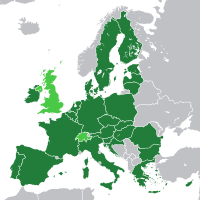
Euratom since 1 January 2021
Economic and Monetary Union
Eurozone members
Austria
Belgium
Croatia
Cyprus
Estonia
Finland
France
Germany
Greece
Ireland
Italy
Latvia
Lithuania
Luxembourg
Malta
Netherlands
Portugal
Slovakia
Slovenia
Spain
Eurogroup
President
Paschal Donohoe
Other currencies in use
Bulgarian lev
Czech koruna
Danish krone
Hungarian forint
Polish złoty
Romanian leu
Swedish krona
ERM II
Enlargement of the eurozone
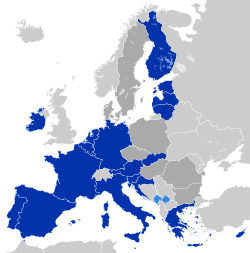
Non Euro countries relationship to Euro
Bulgaria
Czechia
Denmark
Hungary
Poland
Sweden
Romania
Eurozone since 2015
Schengen Area
Austria
Belgium
Bulgaria
Croatia
Czech Republic
Denmark
Estonia
Finland
France
Germany
Greece
Hungary
Italy
Latvia
Lithuania
Luxembourg
Malta
Netherlands
Poland
Portugal
Romania
Slovakia
Slovenia
Spain
Sweden
Non-EU members
Iceland
Liechtenstein
Norway
Switzerland
Prüm Convention
Schengen Information System
Visa Information System
Visa policy of the Schengen Area
Non-Schengen area EU member states
Cyprus
Ireland (Opt-out)
Schengen Area from January 2023
European Economic Area
EEA members
Austria
Belgium
Bulgaria
Croatia
Cyprus
Czech Republic
Denmark
Estonia
Finland
France
Germany
Greece
Hungary
Ireland
Italy
Latvia
Lithuania
Luxembourg
Malta
Netherlands
Poland
Portugal
Romania
Slovakia
Slovenia
Spain
Sweden
Non-EU members
Iceland
Liechtenstein
Norway
Topics
EEA Joint Committee
EEA National Identity cards
Microstates and the European Union
European Economic Area
Elections
Elections to the European Parliament
European parties
European foundations
Political groups of the European Parliament
Spitzenkandidat
Constituencies
Apportionment
Referendums related to the EU
European elections
1979
1984
1989
1994
1999
2004
2009
2014
2019
2024 (latest election)
Elections in EU member states
Austria
Belgium
Bulgaria
Croatia
Cyprus
Czech Republic
Denmark
Estonia
Finland
France
Germany
Greece
Hungary
Ireland
Italy
Latvia
Lithuania
Luxembourg
Malta
Netherlands
Poland
Portugal
Romania
Slovakia
Slovenia
Spain
Sweden
Law
Acquis
Primacy (ECJ Case 6/64)
Subsidiarity
Regulation
Directive
Decision
Recommendation
Fundamental Rights
Policies and issues
Budget
Customs Union
Free Trade Agreements
European Single Market
Area of FS&J
Policies
Agricultural
Energy
Fisheries
Regional
Citizenship
Passports of the European Union
Identity
Pro-Europeanism
Euroscepticism
European banking union
European Banking Supervision
Single Resolution Mechanism
Capital Markets Union
European System of Financial Supervision
Institutional seats of the European Union
Integration
Supranationalism
European Federation
Multi-speed Europe
Enhanced cooperation
Foreign relations
High Representative
Kaja Kallas
Ext. Action Service
Foreign Policy
Defence Policy
Foreign relations of EU member states
Austria
Belgium
Bulgaria
Croatia
Cyprus
Czech Republic
Denmark
Estonia
Finland
France
Germany
Greece
Hungary
Ireland
Italy
Latvia
Lithuania
Luxembourg
Malta
Netherlands
Poland
Portugal
Romania
Slovakia
Slovenia
Spain
Sweden
Argentina–European Union relations
Armenia–European Union relations
Australia–European Union relations
Brazil–European Union relations
Canada–European Union relations
China–European Union relations
European Union–NATO relations
Georgia–European Union relations
Iceland–European Union relations
Kazakhstan–European Union relations
Japan–European Union relations
Mexico–European Union relations
Moldova–European Union relations
Norway–European Union relations
Russia–European Union relations
Switzerland–European Union relations
Turkey–European Union relations
Ukraine–European Union relations
United Kingdom–European Union relations (History)
Post-Brexit United Kingdom relations with the European Union
Brexit
United States–European Union relations
Common Travel Area (Ireland)
Microstates and the European Union
European Union and the United Nations
European Union Association Agreement
European Neighbourhood Policy
Eastern Partnership
Euronest Parliamentary Assembly
G7
G20
Defunct bodies
European Communities (1958–1993)
European Coal and Steel Community
European Economic Community
European Community
Western European Union
Convention on the Future of Europe
European Union portal
Other countries
v
t
e
The Directorate-General for Energy (DG Ener), or ENER, is a Directorate-General of the European Commission, created on 17 February 2010 when it was separated from the Transport DG,[1] with which it had been combined since 2000.
Mission
[edit]
The Directorate-General for Energy is responsible for promoting and regulating the European Energy Union and, since 2019, overseeing the implementation of the Clean Energy for all Europeans package as part of the European Green New Deal.
Resources
[edit]
The Directorate-General for Energy, based primarily in Brussels, reports to Kadri Simson, European Commissioner for Energy. The former Commissioner for Energy and Climate was Miguel Arias Cañete. The current Director-General is Ditte Juul-Jorgensen, former Director-Generals include Dominique Ristori and Phillip Lowe.
Structure
[edit]
The Directorate-General is made up of 6 Directorates (two of which deal with EURATOM issues), and the Euratom Supply Agency.