Categories
Duke of Cornwall
 From Wikipedia - Reading time: 18 min
| Dukedom of Cornwall | |
|---|---|
 | |
| Creation date |
|
| Created by |
|
| Peerage | Peerage of England |
| First holder | Edward of Woodstock |
| Present holder | William, Prince of Wales |
| Extinction date |
|
| Former seat(s) | Restormel Castle |
| Motto | Middle Low German: Houmout, lit. 'High-spirited' |
Duke of Cornwall (Cornish: Duk a Gernow)[1] is a title in the Peerage of England, traditionally held by the eldest son of the reigning British monarch, previously the English monarch. The Duchy of Cornwall was the first duchy created in England and was established in a royal charter in 1337 by King Edward III.[2] In 2022, Prince William became Duke of Cornwall with the accession to the throne of his father, King Charles III; William's wife, Catherine, became Duchess of Cornwall.
Legend
[edit]Some folk histories of the British Isles, such as Geoffrey of Monmouth's History of the Kings of Britain (1136), claim that the first leader of Cornwall was Corineus, a Trojan warrior and ally of Brutus of Troy, portrayed as the original settler of the British Isles. From then through the Arthurian period, such legendary dukes of Cornwall stood apart from the high king of Britain, while serving as his closest ally and, at times, as his protector (all per Monmouth's collected yarns). Notably in this tale, Gorlois, duke of Cornwall under King Uther Pendragon, rebelled when the king became obsessed with Gorlois' wife Igraine. Uther killed Gorlois and took Igraine: the son was King Arthur.[3]
History
[edit]| History of Cornwall |
|---|
  |
 Cornwall portal Cornwall portal |
The historical record suggests that, following the Anglo-Saxon settlement of Britain, Cornwall formed part of a separate Kingdom of Dumnonia, which included Devon, although there is evidence that it may have had its own rulers at times. The Celtic southwest of Britain was gradually conquered by the emerging Germanic Kingdom of England, and after the Norman Conquest in 1066, the new rulers of England appointed their own men as earl of Cornwall, the first of whom was in fact a Breton of Cornouaille in Brittany.
Edward of Woodstock (widely known as 'The Black Prince'), the eldest son of Edward III, was made the first duke of Cornwall in 1337, after Edward III claimed the title of King of France.[4] Cornwall was the first dukedom conferred within the Kingdom of England.[5]
Succession
[edit]
The charter that established the estate on 17 March 1337 set out the rule that the duke and possessor of the estate would be the eldest son and heir apparent of the monarch.[2] There were some deviations from this rule until a legal case (the Prince's Case) in 1606, which held that the rule should be adhered to.[6]
When the estate is without a duke, the possessor is the monarch, even if the former duke left surviving descendants.[2] The monarch's grandson, even if he is the heir apparent, does not succeed to the dukedom. Similarly, no female may ever be duke of Cornwall, even if she is heir presumptive or heir apparent (this becoming a possibility after the passage of the Succession to the Crown Act 2013), although a queen regnant without a son would be the de facto duke.[7]
It is possible for an individual to be Prince of Wales and heir apparent without being Duke of Cornwall. The title 'Prince of Wales' is the traditional title of the heir apparent to the throne, granted at the discretion of the sovereign (not automatically) and is not restricted to the eldest son.
For example, after the death of Frederick, Prince of Wales, George II's heir apparent was his grandson George (Frederick's eldest son and the future George III). The young Prince George was created Prince of Wales but did not become Duke of Cornwall because he was the king's grandson, rather than his son. When the sovereign has no legitimate son, or when the heir apparent is not the sovereign's son, the estates of the duchy revert to the Crown until a legitimate son is born or until the accession of a new monarch who has a son.
James Francis Edward Stuart, son of James II, was born Duke of Cornwall in 1688. Although his father lost the throne, James Francis Edward was not deprived of his own titles and honours as a result of his father's deposition. Instead, from the (prevailing) Hanoverian perspective, it was as a result of his claiming his father's lost thrones that James was attainted for treason on 2 March 1702, and his titles were thus forfeited under English law.[5] However, from the (minority) Jacobite perspective, on his father's death in 1701 the duchy was merged with the Crown.
Rights of the duke
[edit]The duchy includes over 220 square miles (570 square kilometres) of land, more than half of which lies in Devon. The duke has the right to the estates of all those who die without named heirs (bona vacantia) in Cornwall, and also appoints the High Sheriff of Cornwall; in most of England and Wales the Crown has these rights, the other exception being the Duchy of Lancaster, a private estate held in trust for the sovereign. The duke having these rights has contributed to the debate over the constitutional status of Cornwall.
In 2013, the duchy had a revenue surplus of £19 million, a sum that was exempt from income tax, though Prince Charles, the duke, chose to pay the tax voluntarily.[8][9] Until 2011, if there was no Duke of Cornwall the income of the duchy went to the Crown. Under the Sovereign Grant Act 2011, revenues of the duchy now pass to the heir to the throne regardless of whether or not they are Duke of Cornwall. When the heir is a minor, 10% of revenues pass to them, with the balance passing to the Crown; the Sovereign Grant is reduced by the same amount.[10]
Arms
[edit]
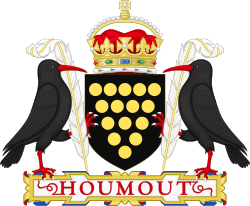
The coat of arms of the duke of Cornwall is blazoned as sable, fifteen bezants, that is, a black field bearing fifteen golden discs. The arms are now used as a badge by the prince of Wales, and they appear below the shield in his coat of arms, along with his other badges.
The arms were adopted late in the 15th century, based on the arms of Richard, Earl of Cornwall. The bezants in Richard's arms were intended to represent peas, known in French as pois, as a punning reference to the French region of Poitou, of which he was count.[11]
On 21 June 1968 a royal warrant augmented the aforementioned arms with the heir apparent's coronet, which consists of four crosses patée and four fleurs-de-lises with one arch (used only by the prince of Wales). The supporters are two Cornish choughs, each supporting an ostrich feather. The motto used with the arms is Middle Low German: Houmout, meaning "high-spirited" in Middle Low German,[12] the personal motto of the Black Prince.[13]
|
|
Dukes of Cornwall, 1337 creation
[edit]All dukes of Cornwall who have been the eldest living son of the sovereign are generally considered to have held the same creation of the dukedom. The following is a table of these dukes of Cornwall, with the processes by which they became duke and by which they ceased to hold the title:
| Duke of Cornwall | Monarch | From | To | Other title held while Duke |
|---|---|---|---|---|
| Edward of Woodstock | Edward III | 1337 (Parliament) |
1376 (death) |
Prince of Wales (1343), Prince of Aquitaine (1362–1372), Earl of Chester (1333) |
| Henry of Monmouth | Henry IV | 1399 (Parliament) |
1413 (acceded as Henry V) |
Prince of Wales and Earl of Chester (1399), Duke of Aquitaine (1390), Duke of Lancaster (1399) |
| Henry of Windsor | Henry V | 1421 (birth) |
1422 (acceded as Henry VI) |
Duke of Aquitaine (1421) |
| Edward of Westminster | Henry VI | 1454 (charter) |
1471 (death) |
Prince of Wales and Earl of Chester (1454) |
| Edward of York | Edward IV | 1471 (charter) |
1483 (acceded as Edward V) |
Prince of Wales and Earl of Chester (1471), Earl of March (1479), Earl of Pembroke (1479) |
| Edward of Middleham | Richard III | 1483 (father's accession) |
1484 (death) |
Prince of Wales and Earl of Chester (1483), Earl of Salisbury (1478) |
| Arthur Tudor | Henry VII | 1486 (birth) |
1502 (death) |
Prince of Wales and Earl of Chester (1489) |
| Henry Tudor | 1502 (death of older brother) |
1509 (acceded as Henry VIII) |
Prince of Wales and Earl of Chester (1504), Duke of York (1494) | |
| Henry Tudor | Henry VIII | 1511 (birth) |
1511 (death) |
|
| Edward Tudor | 1537 (birth) |
1547 (acceded as Edward VI) |
Prince of Wales and Earl of Chester (1537) | |
| Henry Frederick Stuart | James VI and I | 1603 (father's accession) |
1612 (death) |
Prince of Wales and Earl of Chester (1610), Duke of Rothesay, Earl of Carrick and Baron of Renfrew (1469), Lord of the Isles (1540), Prince and Great Steward of Scotland (1469) The italicised henceforth "Duke of Rothesay, etc (1469 & 1540)" |
| Charles Stuart | 1612 (death of older brother) |
1625 (acceded as Charles I) |
Prince of Wales and Earl of Chester (1616), Duke of Rothesay, etc. (1469 & 1540), Duke of Albany (1600), Duke of York (1605), Marquess of Ormond, Earl of Ross, Lord Ardmannoch (1600) | |
| Charles James Stuart | Charles I | 1629 (birth) |
1629 (death) |
Duke of Rothesay, etc. (1469 & 1540) |
| Charles Stuart | 1630 (birth) |
1649 (acceded as Charles II) |
Prince of Wales and Earl of Chester (1638), Duke of Rothesay, etc. (1469 & 1540) | |
| James Francis Edward Stuart ("The Old Pretender") |
James II | 1688 (birth) |
1702 (attainted) |
Prince of Wales and Earl of Chester (1688–1702), Duke of Rothesay, etc. (1469–1702 & 1540–1702) |
| George Augustus | George I | 1714 (father's accession) |
1727 (acceded as George II) |
Prince of Wales and Earl of Chester (1714), Hereditary Elector of Hanover, Duke of Rothesay, etc. (1469 & 1540), Duke of Cambridge, Marquess of Cambridge, Earl of Milford Haven, Viscount Northallerton, Baron Tewkesbury (1706) |
| Frederick Louis | George II | 1727 (father's accession) |
1751 (death) |
Prince of Wales and Earl of Chester (1729), Duke of Rothesay, etc. (1469 & 1540), Duke of Edinburgh, Marquess of Ely, Earl of Eltham, Viscount Launceston, Baron Snowdon (1726) |
| George Augustus Frederick | George III | 1762 (birth) |
1820 (acceded as George IV) |
Prince of Wales and Earl of Chester (1762), Duke of Rothesay, etc. (1469 & 1540) |
| Albert Edward | Victoria | 1841 (birth) |
1901 (acceded as Edward VII) |
Prince of Wales and Earl of Chester (1841), Duke of Rothesay, etc. (1469 & 1540), Earl of Dublin (1850) |
| George Frederick Ernest Albert | Edward VII | 1901 (father's accession) |
1910 (acceded as George V) |
Prince of Wales and Earl of Chester (1901), Duke of Rothesay, etc. (1469 & 1540), Duke of York, Earl of Inverness, Baron Killarney (1892) |
| Edward Albert Christian George Andrew Patrick David | George V | 1910 (father's accession) |
1936 (acceded as Edward VIII) |
Prince of Wales and Earl of Chester (1910), Duke of Rothesay, etc. (1469 & 1540) |
| Charles Philip Arthur George | Elizabeth II | 1952 (mother's accession) |
2022 (acceded as Charles III) |
Prince of Wales and Earl of Chester (1958), Duke of Rothesay, etc. (1469 & 1540), Duke of Edinburgh, Earl of Merioneth and Baron Greenwich (1947) |
| William Arthur Philip Louis | Charles III | 2022 (father's accession) |
Incumbent | Prince of Wales and Earl of Chester (2022), Duke of Rothesay, etc. (1469 & 1540), Duke of Cambridge, Earl of Strathearn, Baron Carrickfergus (2011) |
Dukes of Cornwall, 1376 creation
[edit]When his heir apparent, Edward the Black Prince, predeceased him, Edward III granted a new creation of the title 'duke of Cornwall' to his grandson, Richard. When he acceded to the throne as Richard II in 1377, this creation merged with the Crown.
- Richard of Bordeaux (1367–1400)
- also Prince of Wales and Earl of Chester (1376)
Dukes of Cornwall, 1460 creation
[edit]When Richard Plantagenet, Duke of York, pressed his claim to the throne, he was made heir apparent to Henry VI by the Act of Accord. On 31 October 1460, he was made prince of Wales and earl of Chester, duke of Cornwall and Lord Protector of England. Since he was not the eldest living son of the monarch, this creation was outside the terms of the 1337 warrant; York died in battle two months later, on 30 December 1460.
- Richard Plantagenet (1411–1460)
- also Lord Protector of England, Prince of Wales and Earl of Chester (1460, see Act of Accord); Duke of York (1385), Earl of Ulster (1264), Earl of March (1328), Earl of Cambridge (1414, restored 1426), feudal Lord of Clare (bt. 1066–1075), Baron Mortimer of Wigmore (1331)
Jacobite duke
[edit]Charles Edward Stuart ('The Young Pretender'), eldest son and heir apparent of James Francis Edward Stuart ('The Old Pretender'), was born in Rome on 31 December 1720, and shortly after his birth, he was declared prince of Wales, duke of Cornwall and earl of Chester in the Jacobite succession. With the death of the Old Pretender on 1 January 1766, he acceded to his father's claim to be King of England, Scotland, France, and Ireland. He died on 31 January 1788.[17]
Family tree
[edit]| Family tree of the Princes of Wales, Dukes of Cornwall, Dukes of Rothesay, Earls of Carrick and Earls of Chester | |||||||||||||||||||||||||||||||||||||||||||||||||||||||||||||||||||||||||||||||||||||||||||||||||||||||||||||||||||||||||||||||||||||||||||||||||||||||||||||||||||||||||||||||||||||||||||||||||||||||||||||||||||||||||||||||||||||||||||||||||||||||||||||||||||||||||||||||||||||||||||||||||||||||||||||||||||||||||||||||||||||||||||||||||||||||||||||||||||||||||||||||||||||||||||||||||||||||||||||||||||||||||||||||||||||||||||||||||||||||||||||||||||||||||||||||||||||||||||||||||||||||||||||||||||||||||||||||||||||||||||||||||||||||||||||||||||||||||||||||||||||||||||||||||||||||||||||||||||||||||||||||||||||||||||||||||||||||||||||||||||||||||||||||||||||||||||||||||||||||||||||||||||||||||||||||||||||||||||||||||||||||||||||||||||||||||||||||||||||||||||||||||||||||||||||||||||||||||||||||||||||||||||||||||||||||||||||||||||||||||||||||||||||||||||||||||||||||||||||||||||||||||||||||||||||||||||||||||||||||||||||||||||||||||||||||||||||||||||||||||||||||||||||||||||||||||||||||||||||||
|---|---|---|---|---|---|---|---|---|---|---|---|---|---|---|---|---|---|---|---|---|---|---|---|---|---|---|---|---|---|---|---|---|---|---|---|---|---|---|---|---|---|---|---|---|---|---|---|---|---|---|---|---|---|---|---|---|---|---|---|---|---|---|---|---|---|---|---|---|---|---|---|---|---|---|---|---|---|---|---|---|---|---|---|---|---|---|---|---|---|---|---|---|---|---|---|---|---|---|---|---|---|---|---|---|---|---|---|---|---|---|---|---|---|---|---|---|---|---|---|---|---|---|---|---|---|---|---|---|---|---|---|---|---|---|---|---|---|---|---|---|---|---|---|---|---|---|---|---|---|---|---|---|---|---|---|---|---|---|---|---|---|---|---|---|---|---|---|---|---|---|---|---|---|---|---|---|---|---|---|---|---|---|---|---|---|---|---|---|---|---|---|---|---|---|---|---|---|---|---|---|---|---|---|---|---|---|---|---|---|---|---|---|---|---|---|---|---|---|---|---|---|---|---|---|---|---|---|---|---|---|---|---|---|---|---|---|---|---|---|---|---|---|---|---|---|---|---|---|---|---|---|---|---|---|---|---|---|---|---|---|---|---|---|---|---|---|---|---|---|---|---|---|---|---|---|---|---|---|---|---|---|---|---|---|---|---|---|---|---|---|---|---|---|---|---|---|---|---|---|---|---|---|---|---|---|---|---|---|---|---|---|---|---|---|---|---|---|---|---|---|---|---|---|---|---|---|---|---|---|---|---|---|---|---|---|---|---|---|---|---|---|---|---|---|---|---|---|---|---|---|---|---|---|---|---|---|---|---|---|---|---|---|---|---|---|---|---|---|---|---|---|---|---|---|---|---|---|---|---|---|---|---|---|---|---|---|---|---|---|---|---|---|---|---|---|---|---|---|---|---|---|---|---|---|---|---|---|---|---|---|---|---|---|---|---|---|---|---|---|---|---|---|---|---|---|---|---|---|---|---|---|---|---|---|---|---|---|---|---|---|---|---|---|---|---|---|---|---|---|---|---|---|---|---|---|---|---|---|---|---|---|---|---|---|---|---|---|---|---|---|---|---|---|---|---|---|---|---|---|---|---|---|---|---|---|---|---|---|---|---|---|---|---|---|---|---|---|---|---|---|---|---|---|---|---|---|---|---|---|---|---|---|---|---|---|---|---|---|---|---|---|---|---|---|---|---|---|---|---|---|---|---|---|---|---|---|---|---|---|---|---|---|---|---|---|---|---|---|---|---|---|---|---|---|---|---|---|---|---|---|---|---|---|---|---|---|---|---|---|---|---|---|---|---|---|---|---|---|---|---|---|---|---|---|---|---|---|---|---|---|---|---|---|---|---|---|---|---|---|---|---|---|---|---|---|---|---|---|---|---|---|---|---|---|---|---|---|---|---|---|---|---|---|---|---|---|---|---|---|---|---|---|---|---|---|---|---|---|---|---|---|---|---|---|---|---|---|---|---|---|---|---|---|---|---|---|---|---|---|---|---|---|---|---|---|---|---|---|---|---|---|---|---|---|---|---|---|---|---|---|---|---|---|---|---|---|---|---|---|---|---|---|---|---|---|---|---|---|---|---|---|---|---|---|---|---|---|---|---|---|---|---|---|---|---|---|---|---|---|---|---|---|---|---|---|---|---|---|---|---|---|---|---|---|---|---|---|---|---|---|---|---|---|---|---|---|---|---|---|---|---|---|---|---|---|---|---|---|---|---|---|---|---|---|---|---|---|---|---|---|---|---|---|---|---|---|---|---|---|---|---|---|---|---|---|---|---|---|---|---|---|---|---|---|---|---|---|---|---|---|---|---|---|---|---|---|---|---|---|---|---|---|---|---|---|---|---|---|---|---|---|---|---|---|---|---|---|---|---|---|---|---|---|---|---|---|---|---|---|---|---|---|---|---|---|---|---|---|---|---|---|---|---|---|---|---|---|---|---|---|---|---|---|---|---|---|---|---|---|---|---|---|---|---|---|---|---|---|---|---|---|---|---|---|---|---|---|---|---|---|---|---|---|---|---|---|---|---|---|---|---|---|---|---|---|---|---|---|---|---|---|---|---|---|---|---|---|---|---|---|---|---|---|---|---|---|---|---|---|---|---|---|---|---|---|---|---|---|---|---|---|---|---|---|---|---|---|---|---|---|---|---|---|---|---|---|---|---|---|---|---|---|---|---|---|---|---|---|---|---|---|---|---|---|---|---|---|---|---|---|---|---|---|---|---|---|---|---|---|---|---|---|---|---|---|---|---|---|---|
| |||||||||||||||||||||||||||||||||||||||||||||||||||||||||||||||||||||||||||||||||||||||||||||||||||||||||||||||||||||||||||||||||||||||||||||||||||||||||||||||||||||||||||||||||||||||||||||||||||||||||||||||||||||||||||||||||||||||||||||||||||||||||||||||||||||||||||||||||||||||||||||||||||||||||||||||||||||||||||||||||||||||||||||||||||||||||||||||||||||||||||||||||||||||||||||||||||||||||||||||||||||||||||||||||||||||||||||||||||||||||||||||||||||||||||||||||||||||||||||||||||||||||||||||||||||||||||||||||||||||||||||||||||||||||||||||||||||||||||||||||||||||||||||||||||||||||||||||||||||||||||||||||||||||||||||||||||||||||||||||||||||||||||||||||||||||||||||||||||||||||||||||||||||||||||||||||||||||||||||||||||||||||||||||||||||||||||||||||||||||||||||||||||||||||||||||||||||||||||||||||||||||||||||||||||||||||||||||||||||||||||||||||||||||||||||||||||||||||||||||||||||||||||||||||||||||||||||||||||||||||||||||||||||||||||||||||||||||||||||||||||||||||||||||||||||||||||||||||||||||
See also
[edit]- Cornish Foreshore Case (19th century arbitration about the ownership of minerals and mines under the foreshore of Cornwall)
- Duchy Originals (the duchy's organic produce brand)
- Duke of Rothesay
- Outline of Cornwall
Notes
[edit]- ^ "The Duchy of Cornwall is established". cornwallforever.co.uk.
- ^ a b c "A Charter of 1337". at legislation.co.uk
- ^ Lopez, Teresa Uther and Igraine – The Camelot Project 2002. University of Rochester. Retrieved 23 May 2023.
- ^ Blackstone, William (1765-1769) Commentaries on the Laws of England, book 1 chapter 12
- ^ a b Complete Peerage: 'Duke of Cornwall'
- ^ 77 ER 481, 8 Coke Report 1a, [1606] EWHC Ch J6
- ^ "Succession to the Crown Act 2013".
- ^ Booth, Robert (15 July 2013). "Prince Charles accused of 'dodging around for tax purposes'". The Guardian. London.
- ^ Thomson, Ainsley (15 July 2013). "U.K. Lawmakers Go After Tax Affairs of the Royal Family". The Wall Street Journal.
- ^ "Sovereign Grant Act 2011: guidance". GOV.UK. 5 November 2019.
- ^ Planché, James (1859). The Pursuivant of Arms; or, Heraldry Founded on Facts. R. Hardwick. p. 136.
- ^ a b LANGENFELT, G. (1950). ICH DIEN, 69(Jahresband), 264-265. https://doi.org/10.1515/angl.1950.1950.69.264
- ^ a b c Briggs, Geoffrey, Civic and Corporate Heraldry (1971), p. 122.
- ^ Boutell, Charles; Brooke-Little, John Philip (1978). Boutell's Heraldry. F. Warne. p. 219. ISBN 978-0-7232-2096-1.
- ^ Royal Institution of Cornwall (1915). Journal of the Royal Institution of Cornwall. Workers of Cornwall Limited. p. 115.
- ^ Fox-Davies, Arthur Charles (1909). A Complete Guide to Heraldry. London: T.C. & E.C. Jack. p. 248. Retrieved 22 February 2023 – via Internet Archive.
- ^ Melville Amadeus Henry Douglas Heddle de La Caillemotte de Massue de Ruvigny, Marquis of Ruvigny and Raineval (1904). The Jacobite peerage, baronetage, knightage and grants of honour. Edinburgh: T.C. and E.C. Jack. p. 31.
External links
[edit]
- Duchy of Cornwall website – Duke of Cornwall
- The Prince of Wales's website – Duchy of Cornwall
- Guardian Unlimited article
- Celtic Frontier or County Boundary? Competing discourses of a late nineteenth century British border link dead
- The charter of 1337
|  | |
Cornwall Portal | ||
Extant dukedoms in the peerages of Britain and Ireland | ||
|---|---|---|
| Royal dukedoms |
|  |
England  |
| |
Scotland  |
| |
Great Britain  |
| |
Ireland  |
| |
United Kingdom  |
| |
Italics: This title is held by a peer who holds another of higher precedence. | ||
Original source: https://en.wikipedia.org/wiki/Duke of Cornwall
Status: article is cached
 EncycloReader
is supported by the
EncycloReader
is supported by the  KSF
KSF