E2F4
 From Wikipedia - Reading time: 11 min
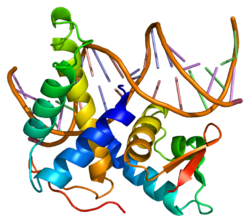


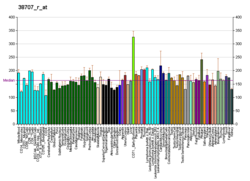
Transcription factor E2F4 is a protein that in humans is encoded by the E2F4 gene.[5][6]
Function
[edit]The protein encoded by this gene is a member of the E2F family of transcription factors. The E2F family plays a crucial role in the control of cell cycle and action of tumor suppressor proteins and is also a target of the transforming proteins of small DNA tumor viruses. This protein binds to all three of the tumor suppressor proteins pRB, p107 and p130, but with higher affinity to the last two. It plays an important role in the suppression of proliferation-associated genes, and its gene mutation and increased expression may be associated with human cancer.[7]
Structure
[edit]The E2F proteins contain several evolutionally conserved domains found in most members of the family. These domains include a DNA binding domain, a dimerization domain which determines interaction with the differentiation regulated transcription factor proteins (DP), a transactivation domain enriched in acidic amino acids (Asp + Glu), and a tumor suppressor protein association domain which is embedded within the transactivation domain.
Interactions
[edit]E2F4 has been shown to interact with Smad3.[8]
See also
[edit]- E2F
References
[edit]- ^ a b c GRCh38: Ensembl release 89: ENSG00000205250 – Ensembl, May 2017
- ^ a b c GRCm38: Ensembl release 89: ENSMUSG00000014859 – Ensembl, May 2017
- ^ "Human PubMed Reference:". National Center for Biotechnology Information, U.S. National Library of Medicine.
- ^ "Mouse PubMed Reference:". National Center for Biotechnology Information, U.S. National Library of Medicine.
- ^ Ginsberg D, Vairo G, Chittenden T, Xiao ZX, Xu G, Wydner KL, DeCaprio JA, Lawrence JB, Livingston DM (Dec 1994). "E2F-4, a new member of the E2F transcription factor family, interacts with p107". Genes Dev. 8 (22): 2665–79. doi:10.1101/gad.8.22.2665. PMID 7958924.
- ^ Sardet C, Vidal M, Cobrinik D, Geng Y, Onufryk C, Chen A, Weinberg RA (Apr 1995). "E2F-4 and E2F-5, two members of the E2F family, are expressed in the early phases of the cell cycle". Proc Natl Acad Sci U S A. 92 (6): 2403–7. Bibcode:1995PNAS...92.2403S. doi:10.1073/pnas.92.6.2403. PMC 42492. PMID 7892279.
- ^ "Entrez Gene: E2F4 E2F transcription factor 4, p107/p130-binding".
- ^ Chen CR, Kang Y, Siegel PM, Massagué J (July 2002). "E2F4/5 and p107 as Smad cofactors linking the TGFbeta receptor to c-myc repression". Cell. 110 (1): 19–32. doi:10.1016/S0092-8674(02)00801-2. PMID 12150994. S2CID 8945574.
Further reading
[edit]- Bandyopadhyay D, Timchenko N, Suwa T, et al. (2001). "The human melanocyte: a model system to study the complexity of cellular aging and transformation in non-fibroblastic cells". Exp. Gerontol. 36 (8): 1265–75. doi:10.1016/S0531-5565(01)00098-5. PMID 11602203. S2CID 26041753.
- Beijersbergen RL, Kerkhoven RM, Zhu L, et al. (1994). "E2F-4, a new member of the E2F gene family, has oncogenic activity and associates with p107 in vivo". Genes Dev. 8 (22): 2680–90. doi:10.1101/gad.8.22.2680. PMID 7958925.
- Xiao ZX, Ginsberg D, Ewen M, Livingston DM (1996). "Regulation of the retinoblastoma protein-related protein p107 by G1 cyclin-associated kinases". Proc. Natl. Acad. Sci. U.S.A. 93 (10): 4633–7. Bibcode:1996PNAS...93.4633X. doi:10.1073/pnas.93.10.4633. PMC 39330. PMID 8643455.
- Moberg K, Starz MA, Lees JA (1996). "E2F-4 switches from p130 to p107 and pRB in response to cell cycle reentry". Mol. Cell. Biol. 16 (4): 1436–49. doi:10.1128/mcb.16.4.1436. PMC 231128. PMID 8657117.
- Vidal M, Brachmann RK, Fattaey A, et al. (1996). "Reverse two-hybrid and one-hybrid systems to detect dissociation of protein-protein and DNA-protein interactions". Proc. Natl. Acad. Sci. U.S.A. 93 (19): 10315–20. Bibcode:1996PNAS...9310315V. doi:10.1073/pnas.93.19.10315. PMC 38381. PMID 8816797.
- Williams CD, Linch DC, Sørensen TS, et al. (1997). "The predominant E2F complex in human primary haemopoietic cells and in AML blasts contains E2F-4, DP-1 and p130". Br. J. Haematol. 96 (4): 688–96. doi:10.1046/j.1365-2141.1997.d01-2086.x. PMID 9074408. S2CID 23265759.
- Lindeman GJ, Gaubatz S, Livingston DM, Ginsberg D (1997). "The subcellular localization of E2F-4 is cell-cycle dependent". Proc. Natl. Acad. Sci. U.S.A. 94 (10): 5095–100. Bibcode:1997PNAS...94.5095L. doi:10.1073/pnas.94.10.5095. PMC 24637. PMID 9144196.
- Wang H, Shao N, Ding QM, et al. (1997). "BRCA1 proteins are transported to the nucleus in the absence of serum and splice variants BRCA1a, BRCA1b are tyrosine phosphoproteins that associate with E2F, cyclins and cyclin dependent kinases". Oncogene. 15 (2): 143–57. doi:10.1038/sj.onc.1201252. PMID 9244350. S2CID 11930784.
- Müller H, Moroni MC, Vigo E, et al. (1997). "Induction of S-phase entry by E2F transcription factors depends on their nuclear localization". Mol. Cell. Biol. 17 (9): 5508–20. doi:10.1128/mcb.17.9.5508. PMC 232399. PMID 9271426.
- Pierce AM, Schneider-Broussard R, Philhower JL, Johnson DG (1998). "Differential activities of E2F family members: unique functions in regulating transcription". Mol. Carcinog. 22 (3): 190–8. doi:10.1002/(SICI)1098-2744(199807)22:3<190::AID-MC7>3.0.CO;2-P. PMID 9688145. S2CID 42749241.
- Ferreira R, Magnaghi-Jaulin L, Robin P, et al. (1998). "The three members of the pocket proteins family share the ability to repress E2F activity through recruitment of a histone deacetylase". Proc. Natl. Acad. Sci. U.S.A. 95 (18): 10493–8. Bibcode:1998PNAS...9510493F. doi:10.1073/pnas.95.18.10493. PMC 27922. PMID 9724731.
- Timchenko NA, Wilde M, Darlington GJ (1999). "C/EBPalpha regulates formation of S-phase-specific E2F-p107 complexes in livers of newborn mice". Mol. Cell. Biol. 19 (4): 2936–45. doi:10.1128/mcb.19.4.2936. PMC 84088. PMID 10082561.
- Zheng N, Fraenkel E, Pabo CO, Pavletich NP (1999). "Structural basis of DNA recognition by the heterodimeric cell cycle transcription factor E2F-DP". Genes Dev. 13 (6): 666–74. doi:10.1101/gad.13.6.666. PMC 316551. PMID 10090723.
- Furukawa Y, Iwase S, Kikuchi J, et al. (1999). "Transcriptional repression of the E2F-1 gene by interferon-alpha is mediated through induction of E2F-4/pRB and E2F-4/p130 complexes". Oncogene. 18 (11): 2003–14. doi:10.1038/sj.onc.1202500. PMID 10208422. S2CID 9069532.
- Lam EW, Glassford J, van der Sman J, et al. (1999). "Modulation of E2F activity in primary mouse B cells following stimulation via surface IgM and CD40 receptors". Eur. J. Immunol. 29 (10): 3380–9. doi:10.1002/(SICI)1521-4141(199910)29:10<3380::AID-IMMU3380>3.0.CO;2-C. PMID 10540350.
- Zhong X, Hemmi H, Koike J, et al. (2000). "Various AGC repeat numbers in the coding region of the human transcription factor gene E2F-4". Hum. Mutat. 15 (3): 296–7. doi:10.1002/(SICI)1098-1004(200003)15:3<296::AID-HUMU18>3.0.CO;2-X. PMID 10679953. S2CID 84967986.
- Takahashi Y, Rayman JB, Dynlacht BD (2000). "Analysis of promoter binding by the E2F and pRB families in vivo: distinct E2F proteins mediate activation and repression". Genes Dev. 14 (7): 804–16. doi:10.1101/gad.14.7.804. PMC 316494. PMID 10766737.
- Schwemmle S, Pfeifer GP (2000). "Genomic structure and mutation screening of the E2F4 gene in human tumors". Int. J. Cancer. 86 (5): 672–7. doi:10.1002/(SICI)1097-0215(20000601)86:5<672::AID-IJC11>3.0.CO;2-X. PMID 10797289.
External links
[edit]- E2F4+protein,+human at the U.S. National Library of Medicine Medical Subject Headings (MeSH)
- FactorBook E2F4
- PDBe-KB provides an overview of all the structure information available in the PDB for Human Transcription factor E2F4
This article incorporates text from the United States National Library of Medicine, which is in the public domain.
PDB gallery | |
|---|---|
|

 | This article on a gene on human chromosome 16 is a stub. You can help Wikipedia by expanding it. |
Original source: https://en.wikipedia.org/wiki/E2F4
Status: article is cached
 EncycloReader
is supported by the
EncycloReader
is supported by the  KSF
KSF