EEF1A2
 From Wikipedia - Reading time: 7 min
| EEF1A2 | |||||||||||||||||||||||||||||||||||||||||||||||||||
|---|---|---|---|---|---|---|---|---|---|---|---|---|---|---|---|---|---|---|---|---|---|---|---|---|---|---|---|---|---|---|---|---|---|---|---|---|---|---|---|---|---|---|---|---|---|---|---|---|---|---|---|
| |||||||||||||||||||||||||||||||||||||||||||||||||||
| Identifiers | |||||||||||||||||||||||||||||||||||||||||||||||||||
| Aliases | EEF1A2, EEF1AL, EF-1-alpha-2, EF1A, HS1, STN, STNL, EIEE33, MRD38, eukaryotic translation elongation factor 1 alpha 2, DEE33 | ||||||||||||||||||||||||||||||||||||||||||||||||||
| External IDs | OMIM: 602959 MGI: 1096317 HomoloGene: 121568 GeneCards: EEF1A2 | ||||||||||||||||||||||||||||||||||||||||||||||||||
| |||||||||||||||||||||||||||||||||||||||||||||||||||
| |||||||||||||||||||||||||||||||||||||||||||||||||||
| |||||||||||||||||||||||||||||||||||||||||||||||||||
| |||||||||||||||||||||||||||||||||||||||||||||||||||
| |||||||||||||||||||||||||||||||||||||||||||||||||||
| Wikidata | |||||||||||||||||||||||||||||||||||||||||||||||||||
| |||||||||||||||||||||||||||||||||||||||||||||||||||


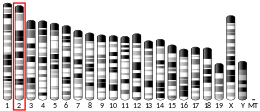


Elongation factor 1-alpha 2 is a protein that in humans is encoded by the EEF1A2 gene.[5][6][7]
Function[edit]
This gene encodes an isoform of the alpha subunit of the elongation factor-1 complex, which is responsible for the enzymatic delivery of aminoacyl tRNAs to the ribosome. This isoform (alpha 2) is expressed in brain, heart and skeletal muscle, and the other isoform (alpha 1) is expressed in brain, placenta, lung, liver, kidney, and pancreas.
Clinical significance[edit]
This gene may be critical in the development of ovarian cancer.[7]
Regulation[edit]
EEF1A2 is a direct target of miRNA-663 and miRNA-744.[8]
References[edit]
- ^ a b c GRCh38: Ensembl release 89: ENSG00000101210 - Ensembl, May 2017
- ^ a b c GRCm38: Ensembl release 89: ENSMUSG00000016349 - Ensembl, May 2017
- ^ "Human PubMed Reference:". National Center for Biotechnology Information, U.S. National Library of Medicine.
- ^ "Mouse PubMed Reference:". National Center for Biotechnology Information, U.S. National Library of Medicine.
- ^ Knudsen SM, Frydenberg J, Clark BF, Leffers H (Sep 1993). "Tissue-dependent variation in the expression of elongation factor-1 alpha isoforms: isolation and characterisation of a cDNA encoding a novel variant of human elongation-factor 1 alpha". Eur J Biochem. 215 (3): 549–54. doi:10.1111/j.1432-1033.1993.tb18064.x. PMID 8354261.
- ^ Lund A, Knudsen SM, Vissing H, Clark B, Tommerup N (Jan 1997). "Assignment of human elongation factor 1alpha genes: EEF1A maps to chromosome 6q14 and EEF1A2 to 20q13.3". Genomics. 36 (2): 359–61. doi:10.1006/geno.1996.0475. PMID 8812466.
- ^ a b "Entrez Gene: EEF1A2 eukaryotic translation elongation factor 1 alpha 2".
- ^ Vislovukh A, Kratassiouk G, Porto E, Gralievska N, Beldiman C, Pinna G, El'skaya A, Harel-Bellan A, Negrutskii B, Groisman I (11 June 2013). "Proto-oncogenic isoform A2 of eukaryotic translation elongation factor eEF1 is a target of miR-663 and miR-744". British Journal of Cancer. 108 (11): 2304–11. doi:10.1038/bjc.2013.243. PMC 3681015. PMID 23695020.
Further reading[edit]
- Lee JM (2004). "The role of protein elongation factor eEF1A2 in ovarian cancer". Reprod. Biol. Endocrinol. 1: 69. doi:10.1186/1477-7827-1-69. PMC 239897. PMID 14588074.
- Beh KJ (1976). "Immunoglobulin class specificity of non-agglutinating antibody produced in cattle following Brucella abortus 45/20 vaccination". Aust. Vet. J. 51 (10): 481–3. doi:10.1111/j.1751-0813.1975.tb02385.x. PMID 812466.
- Lee S, Ann DK, Wang E (1994). "Cloning of human and mouse brain cDNAs coding for S1, the second member of the mammalian elongation factor-1 alpha gene family: analysis of a possible evolutionary pathway". Biochem. Biophys. Res. Commun. 203 (3): 1371–7. doi:10.1006/bbrc.1994.2336. PMID 7945283.
- Wu-Baer F, Lane WS, Gaynor RB (1996). "Identification of a group of cellular cofactors that stimulate the binding of RNA polymerase II and TRP-185 to human immunodeficiency virus 1 TAR RNA". J. Biol. Chem. 271 (8): 4201–8. doi:10.1074/jbc.271.8.4201. PMID 8626763.
- Bischoff C, Kahns S, Lund A, Jørgensen HF, Praestegaard M, Clark BF, Leffers H (2001). "The human elongation factor 1 A-2 gene (EEF1A2): complete sequence and characterization of gene structure and promoter activity". Genomics. 68 (1): 63–70. doi:10.1006/geno.2000.6271. PMID 10950927.
- McClatchy DB, Knudsen CR, Clark BF, Kahn RA, Hall RA, Levey AI (2002). "Novel interaction between the M4 muscarinic acetylcholine receptor and elongation factor 1A2". J. Biol. Chem. 277 (32): 29268–74. doi:10.1074/jbc.M203081200. PMID 12048193.
- Anand N, Murthy S, Amann G, Wernick M, Porter LA, Cukier IH, Collins C, Gray JW, Diebold J, Demetrick DJ, Lee JM (2002). "Protein elongation factor EEF1A2 is a putative oncogene in ovarian cancer". Nat. Genet. 31 (3): 301–5. doi:10.1038/ng904. PMID 12053177. S2CID 37997742.
- Bouwmeester T, Bauch A, Ruffner H, Angrand PO, Bergamini G, Croughton K, Cruciat C, Eberhard D, Gagneur J, Ghidelli S, Hopf C, Huhse B, Mangano R, Michon AM, Schirle M, Schlegl J, Schwab M, Stein MA, Bauer A, Casari G, Drewes G, Gavin AC, Jackson DB, Joberty G, Neubauer G, Rick J, Kuster B, Superti-Furga G (2004). "A physical and functional map of the human TNF-alpha/NF-kappa B signal transduction pathway". Nat. Cell Biol. 6 (2): 97–105. doi:10.1038/ncb1086. PMID 14743216. S2CID 11683986.
- Rush J, Moritz A, Lee KA, Guo A, Goss VL, Spek EJ, Zhang H, Zha XM, Polakiewicz RD, Comb MJ (2005). "Immunoaffinity profiling of tyrosine phosphorylation in cancer cells". Nat. Biotechnol. 23 (1): 94–101. doi:10.1038/nbt1046. PMID 15592455. S2CID 7200157.
- Andersen JS, Lam YW, Leung AK, Ong SE, Lyon CE, Lamond AI, Mann M (2005). "Nucleolar proteome dynamics". Nature. 433 (7021): 77–83. Bibcode:2005Natur.433...77A. doi:10.1038/nature03207. PMID 15635413. S2CID 4344740.
- Byun HM, Suh D, Jeong Y, Wee HS, Kim JM, Kim WK, Ko JJ, Kim JS, Lee YB, Oh YK (2005). "Plasmid vectors harboring cellular promoters can induce prolonged gene expression in hematopoietic and mesenchymal progenitor cells". Biochem. Biophys. Res. Commun. 332 (2): 518–23. doi:10.1016/j.bbrc.2005.04.155. PMID 15893736.
- Ahmed M, Forsberg J, Bergsten P (2005). "Protein profiling of human pancreatic islets by two-dimensional gel electrophoresis and mass spectrometry". J. Proteome Res. 4 (3): 931–40. doi:10.1021/pr050024a. PMID 15952740.
- Tomlinson VA, Newbery HJ, Wray NR, Jackson J, Larionov A, Miller WR, Dixon JM, Abbott CM (2006). "Translation elongation factor eEF1A2 is a potential oncoprotein that is overexpressed in two-thirds of breast tumours". BMC Cancer. 5: 113. doi:10.1186/1471-2407-5-113. PMC 1236916. PMID 16156888.
- Li R, Wang H, Bekele BN, Yin Z, Caraway NP, Katz RL, Stass SA, Jiang F (2006). "Identification of putative oncogenes in lung adenocarcinoma by a comprehensive functional genomic approach". Oncogene. 25 (18): 2628–35. doi:10.1038/sj.onc.1209289. PMID 16369491.
External links[edit]
- Overview of all the structural information available in the PDB for UniProt: Q05639 (Elongation factor 1-alpha 2) at the PDBe-KB.
 | This article on a gene on human chromosome 20 is a stub. You can help Wikipedia by expanding it. |
This article is licensed under CC BY-SA 3.0.
Original source: https://en.wikipedia.org/wiki/EEF1A2
Status: article is cached
Original source: https://en.wikipedia.org/wiki/EEF1A2
Status: article is cached
 EncycloReader
is supported by the
EncycloReader
is supported by the  KSF
KSF