Elections in Germany
 From Wikipedia - Reading time: 17 min
| This article is part of a series on the |
| Politics of Germany |
|---|
 |
|


Several articles in several parts of the Basic Law for the Federal Republic of Germany govern elections and establish constitutional requirements such as the secret ballot, and the requirement that all elections be conducted in a free and fair manner. The Basic Law also requires that the federal legislature enact detailed federal laws to govern elections; electoral law(s). One such article is Article 38, regarding the election of deputies in the federal Bundestag. Article 38.2 of the Basic Law establishes universal suffrage: "Any person who has attained the age of eighteen shall be entitled to vote; any person who has attained the age of majority may be elected."
German federal elections are for all members of the Bundestag, which in turn determines who is the chancellor of Germany. The most recent federal election was held on 23 February 2025.
Latest election
[edit] | ||||||||
|---|---|---|---|---|---|---|---|---|
| Party | Party-list | Constituency | Total seats | |||||
| Votes | % | Seats | Votes | % | Seats | |||
| Christian Democratic Union of Germany | 11,196,374 | 22.55 | 36 | 12,604,184 | 25.46 | 128 | 164 | |
| Alternative for Germany | 10,328,780 | 20.80 | 110 | 10,177,318 | 20.56 | 42 | 152 | |
| Social Democratic Party of Germany | 8,149,124 | 16.41 | 76 | 9,936,433 | 20.07 | 44 | 120 | |
| Alliance 90/The Greens | 5,762,380 | 11.61 | 73 | 5,443,393 | 11.00 | 12 | 85 | |
| The Left (Germany) | 4,356,532 | 8.77 | 58 | 3,933,297 | 7.95 | 6 | 64 | |
| Christian Social Union in Bavaria | 2,964,028 | 5.97 | 0 | 3,272,064 | 6.61 | 44 | 44 | |
| Sahra Wagenknecht Alliance | 2,472,947 | 4.98 | 0 | 299,401 | 0.60 | 0 | 0 | |
| Free Democratic Party (Germany) | 2,148,757 | 4.33 | 0 | 1,622,912 | 3.28 | 0 | 0 | |
| Free Voters | 769,279 | 1.55 | 0 | 1,254,565 | 2.53 | 0 | 0 | |
| Human Environment Animal Protection Party | 482,201 | 0.97 | 0 | 82,498 | 0.17 | 0 | 0 | |
| Volt Germany | 355,262 | 0.72 | 0 | 391,666 | 0.79 | 0 | 0 | |
| Die PARTEI | 242,741 | 0.49 | 0 | 122,268 | 0.25 | 0 | 0 | |
| Grassroots Democratic Party of Germany | 85,373 | 0.17 | 0 | 41,923 | 0.08 | 0 | 0 | |
| Bündnis Deutschland | 76,372 | 0.15 | 0 | 87,955 | 0.18 | 0 | 0 | |
| South Schleswig Voters' Association | 76,138 | 0.15 | 1 | 58,779 | 0.12 | 0 | 1 | |
| Ecological Democratic Party | 49,764 | 0.10 | 0 | 54,606 | 0.11 | 0 | 0 | |
| Team Todenhöfer | 24,553 | 0.05 | 0 | 9,783 | 0.02 | 0 | 0 | |
| Party of Progress (Germany) | 21,388 | 0.04 | 0 | 1,282 | 0.00 | 0 | 0 | |
| Marxist–Leninist Party of Germany | 19,551 | 0.04 | 0 | 24,218 | 0.05 | 0 | 0 | |
| Party of Humanists | 14,294 | 0.03 | 0 | 1,871 | 0.00 | 0 | 0 | |
| Pirate Party Germany | 13,800 | 0.03 | 0 | 2,151 | 0.00 | 0 | 0 | |
| Bavaria Party | 12,278 | 0.02 | 0 | 5,763 | 0.01 | 0 | 0 | |
| Alliance C – Christians for Germany | 11,768 | 0.02 | 0 | 2,021 | 0.00 | 0 | 0 | |
| MERA25 | 6,994 | 0.01 | 0 | 658 | 0.00 | 0 | 0 | |
| Values Union | 6,736 | 0.01 | 0 | 2,849 | 0.01 | 0 | 0 | |
| Human World (political party) | 694 | 0.00 | 0 | 0 | 0.00 | 0 | 0 | |
| Bürgerrechtsbewegung Solidarität | 676 | 0.00 | 0 | 1,295 | 0.00 | 0 | 0 | |
| Socialist Equality Party (Germany) | 425 | 0.00 | 0 | 73 | 0.00 | 0 | 0 | |
| Party for Rejuvenation Research | 303 | 0.00 | 0 | 0 | 0.00 | 0 | 0 | |
| Independents | 0 | 0.00 | 0 | 70,163 | 0.14 | 0 | 0 | |
| Total | 49,649,512 | 100.00 | 354 | 49,505,389 | 100.00 | 276 | 630 | |
Result in history
[edit]1919 German federal election
[edit] | ||||
|---|---|---|---|---|
| Party | Votes | % | Seats | |
| Social Democratic Party of Germany | 11,509,048 | 37.86 | 163 | |
| Centre Party (Germany) | 5,980,216 | 19.67 | 91 | |
| German Democratic Party | 5,641,825 | 18.56 | 75 | |
| German National People's Party | 3,121,479 | 10.27 | 44 | |
| Independent Social Democratic Party of Germany | 2,317,290 | 7.62 | 22 | |
| German People's Party | 1,345,638 | 4.43 | 19 | |
| Bavarian Peasants' League | 275,125 | 0.91 | 4 | |
| German-Hanoverian Party | 77,226 | 0.25 | 1 | |
| Schleswig-Holstein Farmers and Farmworkers Democracy | 57,913 | 0.19 | 1 | |
| Brunswick State Electoral Association | 56,858 | 0.19 | 1 | |
| Mecklenburg Village League | 10,891 | 0.04 | 0 | |
| German Peace Party | 3,503 | 0.01 | 0 | |
| German Officials', Employees' and Middle Class Party | 1,438 | 0.00 | 0 | |
| Christian Social Party (Germany) | 664 | 0.00 | 0 | |
| Middle Class Party | 640 | 0.00 | 0 | |
| German Social Aristocracy | 279 | 0.00 | 0 | |
| Democratic Middle Class Party | 208 | 0.00 | 0 | |
| Social Reform Party | 45 | 0.00 | 0 | |
| Total | 30,400,286 | 100.00 | 421 | |
November 1933 German parliamentary election
[edit]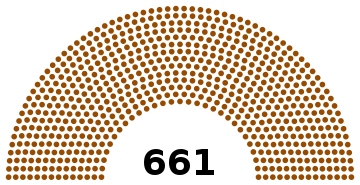 | ||||
|---|---|---|---|---|
| Party | Votes | % | Seats | |
| Nazi Party | 39,655,224 | 92.11 | 661 | |
| Against | 3,398,249 | 7.89 | 0 | |
| Total | 43,053,473 | 100.00 | 661 | |
1949 West German federal election
[edit]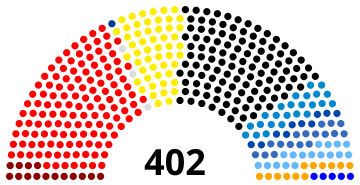 | ||||
|---|---|---|---|---|
| Party | Votes | % | Seats | |
| Social Democratic Party of Germany | 6,934,975 | 29.22 | 131 | |
| Christian Democratic Union of Germany | 5,978,636 | 25.19 | 115 | |
| Free Democratic Party (Germany) | 2,829,920 | 11.92 | 52 | |
| Christian Social Union in Bavaria | 1,380,448 | 5.82 | 24 | |
| Communist Party of Germany | 1,361,706 | 5.74 | 15 | |
| Bavaria Party | 986,478 | 4.16 | 17 | |
| German Party (1947) | 939,934 | 3.96 | 17 | |
| Centre Party (Germany, 1945) | 727,505 | 3.07 | 10 | |
| Economic Reconstruction Union | 681,888 | 2.87 | 12 | |
| Deutsche Rechtspartei | 429,031 | 1.81 | 5 | |
| Radical Social Freedom Party | 216,749 | 0.91 | 0 | |
| South Schleswig Voters' Association | 75,388 | 0.32 | 1 | |
| European People's Movement of Germany | 26,162 | 0.11 | 0 | |
| Rheinish-Westfalian People's Party | 21,931 | 0.09 | 0 | |
| Independents | 1,141,647 | 4.81 | 3 | |
| Total | 23,732,398 | 100.00 | 402 | |
1949 East German Constitutional Assembly election
[edit]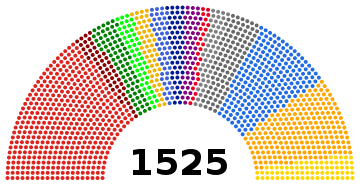 | ||||||
|---|---|---|---|---|---|---|
| Party or alliance | Votes | % | Seats | |||
| Democratic Bloc (East Germany) | Socialist Unity Party of Germany | 7,943,949 | 66.07 | 450 | ||
| Christian Democratic Union (East Germany) | 225 | |||||
| Liberal Democratic Party of Germany | 225 | |||||
| Cooperatives | 100 | |||||
| Democratic Farmers' Party of Germany | 75 | |||||
| National Democratic Party of Germany (East Germany) | 75 | |||||
| Democratic Women's League of Germany | 50 | |||||
| Free German Trade Union Federation | 50 | |||||
| Free German Youth | 50 | |||||
| Cultural Association of the GDR | 50 | |||||
| Peasants Mutual Aid Association | 50 | |||||
| Union of Persecutees of the Nazi Regime | 50 | |||||
| Social Democratic Party in the GDR | 25 | |||||
| Independents | 50 | |||||
| Against | 4,080,272 | 33.93 | 0 | |||
| Total | 12,024,221 | 100.00 | 1,525 | |||
German elections from 1871 to 1945
[edit]
After the unification of Germany under Emperor Wilhelm I in 1871, elections were held to the German Reichstag or Imperial Assembly, which supplanted its namesake, the Reichstag of the North German Confederation. The Reichstag could be dissolved by the emperor or, after the abdication of Wilhelm II in 1918, the president of Germany. With the Weimar Republic's Constitution of 1919, the voting system changed from single-member constituencies to proportional representation. The election age was reduced from 25 to 20 years of age.[1] Women's suffrage had already been established by a new electoral law in 1918 following the November Revolution of that year.
Following the Nazi seizure of power in January 1933, another national election was held on 5 March. This was the last competitive election before World War II, although it was neither free nor fair. Violence and intimidation by the Sturmabteilung, Schutzstaffel and Der Stahlhelm had been underway for months against trade-unionists, communists, social democrats, and even centre-right Catholics.[2] On 27 February, just prior to the election, the Reichstag Fire Decree suspended freedom of the press and most civil liberties. Mass arrests followed, including all Communist and several Social Democrat delegates to the Reichstag. 50000 members of the Hilfspolizei (auxiliary Nazi police) "monitored" polling places on election day to further intimidate voters.[3] While the Nazi Party performed better than it had in the elections of November 1932, it still won only 33% of the vote. By placing their rivals in jail and intimidating others not to take their seats, the Nazis went from a plurality to the majority. Just two weeks after the election, the Enabling Act of 1933 effectively gave Hitler dictatorial power. Three more elections were held in Nazi Germany before the war. They all took the form of a one-question referendum, asking voters to approve a predetermined list of candidates composed exclusively of Nazis and nominally independent "guests" of the party.
Imperial elections
[edit]- 1848
- 1871
- 1874
- 1877
- 1878
- 1881
- 1884
- 1887
- 1890
- 1893
- 1898
- 1903
- 1907
- 1912
Weimar Republic federal elections
[edit]- 1919
- 1920
- May 1924
- December 1924
- 1928
- 1930
- July 1932
- November 1932
Elections in Nazi Germany
[edit]- March 1933, federal
- November 1933, federal
- 1936, parliamentary
- 1938, parliamentary
German elections since 1949
[edit]Federal Republic of Germany
[edit]Election system
[edit]
Federal elections (Bundestagswahlen) are conducted approximately every four years, resulting from the constitutional requirement for elections to be held 46 to 48 months after the assembly of the Bundestag.[4] Elections can be held earlier in exceptional constitutional circumstances: for example, were the Chancellor to lose a vote of confidence in the Bundestag, then, during a grace period before the Bundestag can vote in a replacement Chancellor, the Chancellor could request the Federal President to dissolve the Bundestag and hold elections. Should the Bundestag be dismissed before the four-year period has ended, elections must be held within 100 days. The exact date of the election is chosen by the President[5] and must be a Sunday or public holiday.
German nationals over the age of 18 who have resided in Germany for at least three months are eligible to vote. Eligibility for candidacy is essentially the same.
The federal legislature in Germany has a one chamber parliament—the Bundestag (Federal Diet); the Bundesrat (Federal Council) represents the States (in particular the state Governments) and is not considered a chamber as its members are not elected. The Bundestag is elected using a mixed member proportional system. The Bundestag has 598 nominal members, elected for a four-year term. Half, 299 members, are elected in single-member constituencies by first-past-the-post voting, while a further 299 members are allocated from party lists to achieve a proportional distribution in the legislature, conducted according to a form of proportional representation called the Mixed member proportional representation system (MMP). Voters vote once for a constituency representative, and a second time for a party, and the lists are used to make the party balances match the distribution of second votes. Overhang seats may add to the nominal number of 598 members: for example, in the 2009 federal election there were 24 overhang seats, giving a total of 622 seats. This is caused by larger parties winning additional single-member constituencies above the totals determined by their proportional party vote.
Germany has a multi-party system with two historically strong political parties and some other third parties also represented in the Bundestag. Since 1990, and including the results of the most recent federal election in 2021, just six main political parties have managed to secure representation in the Bundestag (counting the CDU and CSU as one, and excluding recognised minority group parties such as the SSW which are exempted in federal law from the 5% threshold that is normally required to be breached in order to win party-list seats).
In 2008, some modifications to the electoral system were required under an order of the Federal Constitutional Court. The court had found that a provision in the Federal Election Law made it possible for a party to experience a negative vote weight, thus losing seats due to more votes, and found that this violated the constitutional guarantee of the electoral system being equal and direct.[6]
The court allowed three years to amend the law. Accordingly, the 2009 federal election was allowed to proceed under the previous system. The changes were due by 30 June 2011, but appropriate legislation was not completed by that deadline. A new electoral law was enacted in late 2011, but declared unconstitutional once again by the Federal Constitutional Court upon lawsuits from the opposition parties and a group of some 4,000 private citizens.[7]
Finally, four of the five factions in the Bundestag agreed on an electoral reform whereby the number of seats in the Bundestag will be increased as much as necessary to ensure that any overhang seats are compensated through apportioned leveling seats, to ensure full proportionality according to the political party's share of party votes at the national level.[8] The Bundestag approved and enacted the new electoral reform in February 2013.[9]
List of federal election results
[edit]

- 1st: 1949 West German federal election
- 2nd: 1953 West German federal election
- 3rd: 1957 West German federal election
- 4th: 1961 West German federal election
- 5th: 1965 West German federal election
- 6th: 1969 West German federal election
- 7th: 1972 West German federal election
- 8th: 1976 West German federal election
- 9th: 1980 West German federal election
- 10th: 1983 West German federal election
- 11th: 1987 West German federal election
- 12th: 1990 German federal election (1st of the re-united Germany)
- 13th: 1994 German federal election
- 14th: 1998 German federal election
- 15th: 2002 German federal election
- 16th: 2005 German federal election
- 17th: 2009 German federal election
- 18th: 2013 German federal election
- 19th: 2017 German federal election
- 20th: 2021 German federal election
- 21st: 2025 German federal election
-
 1949
1949 -
 1953
1953 -
 1957
1957 -
 1961
1961 -
 1965
1965 -
 1969
1969 -
 1972
1972 -
 1976
1976 -
 1980
1980 -
 1983
1983 -
 1987
1987 -
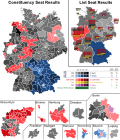 1990
1990 -
 1994
1994 -
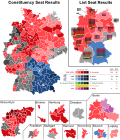 1998
1998 -
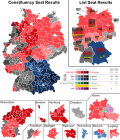 2002
2002 -
 2005
2005 -
 2009
2009 -
 2013
2013 -
 2017
2017 -
 2021
2021
European elections
[edit]Every 5 years, Germany, as a founding member of the European Union, votes to select their delegates to the European Parliament. Members of the European Parliament (MEPs) are elected through a proportional party list system, which, unlike federal elections, do not require a minimum threshold to win seats or constituency seats. The voting age is set at 16.[10]
- 1st: 1979 European Parliament election in West Germany
- 2nd: 1984 European Parliament election in West Germany
- 3rd: 1989 European Parliament election in West Germany
- 4th: 1994 European Parliament election in Germany
- 5th: 1999 European Parliament election in Germany
- 6th: 2004 European Parliament election in Germany
- 7th: 2009 European Parliament election in Germany
- 8th: 2014 European Parliament election in Germany
- 9th: 2019 European Parliament election in Germany
- 10th 2024 European Parliament election in Germany
-
 2009
2009 -
 2014
2014 -
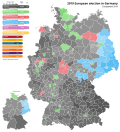 2019
2019 -
 2024
2024
Presidential elections
[edit]Germans do not directly vote for their President. Instead the President is elected every 5 years by the Federal Convention. All members of the Bundestag and an equal number of state delegates elected by the state parliaments specifically for this purpose, proportional to their population, comprise the voters of the convention.[11]
State elections in the Federal Republic of Germany
[edit]State elections are conducted under various rules set by the states. In general they are conducted according to some form of party-list proportional representation, either the same as the federal system or some simplified version. The election period is generally four to five years, and the dates of elections vary from state to state.
Baden-Württemberg state election results
[edit]- 2001 Baden-Württemberg state election
- 2006 Baden-Württemberg state election
- 2011 Baden-Württemberg state election
- 2016 Baden-Württemberg state election
- 2021 Baden-Württemberg state election
- 2026 Baden-Württemberg state election
Bavaria state election results
[edit]- 1986 Bavarian state election
- 1990 Bavarian state election
- 1994 Bavarian state election
- 1998 Bavarian state election
- 2003 Bavarian state election
- 2008 Bavarian state election
- 2013 Bavarian state election
- 2018 Bavarian state election
- 2023 Bavarian state election
- 2028 Bavarian state election
Berlin state election results
[edit]- 2001 Berlin state election
- 2006 Berlin state election
- 2011 Berlin state election
- 2016 Berlin state election
- 2021 Berlin state election
- 2023 Berlin repeat state election
- 2026 Berlin state election
Brandenburg state election results
[edit]- 1999 Brandenburg state election
- 2004 Brandenburg state election
- 2009 Brandenburg state election
- 2014 Brandenburg state election
- 2019 Brandenburg state election
- 2024 Brandenburg state election
Bremen state election results
[edit]- 2003 Bremen state election
- 2007 Bremen state election
- 2011 Bremen state election
- 2015 Bremen state election
- 2019 Bremen state election
- 2023 Bremen state election
Hamburg state election results
[edit]- 2004 Hamburg state election
- 2008 Hamburg state election
- 2011 Hamburg state election
- 2015 Hamburg state election
- 2020 Hamburg state election
- 2025 Hamburg state election
Hessian state election results
[edit]- 1999 Hessian state election
- 2003 Hessian state election
- 2008 Hessian state election
- 2009 Hessian state election
- 2013 Hessian state election
- 2018 Hessian state election
- 2023 Hessian state election
Lower Saxony state election results
[edit]- 1998 Lower Saxony state election
- 2003 Lower Saxony state election
- 2008 Lower Saxony state election
- 2013 Lower Saxony state election
- 2017 Lower Saxony state election
- 2022 Lower Saxony state election
- 2027 Lower Saxony state election
Mecklenburg-Vorpommern state election results
[edit]- 2002 Mecklenburg-Vorpommern state election
- 2006 Mecklenburg-Vorpommern state election
- 2011 Mecklenburg-Vorpommern state election
- 2016 Mecklenburg-Vorpommern state election
- 2021 Mecklenburg-Vorpommern state election
- 2026 Mecklenburg-Vorpommern state election
North Rhine-Westphalia state election results
[edit]- 2000 North Rhine-Westphalia state election
- 2005 North Rhine-Westphalia state election
- 2010 North Rhine-Westphalia state election
- 2012 North Rhine-Westphalia state election
- 2017 North Rhine-Westphalia state election
- 2022 North Rhine-Westphalia state election
- 2027 North Rhine-Westphalia state election
Rhineland-Palatinate state election results
[edit]- 2001 Rhineland-Palatinate state election
- 2006 Rhineland-Palatinate state election
- 2011 Rhineland-Palatinate state election
- 2016 Rhineland-Palatinate state election
- 2021 Rhineland-Palatinate state election
- 2026 Rhineland-Palatinate state election
Saarland state election results
[edit]- 1999 Saarland state election
- 2004 Saarland state election
- 2009 Saarland state election
- 2012 Saarland state election
- 2017 Saarland state election
- 2022 Saarland state election
- 2027 Saarland state election
Saxony state election results
[edit]- 1999 Saxony state election
- 2004 Saxony state election
- 2009 Saxony state election
- 2014 Saxony state election
- 2019 Saxony state election
- 2024 Saxony state election
Saxony-Anhalt state election results
[edit]- 2002 Saxony-Anhalt state election
- 2006 Saxony-Anhalt state election
- 2011 Saxony-Anhalt state election
- 2016 Saxony-Anhalt state election
- 2021 Saxony-Anhalt state election
- 2026 Saxony-Anhalt state election
Schleswig-Holstein state election results
[edit]- 2000 Schleswig-Holstein state election
- 2005 Schleswig-Holstein state election
- 2009 Schleswig-Holstein state election
- 2012 Schleswig-Holstein state election
- 2017 Schleswig-Holstein state election
- 2022 Schleswig-Holstein state election
- 2027 Schleswig-Holstein state election
Thuringia state election results
[edit]- 2004 Thuringian state election
- 2009 Thuringian state election
- 2014 Thuringian state election
- 2019 Thuringian state election
- 2024 Thuringian state election
German Democratic Republic
[edit]In the German Democratic Republic, elections to the Volkskammer were effectively controlled by the Socialist Unity Party of Germany (SED) and state hierarchy, even though multiple pro forma parties existed. The 18 March 1990 election were the first free ones held in the GDR, producing a government whose major mandate was to negotiate an end to itself and its state.[citation needed]
Prior to the Fall of the Berlin Wall, East Germany did not have free elections. Polling places were under surveillance by the state security apparatuses and the ruling party, the SED, presented voters with a slate of proposed candidates. Voters could optionally enter a booth to strike any candidates the voter did not want; a voter who agreed with the SED's full list simply folded the unmarked ballot in half and placed it into the ballot box. Entering a voting booth was considered suspicious and was noted by the state security apparatuses, which could lead to consequences later for the voter. East German voters commonly referred to the act of voting as "folding" (German: falten). Election outcomes prior to 1990 commonly saw 99% of voters in favor of the suggested slate of candidates. On top of this, the government engaged in electoral fraud and commonly falsified both results and voter turnout percentages, even as late as the May 1989 municipal elections.[12][13]
- 1949 East German Constitutional Assembly election
- 1950 East German general election
- 1954 East German general election
- 1958 East German general election
- 1963 East German general election
- 1967 East German general election
- 1971 East German general election
- 1976 East German general election
- 1981 East German general election
- 1986 East German general election
- 1990 East German general election
Local elections
[edit]Local elections in Germany (German: Kommunalwahlen) include elections for most regional and local subdivisions, unless their representatives are appointed or elected by another assembly or office. Such local elections are conducted for representatives in districts, cities, towns, villages and various other administrative regional organizations. In cities and towns local elections usually include voting for a lord mayor or mayor. Smaller villages and settlements may elect a representative (German: Ortsvorsteher) with limited administrative power. Local elections are also often combined with polls about important local matters and questions of general public interest (i.e. the construction of local roads or other infrastructure facilities). While such polls are not legally binding in most cases, their results have considerable influence on local political decisions.[citation needed]
After the Maastricht Treaty of 1992 to strengthen the European integration, Germany and other EU member states implemented legislative changes to grant foreigners of other EU countries the right to vote in local elections in their host country. Foreign EU citizens can vote in elections on district and municipal level in Germany, after the German states adapted their regulations between 1995 and 1998.[citation needed]
See also
[edit]- Electoral calendar
- Electoral system
- Electoral system of Germany
- Referendums in Germany
References
[edit]- ^ Peter Marschalck: Bevölkerungsgeschichte Deutschlands im 19. und 20. Jahrhundert, Frankfurt am Main 1984, S. 173.
- ^ Evans, Richard J., The Coming of the Third Reich, Penguin Press, New York, 2004.
- ^ von Götz, Irene. "Violence Unleashed". Berlin.de. Archived from the original on 18 August 2016. Retrieved 18 March 2017.
- ^ "Art. 39 Grundgesetz". Grundgesetz Bundesrepublik Deutschland. Bundesministerium der Justiz. 19 March 2009. Retrieved 5 June 2009.
- ^ "§16 Bundeswahlgesetz". Bundeswahlgesetz Bundesrepublik Deutschland. Bundesministerium der Justiz. 3 June 2008. Retrieved 5 June 2009.
- ^ "Federal Constitutional Court decision on the Federal Election Law". Bverfg.de. 3 July 2008. Retrieved 20 September 2013.
- ^ Decision of the Federal Constitutional Court. 25 July 2012. Retrieved 13 August 2012.
- ^ Bill amending the Federal Election Law. 11 December 2012. Retrieved 25 December 2012.
- ^ "Bundestag: Deutschland hat ein neues Wahlrecht". Die Zeit (in German). 22 February 2013. ISSN 0044-2070. Retrieved 26 January 2017.
- ^ "Elections to the European Parliament". Federal Ministry of the Interior and Community. Archived from the original on 22 January 2025. Retrieved 27 January 2025.
- ^ "Election of the Federal President". Der Bundespräsident. Archived from the original on 15 December 2023. Retrieved 27 January 2025.
- ^ Richter, Hedwig (February 2012). "Mass Obedience: Practices and Functions of Elections in the German Democratic Republic". In Jessen, Ralph; Richter, Hedwig (eds.). Voting for Hitler and Stalin. Elections under 20th Century Dictatorships. Frankfurt am Main: Campus Verlag. pp. 103–124. ISBN 9783593394893.
- ^ Weber, Hermann (2012). "Oldenbourg Grundriss der Geschichte". Die DDR 1945–1990 (in German). Vol. 20 (5 ed.). München: Oldenbourg. p. 32. ISBN 9783486523638.
Further reading
[edit]- Kitschelt, Herbert (October 2003). "Political-economic context and partisan strategies in the German federal elections, 1990–2002". West European Politics. 26 (4): 125–152. doi:10.1080/01402380312331280718. S2CID 154479425.
- Manow, Philip (January 2007). "Electoral rules and legislative turnover: Evidence from Germany's mixed electoral system". West European Politics. 30 (1): 195–207. doi:10.1080/01402380601019852. hdl:11858/00-001M-0000-0012-48E7-7. S2CID 59398190.
External links
[edit]- Adam Carr's Election Archive
- Parties and elections
- Opinion poll tracker with data, graph and daily average
- Latest polling results for state and federal elections (in German)
- The Federal Returning Officer. Official Site of the Federal Returning Officer.
- Collection of German Election Posters of Weimar Republic and Federal Republic
- NSD: European Election Database – Germany Archived 5 October 2017 at the Wayback Machine publishes regional level election data; allows for comparisons of election results, 1990–2009
| Parliamentary elections |
|
|---|---|
| Presidential elections |
|
| European elections |
|
| Referendums |
|
| |
 German presidential elections German presidential elections | |
|---|---|
| Weimar Republic (1919–1933) |
|
| East Germany (1949–1960) |
|
| Federal Republic of Germany (since 1949) |
|
Original source: https://en.wikipedia.org/wiki/Elections in Germany
Status: article is cached
 EncycloReader
is supported by the
EncycloReader
is supported by the  KSF
KSF