Parliamentary constituency in the United Kingdom, 1885–1974
Not to be confused with Electoral district of Epping.
Epping
Former county constituency for the House of Commons
County
Essex
1885–1974 (1974)
Seats
One
Created from
West Essex
Replaced by
Chingford, Epping Forest and Harlow
During its existence contributed to new seat(s) of
Woodford and Chigwell
Epping was a parliamentary constituency represented in the House of Commons of the UK Parliament from 1885 to 1974. It elected one Member of Parliament (MP) by the first past the post system of election.
History
[edit]
Epping was one of eight single-member divisions of Essex (later classified as county constituencies) created by the Redistribution of Seats Act 1885, replacing the three two member divisions of East, South and West Essex.
The seat underwent a significant loss of territory at the 1945 boundary review, with the majority of the electorate forming the new constituency of Woodford. It was abolished for the February 1974 general election when it was divided between the new seats of Chingford, Epping Forest and Harlow.
Its most prominent MP was Winston Churchill, who served as Prime Minister twice, the local MP for twenty-one years from 1924 to 1945, spanning the middle part of his long service as an MP. From 1945, he was the MP for Woodford.
In the 1955 and 1959 general elections, the celebrated cricket commentator and journalist John Arlott stood as the Liberal Party candidate.
Boundaries and boundary changes
[edit]
1885–1918
[edit]
The Sessional Divisions of Epping, Harlow, and Ongar; and
Gained Woodford from the abolished Walthamstow Division of Essex and Wanstead from the Romford Division. Lost eastern areas, including Chipping Ongar, to Chelmsford, and northern areas, including Great Dunmow and Hatfield Broad Oak, to Saffron Walden.
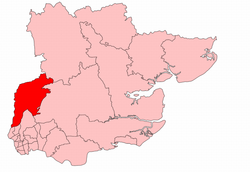
Epping in Essex, boundaries 1945-50
1945–1974
[edit]
The Municipal Borough of Chingford;
The Urban Districts of Epping and Waltham Holy Cross; and
The House of Commons (Redistribution of Seats) Act 1944 set up Boundaries Commissions to carry out periodic reviews of the distribution of parliamentary constituencies. It also authorised an initial review to subdivide abnormally large constituencies in time for the 1945 election.[3] This was implemented by the Redistribution of Seats Order 1945 under which Epping was divided into two constituencies. As a consequence, the new Parliamentary Borough of Woodford was formed from the Municipal Borough of Wanstead and Woodford (created from amalgamating the two separate Urban Districts) and the Urban District of Chigwell (previously a parish in the Rural District of Epping which had also absorbed the former Urban Districts of Buckhurst Hill and Loughton).
Abolition
[edit]
The seat was abolished in 1974 following the Second Periodic Review of Westminster constituencies. The Borough of Chingford had been absorbed into the London Borough of Waltham Forest on its creation within Greater London and now formed the basis for the new constituency of Chingford within that Borough; the Urban District of Harlow, which had been created out of the Rural District of Epping, together with neighbouring parishes (now part of the merged Rural District of Epping and Ongar), formed the new constituency of Harlow; and remaining parts were included in the new constituency of Epping Forest.
Areas covered
[edit]
Area
1885
1918
1945
1955
1974
Great Dunmow, Hatfield Broad Oak
Epping
Saffron Walden (part)
Chipping Ongar
Chelmsford (part)
Chigwell
Brentwood and Ongar (part)
Harlow
Epping
Epping
Epping
Harlow
Chingford
Chingford
Waltham Abbey, Theydon Bois, Epping
Epping Forest
Loughton, Buckhurst Hill, Chigwell
Woodford
Chigwell
Woodford
Walthamstow (part)
Woodford1
Wanstead and Woodford
Wanstead
Romford (part)
1Renamed Wanstead and Woodford, with minor boundary changes, for the 1964 general election (S.I. 1960/454).[2]
This section needs expansion. You can help by adding to it. (December 2023)
Another general election was required to take place before the end of 1915. The political parties had been making preparations for an election to take place and by July 1914, the following candidates had been selected:
Unionist: Amelius Lockwood
Liberal:
This election was suspended by the Parliament and Registration Act 1916 (royal assent 27 January 1916), which was extended five times, due to the First World War. A general election was finally allowed in December 1918 after the war was over; but first, Amelius Lockwood was disqualified as an MP by being raised to the peerage in 1917, necessitating a by-election. The Liberals, in wartime coalition with the Conservatives and Unionists, did not oppose the Unionist candidate.
A general election was required to take place before the end of 1940. The political parties had been making preparations for an election to take place from 1939 and by the end of this year, the following candidates had been selected:
The election was suspended by the Prolongation of Parliament Act 1940 (royal assent 6 November 1940), which was extended four times, due to the Second World War.
General election 1945: Epping
Party
Candidate
Votes
%
±%
Labour
Leah Manning
15,993
44.1
+19.3
Conservative
Roy Wise
15,006
41.3
−17.8
Liberal
Sydney Robinson
5,134
14.6
−1.9
Majority
987
2.8
N/A
Turnout
36,313
71.4
+3.7
Labour gain from Conservative
Swing
+18.6
Elections in the 1950s
[edit]
General election 1950: Epping
Party
Candidate
Votes
%
±%
Conservative
Nigel Davies
24,292
49.1
+7.8
Labour
Leah Manning
20,385
41.2
+3.9
Liberal
Peter Edwin Lewis
4,755
9.6
−5.0
Majority
3,907
7.9
N/A
Turnout
49,432
86.6
+15.2
Conservative gain from Labour
Swing
General election 1951: Epping
Party
Candidate
Votes
%
±%
Conservative
Graeme Finlay
27,392
54.8
+5.7
Labour
Leah Manning
22,598
45.2
+4.0
Majority
4,794
9.6
+1.7
Turnout
49,990
85.1
−1.5
Conservative hold
Swing
+0.9
General election 1955: Epping
Party
Candidate
Votes
%
±%
Conservative
Graeme Finlay
26,065
46.4
−8.4
Labour
Leah Manning
22,542
40.2
−5.0
Liberal
John Arlott
7,528
13.4
New
Majority
3,523
6.2
−3.4
Turnout
56,135
82.3
−2.8
Conservative hold
Swing
−1.7
General election 1959: Epping
Party
Candidate
Votes
%
±%
Conservative
Graeme Finlay
31,507
44.7
−1.7
Labour Co-op
Donald F W Ford
27,114
38.4
−1.8
Liberal
John Arlott
11,913
16.9
+3.5
Majority
4,393
6.2
0.0
Turnout
70,534
84.3
+2.0
Conservative hold
Swing
−0.1
Elections in the 1960s
[edit]
General election 1964: Epping
Party
Candidate
Votes
%
±%
Labour
Stan Newens
34,991
44.4
+6.0
Conservative
Graeme Finlay
31,753
40.3
−4.4
Liberal
Nancy Seear
12,093
15.3
−1.6
Majority
3,238
4.1
N/A
Turnout
78,837
83.3
−1.0
Labour gain from Conservative
Swing
+5.2
General election 1966: Epping
Party
Candidate
Votes
%
±%
Labour
Stan Newens
38,914
48.4
+4.0
Conservative
E Michael Ogden
31,406
39.0
−1.3
Liberal
Derek A McKie
10,162
12.6
−2.7
Majority
7,508
9.4
+5.3
Turnout
80,482
82.4
−0.9
Labour hold
Swing
+2.7
Elections in the 1970s
[edit]
General election 1970: Epping
Party
Candidate
Votes
%
±%
Conservative
Norman Tebbit
43,615
51.5
+12.5
Labour
Stan Newens
41,040
48.5
+0.1
Majority
2,575
3.0
N/A
Turnout
84,655
73.3
−9.1
Conservative gain from Labour
Swing
+6.2
References
[edit]
^Great Britain, Incorporated Council of Law Reporting for England and Wales. The public general acts. unknown library. Proprietors of the Law Journal Reports, 1884.
^ abcCraig, Fred W. S. (1972). Boundaries of parliamentary constituencies 1885-1972;. Chichester: Political Reference Publications. ISBN 0900178094. OCLC 539011.
^ abDebrett's House of Commons & Judicial Bench, 1901
^ abDebrett's House of Commons & Judicial Bench, 1916
^ abcdeCraig, F. W. S. (1983). British parliamentary election results 1918–1949 (3rd ed.). Chichester: Parliamentary Research Services. ISBN 0-900178-06-X.
^Report of the Annual Conference of the Labour Party, 1939
UK Parliament constituency Representative for Wanstead, Woodford 1885–1945
Succeeded by
Woodford
UK Parliament constituency Representative for Loughton, Buckhurst Hill, Chigwell 1885–1950
Succeeded by
Woodford
UK Parliament constituency Representative for Chingford 1885–1974
Succeeded by
Chingford
UK Parliament constituency Representative for Harlow 1885–1974
Succeeded by
Harlow
UK Parliament constituency Representative for Waltham Abbey, Theydon Bois, Epping 1885–1974
Succeeded by
Epping Forest
Preceded by
Colne Valley
Constituency represented by the chancellor of the Exchequer 1924–1929
Succeeded by
Colne Valley
Preceded by
Birmingham Edgbaston
Constituency represented by the prime minister 1940–1945
Succeeded by
Limehouse
This article is licensed under CC BY-SA 3.0. Original source: https://en.wikipedia.org/wiki/Epping (UK Parliament constituency) Status: article is cached
 From Wikipedia - Reading time: 8 min

![[icon]](https://upload.wikimedia.org/wikipedia/commons/thumb/1/1c/Wiki_letter_w_cropped.svg/20px-Wiki_letter_w_cropped.svg.png)

 EncycloReader
is supported by the
EncycloReader
is supported by the  KSF
KSF