Categories
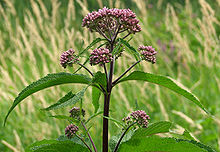
Eutrochium maculatum
 From Wikipedia - Reading time: 6 min
| Spotted joe-pyeweed | |
|---|---|

| |
| Portage, Michigan | |
Conservation status
| |
 Secure (NatureServe) | |
Scientific classification 
| |
| Kingdom: | Plantae |
| Clade: | Tracheophytes |
| Clade: | Angiosperms |
| Clade: | Eudicots |
| Clade: | Asterids |
| Order: | Asterales |
| Family: | Asteraceae |
| Genus: | Eutrochium |
| Species: | E. maculatum
|
| Binomial name | |
| Eutrochium maculatum (L.) E.E.Lamont
| |
| Synonyms[1] | |
|
Synonymy
| |
Eutrochium maculatum, the spotted joe-pyeweed,[2] is a North American species of flowering plant in the family Asteraceae. It is widespread through much of the United States and Canada.[3] It is the only species of the genus Eutrochium found west of the Great Plains.[4]
This herbaceous perennial sometimes grows as high as 2 m (6 ft 7 in). Stems are sometimes completely purple, sometimes green with purple spots. One plant can produce numerous rose-purple flower heads in late summer, each head with 8-22 disc flowers but no ray flowers.[5] The specific name maculatum, meaning spotted, refers to the purple spots on the stem.[6][4]
Spotted joe-pyeweed thrives in marshes, rich fens and swamps. It also does well in man-made moist expanses such as ditches, seepage areas and wet fields. Above all else the plant flourishes in the non-shaded environments that are also abundant in wetlands.[7][8]
It is a larval host to the Clymene moth, the eupatorium borer moth, the ruby tiger moth, and the three-lined flower moth.[9] The plant also attracts butterflies and honeybees.[10][11]
Varieties[edit]
The following varieties are known:[1][8]
- Eutrochium maculatum var. bruneri (A. Gray) E. E. Lamont - western Canada (British Columbia to Saskatchewan), western USA (Minnesota west to Idaho, south to Arizona + New Mexico)
- Eutrochium maculatum var. foliosum (Fernald) E. E. Lamont - eastern Canada (Newfoundland to Ontario), northern USA (Maine to Minnesota)
- Eutrochium maculatum var. maculatum - eastern Canada (Newfoundland to Ontario), eastern USA (Maine to Minnesota, south to northern Georgia)
Cultivars[edit]
The following cultivars are recipients of the Royal Horticultural Society's Award of Garden Merit (listed under the synonym Eupatorium maculatum):-
- (Atropurpureum Group) 'Orchard Dene' [12]
- (Atropurpureum Group) 'Purple Bush' [13]
- (Atropurpureum Group) 'Riesenschirm' [14]
References[edit]
- ^ a b "Eutrochium maculatum (L.) E.E.Lamont". The Global Compositae Checklist (GCC) – via The Plant List. Note that this website has been superseded by World Flora Online
- ^ "Eutrochium maculatum". Germplasm Resources Information Network. Agricultural Research Service, United States Department of Agriculture. Retrieved 14 January 2018.
- ^ Eutrochium maculatum, Natural Resources Canada
- ^ a b "Eutrochium maculatum". County-level distribution map from the North American Plant Atlas (NAPA). Biota of North America Program (BONAP). 2014.
- ^ RHS A-Z encyclopedia of garden plants. United Kingdom: Dorling Kindersley. 2008. p. 1136. ISBN 978-1405332965.
- ^ Dickinson, T.; Metsger, D.; Bull, J.; & Dickinson, R. (2004) ROM Field Guide to Wildflowers of Ontario. Toronto:Royal Ontario Museum, p. 164.
- ^ "Eutrochium maculatum var. maculatum". New York Flora Association. 2005. Retrieved 2008-09-24.[permanent dead link]
- ^ a b Lamont, Eric E. (2006). "Eutrochium maculatum". In Flora of North America Editorial Committee (ed.). Flora of North America North of Mexico (FNA). Vol. 21. New York and Oxford: Oxford University Press – via eFloras.org, Missouri Botanical Garden, St. Louis, MO & Harvard University Herbaria, Cambridge, MA.
- ^ The Xerces Society (2016), Gardening for Butterflies: How You Can Attract and Protect Beautiful, Beneficial Insects, Timber Press.
- ^ "Eutrochium maculatum - Plant Finder". www.missouribotanicalgarden.org. Retrieved 2021-11-30.
- ^ "Eutrochium maculatum (Joe-Pye-weed, Queen of the Meadow, Spotted Joe-pye-weed, Spotted Trumpet Weed) | North Carolina Extension Gardener Plant Toolbox". plants.ces.ncsu.edu. Retrieved 2021-11-30.
- ^ "Eupatorium maculatum (Atropurpureum Group) 'Orchard Dene'". RHS. Retrieved 23 June 2020.
- ^ "Eupatorium (Atropurpureum Group) 'Purple Bush'". RHS. Retrieved 23 June 2020.
- ^ "Eupatorium maculatum (Atroput]rpureum Group) 'Riesenschirm'". RHS. Retrieved 23 June 2020.

 Media related to Eutrochium maculatum at Wikimedia Commons
 | This Eupatorieae article is a stub. You can help Wikipedia by expanding it. |
Original source: https://en.wikipedia.org/wiki/Eutrochium maculatum
Status: article is cached
 EncycloReader
is supported by the
EncycloReader
is supported by the  KSF
KSF