Categories
Finisterre–Huon languages
 From Wikipedia - Reading time: 11 min
| Finisterre–Huon | |
|---|---|
| Geographic distribution | Finisterre Range and Huon Peninsula, Morobe Province, Papua New Guinea |
| Linguistic classification | Trans–New Guinea
|
| Subdivisions |
|
| Language codes | |
| ISO 639-3 | – |
| Glottolog | fini1244 |
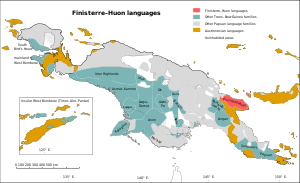 Map: The Finisterre–Huon languages of New Guinea
The Finisterre–Huon languages
Other Trans–New Guinea languages
Other Papuan languages
Austronesian languages
Uninhabited | |
The Finisterre–Huon languages comprise the largest family within the Trans–New Guinea languages (TNG) in the classification of Malcolm Ross. They were part of the original TNG proposal, and William A. Foley considers their TNG identity to be established. The languages share a small closed class of verbs taking pronominal object prefixes some of which are cognate (Suter 2012), strong morphological evidence that they are related.
History of classification
[edit]Huon and Finisterre, and then the connection between them, were identified by Kenneth McElhanon (1967, 1970). When McElhanon compared notes with his colleague Clemens Voorhoeve, who was working on the languages of southern Irian Jaya, they developed the concept of Trans–New Guinea. Apart from the evidence which unites them, the Finisterre and Huon families are clearly valid language families in their own right, each consisting of several fairly-well defined branches.
Pronouns
[edit]Ross (2005) reconstructs the pronouns as follows:
sg du pl 1 *na *na-t, *ni-t *na-n, *n-in 2 *ga *ja-ł, *ji-ł, *gi-ł *ja-n, *ji-n, *gi-n 3 *[y]a, *wa, *i *ya-ł, *i-ł *ya-n, *i-n
These are not all coherent: 3sg *ya and *i are found in Huon, for example, while 3sg *wa is found in Finisterre. In other cases, however, the multiple forms are found in both branches.
Vocabulary comparison
[edit]The following basic vocabulary words are from McElhanon & Voorhoeve (1970)[1] and McElhanon (1967),[2] as cited in the Trans-New Guinea database.[3]
The words cited constitute translation equivalents, whether they are cognate (e.g. hɔme, samo for “nose”) or not (e.g. mic-, sot, dzɔŋɔ for “tooth”). Notice the very low number of cognate triplets, or even pairs, among these languages.
gloss Kâte Selepet Kovai head kpitsec- kun; kun- buno hair dzâwâ- somot; somot- ear hatsec- âdâp-; ɔndɔp ano eye dzâŋe- sen; sen- dziŋo nose sâke- hâme-; hɔme samo tooth mic- sât-; sot dzɔŋɔ tongue nameŋ- nibilam-; nimbilam biŋio louse imeŋ imen apalau dog kpâto soso goun bird wipe nâi; nɔi naŋ blood soc- hep- bone siec- haǥit; hahit- yo skin sahac- hâk-; hɔk siŋlo breast moŋ- nam; nam- suyo tree yâc nak man ŋic lok woman ŋokac apet; ibi sky sambâŋ hibim sun dzoaŋ dewutâ; dewutɔ sual moon mosa emesenŋe water opâ to lap fire kɔlɔp puŋ stone kpânâ kât; kɔt road, path hata giop atam name dzâne- kut; kut- eat nâ- ne; ni- one mocyaha konok two yayahec yâhâp
Evolution
[edit]Finisterre-Huon reflexes of proto-Trans-New Guinea (pTNG) etyma are:[4]
Kâte language:
- bɔruŋ ‘flame’ < *mbalaŋ ‘flame’
- butoŋ ‘fingernail’ < *mb(i,u)t(i,u)C
- bekɔ ‘orphan’ < *mbVŋga(-masi)
- masiŋ ‘widow’ < *masi
- sambɔŋ ‘sky’ < *sambV ‘cloud’
- tofeʔ ‘saliva’ < *si(mb,p)atV
- lo- ‘take’ < *(nd,t)a-
- munduŋ ‘inner yolk of egg’ < *mundun ‘internal organs’
- go ‘2sg’ < *ŋga
- hɔmo- ‘die’ < *kumV-
- bɔriʔ ‘glitter, flash of lightning’ < *(m,mb)elak ‘light, lightning’
- mi ‘not’ < *ma- ‘not’
- maŋu(zo) ‘to vomit’ < *mV(k,ŋ)V t(e,i)-
- ame(ʔ) ‘breast’ < *amu
- tsimin(uŋ) ‘stiff coarse hair’ < *[nd,s]umu[n,t]V ‘hair’
- imeŋ ‘louse’ < *iman ‘louse’
- no ‘1sg’ < *na ‘1sg’
- nɔ- ‘eat’ < *na-
Selepet language:
- balam ‘flame’ < *mbalaŋ
- (ni)bilim ‘tongue’ < *mbilaŋ
- kɔlɔp ‘fire’ < *kend(o,u)p
- kɔlip ‘long’ < *kuta(mb,p)(a,u)
- irak ‘new’ < *kVtak
- sak ‘sand’ < *sa(ŋg,k)asin
- somot ‘hair’ < *(s,nd)umu(n,t)[V]
- madu ‘orphan’ < *masi
- si- ‘burn’ < *nj(a,e,i)- ‘burn’
- ga ‘2sg’ < *ŋga
- kaku- ‘carry on shoulder’ < *kakV-
- kɔu ‘ashes’ < *kambu ‘ashes’
- belek ‘lightning’ < *(m,mb)elak
- ibi ‘name’ < *imbi
- mete ‘forehead’ < *me(n,t)e ‘head’
- man- ‘live, dwell’ < *mVn[a]-
- imen ‘louse’ < *iman ‘louse’
- (n)am ‘breast, milk’ < *amu ‘breast’
References
[edit]- ^ McElhanon, K.A. and Voorhoeve, C.L. The Trans-New Guinea Phylum: Explorations in deep-level genetic relationships. B-16, vi + 112 pages. Pacific Linguistics, The Australian National University, 1970. doi:10.15144/PL-B16
- ^ McElhanon, K.A. 1967. Preliminary observations on Huon Peninsula languages. Oceanic Linguistics 6: 1-45.
- ^ Greenhill, Simon (2016). "TransNewGuinea.org - database of the languages of New Guinea". Retrieved 2020-11-05.
- ^ Pawley, Andrew; Hammarström, Harald (2018). "The Trans New Guinea family". In Palmer, Bill (ed.). The Languages and Linguistics of the New Guinea Area: A Comprehensive Guide. The World of Linguistics. Vol. 4. Berlin: De Gruyter Mouton. pp. 21–196. ISBN 978-3-11-028642-7.
Bibliography
[edit]- Ross, Malcolm (2005). "Pronouns as a preliminary diagnostic for grouping Papuan languages". In Andrew Pawley; Robert Attenborough; Robin Hide; Jack Golson (eds.). Papuan pasts: cultural, linguistic and biological histories of Papuan-speaking peoples. Canberra: Pacific Linguistics. pp. 15–66. ISBN 0858835622. OCLC 67292782.
- Suter, Edgar (2012). Verbs with pronominal object prefixes in Finisterre–Huon languages. In: Harald Hammarström and Wilco van den Heuvel (eds.). History, contact and classification of Papuan languages. [Special Issue 2012 of Language and Linguistics in Melanesia]. 23–58. Port Moresby: Linguistic Society of Papua New Guinea.
Further reading
[edit]- Ross, Malcolm. 2014. Proto-Finisterre-Huon. TransNewGuinea.org.
Original source: https://en.wikipedia.org/wiki/Finisterre–Huon languages
Status: article is cached
 EncycloReader
is supported by the
EncycloReader
is supported by the  KSF
KSF