Categories
Flag of Guinea
 From Wikipedia - Reading time: 7 min
 | This article needs additional citations for verification. (September 2021) |
 | |
| Use | National flag and ensign    |
|---|---|
| Proportion | 2:3 |
| Adopted | 10 November 1958 |
| Design | A vertical tricolour of red, yellow and green |

The national flag of Guinea (French: drapeau national de la Guinée) is a triband of red, yellow, and green.[1] It was adopted on 10 November 1958, with the publication of the country's first Constitution.[2][3]
Design
[edit]The colors of the flag were adapted from those of the Rassemblement Démocratique Africain, the dominant movement at the time of independence. The colors were in turn derived from those of the flag of Ghana, which had first adopted them in 1957. Sékou Touré, the first President of Guinea, was a close associate of Kwame Nkrumah, the former president of Ghana.
Colors
[edit]According to Sékou Touré, first President of Guinea, the three colors of the flag represent the following: red symbolizes the blood of anti-colonialist martyrs, the labor of the working classes, and the wish for progress; yellow represents Guinean gold, as well as the sun, which is "the source of energy, generosity and equality for all men to which he gives light equally"; and green represents the country's vegetation, continued prosperity arising from its natural resources, and the historically difficult life of the Guinean masses who live in the countryside. In turn, the symbolism behind each of the three colors corresponds to the three components of the national motto: Travail, Justice, Solidarité ("Work, Justice, Solidarity").[4]
In keeping with other flags in the region, the Pan-African movement's colors of red, yellow, and green are used.
The design is a tricolor. The colors of the flag from left to right are the reverse of the flag of Mali. The previous flag of Rwanda (in use from 1961 to 2001), the design of which was inspired by the flag of the Kingdom of Rwanda, had a large black R to distinguish it from the near-identical flag of Guinea.[5]
| This section does not cite any sources. (June 2024) |
 (1958–present) |
Red | Yellow | Green |
|---|---|---|---|
| Pantone | 186c | 116c | 340c |
| CMYK | 0-0.92-0.82-0.19 | 0-0.17-0.91-0.01 | 1-0-0.35-0.42 |
| RGB | 206-17-38 | 252-209-22 | 0-148-96 |
| Hexadecimal | #CE1126 | #FCD116 | #009460 |
Governmental flags
[edit]-
 Presidential standard
Historical flags
[edit]-
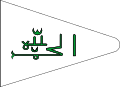
 Flag of the Imamate of Futa Jallon (pre-1896)
 -
 Flag of the Imamate of Futa Jallon after becoming a French protectorate (1896–1912)
 -

 Samory Toure's flag (1898)
 -
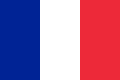 Flag of French Guinea (1912–1958)
 -
 Presidential standard of Guinea (1958–1984)
 -
 Presidential standard of Guinea (1984–1993)
See also
[edit]- Flag of Bolivia, a rotated version of the flag
- Flag of Mali, a mirrored version of the flag
References
[edit]
- ^ https://www.constituteproject.org/constitution/Guinea_2010#s15
- ^ "République de Guinée: Constitution du 10 novembre 1958". Digithèque de matériaux juridiques et politiques (in French). Archived from the original on 29 January 2021. Retrieved 5 September 2021.
- ^ "Guinean Flag Legislation". www.crwflags.com. Retrieved 2021-09-05.
- ^ "Guinea". www.crwflags.com. Retrieved 2021-09-05.
- ^ "Rwanda : Historical Flags". www.crwflags.com. Retrieved 2021-09-05.
National flags and coats of arms | |
|---|---|
| National flags |
|
| National coats of arms |
|
 Heraldry portal Heraldry portal | |
Original source: https://en.wikipedia.org/wiki/Flag of Guinea
Status: article is cached
 EncycloReader
is supported by the
EncycloReader
is supported by the  KSF
KSF